Why Faith Matters by David J. Wolpe

In this nonfiction work, Rabbi Wolpe shares his journey from non-believer in God to believer, explaining his view of this belief and countering the common challenges to faith. Using personal experiences, parables, and quotations from innumerable biblical, scientific, philosophical and historical sources, he asserts that religion can coexist with science, that it is NOT responsible for violence, and that it is the backbone of morality. Rabbi Wolpe provides evidence that faith in God can improve our lives, our health, and our societies.

For those of us who question, who seek to learn, this is an accessible, readable work that provides, if not definitive answers, certainly strong support for why belief in God and participation in a religious community is a healthy, logical, and meaningful way of life. When Rabbi Wolpe’s experience with confronting illness might have challenged his faith, for example, it actually appeared to have strengthened it, inspiring him to dig deeper, helping him cope. And it is not “blind faith” that he turns to, but rather questions he relishes in. Religion is nothing if not all about our questioning. But the tone of our questions matter: if we ask with a cynical bent, we close ourselves off to the benefits of faith. If we question with an open heart, we will understand that there are things we cannot possibly ever know, and hopefully we will have the humility to be able to live with that. We live with other concepts that are not tangible – thought, ideas, even love. So why not God?

If you are, yourself, questioning, this may help you parse things out. You will find here a thoughtful, well-researched, well-articulated argument for faith in God, no matter what religion you are.

The Genius of Israel by Dan Senor and Paul Singer

Out of all the wealthy, first world countries in the world, Israel ranks 4th in how its citizens rate their happiness. This may come as a surprise to anyone who has visited this chaotic, yet vibrant country that is steeped in history, conflict, and challenge. But what it lacks in tranquility, even civility, it makes up for with the strong connections its citizens build through family, the army, its tech world, and through its acceptance and appreciation of diversity of its people. Citizens of Israel share a common bond and purpose – the sheer existence of the State of Israel, which is no small thing. In a world in which people living in many industrial nations are moving further and further apart, the people of Israel are staying closely bound – and this is the key to their happiness.

What is astounding is that this book was written during a time when so much of Israel was as polarized as a country could be – during massive protests against a government that was trying to undo democracy as it had been known to be. Thousands had been taking to the streets on a weekly basis to confront a government that was trying to take away the checks and balances that their Supreme Court provided to curb any potential government overstep. Netanyahu at the helm, again, was leading the charge to remove any obstacles in his way of having full reign over the country. And yet, it appears, the people were still rating their happiness as high, still feeling that their country was worth fighting for and that they had a quality of life they would not give up.

On the other hand, this book was written before October 7th, which has shifted the world as we know it. It changed Israelis’ feeling of security on a granular level and rattled their confidence in the government’s ability to lead like nothing ever before. Never before had the IDF failed the citizens of Israel as it did on 10/7. Nevertheless, I suspect, that if the citizens of Israel were to be polled now, they would still rate their happiness in the same way. After 10/7, the country rallied together like nothing I have ever witnessed. Citizens – not the government – organized makeshift hostels for the displaced kibbutzniks who survived the gruesome attacks and had to be rehoused further north. Citizens are still coordinating efforts to continue to provide shelter, food, clothing, mental health services, schooling, and other services to the thousands of displaced citizens resulting from the war with Hamas. The citizens are bonded in their efforts in surviving an existential threat of survival, with enemies attacking them from all sides and they are bonded together, supporting each other from within. There is nothing more unifying – or community-building – than this.

Because of the timing, it was difficult to be reading about Israel with all that has been going on – but it also gave a positive spin on what is going on as well, if that could possibly be. In the darkest of times, we must find light, and in these pages, one can find that tiny spark.

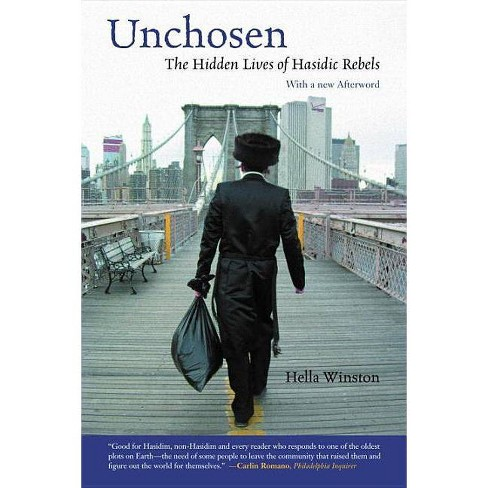
Unchosen by Hella Winston

After spending 2 years gaining the trust and confidence of over 60 individuals in mainly two of the Hasidic communities in Brooklyn, NY, Hella Winston has composed this narrative of their lives and their struggles with the insular lives they lead. She focuses on a few individuals, through whom she communicates the tension between the traditional and the modern, what is considered “safe” and what is occasionally hungered for. And she does so with curiosity and with compassion.

If you are not familiar with their history, the Hasidic community was established here in the US by a few leaders that were survivors of the Holocaust of World War II and that has had a great influence on their philosophy and their attitude toward the outside world. While they looked to the United States as a place of refuge where they were able to be free to practice their religion, they also saw it as a country of strangers who might tempt them into being led away from their customs and traditions. This tension has kept them insulated and isolated from the outside world, as they shun any contact with it – whether through media, language, or even secular education.

What is saddest to me is that so often the root of the difficulty is that the community and the families rule by fear, not by love. The most fundamental fear is of nonconformity. If one is different, it interferes with one’s chances of finding a mate, and the ultimate purpose in one’s life is to form a family and be “fruitful and multiply,” no matter what one’s true dreams or goals are in life. Even if one is not being considered for matching, one’s sibling may be, and so one must conform to ensure the security of one’s family’s matches as well. Any deviation from the norm, any rebelliousness, any questioning, any appearance of difference, can affect one’s standing in the community. Furthermore, there is a sort of underground watchdog system of spies in the community looking out for this deviance. And even when one is a victim of abuse or neglect, especially if one is female, one has little recourse, because, again, it just reflects badly on the perpetrator and on the community, so it cannot be called out or acknowledged.

There is not only bad here, of course. The Hasidic community is a tight-knit community that looks out for its own. No one goes hungry. No one is not cared for. And while the majority live in poverty, they do provide for each other (even if it is with your tax money that they do so!).

It seems to me that it all boils down to this quote, taken from Winston’s Afterward, “…the need to coerce people’s behavior through fear and shame suggests a fundamental weakness in the belief system itself. To feel forced to abuse or reject a loved one for his or her failure to conform to community standards seems to negate any claim to true religiousness. But this is the paradox of fundamentalism.” And Hasidism is absolutely religious fundamentalism, tolerating no deviance, allowing no questioning, and dictating by fear.

An interesting read, for sure. I wish there had been more cases discussed, more examples and more details – but it was certainly eye-opening, even for someone who had been familiar with this community and who’d heard some of these kinds of stories before.