
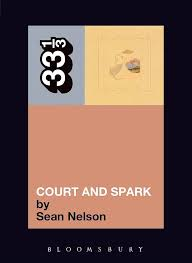
This tiny book, one of a series, each of which strives to analyze a chosen music album, provides the author’s insight into Joni Mitchell’s Court and Spark. One of my favorite Joni Mitchell albums, this one is apparently the author’s favorite of hers as well. Nelson begins with some context of how this album might have been conceived, how it logically grows and expands from her former works. He then delves into each of the songs themselves, primarily focusing on the lyrics and how they reflect a message of confusion and frustration over relationships, loneliness. And then he ends with his perspective on her works that follow.
The initial chapters are frustrating. The author is meant to be speaking about Court and Spark, yet his analysis wanders from album to album, giving the feeling that he is circling around the album but doesn’t know quite where to land. He writes in detail about “related” songs from other albums, which might have been acceptable had they been quick references rather than the diatribes they amounted to. It was challenging to follow, to be honest.
Nevertheless, once he settled in to the actual album, focusing on each individual song on this album, his thoughts were interesting and his ideas were expressed more coherently. He provides evidence for his opinion that there is a unifying theme throughout the album, and while I disagree with him on which songs are best/worst, I can appreciate his analysis of the poetry found here. I would have liked, however, to hear more about how the music supports the lyrics so aptly, which he touches upon sometimes, but avoids often.
And while I am to this day a huge Joni Mitchell fan, I do agree with the author that after Court and Spark and Miles of Aisles, her music spiraled into a jazz/fusion/dissonance that while musically more sophisticated is just less appealing, less fun to listen to (at least to both the author and myself). And isn’t that what music should be about? Joy?
On the whole, I am grateful to have read this book. I suggest investigating these easy, short, monographs if you’re interested in learning more about the vinyl you may still own – or wish you did.
 kindread spirits