
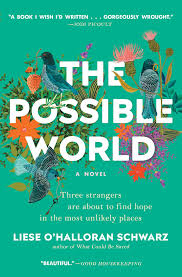
In the aftermath of a terrifying scenario, Ben, a young boy, is brought to an ER in downtown Providence, where he is seen briefly by senior resident, Lucy, whose main focus is to stabilize patients and send them to wherever they need to go next. While Ben is clearly in shock and does not have any memory of the traumatic incident, he also seems to not even know who he is. As much as Lucy tries to disconnect from Ben, she cannot help being drawn to this sweet, vulnerable child even in spite of herself.
Meanwhile, in a nursing home in a RI suburb, we meet Clare, a woman approaching her 100th birthday, who remains an enigma to all around her. She rarely speaks, and when she does it is never about herself, fending off anything that might give herself away. But it appears that a new tenant, despite her younger age and her independent attitude, might be just the one to break through the hard shell Clare has built around herself.
It takes time and patience to learn how these two stories connect, and once you do, you still need some degree of faith and imagination. Nonetheless, this is a beautiful story, written with such tenderness that you cannot pull away from its pages until the end. Each character, down to the philosophical alcoholic with “worms in his knees” who shows up to the ER on a regular basis, is depicted with love. We adore the awkward, inquisitive Ben, who cannot help asking about the world. We adore Lucy, as she navigates her lonely, newly single life. We even adore Clare, even as she snaps at those around her. Each story is compelling in itself. And as their stories meld together, we are filled with compassion for each of them, because we cannot help but be so.
I suppose I have a particular affinity for this narrative. Since I am from Providence, I love the local references: fishing in Point Judith and Rocky Point, the 3-family houses on the short streets off of Hope Street, or a College Hill book store. Novels are rarely based in Providence, so I appreciate when they are. In addition, the grueling schedule, the span of patients, and the absence of an outside life that Lucy experiences is real – I can attest to that as well. Though I was a pediatric resident a thousand years ago, I can still feel the painful exhaustion I felt coming home after taking care of deathly ill patients for 36 hours straight. I could not have a social life because there was barely time for me to have a life at all.
That said, while the book spoke to me in particular, it will speak to you as well. I encourage you to let yourself be taken away by this tale.
 kindread spirits