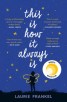
This Is How it Always Is by Laurie Frankel

this is how it always is

This is the poignant story of a loving family: parents, Rosie and Penn, and their 5 boys; that is, they believed they had 5 boys until the youngest, Claude, declared that he wanted to bring a purse to kindergarten instead of a lunchbox. Gradually, it became clearer that Claude was much happier in dresses than pants and identified more with the princess in his father’s bedtime fairytale than the prince.  While his parents and brothers were accepting of this, they were fearful that people around him were not, and they went to great lengths to protect Claude, who eventually called herself Poppy.  As the story unfolds, we learn that while intentions may be pure, our actions may not be in others’ best interests and over-protection can lead to inadvertent harm.

This is a fictional story, but it has all the markings of a story that is true.   Every character is endowed with a dynamic, vulnerable, and big-hearted quirkiness that makes all of them larger than life.  We come to love each member of this family almost as our own.  The story is enriched with some detail of how Claude/Poppy’s experience affects the other members of the family – as it certainly would – and their own struggles with growing and seeking their own identities.  And most genuinely, Poppy’s struggle is not straightforward – she is not sure what her journey will be like or where it will end.  This is the true meaning of a non-binary identity.  One does not have to be male or female.  While this may be hard for  many to comprehend, it is even harder for others to squeeze themselves into one or the other, and I believe because of that, we all just have to get over ourselves and accept the vast space in-between.

I loved this novel, both for the message within and for the beauty of the story on its own merit.  It is a story of a family dealing with a secret that they learn doesn’t have to be a secret.  It is a story of a family learning to cope with difference, which most families have to deal with on some level, as no one is exactly like anyone else anyway.  And it is a story about love and family bonds that keep a family tied together no matter what.


Chiefs by Stuart Woods

chiefs

In looking for something different to read, I stumbled upon this thriller from the 1980’s, which was so much more substantive and nuanced than I ever imagined.

It begins in 1919, when Will Henry Lee is appointed the Chief of Police in the tiny town of  Delano, Georgia.  Things are fairly quiet until the first body turns up – that of a young boy, naked, with suspicious marks on him.  This case is niggling at him but life goes on and he is forced to move on with the times.  As the years pass, the case becomes buried deeper and deeper in layers of race, power, politics, and in simple human nature and the ultimate resolution is a shock to everyone.

This story is so carefully delivered, over time, even over generations, and the reader’s patience is rewarded with an exquisitely intricate plot.  There is a horrifying overlay of the deep south’s history of racial bias which, sadly, is quite poignant and relatable today.  So too, are the political power plays, the small town alliances, and injustices.  Timeless, apparently.

The writing, too, is sharp and clear, with poignant dialogue and a few great scenes.  My particular favorite scene is one in which the wife of Billy, Will Henry’s son, buys a shotgun and shows what a woman can do all by herself to protect herself from the nasty Klansmen who are out to get her and her husband.  I won’t give it all away, but I’d say that scene alone is worth reading the book for!

This book is a definite page-turner and one that will stay with me for awhile.  I’m not sure it’s a “must read” but it’s close!


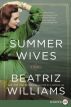
The Summer Wives by Beatriz Williams

summer wives

Miranda Schuyler has just arrived back home to Winthrop Island to hide away from her life just a bit.  She just wants some quiet, to try to repair her relationship with her mother and her half-sister – if possible – and to heal, both physically and emotionally.  What she doesn’t expect is that on arriving back here, all of her memories and the emotions tied to them would come flooding back as well.  And with them, much of her understanding of her world might just be turned upside-down.

Beatriz Williams creates the most wonderful female characters – they are strong, smart, witty, and often rebellious without ever losing their femininity or grace.  They are characters who drive the plot, who outwit the demons, and who, while we guess will be victorious in the end, we never know exactly how.  There are always clever plot twists and there are sometimes dark details, but there is always a lightness and humor in the telling.  And Miranda, with her story, certainly falls in line with this pattern.

Williams also utilizes the shifting of voices and of time to build the story from various vantage points. I love this technique.  I find this builds suspense and keeps the motion of the story moving forward, even when we’re essentially hearing backstory.  It enriches both the story and the people in it and deepens our understanding of both.  Because sometimes it isn’t the “what” that is the mystery of the story but the “why” – and here is a good example of that.

I really enjoyed this book – and am hoping to read all of her books at some point!

The Light We Lost by Jill Santopolo

the light we lost

This is a love story that starts, ironically, when the world feels like it might end – in New York City, on 9/11/01.  Lucy and Gabe feel it too – they reach for each other, barely knowing each other, and then it’s over.  But years later, when they meet again, the spark is reignited, and this begins a heartbreaker for Lucy that she endures quite in spite of herself.

The voice is what is unique in this story and I think is what engages the reader.  It is written from Lucy to Gabe, almost as a letter, which gives it a very intimate feel.  On the other hand, because we only hear Lucy’s voice, it can sometimes feel one-dimensional.  There is no layering of the plot, but rather a single-mindedness of the narrative becomes almost droning as the novel progresses.

What is more deeply troubling about this novel, however, is that once again,  the outwardly independent female character is bound to a male character and jumps to his beck and call each and every time.  I felt myself literally growing angry as Lucy again and again fell into this same pattern.  While Lucy does not go with Gabe when he needs to travel for his life work – hurrah for her –  she then pines for him throughout the rest of the book, answering his calls whenever he deigns to reach out and dropping everything for him when he needs her.  (Really?  We’ve not moved past that?). And while she notices when her new boyfriend, Darren, makes plans without her input- and gets angry about it – she never stands up to him or says anything about it.  Why can’t our female characters be unequivocally strong?  I’m tired of this.

I think this book was off to a great start, and had great potential but was just disappointing on multiple levels.  Oh, well!


No One Can Pronounce My Name by Rakesh Satyal

no one can pronounce my name

Harit does not imagine how he will ever escape the droll and bizarre routine of his life, working in Men’s Accessories in a department store with the tedious and talkative Teddy, and then on returning home each day, having to dress as his dead sister for his mother to appease her denial of the death.  This just seems to be his life.  Likewise,, on the other side of their Cleveland suburb,  Ranjana is questioning how she should adapt to what she has found on her husband’s search history on their shared computer, which suggests the possibility of an affair.  Now that their one son is off to Princeton, does this mean that their life together will change?  Not that she’s been all that satisfied, as she’s had to express herself through the writing which she’s all but hidden from everyone but her little writing group that she sneaks off to once a week.  Eventually, her world collides with Harit’s in an unusual way, and the two of them find what friendship really means and how deeply it can enrich their lives and enable each of them to grow into their best selves.

This is a very quirky, sweet novel that highlights the immigrant experience and shows how important it is to find community and support from others.  Neither of these characters has just arrived to the United States and neither is young, but both are still grappling with finding themselves in the context of their families and their histories, given their own talents, limitations, and orientations.  They each reach out for friendship and learn that it may be hard to find honesty where you hope to find it.

I believe the strength of this story rests in the character development, as each character is rich and layered and colorful.  Each one is traced out at different times in the story and we travel through time and country with each as they track back to the center of the action, successfully reinvigorating the story with a new understanding of each character. It is similar to the experience of getting to know those in our own lives as we ask more and more about them and learn more and more about their past.

This is an interesting read – colorful, quirky and sweet.  Enjoy!

Erotic Stories for Punjabi Widows by Balli Kaur Jaswal

Nikki has been caught between feeling like she’d let her family down by walking out on her legal education and feeling resentful that they’d tried to control everything in her life.  She couldn’t imagine letting her family arrange and control as much as her sister did – even going to the extreme of seeking a possible arranged marriage! – but then again, here she was, working in and living above a bar.  Was this a better option?  When an opportunity arises to teach women in an Indian cultural center to write stories about their lives, Nikki applies and gets the position.  Little does she know that these women have stories to tell that will shock and amaze her.  And as she comes to know these women, she comes to also uncover the mystery surrounding a single voice that has been stifled forever…

This book was surprisingly engaging and ultimately suspenseful.  What started out quite innocent and almost superficial grew into a much more complicated plot and twisted and turned quite unexpectedly.  Characters that one would have guessed would have been staid and traditional showed not only a cheekier side, but actually true, deep-seeded bravery.  This made a book that I initially felt nonchalant about become much more meaningful to me.

I am still unsure if the sexually explicit scenes in this book are totally necessary.  I am not prudish and I do not shy away from this.  I know why they are here.  But I felt they were a bit too long.  (I almost got a little bored with the off -shooting they provided.)  I’d be interested to hear what others think about this.

A worthwhile read, in the end, though.  Please add comments –  I’d really be interested to hear what you all think about my issues with this book!


LETHAL WHITE BY ROBERT GALBRAITH

lethal white

After being thrust into the headlines by their prior notorious capture of a serial killer, Cormoran Strike and Robin Ellacott are struggling to regain their footing.  The fame has brought in much business but it has also strained their relationship.  Everyone is on edge, when an unwashed, terrified and possibly psychotic young man storms into their office twitching away and muttering loudly about a child having been murdered and buried, wrapped in a pink blanket many years ago.  Could this be connected to the new case of blackmail of the Minister of Culture, which they are being asked to investigate?  As Robin and Strike are thrown back into this case, their private lives become somewhat entwined and the suspense, as always, sustains you until the very last word.

What is truly magical about the writing of this novel is that while an incredibly intricate plot is unfolding, the characters who are acting in this story are vulnerable and human and so real the reader might reach out and touch them.  The pain of Cormoran Strike’s stump of his amputated leg is so palpable that each time he is forced by circumstance to go back out to follow another suspect, the reader can almost feel pain in their own leg in empathy.  And when Robin becomes angry at her new husband, who is quite the “arsehole” as is demonstrated in this story time and again, we want to slay him ourselves on her behalf.  Because they are so kind, we almost feel we have a personal stake in their success and that they are more than fictional characters from the mind of an author.

These are completely absorbing works of great suspense and highly recommend the whole series – and to read them in order is definitely worthwhile.  First, you’ll have the opportunity to read them all, and one is better than the next, but also they build on each other, with references to prior cases and prior history in their respective lives.

Highly, highly recommend these books!  You won’t regret them!

State of Wonder by Ann Patchett

state of wonder

Marina is heartbroken by the news of the death of her co-worker, Anders, who had been sent to the Amazon to assess the progress of research being conducted down there.  But when she learned that she now was the one being sent after him to investigate his death, her feelings were, understandably, quite mixed.  Why would her boss, Mr. Fox, with whom she had an “un-bossly” relationship send her down into a perilous situation?  And what would she encounter with the strong-minded and controversial researcher with whom she’d trained and had a checkered past with herself?  After seeing Anders’ wife and 3 boys and their sadness and disbelief that their father could truly be dead, she felt it her duty, though, to go and to see for herself how he’d died and what she could do to bring back his effects to help them in their grief.  What she found was beyond what she could have ever imagined.

This novel was stunning in both beauty and its depth.  As Marina learns more and more about the Amazon —  its people, its natural habitat, its dangers and its wonders — so too, does the reader.  Because of the crispness of the writing, one can breathe in the heaviness of the air, hear the insects buzzing around ones ears, feel the murkiness of the water they bathe in, and see the filth on the clothing Marina is forced to wear because she’s lost all of her luggage on the very first day.

But there is also a layering to the story which gives it depth.  There is the search for how Anders became sick with his undiagnosed fevers and the tenderness of the relationship he’d developed with the boy raised by the head researcher, Dr. Swenson.  There is the research itself, looking into why the women in the local tribe maintained their fertility well into their sixties and seventies – and the ethical concerns surrounding this.  There is the controversial character of Dr. Swenson – her avoidance of oversight and reluctance to be beholden to those who are funding her research.  What is she hiding?

I will not say how this book ended – but I will admit to you that I cried as I read the last few pages.  There unexpected twists that tug at your heart and at least caught me quite off guard.  So well done!

I have to say, this is a must-read!


The Girl who Wrote in Silk by Kelli Estes

girl who wrote in silk

In the late 1880’s, Washington territory, Mei Lien’s whole world revolved around her father and grandmother, both of whom she revered and loved with all her heart.  But with one unthinkable strike, both of them were torn from her and her entire life trajectory changed.

Fast forward to current day, and we find Inara, whose favorite aunt has died, with a wish that Inara take her estate and turn it into an island inn.  In her exploration of the estate, Inara stumbles upon the sleeve of a robe, embroidered with an elaborate scene that appears to be communicating an urgent message from long ago.

What is the connection?  And what will that connection mean for Inara’s family?  What did it mean, more importantly, for Mei Lien?

I feel this book, while powerful in its message and matter, just missed its mark in the telling.  The idea of the story is a brilliant one, based in a historical reality that needs to be told – and one that I, for one, was beforehand, ignorant of.  In the late 1800’s and well into the 1900’s, the Chinese who immigrated to the US and Canada were treated abominably, often with prejudice at best and with violence at worst.  This story brings that racism to a very personal level, highlighting the loneliness, despair, and abject terror that racism induces.

On the more literary side, the resolution of the story that is told is just too extreme to be believable.  The family connections are too improbable.  The way Inara finds a chef for her kitchen for her inn is too coincidental.  And the ending just slides into home plate for that grand slam in a way that almost trivializes the story.  I am not saying that the ending is not what anyone reading the story would have wanted, but I think it was too neat and tidy.  It’s not real life.

But maybe that is why it’s called fiction.

I am still glad I read this book and would recommend it to others as well.  If not for the literary sparkle, for the historical perspective it provides.


The Arsonist by Sue Miller

the arsonist

Frankie has just arrived home from her relief work in Africa, unsure of her next step, and immediately she is sucked into the drama of both her parents’ lives and of the small New England town they now inhabit year-round.  What everyone seems to be caught up in are the fires – fires being set in peoples’ homes.  First in homes of those not yet up for the summer, then gradually in homes of those who were up but not at home at the time, and then, most frighteningly, a few set when people were home.  As Frankie becomes more involved because of her parents’ involvement, she also becomes more involved in the newspaper reporter who is reporting on the fires – and this may disrupt her usual lifestyle of keeping herself unencumbered.  Will she change her pattern for him?  Will she change her pattern to help her more needy parents?  And who is setting these fires?

There is just enough suspense and character development to keep interest in this story, although it is only just enough.  It seems as though the author herself has only just enough interest in the story itself.  There is good character development and I liked each of the characters, particularly Bud, the newspaper reporter, who has given up the big city, political reporting for the small town, local newspaper gig.  He is down-home, and down-to-earth, and he connects to people genuinely with his heart.  She also creates a side story of Frankie’s parents and their tragic aging, which is painful and harsh, but also realistic and relatable.

I think the point is that the story is about relationships and not what is actually happening/the plot.  Maybe that is what the author intends all along.

Maybe that is life?