Life’s Work by Dr. Willie Parker

life's work

This is a modest but monumental work by one of my newest heroes, Dr. Willie Parker.  Dr. Parker was born and raised in the South, by his single, very poor black mother who instilled in him a strong value system, prioritizing family, love and God above all else.  He managed to find additional role models and mentors who encouraged him to climb to heights even he never imagined he’d achieve, cultivating his thirst for understanding science, even in the face of his religious fervor.  He found his calling in the field of medicine and further in the speciality of OB/GYN and practiced in many areas of the country, ultimately ending up in a beautiful area of Hawaii.  While he did find himself advocating for women in some areas, his religious convictions still held him back from performing abortions.  He was not against referring his patients to others to perform them, but he himself felt he could not do them.

Then he suddenly found the way to reconciling this within himself.  He suddenly recognized that, just as the Good Samaritan in the Bible helped the injured traveler out of concern about what would happen to the traveler (ignoring what would happen to himself), that he, Dr. Parker, should also be concerned with what would happen to his patients if he did not do abortions and not what would happen to him (or how he would be judged).  Taking this further, Dr. Parker saw in this a moral, – no a religious! – imperative to carry out his patients’ wishes, whether they be to carry a pregnancy to term or to terminate that pregnancy.  Furthermore, denying patients the choice of what to do with their bodies, denying them access to safe, healthy choices, denying them the right to choose to continue their educations or their jobs or whatever they needed to do without interruption to have a baby – he realized, went against everything his religion and God stood for.  Really, the “anti’s” as he calls them, had it backwards.

He is extremely articulate about a lot of the arguments that the anti’s give about why abortion might be perceived as being wrong – and they’re all mostly devious.  They are mostly about controlling women, and usually about controlling women of color and/or who are poor.  Women, and particularly women in the south and the midwest, now have such minimal access to safe, healthy abortions,  and it is being chipped away –  mostly by white men – day after day after day.  It is merely a power play.

Dr. Parker is one of those rare brave souls who do perform abortions in the south, making safe, healthy procedures available to those who need them.  Thank God for Dr. Parker.

In sum, here is a gorgeously articulated argument for all of you who feel that just because you are religious, you cannot support abortion.  On the contrary, if you are religious – in this light, you are morally obligated to honor the choice and the freedom of the already living, as Dr. Parker does.

Hillbilly Elegy by JD Vance

hillbilly elegy

This memoir from JD Vance is an eye-opening, articulate depiction of the “hillbilly” culture of the Appalachian region.  As Vance shares with the reader about his upbringing – bouncing between Kentucky and Ohio – he opens our hearts to the plight of the poor, often uneducated, white population in this region.  As we learn about his experience with his traumatized and drug-addicted mom and his angry, foul-mouthed, sometimes violent, but unendingly loving and devoted grandparents, we see how entrenched the culture is and how difficult it is to dream in this world.  Fortunately, for him, he was able to find love and support enough to find his way to success – but his journey was complicated and chaotic and he never forgot from where he came.

The honesty and self-reflection with which this story is told brings the reader right into the author’s life.  We are right there with him when his mother takes him on a death-defying car ride.  We are right there when his older sister cares for him as a devoted mother would.  The love and appreciation that he feels for his grandparents who were his constants in a very tumultuous childhood is palpable.  And we can understand when he reflects on how to improve the lot of his fellow hillbilly peers and come up short.  The poverty, the distrust, and the violence that pervades this culture are so entrenched that it feels impossible to overcome.

I think this is an important book for people who are not from the South to read.  It really provides an understanding of a whole sub-culture of people that comprise  part of the fabric of our United States.

A very, very worthwhile read!


Lasting Impact by Kostya Kennedy

51gam-ej-bl

So the bottom line, here, is that my friend, Kostya Kennedy must be a good writer to get me to read – and actually enjoy! – a book about football.  While I love some sports, football is not one of them and being a pediatrician experienced in treating concussions, I am really not a fan.  But in this non-fiction account of Kostya’s shadowing the New Rochelle High School football team for their 2014 season, Kostya manages to impress upon even me (a true cynic) why many tolerate the risk for the game.

In the course of the season, Lou DiRienzo, the NRHS football coach takes on the role of coach, teacher, mentor, father-figure, even therapist to many of the boys and he leads them with a kindness and honesty and integrity that earns their trust and respect.  Right from their intensive camp experience at the start of the season, the boys bond and their lives are knitted together as a family.  The team becomes an anchor for those with family issues and a sort of home base for all.  Even at the advent of the Ray Rice scandal, Coach D reiterates that no matter what kind of trouble the boys ever get themselves into, the NRHS football family will always have their back.  And even though the players are injured one after another, there is still an undying devotion to the game.  So even though I am one of those mean mothers who won’t let my son play football, I do see, through the reading of this evenly researched account, its allure.

On the other hand, the negative side is presented quite clearly, too.  The statistics about sudden death from the game, about the potential long- lasting cognitive and emotional deficits, not to mention the broken bones and orthopedic surgeries, are exposed.    This feels to me like a high price to pay for something that another team experience might lend itself to.Still, what is conveyed here is that football, maybe because of its physicality, achieves gains for its players that transcend the immediate physical injuries.

So for all of you football fans, this one’s for you; however, even if you’re just human, you will feel the warmth and compassion of the writer toward the sport and the young people playing it.


Eating Animals by Jonathan Safran Foer

51flAsKFoAL._SX272_BO1,204,203,200_ (2)

I can only start by saying that this book rocked my world.

After 3-4 years of extensive research, travel and investigation, Jonathan Safran Foer collected his findings and analysis into this very readable, very engaging litany of the horrors of the factory farm, through which over 95% of US meat is processed.  These “farms” are really not farms at all, but rather enormous, hugely overcrowded storage facilities for live animals (chickens, turkeys, hogs, and slightly less often, cows).  The animals are fed antibiotic-laced, genetically modified corn, given no fresh air, and crowded into either tiny cages or if they are “cage-free” they are still rarely given more than a few square inches in which to live.  The  drainage of sewage is poor and most live in their own feces.  The animals are sickly and prone to many diseases, including osteoporosis, which makes them susceptible to frequent broken bones.  The killing is generally horrific and not at all the painless, quick way we’d like to think.

In addition to causing animal suffering, the factory farms wreak havoc on the environment.  The sewage alone is enough to pollute the air with toxic gases and nearby water supplies because of run-off.  People living near these facilities have higher incidences of respiratory illness, nausea and other symptoms because of the toxins.

I did not read this because I was a vegetarian.  I did not read this because I am an activist and want to convince everyone to think as I now am thinking.  In fact, this is not even why the author wrote this book.  I have eaten meat all my life – especially poultry.  The author wavered in the past between eating animals and not, acknowledging that there is a shared experience of eating food with other people that perhaps can be impacted if one restricts in some way.  In addition, Foer describes a few farmers who actually have managed to salvage some of the more humane practices on smaller farms to improve the quality of life for the animals and to keep them healthier.  In this way, he presents a more balanced picture, even as these  examples comprise a tiny portion of the animals available for food.  Moreover, Foer does not try to make up anyone else’s mind about what to eat.  He merely presents the facts, gruesome as they are, about the source of our animal foods – and we are free to decide what to do with those facts.

I said it rocked my world and it really did.  I think, after reading this, that I cannot eat poultry.  I’d already cut out red meat awhile ago, so that isn’t a problem, but not eating chicken is going to be quite the challenge.  But I just don’t think I can go back, knowing what I know now, to supporting these practices.

Am I sorry I read this book?  Isn’t ignorance bliss?  I think I’m just sorry it exists at all.  I am not at all sorry that I read this book, though, and I encourage everyone to read it.  It still exists even if we don’t know about it.  Better, then, to know.  And better yet, to act.

The Teenage Brain by Frances E. Jensen, MD with Amy Ellis Nutt

41hjKMRKNzL._SX324_BO1,204,203,200_

A stark departure from my usual posts, this non-fiction book is the product of a neuroscience researcher who also survived as a single mom raising her own 2 sons through their adolescent years.  It is written for parents – not just for those of us who work with adolescents – so while it is somewhat technical, it also is quite readable.  While the authors describe many studies about how the brain functions and how adolescent brains function uniquely, they also pepper the chapters with anecdotes about specific individuals who illustrate their points.  The stories are quite poignant and really keep the reader engaged.

What I like about this book is that it is not all negative and bad news.  Adolescents often get slammed when written about, with emphasis only on the risky behaviors and the poor decision-making that they are capable of.  While there is some of that here, there is also explanation for why they are vulnerable to unwise decisions – their still developing frontal cortices, primarily.  In addition, there is also very positive discussion about the plasticity of their brains, which enables them to learn much more easily and quickly than those of us who are older.  There is interesting discussion about why adolescents are more vulnerable to addiction, whether to smoking or drugs or gambling, etc., and there is also discussion of mental illness and legal issues.  Finally, there is also discussion of the emerging adult, or the post-adolescent, which is a newer area of investigation.

In this text, you’ll find reasoned parenting advice, strategies to help teens cope with difficulties, and resources, which any parent of a teen can benefit from.  This book is not for everyone, but if you are a parent of teens and have questions or issues, I would recommend this as a resource.  Also, if you work with teens in any capacity, this is a must-read.   Check it out!


An Improbable Friendship by Anthony David

1443346094_12032187_10153651012127604_2363010507657277030_n

This is a difficult book to write about, probably because I am still trying to digest it all for myself, let alone try to share it with anyone else.  The friendship that is chronicled in this book is that which existed for many years between Ruth Dayan, wife of Moshe Dayan, and Raymonda Tawil, Yasser Arafat’s mother-in-law.  Although they were each related to men who were enemies, they themselves were able to strike a bond of friendship and respect because of their common goals and common ideals.  They each believed in the inherent good in all people and that peace could be achieved between Palestinians and Israelis if they were just brought together and allowed to live side by side.  Each worked relentlessly to try to bring this dream into a reality, Ruth by working directly with Palestinian women (helping them to earn money through their weaving) and Raymonda through the media.

What became difficult about this book is the details, which were, as the history of Israel is, quite bloody and controversial.  While I have always been aware of Israel’s displacement of Arabs from their homes during the formative years of the state, this book provides the gory details and describes it in real, human terms.  It is, to say the least disturbing.  It did truly open my eyes to some of Israel’s darkest moments.  On the other hand, I cannot help feeling as though there are some details that are not included, such as the fact that after the U.N. declaration of a 2-state situation in 1948, the Israelis were willing to abide by this but the Arabs were not.  And terrorism is terrorism, no matter what the root of it, and the only true way to solve a problem is to negotiate it through.  The story, as it is written, portrays Palestinians as the underdogs and I think the bias in the writing is a fault in the book.  It is so clearly slanted to the left that in the writing of the story of these 2 very brave women, the author actually alienates readers – and probably the very readers he wants to sway.

The book does highlight how the female perspective on the situation is often different from the male one.  Ruth and Raymonda were able to disagree about many things, but they always found common ground and started back from this.  Their priority was always to fall back onto humanism and love.  I firmly believe that if women were in charge, we’d be able to reconcile a solution to the Middle East and find a way to make peace.  I think leaving out testosterone and “honor” would do the world a service.

I definitely learned a lot about the history of Israel, the complexity of the political quagmire that remains there, but also how one can spin events in many ways to work to one’s purpose.  I think too much of the latter was done in this book and this may have caused what I understood to be the “mission” of this book to backfire.


All Who Go Do Not Return by Shulem Deen

all who go

In the tiny, ultra-Hassidic (Skverer) community of New Square, author Shulem Deen dared to question his religious practices and belief in God. Born in Brooklyn to a different sect of Hassidism, he chose this community because of his impression that it was welcoming and that it espoused the spiritual essence he was searching for.  He studied in the yeshivah there and in time was married off to a girl he’d met only once before his wedding.  He tried to make a life for himself, studying, working (or trying to, in spite of the minimal secular education he was provided), and even fathering children.  But his doubts began to niggle at him as did his curiosity about the outside world (of which he knew almost nothing).

This is not the best-written or the most gripping story, but it is very human and very heartfelt.  More importantly, it also gives the reader an insider’s view into this terribly insular ghetto.  More than almost any other sect of Judaism, this group of people consider any exposure to the outside/modern world (television, newspapers, etc.) a doorway to sin.  There is no such thing as discussion or debate, unless it is related to the study of Torah.  Anyone who questions the Rebbe — the ultimate leader believed, in a sense, to hold a direct line to God — is one who must be punished and abolished from their midst.  And this is the ultimate fate of Shulem.

Sadly, this is another example of how religious extremism promotes hatred, intolerance, and cruelty toward anyone who is perceived as different.  Poor Shulem was just another victim of this.


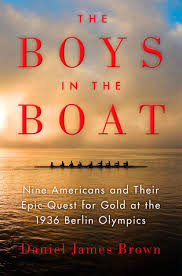
The Boys in the Boat by Daniel James Brown

download (1)

This awe-inspiring historical novel describes the true backstory of the boys from the University of Washington who succeeded in winning the Gold Medal in the 1936 Olympics in Berlin.  No, I didn’t just ruin the book for you – this is a known fact and is assumed from the get go.  But the suspense in this book still rises with each and every qualifying event leading up to the finale, primarily because the author brings you intimately into the lives of each of the remarkable people who were a part of this drama.  Brown focuses on the primary hero of this story, Joe Rantz.  Joe had an extremely difficult childhood and his resilience can only be described as astounding.  Through each of his loses in his life, he grew stronger and more independent, and learned to take care of himself because he had no choice.  This proved to be both a strength and a weakness as he began to train with the University of Washington crew team.

What is also fascinating about this story is the various times the author relates what is going on across the Atlantic, in Berlin, during the time leading up to the Olympics there.  As Hitler was strengthening his position as leader of the Third Reich, he was also bent on making Germany appear civilized and cultured and harmless in the world’s eyes by creating the perfect setting for the 1936 Olympics.  For this he utilized his right hand PR man, Goebbels and his friend and movie maker, Leni Reifenstahl to stage the one of the most successful cons ever.

While there is a great deal of detail shared in the book about rowing, the quality and design of the boats, the rigors of the training and the conditions under which the boys trained, it does help the reader to develop a profound respect for anyone in the boat.   I learned a great deal about the sport and the various people who are essential to the success of anyone who rows.  Most dramatic, though, was the way the boys came together as a team – that their success hinged on their putting faith in each other and forging the connection that enabled them to act as a single unit.  Experiencing this right along with them was a privilege that I encourage you to share.

Genuine drama and a truly beautiful story…

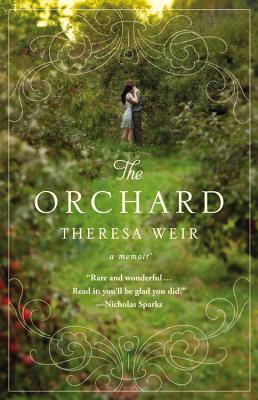
The Orchard by Theresa Weir

orchard

Have you ever started a book and realize that you’ve already read it?  This is what happened with this book – and it’s really the reason why I’m writing this blog!  I lose track of what I’ve read already – and now that I’m blogging, hopefully it won’t happen again…  This book is intriguing, though, and I ended up reading it again anyway.

It is actually a memoir, the story of Theresa Weir, a young woman with a rocky past, who worked and actually lived in her uncle’s bar.  She meets Adrian, a young, handsome apple farmer whose farm was rumored to be cursed.  Theresa, usually guarded, is taken by Adrian’s innocence and they begin a whirlwind romance that no one anticipates will last.  Theresa learns gradually what is at the root of the “curse” of the farm and she fights along with Adrian to try to overcome the history of the farm (guarded severely by Adrian’s hideous mother) to save themselves and their family.

What is important here is the message, which is that pure greed has led to the enlargement of farms and the use of toxic chemicals to achieve the “perfect” specimen of produce.  A key line in the book says something to the effect of man needing to work with nature not against it in order to grow the food he needs.  Adrian’s mother insists on perpetuating the use of pesticides on their farm, even in light of the deaths and miscarriages that have occurred there because of the chemicals.  And nothing convinces her otherwise, even the death of those close to her.

It is a story very close to my heart – as I agree that there is insurmountable evidence that pesticides are toxic.  The more we work with nature and not against it, the better!

Yes Please by Amy Poehler (migrated from bookblogger)

In the tradition of Bossy Pants, by Tina Fey, this book is a compilation of musings by her friend, Amy Poehler.  In fact, I liked this one better.  Amy Poehler speaks about her roots in improv and comedy, her earlier, hungrier days, and her experiences on SNL and on Parks and Rec.  She speaks about her family, her marriage, and her children in sort of random order.  She is funny, smart, honest and a little philosophical and the book definitely held my attention all the way through.

A nice little break from the serious stuff I’ve been reading…   Shout out to my daughter who is her biggest fan and who lent me her pre-ordered book!