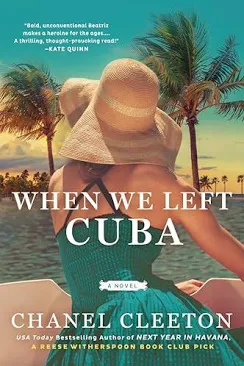
When We Left Cuba by Chanel Cleeton

Beatriz has been waiting… stewing actually. She has had to flee the home she adored, has been mourning the untimely death of her twin brother, and has been trying to see a way to extracting revenge for all of it. While her sisters have taken to the society life in Palm Beach, Florida – albeit at a lower social situation than they were used to – Beatriz has held fast to the belief that she’d return to Havana, that Fidel Castro will be ousted, and that they will see Cuba return to better days. When she meets a tall, broad-shouldered, extremely handsome stranger at the ball she’s been made to attend, she is shocked by how he so quickly rocks her world. At the same time, she struggles to remain firm in her desire to pursue justice for her brother and for Cuba.

This is a beautifully written historical fiction novel that enlightened me about this piece of history about which I admittedly knew too little. Written by the author of Next Year in Havana (which I’ve not yet read. I know, I’m going in the wrong order!), this book centers on the aftermath of the revolution that Fidel Castro led, focusing on those who fled mainly to Florida. We are given a close, personal experience of what it was like to live through the Bay of Pigs with family who were affected, followed of course by the Cuban Missile Crisis. We learn of the subterfuge, the Communist agenda, and the complicated spy network that Castro spun in order to hold onto power, and we come to understand why there was suspicion of Castro’s involvement in President Kennedy’s assassination. I certainly knew bits and pieces of this history, but learning about it from the Cuban perspective is extremely helpful.

I am also enamored by Beatriz’s character. She is staunchly independent, resists the comforts she might have felt entitled to, even risks her life in order to do what she feels is right. Particularly for the time she in which she is living and the family she grew up in, she is unusual and admirable.

I highly recommend this book. It’s exactly what I love about historical fiction: the opportunity to learn important pieces of our past but in the most entertaining way.

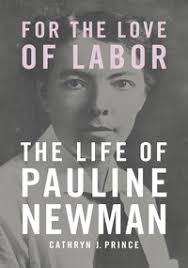
For the Love of Labor: The Life of Pauline Newman by Cathryn J. Prince

Born in the Jewish section of a small town in Lithuania in the late 1800’s, Pauline Newman spent her early years in a small but tidy house with her mother, father, and brothers and sisters. Although only a child, she already felt the frustration of being a girl in a world built for men. The boys were allowed to go to school while she was not; the boys were allowed more freedoms, while she was tasked with helping her mother with the housework. When her beloved father (who in fact did sneak her into the school while he taught the young boys) passed away, her mother suspected she’d be safer and have more opportunity as a single mother with children in America. Unfortunately, thousands of Jewish immigrants had the same idea, and opportunities were scarce. Because of the urgent need for a way to support themselves, Pauline was sent to find a job so that she could help contribute to the family, despite her very young age. It was there that she was exposed to the unimaginable work conditions in the sweatshops, there where her ideas on organizing and bargaining for improvements took root. These ideas would galvanize her to making improving life for workers – particularly women workers – her life’s work.

This non-fiction book reads like a novel, telling the true story of an American heroine. Before she was even through her middle teens, Pauline Newman established herself as a force to be reckoned with. Never one to shy away from conflict, her ability to speak and write despite her lack of formal education enabled her to organize women around the issues of the day: namely, the unsanitary, unsafe working conditions that she and so many other women and children endured while working in the sweatshops of the Lower East Side, including the notorious Triangle Shirtwaist Factory. Knowing that their only hope was collective bargaining, she organized groups to strike and bargain from the strength of unions. Little by little, she made headway, working with various organizations and writing for various publications.

Too often non-fiction can be laborious, but I found the writing in this book to be incredibly accessible and readable. I particularly enjoyed the more personal sections, those that focused on Newman’s private life. While often lonely and frustrated, Newman did manage to find love, albeit in someone who, because of their differences, broke her heart in some ways.

I cannot imagine the hours of research that went into this book – but the final product is a gift to those of us willing to read it. It is quite an American, real-life drama! (If you’re interested, you can find it at https://www.press.uillinois.edu/books/?id=c049552.)

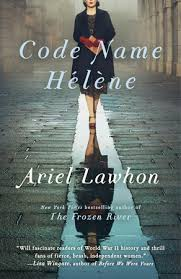
Code Name Helene by Ariel Lawhon

The dual timeline here:

1944: Helene (aka Nancy) finds herself being flown back into France, under the cover of night. From the get-go, she learns that the “rules” don’t count here on the ground and survival is what is of the utmost importance. That and arming, feeding, clothing, and paying the Resistance fighters she is here to safeguard.

1936: Nancy Wake her younger self, one who has boldly talked her way into a job as a journalist (no formal training), one of her first interviews having been with a then little-known, arrogant and aloof politician named Adolf Hitler. Soon after, we are with her as she bears witness to the evil work of his disciples, torturing Jews in a characteristic gruesome fashion in a public square in Vienna. She is immediately spurred on to do something, anything, to fight against this evil force. At the same time, she also attracts the gaze of one of France’s elite and most eligible young men. So as Europe gears up for war, Nancy is falling in love.

This is another magnificent work of historical fiction from the author of The Frozen River (reviewed here relatively recently). We follow larger-than-life Nancy Wake, an Australian national who lived in Paris before the war, just long enough to be tutored by her best friend in the language, the look, and the poise of the French. But Nancy’s accomplishments were all her own. She proved herself in the early days of the occupation by the Nazis, enough to be noticed by the right men in the right positions. Most impressive was the fact that Nancy was able to garner the respect, loyalty, and support of the thousands of men she led in their unofficial battalions of the French Resistance. It was a testament to her courage, bravado, and willingness to put herself in harm’s way for those fighting for justice.

This is most definitely a MUST READ, not only because it is an utterly addictive novel, replete with emotion and suspense, but because it is our duty to honor individuals (and particulary women, who are so often ignored in war stories) who fought so bravely for justice, civility, and democracy.

A Gentleman in Moscow by Amor Towles

I rarely reread novels because generally I feel there is so little time and so many books – but this one is an exception. I have already reviewed this novel previously (please search my former review), and I stand by my initial recommendation as a MUST READ.

There are few novels written with such insight, such kindness, and such a generous outlook on the foibles of mankind as this one. The character embodied in the Count is utterly endearing, for his humility, his wisdom, and his humor. While he has been accustomed to wealth and opportunity, he also, shaped as we learn by his grandmother, has a deep appreciation for everyone, no matter their station in life, no matter their role. And so, even as he is sentenced to house arrest (albeit in the nicest hotel in Moscow), he befriends most of the staff, the guests, and even finds a helpful role for himself so that he may be productive. Still we see his most tender aspect as we observe his interactions with the children he befriends and cares for. He treats even then with the utmost respect – and earns theirs in return (along with most others’ as well).

We can all learn so much from his character – and from this incredible novel that I might just read again at some point!

It remains one of my all-time favorites!

No More Tears: The Dark Secrets of Johnson & Johnson by Gardiner Harris

Johnson & Johnson is probably the most venerated pharmaceutical company in the US. They may not even be thought of as a pharmaceutical company (which we normally associate with prescription drugs), because most know them best for their baby products, bandages, and skin care lines. Their story, as they love to tell it, is more about how they are the most honest, most trustworthy, family-run company, having recalled their tainted Tylenol decades ago, at great cost to them. Well, this revelatory, painstakingly-researched book will call into question everything we have believed about this company, reducing their golden reputation to a mythology. Time and again, this company has chosen to spend billions of dollars on litigation defending their repetitive deceptions rather than admit that a product is harmful. They have released products before being tested, not tested enough subjects, hidden data that has not been favorable, and have falsified data on tests they have submitted for review. Their executives have lied under oath about their products. Even after seeing horrific harm result from their products, they have continued to conceal evidence in order to continue to make money. No matter the human toll (including deaths in the millions). Because, of course, it is always about the money.

This book is, of course, a MUST READ. It is relevant not only to anyone in the medical or pharmaceutical field. lt is relevant because it is a perfect example of how money and power are so inextricably linked. As J & J grew, so too did its influence and lobbying power. We see how the independence and integrity of the FDA, for example, has been compromised to the detriment of all of us – because those who make decisions on what drugs and devices are approved for use are also the ones who benefit financially from them being approved. How can anyone possibly be objective when these decisions affect whether or not they may keep their job? Or perhaps their future one? In addition, the company uses FDA approval (for what it’s worth) to shield them from litigation. And those medications and/or devices that are approved by this compromised agency will be used by you, or by your family member, or by your best friend. Are you comfortable with that?

I would encourage everyone to read this book. It’s distressing, yes, but so important to be informed. This “trustworthy” company may no longer be so. And there is much to be done to fix the system that has allowed it to become this way.

Ohio by Stephen Markley

When four former classmates turn up in their Pennsylvania hometown on the same night in 2013, we learn how their high school experience in a town impacted by both the Great Recession of 2008 and by the opioid epidemic, has had a formative and mostly devastating impact on their respective lives. One copes with substances, one by escaping into the military, another by traveling the world, and the latter not really coping at all.

This is a brutally honest depiction of how the convergence of the economic disaster of 2008 and the opioid crisis has impacted a generation of young folks. Even those characters with talent or high intellect had challenges because of their low middle class status and lack of cultural capital. They lacked the the connections, the mentorship, the folks who believed in them and who might lead them to achieve their higher goals. With a few noteworthy exceptions, the adults around them were too preoccupied with their own struggles to be supportive or encouraging.

The writing here is outstanding. It is a hard narrative, replete with painful images, but it is powerful and gritty and truly the only way to tell this story. The rotating perspective is also extremely effective. As we learn more and more through each character, the story builds and adds tension, and the climax is both shocking and satisfying.

I recommend this novel, but it is not for the feint-hearted. It is a tragic story, with graphic scenes. But it is honest, vivid, and authentic.

Coming Up Short by Robert Reich

This non-fiction memoir by Robert Reich is an accounting of how America failed to maintain the middle class, from the boom of the post-WWII era to current times. Having grown up being taunted and abused by bullies because of his short stature, Reich was particularly sensitive to protecting the underdog, and since he could not do so physically, he did so with his economic wisdom and understanding. He taught at Harvard and he also served in the Department of Labor in the Clinton administration, advocating for policies that in his view would protect the middle class and thereby narrow the gap between the very rich and the very poor. Much to his dismay, he was undermined at each turn, and over the course of the ensuing years, regulations over high finance and banking only relaxed, the highest earners became taxed at a lower rate, and the gap only widened. We are now left with a country that has an enormous wealth gap in spite of his efforts and it is a dismal outlook ahead.

I have to confess that I did not complete this entire book. I usually do not blog when I’ve done that, but I felt that I’d read enough to 1) learn quite a bit from it already and 2)get the gist of what he is trying to say from what I did read. While it is definitely readable, and he makes the economic parts very accessible (even to someone like me who never studied economics for very good reason…!), it was also quite repetitive. Perhaps that is a function of his frustration with everyone who did not listen to his advice -as he tried over and over to push for more decency in the policies and laws that were being passed. It was also quite hard to see how so many leaders, including Clinton and Obama, both of whom I had admired, came under the spell of Wall Street and its powerful lobbyists, who led them to pass such irresponsible and dangerous legislation. Worse, this deregulation of Wall Street and the disaster of 2008 did not teach us anything at all. Deregulation has only continued – to the point where folks are now predicting another similar bubble from AI. Will we never learn?

In any case, I believe this book carries much insight, much wisdom and even a bit of humor as it guides us through the past couple of decades of economic downfall. It gives us a window into how we’ve narrowed the middle class and why billionaires exist when the rest of society has seen little to no increase in wealth.

I would have liked to see answers to what we can do about it – perhaps how we can make changes for a brighter future.

Maybe that will be his next book? Or that is the book for the next generation to write…

The Lion Women of Tehran by Marjan Kamali

Ellie, aged 7, has just lost her father and feels as if her whole world has changed. She and her mother can no longer stay in their enormous home in the center of Tehran and must move to the “down” side of town. Nevertheless, while her mother is distraught over this and worries about their place in society, Ellie is actually excited to see children playing in the street, thrilled at the possibility of learning to play hopscotch, and dreams of meeting her ideal, best friend. When she walks in on the first day of her new school and is greeted by a spunky girl with dark, curly hair who shocks her with her outgoing nature, she thinks that this is not who she imagines will be her best friend. Ellie learns quickly that Homa, this warm, bright, honest, and fiercely loyal girl might just be that very friend.

This is a beautiful story of friendship, hardship, and loyalty. The two unlikely friends, Ellie and Homa, are as different as two girls might be – but perhaps it is because of this that they are amused by each other and get along. Ellie, self-aware in her materialism and superficiality, is nevertheless caught up in their friendship and feels a bond with Homa in spite of her absence of passion for the politics of the day. Nevertheless, she admires Homa – and is worried for her – for her passion and strength in seeking to promote human rights, particularly women’s rights. This is at the heart of both their friendship and their schism.

I actually love the way Ellie portrays herself as superficial, wanting what many want, and being self-aware about it. She is terrified of having to go back to being dependent on someone to pay her bills, to live in squalor, to have to need/want. She fears poverty, lack of power. And she admits to being afraid of being imprisoned, as we all are, at heart. So many novels are written with the main character as the brave one, the fighter, the hero. I love that in this one, the main character is the one who is the worrier, the caregiver, the friend. She is the one who has faults, is honorable, honest, and self aware, but who is supportive and can be helpful when the time is right. While many are brave and undertake righteous causes, fighting for freedom against oppressive and suppressive governments (such as that of the Shah’s and later that of the Ayatollah’s), not everyone is meant for that. I think that by creating an admirable, honorable, human and faulty main character for this tale, we can perhaps see ourselves identifying with that fear and relate to those that can help, those who support the heroes, the fighters.

This also gives a background to the story of the women of Iran. It is not only a historical context but a warning to all of us. It happened in Iran with extremists who toppled a democratically elected government, violently forcing themselves into power and overturning years of fighting for women’s rights in just moments. We in the US think we are so safe from this, but here we are, already fighting for power to make medical decisions over our own bodies. It starts there. Where will it end? If it happened in Iran, it can happen here as well.

I think this is an important read for not only women but men everywhere, and particularly here in the US and particularly now in this uncertain moment. We are experiencing no less than an undoing of our democracy in small (and not-so-small) steps. We need to pay attention and learn from other countries and other individuals’ experiences. Or there may be no where else to go…

We Were the Mulvaneys by Joyce Carol Oates

The Mulvaney family – Michael Sr, Corinne, and their four children, not to mention all their animals – are a boisterous, close-knit, and fairly prosperous family living on a working farm in upstate NY. Michael has worked his way up from humble beginnings, to say the least, and Corinne, who left college to marry Michael, prides herself on knowing exactly what is going on with their 3 boys and 1 girl at all times. And while she adores her sons, she takes particular pride in her beautiful, popular, and smart daughter, who mystifies her by the attention, the phone calls, and the friends she garners (that Corinne herself was never able to). So how is it that Corinne missed the change in Marianne, the alteration in her mood, her habits, even her appearance since the prom a week ago? And how would this affect the Mulvaneys going forward?

This portrait of the gradual demise of a family after a major trauma is tragic, heart-wrenching, and devastatingly realistic. We watch as their communication breaks down, as they increasingly close off to one another, drawing inside themselves, festering in their own grief, unable to reach out to the one who actually is the one who truly needs the nurturing: Marianne. Even Corinne, the mom, who is supposedly the heart of the family, desperately tries to be the glue tying them all to their beloved home. She is coming apart at the seams, fraying and caving to the weaknesses of the men around her, particularly her husband’s. Marianne’s vulnerability, her trauma, becomes her fault. As happens way too often, Marianne punishes herself and is punished by everyone around her, as if she has asked for this trauma. As if something she has done has provoked the trauma she’s experienced. (Which, of course, it has not.)

It is hard to read this novel without becoming angry – at the family, at the community, at society in general. Because this is the story of women. It is set in the 1970’s but it can be anytime, anywhere and it will be true all over again. A man assaults a woman and it becomes her fault, she gets blamed and it becomes all about the men around her. How it reflects on the family. How it must be avenged. How she must have brought it on, somehow. How she must be punished for it, ultimately. Because somehow it is her shame, not the shame of the perpetrator. (Why is this still a thing? It is impossible to comprehend.)

I believe the writing is a bit meandering, with quite a lot of extraneous detail. But within is a story for all time, an important statement about the past and current way in which the needs of women become undermined by those of the men around them. How a single traumatic event can impact an entire family for their whole lives. And how if we don’t communicate, face what is needed with kindness, compassion, and humility, we will never get beyond this hypocritical treatment of women in our society.

The House of Lincoln by Nancy Horan

1851 in Springfield, IL could be a terrifying time, depending on the color of your skin, your heritage, and your politics. While Illinois was a northern state, there was the constant threat of slave hunters prowling around, searching for the bounty they would earn for themselves if they tracked down runaways. In fact, having arrived into this country as a Portuguese refugee herself, Ana finds herself with her friend Cal, witnessing a frightening scene that she must keep to herself in order to protect those she has come to love and respect. This comes to help form her views as she moves forward through her life, becomes a nanny and cleaner for the Lincoln family and follows the rise and tragic fall of the most impactful presidents our nation has ever seen.

Told through the eyes of this young woman, we glimpse into the home of the Lincolns, seeing their experience of both personal and national tragedies. We view the life of Mary Todd Lincoln, who experienced loss after loss, and, understandably, struggled with her mental health because of it. Yet she still fought so hard to encourage her absent-minded but brilliant and kind husband to fight for what he felt was the best for the Black slave – emancipation. Through Ana, we see how he agonized, how he sought the argument, the magical words that would not only convince his enemies to join him, but how to bring the fractured country back together. Through Ana, we also view the backlash, so quick to happen, so easily sprung back. Even in the hometown of Abraham Lincoln, where he was beloved, or so one would think, there was an evil backlash of hatred.

Not only is this an important part of our history, providing details that one might not know, but it is frighteningly relevant to what is happening today. While we might have made some progress toward freedoms, there is much in the way of backsliding and backlash happening now as well. Not only from people in the streets, but it is being supported and legitimized by our Conservative legislators and the courts. The civil rights of marginalized people are being chipped away and the highest court in our land is jubilantly cementing this in. I fear it will take years to undo the damage they are doing now.

We are growing less and less the “land of the free and the home of the brave” our founders sought for us. Shame on those who are perpetrating this backlash (and the current conservative members of the Supreme Court). This is why it is so important to know what has happened in our past. So that we can do our best to prevent the extreme backsliding to this segregation, this hatred, this fear of the “other” for our future.