The Teenage Brain by Frances E. Jensen, MD with Amy Ellis Nutt

41hjKMRKNzL._SX324_BO1,204,203,200_

A stark departure from my usual posts, this non-fiction book is the product of a neuroscience researcher who also survived as a single mom raising her own 2 sons through their adolescent years.  It is written for parents – not just for those of us who work with adolescents – so while it is somewhat technical, it also is quite readable.  While the authors describe many studies about how the brain functions and how adolescent brains function uniquely, they also pepper the chapters with anecdotes about specific individuals who illustrate their points.  The stories are quite poignant and really keep the reader engaged.

What I like about this book is that it is not all negative and bad news.  Adolescents often get slammed when written about, with emphasis only on the risky behaviors and the poor decision-making that they are capable of.  While there is some of that here, there is also explanation for why they are vulnerable to unwise decisions – their still developing frontal cortices, primarily.  In addition, there is also very positive discussion about the plasticity of their brains, which enables them to learn much more easily and quickly than those of us who are older.  There is interesting discussion about why adolescents are more vulnerable to addiction, whether to smoking or drugs or gambling, etc., and there is also discussion of mental illness and legal issues.  Finally, there is also discussion of the emerging adult, or the post-adolescent, which is a newer area of investigation.

In this text, you’ll find reasoned parenting advice, strategies to help teens cope with difficulties, and resources, which any parent of a teen can benefit from.  This book is not for everyone, but if you are a parent of teens and have questions or issues, I would recommend this as a resource.  Also, if you work with teens in any capacity, this is a must-read.   Check it out!


An Improbable Friendship by Anthony David

1443346094_12032187_10153651012127604_2363010507657277030_n

This is a difficult book to write about, probably because I am still trying to digest it all for myself, let alone try to share it with anyone else.  The friendship that is chronicled in this book is that which existed for many years between Ruth Dayan, wife of Moshe Dayan, and Raymonda Tawil, Yasser Arafat’s mother-in-law.  Although they were each related to men who were enemies, they themselves were able to strike a bond of friendship and respect because of their common goals and common ideals.  They each believed in the inherent good in all people and that peace could be achieved between Palestinians and Israelis if they were just brought together and allowed to live side by side.  Each worked relentlessly to try to bring this dream into a reality, Ruth by working directly with Palestinian women (helping them to earn money through their weaving) and Raymonda through the media.

What became difficult about this book is the details, which were, as the history of Israel is, quite bloody and controversial.  While I have always been aware of Israel’s displacement of Arabs from their homes during the formative years of the state, this book provides the gory details and describes it in real, human terms.  It is, to say the least disturbing.  It did truly open my eyes to some of Israel’s darkest moments.  On the other hand, I cannot help feeling as though there are some details that are not included, such as the fact that after the U.N. declaration of a 2-state situation in 1948, the Israelis were willing to abide by this but the Arabs were not.  And terrorism is terrorism, no matter what the root of it, and the only true way to solve a problem is to negotiate it through.  The story, as it is written, portrays Palestinians as the underdogs and I think the bias in the writing is a fault in the book.  It is so clearly slanted to the left that in the writing of the story of these 2 very brave women, the author actually alienates readers – and probably the very readers he wants to sway.

The book does highlight how the female perspective on the situation is often different from the male one.  Ruth and Raymonda were able to disagree about many things, but they always found common ground and started back from this.  Their priority was always to fall back onto humanism and love.  I firmly believe that if women were in charge, we’d be able to reconcile a solution to the Middle East and find a way to make peace.  I think leaving out testosterone and “honor” would do the world a service.

I definitely learned a lot about the history of Israel, the complexity of the political quagmire that remains there, but also how one can spin events in many ways to work to one’s purpose.  I think too much of the latter was done in this book and this may have caused what I understood to be the “mission” of this book to backfire.


All Who Go Do Not Return by Shulem Deen

all who go

In the tiny, ultra-Hassidic (Skverer) community of New Square, author Shulem Deen dared to question his religious practices and belief in God. Born in Brooklyn to a different sect of Hassidism, he chose this community because of his impression that it was welcoming and that it espoused the spiritual essence he was searching for.  He studied in the yeshivah there and in time was married off to a girl he’d met only once before his wedding.  He tried to make a life for himself, studying, working (or trying to, in spite of the minimal secular education he was provided), and even fathering children.  But his doubts began to niggle at him as did his curiosity about the outside world (of which he knew almost nothing).

This is not the best-written or the most gripping story, but it is very human and very heartfelt.  More importantly, it also gives the reader an insider’s view into this terribly insular ghetto.  More than almost any other sect of Judaism, this group of people consider any exposure to the outside/modern world (television, newspapers, etc.) a doorway to sin.  There is no such thing as discussion or debate, unless it is related to the study of Torah.  Anyone who questions the Rebbe — the ultimate leader believed, in a sense, to hold a direct line to God — is one who must be punished and abolished from their midst.  And this is the ultimate fate of Shulem.

Sadly, this is another example of how religious extremism promotes hatred, intolerance, and cruelty toward anyone who is perceived as different.  Poor Shulem was just another victim of this.


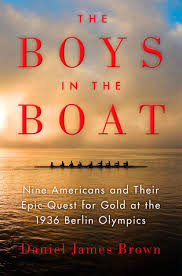
The Boys in the Boat by Daniel James Brown

download (1)

This awe-inspiring historical novel describes the true backstory of the boys from the University of Washington who succeeded in winning the Gold Medal in the 1936 Olympics in Berlin.  No, I didn’t just ruin the book for you – this is a known fact and is assumed from the get go.  But the suspense in this book still rises with each and every qualifying event leading up to the finale, primarily because the author brings you intimately into the lives of each of the remarkable people who were a part of this drama.  Brown focuses on the primary hero of this story, Joe Rantz.  Joe had an extremely difficult childhood and his resilience can only be described as astounding.  Through each of his loses in his life, he grew stronger and more independent, and learned to take care of himself because he had no choice.  This proved to be both a strength and a weakness as he began to train with the University of Washington crew team.

What is also fascinating about this story is the various times the author relates what is going on across the Atlantic, in Berlin, during the time leading up to the Olympics there.  As Hitler was strengthening his position as leader of the Third Reich, he was also bent on making Germany appear civilized and cultured and harmless in the world’s eyes by creating the perfect setting for the 1936 Olympics.  For this he utilized his right hand PR man, Goebbels and his friend and movie maker, Leni Reifenstahl to stage the one of the most successful cons ever.

While there is a great deal of detail shared in the book about rowing, the quality and design of the boats, the rigors of the training and the conditions under which the boys trained, it does help the reader to develop a profound respect for anyone in the boat.   I learned a great deal about the sport and the various people who are essential to the success of anyone who rows.  Most dramatic, though, was the way the boys came together as a team – that their success hinged on their putting faith in each other and forging the connection that enabled them to act as a single unit.  Experiencing this right along with them was a privilege that I encourage you to share.

Genuine drama and a truly beautiful story…

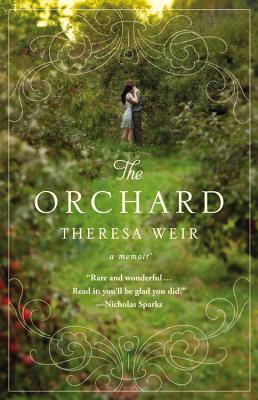
The Orchard by Theresa Weir

orchard

Have you ever started a book and realize that you’ve already read it?  This is what happened with this book – and it’s really the reason why I’m writing this blog!  I lose track of what I’ve read already – and now that I’m blogging, hopefully it won’t happen again…  This book is intriguing, though, and I ended up reading it again anyway.

It is actually a memoir, the story of Theresa Weir, a young woman with a rocky past, who worked and actually lived in her uncle’s bar.  She meets Adrian, a young, handsome apple farmer whose farm was rumored to be cursed.  Theresa, usually guarded, is taken by Adrian’s innocence and they begin a whirlwind romance that no one anticipates will last.  Theresa learns gradually what is at the root of the “curse” of the farm and she fights along with Adrian to try to overcome the history of the farm (guarded severely by Adrian’s hideous mother) to save themselves and their family.

What is important here is the message, which is that pure greed has led to the enlargement of farms and the use of toxic chemicals to achieve the “perfect” specimen of produce.  A key line in the book says something to the effect of man needing to work with nature not against it in order to grow the food he needs.  Adrian’s mother insists on perpetuating the use of pesticides on their farm, even in light of the deaths and miscarriages that have occurred there because of the chemicals.  And nothing convinces her otherwise, even the death of those close to her.

It is a story very close to my heart – as I agree that there is insurmountable evidence that pesticides are toxic.  The more we work with nature and not against it, the better!

Yes Please by Amy Poehler (migrated from bookblogger)

In the tradition of Bossy Pants, by Tina Fey, this book is a compilation of musings by her friend, Amy Poehler.  In fact, I liked this one better.  Amy Poehler speaks about her roots in improv and comedy, her earlier, hungrier days, and her experiences on SNL and on Parks and Rec.  She speaks about her family, her marriage, and her children in sort of random order.  She is funny, smart, honest and a little philosophical and the book definitely held my attention all the way through.

A nice little break from the serious stuff I’ve been reading…   Shout out to my daughter who is her biggest fan and who lent me her pre-ordered book!

This Common Secret: My Journey as an Abortion Doctor by Susan Wicklund and Alex Kesselheim (migrated from bookblogger)

This stirring memoir is the story of Susan Wicklund, MD, who performed abortions in multiple states for over 20 years.  It begins with an account of her personal experiences that lead to her decision to do this work and it takes the reader through the course of her tumultuous and dramatic career.  No other type of doctor is hunted and intimidated the way these brave physicians are.  No other doctor is forced to subject their families and friends to the kind of outright brutality that these doctors are — and ironically in the name of God!  They deserve all the recognition that this book begins to achieve.

It truly brings to light the hypocrisy of the protestors who plagued her.  In their urgency to protect “rights” of the unborn, for example, they completely trample over the rights of ACTUAL LIVING PEOPLE WHO SHOULD BE PROTECTED!  Staggeringly, some of the people who protested actually came in for services and then went  back out and protested again.  And you can be sure that their sisters, mothers, cousins and friends had probably used the services as well.  But go and shoot at the doctor and go and burn down the clinic so that you can make your empty, cowardly statement.

As you can see, I am passionate about this topic.  But I think no matter what your view on this subject, this book is a fascinating real-life story of a heroine.  An important book for us to be reading especially in the current, right-wing, conservative political climate in which we are, sadly, living.

Thrive by Arianna Huffington (migrated from bookblogger)

This non-fiction book by the founder of the Huffington Post,  is a treatise on creating a balance in our lives.  Huffington makes a well-argued point that we are so bent in our society on achieving success as defined by money and power that we lose sight of what can make us actually happy — which she suggests are well-being, wisdom and wonder.

Taking care of ourselves physically and emotionally, she argues, is the most important.  Getting adequate sleep, exercising, meditating, taking time away from our technological tethers are all key factors in fostering actual happiness.  Huffington pushes for a change in culture away from the macho attitude of bragging about all-nighters in the office to one where time off taken to re-charge is respected.  She argues for balance, for spiritual fulfillment, for volunteerism as a means of achieving success as she defines it.

I think Huffington’s ideas are valuable and well-fueled by research.  Maybe I also like it so much because I’ve chosen the less academic route in my career in order to find this balance.  I do think it’s a hard thing to achieve in our high-powered, high-tech world.  But it is an important goal, balance.

I think this book is a good gift for all the workaholics that we know!

The Immortal Life of Henrietta Lacks by Rebecca Skloot (migrated from bookblogger)

This non-fiction book is the story of Henrietta Lacks, made immortal by her cervical cancer cells that were essentially stolen from her and used for medical research without her consent or knowledge.  Known only as HeLa cells for many years, the cancer cells divided at such a steady, rapid pace that they were essentially the earliest and most successful cells to be grown in a lab.  Since they were so hardy, they were able to be cultivated and shipped around the world and used by researchers to conduct studies and develop medical breakthroughs never before even imagined.

Unfortunately, though, the fact that they were taken from a real person with a life and a family was pretty much ignored.  The uncovering of this story by the author became a revelation to both her and to the family and she reveals the impact of this as the story unfolds.  There is, in the telling of this injustice, a chronology of sorts of many other injustices and the resultant development of informed consent for medical research.  (One horrifying fact this book reveals is that our country had developed laws regulating the treatment of animals in research even before we had laws protecting humans!  Imagine that!)

It’s a very personal story, particularly as it relates to Deborah, Henrietta’s daughter, and a very public story as it relates to the history of medical research.  It does jump a bit from topic to topic and the writing is a bit choppy, but it is a fascinating and honest story nonetheless.

Unbroken by Laura Hillenbrand (migrated from bookblogger)

I was really not sure I was going to make it through this one, but a dear friend encouraged me to complete it and I’m glad I did.  This true story is at once disturbing and inspiring, hard to believe and hard to endure.  It is the story of Louie Zamporini, who was an Olympic track hopeful who was drafted into the Air Force, based in Hawaii during World War II.  From a downed plane, to weeks on a raft in the middle of the Pacific Ocean, to being captured as a POW by the Japanese, his journey took him through years of torment and torture.  Survival was a mixed blessing and his journey afterwards through PTSD brought him eventually to a place where he was able to confront his past and come to terms with it.

The story has parts that are relentlessly heart-wrenching and depressing for the reader.  I nearly gave up because I felt I couldn’t bear to read it anymore.  In fact, I downloaded another, mindless book to read to distract myself and lighten my heart a bit.  I did return to it, though, and I am happy that I did.

What is so inspiring about this story is not only the bravery and the tenacity with which the POW’s lived through their experience, but also the ability to ultimately forgive and relinquish the hatred of the enemy.  I only read about their experiences and I have trouble forgiving the individuals responsible.

This is a painful, torturous book but it does inspire and give hope of healing.  Not advised if you have a weak stomach, though!

P.S.  The movie, directed by Angelina Jolie, comes out in December!