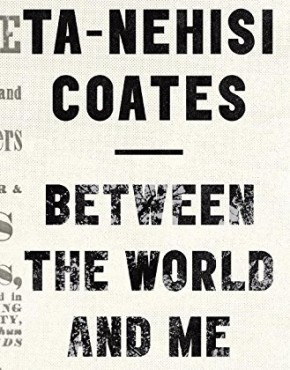
Between the World and Me by Ta-Nahisi Coates

This work by Ta-Nehisi Coates, written in the form of a letter to his adolescent son, Samori, is a treatise on his experience as a Black man in America.  What Coates is doing here is what so many Black parents in America have needed to do:  encourage their children to be cautious in order to preserve the sanctity and safety of their Black bodies.   As he states on page 129-130, “When I was eleven my highest priority was the simple security of my body.  … already you have expectations,…  survival and safety are not enough.”  And “What I am saying is that it does not all belong to you, that the beauty in you is not strictly yours and is largely the result of enjoying an abnormal amount of security in your black body.”  He is sharing his own past struggles as well as those around him, in order to communicate his concern for his son’s safety, while also communicating generally the plight of living in a body of color in this country.

Unless you have been living under a proverbial rock over the last few months, you have to be aware of the uncovering of the ongoing racism that we have been seeing in our country.  I say uncovering because the racism is not new – no, it has been going on since White men arrived on these lands–  but it’s once again being exposed for what it is on a national level.  While I rarely quote in this blog, I find that Coates’ words are far more poetic and useful than my own here.  He says, on page 17,  for example, “To be black… was to be naked before the elements of the world…  the nakedness is the correct and intended result of the policy, the predictable upshot of people forced for centuries to live under fear.”  This, I believe, says it all.  This is the institutionalized, ratified, codified racist structure upon which our country was built.  It began with the enslavement of a people, evolved into a Jim Crow structure and now exists in the form of a criminal “justice” system that is an entirely purposeful perpetration of a racist segregation of people based on the color of their skin.  It’s all the same thing.

And it is our obligation to blow this apart.

I’m still struggling with how we, as individuals can make a difference, but the very first step is understanding how deeply entrenched the problem is.  This takes looking both inward at our own implicit biases, which we all have, and examining the structural racism upon which our country has been erected.  Understanding the deeply rooted fear of a child for his own bodily security, and then as he grows, for the safety of his peers and then for the safety of his children, as Coates relays here, gives an up-close-and-personal view of what it is like to live in his skin.  We feel his terror and we feel his rage over having to feel that terror.  This is where we start.

The more I read, the more I understand how little I know.


White Fragility by Robin DiAngelo

The more I read, the more I understand how little I know.  Many books have taught me this, but few as starkly as this one.  And in this moment in our history, I feel it is imperative for all white folks to be reading books like this one – at the very least this one.  Because racism is our problem.

Robin DiAngelo,  through trainings and lectures on racism and working with people of color, has helped both herself and many others become aware of the phenomenon of white fragility.  Because the power of white folks over black folks is so fundamental to the structure of our society, white folks have the luxury of being able to tune it out while black folks cannot.  What DiAngelo focuses on in this book is the responsibility of us white folks to do our own work and to take responsibility for our own part in the perpetuation of this power differential, which is racism.

One of the first steps is to separate the notion that being racist or committing racist acts falls into the binary of the good/bad person.  As DiAngelo points out, our images of racists are generally from the 1960’s, when we see white people brutally attacking black people, and we equate all racist acts with those people.  On the other hand, we have to realize that we as white folks inadvertently commit acts of racism frequently, and while our intentions may not be bad or hurtful, it does not mitigate the fact that the impact of our actions or words may still be.  This does not make us bad people – but it does make us racists and it does still mean we’ve committed racist acts.  We are still responsible for having committed them and are still responsible for changing our behavior and avoiding these acts in the future.

What are we to do?  As I am continuing to learn here, we are responsible to learn about the history of racism, the systemic ways in which white folks have had power over black folks since 1619 in the U.S., and how we need to get over ourselves.  We have to learn to let down our defenses, be open to criticism, and be curious and honest about learning how to be better and more just.  It’s not about being nicer, but more sensitive and responsive to the other.  As DiAngelo states in the book: “Stopping our racist patterns must be more important than working to convince others that we don’t have them.”  And this is hard.  We will make mistakes.  But if we don’t try, we will not make any progress toward achieving a more equitable space for others and a more just society.

And everybody benefits from a just society.

Let this book be the beginning of our work.


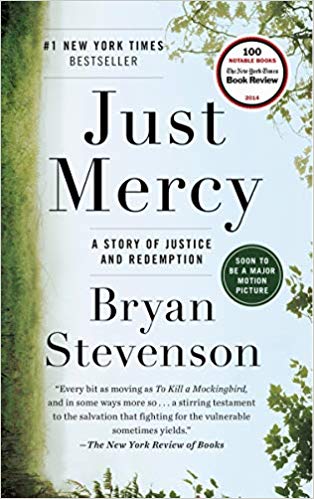
Just Mercy by Bryan Stevenson


Bryan Stevenson is a graduate of Harvard Law School who, after graduating, went down South to work to establish the Equal Justice Initiative, which began as a legal nonprofit defending those who found themselves unjustifiably on death row, but expanded to defending others who were also victims of our imbalanced justice system here in the U.S. The primary thread that runs through the book is the story of Walter McMillan, an African American framed for the murder of a white woman in a laundromat in Alabama.  And while Walter’s story is compelling and tragic in and of itself, the many others that Stevenson shares with us along the way similarly intrigue and horrify in their revelation of the truth of how racially biased our criminal justice system is and has been for decades.

I honestly feel like this book should be required reading for every American.  Whatever we think we know about racism and bias – it’s just not enough.  Racism is ugly, and painful and insidious and pervasive and it infects our law enforcement, our criminal justice system, and our politics and even our day-to-day interactions with others.  This book reveals the magnitude of the problem. Thousands of individuals have had outrageous sentences for smaller crimes and so many children – 13 and 14 years old! — have been given extremely harsh, long sentences really just because they were of color.  Most of these “criminals” were victims themselves, whether of their circumstances, of trauma they’d experienced, or of their poverty that prevented them from obtaining suitable defense.

I think that Bryan Stevenson is one of the true heroes of our time.  He has stood up for the impoverished and for those who have had no voice and given them a voice.  He has bravely fought for those who would have been killed because of inhumane death penalty laws (one could argue – as I have, that all death penalty laws are inhumane).

I have not seen the movie, but I believe the movie could not possibly have all the details that this book provides and I always believe the details are crucial.  Especially in an important book such as this one.

This is absolutely a MUST READ!

P.S.  It’s been awhile since a book has made me cry the way this one has.  There is one particular vignette that really threw me, for its beauty and its power.  If you read this book and come upon a story about a chocolate milkshake, you’ll know when it was that I cried the hardest…!