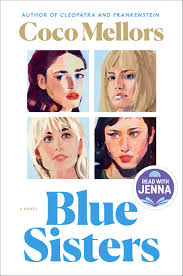
Blue Sisters by Coco Mellors

Avery, Lucky, and Bonnie are all too well aware of what day it is – and not just because it’s the Fourth of July. They have been acutely aware of this date since last year on this dark day, when they lost their treasured sister, Nicky. She was the extroverted, kind, and “girly” one of the quartet, the one everyone loved. Ever since her death, each sister has been grieving her loss, each in her own way. Making matters even worse, the sisters receive an email from their mother alerting them that she will be selling the family apartment where Nicky lived, and that this apartment needs to be emptied by the end of the month. This insurmountable challenge – dealing with Nicky’s belongings no one has had the courage to dispose of – may in fact be just what the sisters need.

This is a beautifully written account of the unique relationship between siblings and how a loss can be traumatic, even during adulthood. The sisters, each prone to coping by utilizing self-destructive habits, have been suffering over the year since Nicky’s death. Not having their parents’ support – and having turned away from each other – has only added fuel onto their inner fires. And because each sister’s character is painted so artfully, we become entangled in each story, every challenge. We are compelled to keep turning the pages because we HAVE to learn what happens next.

I highly recommend this novel. While it sometimes feels as if you’re watching a car accident about to happen – and you want to jump in front of the car – it also has moments of such raw tenderness that it is worth every tear you might shed.

Long Bright River by Liz Moore

Mickey is worried about her sister, Kacey, who’s been missing for more than a month. This would not be so unusual – both that her sister has been missing or that she is worried about her – except that there is currently a strangler on the loose who is out for women with exactly Kacey’s description: young, pretty, and addicted to heroin. You would think that Mickey might be able to rely on her family to help. You would also think that being on the police force in Philly would give her an advantage. Neither, sadly, seem to be the case. And apparently, it’s up to Mickey to figure out just why this is so.

This novel, which has recently been made into a streaming series (which I have not yet seen), is quite addictive in itself. The story is engaging from the beginning, growing ever more suspenseful as one turns its pages. And I found the characters to be gritty and vulnerable and often just desperate to find connection, family, and love – just as we all are, really. I felt totally connected to Mickey, even as hard as she had to be.

It’s admittedly a tough read, though, with some scenes that, while brief, depict the lives of those who are under the deeply-unmagical spell of the terrible drugs we’re seeing out there in such high numbers. But while it depicts the deplorable conditions many resign themselves to while in search of that next fix, it also highlights the community, the unofficial network that develops, even the care that some take to watch out for each other. These folks understand that underneath the unwashed desperation and the naked fear, these are human beings, with family who care about them, with complicated histories and feelings, and often with a true yearning to get clean but who just struggle against this horrible disease.

This story also addresses police corruption, which can be rampant in some cities. While I have true respect for officers who defend us honorably – they provide one of the most thankless and important contributions to society that we live with, truly. But I live in fear of those who are dishonorable. The abuse of power is a thing to be feared on any level – but if it’s someone with a weapon, that is terrifying.

On the whole, this is a novel that is hard to put down. If you commit to it, make sure you set aside time – you will not want to do anything else until you get to that very last page!

The Art of Losing by Lizzy Mason

Harley’s only wish is that she could unwind the clock, just reverse time to the moment before she made the impulsive decision to leave her best friend’s party before assuring her sister had a ride home with someone other than her own drunken boyfriend, Mike. Maybe then her sister, Audrey, would not be in the Neuro ICU in a coma, having just barely survived a near-fatal car accident. And although it was not Harley at the wheel, she feels so much responsibility for the whole mess, it may as well have been. Overwhelmed with anger and guilt, Harley muddles through Audrey’s recovery, all the while sorting out issues around her relationships, substance use, and how to manage and express her own very complicated feelings.

Written as a young adult novel by an author who has experienced addiction and rehab treatment herself, this novel seeks to provide a wake-up call for those who try to deny that those in their teens can be addicts, and/or that just alcohol alone can be a drug that can endanger lives. Many minimize the risks of teenage binge drinking that is seen both in high schools and on college campuses, but it in fact takes a huge toll on both the physical and the psychological health of those affected (and often those around them as well) – and alcohol intoxication is a cause of 30% of fatal car accidents in the US. Only when one takes treatment seriously, whether through residential or intensive outpatient rehab or through regular group meetings like AA, can one begin to find a path toward recovery.

Unfortunately, while the message here is crucial, the story itself is part after-school special, part soap opera. The characters are a bit flat and over-privileged (every teen has their own car, somehow), and the plot just misses the mark in plausibility. For example, we learn that somehow, just when Harley realizes her boyfriend is really a dick, she discovers that her literal “boy next door” is really the love of her life? Really? Way too pre-packaged, in my opinion. Why does she need another boyfriend anyway? I would have loved to see her come to an understanding of herself without another guy in the picture, all on her own. That was a bit disappointing…

In spite of my misgivings about the delivery, this novel still raises truly valuable messaging around addressing mental heath treatment, particularly addiction and substance use. If it can sway even one young person to confront their own issue, to turn to someone for help, then the author will have accomplished tremendous good.


Beautiful Boy (migrated from Bookblogger)

Beautiful Boy by David Sheff

I put off reading this book for so long because I knew it would be difficult — and rightfully so.  However, I do believe it is worth reading.  It is the harrowing, true story (probably so much more harrowing because it’s true!) of a father whose son is addicted to methamphetamine.  The account is painstaking and painful, recurrent and repetitive, really because the experience is.  He tells of his son, Nic, who is a bright, talented, truly “beautiful” boy who maybe  and maybe not because of his parents’ difficult divorce and their long-distance custody arrangement, begins to use marijuana.  He quickly moves on to alcohol and other drugs and finally finds his true love in meth.  And the drug, as it tends to do, takes over his life.  When Nic is on the drug, he becomes a different person — cold, impervious, resentful and conniving and completely manipulates his friends and family to enable his drug use.

His is a typical story, evidently, and the author peppers the story with actual research statistics and theories and advice for other parents in the same situation.  Mostly, though, it seems to be a catharsis for this father who writes as his way of coping.  He offers frequently that there is no great advice and there is no single answer to what heals an addict.  It seems there are some addicts who cannot be healed.  Even with treatment and rehab there is relapse and it often seems truly hopeless.

Probably most importantly, the author stresses particularly at the end of the book, the importance of the family members to get treatment themselves.  Being that closely tied to an addict can be just as “addictive” and destructive as being the addict.  It can take over your life just as easily.  This is an important message for those close to anyone with such an overwhelming disease.

As painful as this book was to read, I am so glad I did read it.  I learned so much.