Cassandra in Reverse by Holly Smale

Cassandra is definitely NOT having a good day. She’s been broken up with by her boyfriend of 4 months, she’s being fired by her boss, and they actually don’t even have banana muffins at her favorite pit stop. How can they be out of banana muffins??? When she learns suddenly on this day that she has the gift of time travel, she wonders, maybe, can she reverse some of these things that have happened? More importantly, can she reverse the bigger things that have affected her life? As she learns about how this new “gift” actually works, she also learns quite a bit about herself.

No one can describe what it’s like to be inside the mind/body of an autistic individual as one who is autistic – and this autistic author gives us the gift of sharing that experience by creating a brilliant, sarcastic, awkward, and deeply lovable autistic character in Cassandra. We feel for her as she struggles with her social interactions and we cringe on her behalf as she is challenged with various overwhelming noises, textures, and changes in her routine. She tries to learn from her prior experiences and she tries to “undo” – as we all wish we could, at times. And her journey is as entertaining as it is endearing. What she learns to appreciate is that she has to be true to herself and treasure who she is and the good she alone can bring to the world.

And don’t we all have this to learn? While we’d all like to change certain parts of ourselves, it may be more valuable to appreciate what we can do instead of trying to change what we cannot.

 

Happiness Falls by Angie Kim

“We didn’t call the police right away” laments Mia as she begins to unravel the tale of what happens after her autistic, non-speaking younger brother Eugene, returns from his therapeutic exercise in the park without their father. Eugene is clearly traumatized by what has happened in the park, as demonstrated by his persistent jumping to calm himself for hours and hours, but the family is unable to assess from him what exactly has occurred. As the family searches for their father/husband, in what becomes a missing person mystery, they also learn more about both him and about Eugene – and while the lessons become harder and harder, they also bring the family closer and closer.

As Mia reflects on her search for her father and the family’s approach to figuring out what might have occurred between Eugene and him in the park, Mia realizes that she has been self-absorbed, as a 20 year-old college student might be, as well as biased, as any of us might be.  As she learns more about her father and what he’s been analyzing during his time as a stay-at-home dad, she cycles through various reactions. Similarly, as it slowly dawns on her that her brother Eugene, is capable of much deeper thought than she’d previously understood, she has a mixture of emotions as well. Because her brother is right in front of her, this becomes a crucial part of the story.  Not only does she realize that one’s ability to speak may not be reflective of their verbal skills (they may just not have the ability to actually  vocalize their internal dialogue), but moreover, that one’s verbal skills are not the full picture of one’s overall intelligence, as she’d presumed. 

I certainly appreciated this book for opening my eyes to the possible deeper intelligence of those I may have judged erroneously as having less intelligence just because of their challenges with communication. Whether it is a language barrier because of a foreign nationality, a look that is different from our own, or behaviors/movements that do not match those we may associate with “normal” (whatever that might mean). we presume, judge, and miscalculate others’ abilities based on biases about which we are not even conscious. These feed into our understanding of those around us and we may be dismissive — even rude —  without even realizing we are being so. It is so important that we open our minds and our hearts to these possibilities, because only then can we become aware and hopefully prevent these insults, offenses to others. And in this moment of polarization, the more we can come together, the better.

And not to worry – there is of course also a story here, with a plot, characters, and suspense. It is not preachy, nor bogged down in too much detail. We do empathize with Mia as she parses out her discoveries. and we also develop a strong attachment for Eugene as we discover his personality, his humor. There is warmth without the saccharine. 

A definitely recommended read!  


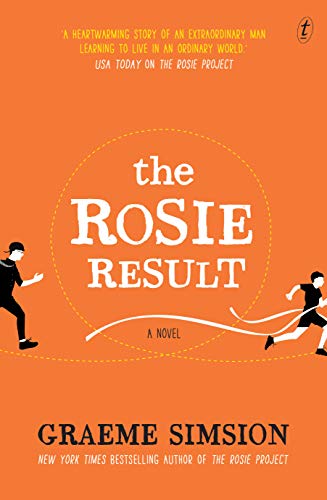
The Rosie Result by Graeme Simsion

This is the third in this delightful series about the exploits of Don Tillman, who has found the love of his life – Rosie – married her, and is now raising their “result,” Hudson.  As Rosie has now been offered a position in their native Australia, they have uprooted 11-year-old Hudson and are trying to help him adjust to the transition.  Because Hudson is definitely a creature of habit, he is not very happy with the change and he is letting Don and Rosie know it.  And so are his teachers.  And the school principal.  As a professional crisis for Don leads him to change his work schedule and focus, he opts to spend more time with Hudson to support him with the adjustment.  This process leads both Don and Hudson down a road to self-discovery that is truly life-changing for both of them.

I love the writing for its voice.  The author creates the most endearing character in Don, even as Don verbalizes little directly of his own emotions.  Don’s utter honesty and kindness are reflected in the things he says and does for those around him and the reactions he elicits are often surprise and wonder., even as people see him as different.  He struggles to fit in with those who are “neurotypical” (not autistic) and wants his son to fit in as well in order to avoid the difficulties Don has had to contend with. In this and many other ways, he demonstrates that he deeply feels compassion and empathy, even if he misses other more subtle social cues.

Clearly, the author,  with the assistance of his wife (a psychologist), has made a statement here in this novel in support of those in the autism community.  Apparently there are differing opinions on how to approach children with autism –whether to teach them skills to integrate more into the neurotypical community or to allow them to be as they are (and obviously to reach out to the general public and educate us more on acceptance, which should be happening anyway).  I imagine this must be a painfully difficult decision for some parents, who want to spare a child’s suffering (these children are often bullied because they are different) but also allow a child to see that they are loved for who they are, no matter what.  I believe this book gives a lot of insight into both the challenges and the capabilities of those with autism and one turns the final pages feeling strongly allied with this community.

I also love the not-so-subtle shout out in support of vaccinations.  There is a very strong statement countering the absolutely unsubstantiated idea that vaccines cause autism.  This idea was started by an unethical researcher in England years ago who was later found to have fudged his data in order to be published.  But the damage was done.  He’s created a community of people who believe in conspiracy theories about vaccines that are just untrue.  Vaccines save lives.  Period.

I love all of the Rosie books – and this one is another great one!  Definitely read it!