Tell Me Everything by Elizabeth Strout

Lucy and Bob have developed a lovely friendship over the years. While they are both either living with or married to other people, they take frequent walks with each other, confiding in each other about their lives, their relationships, even random thoughts in a way that they do with few others. Even when Bob becomes involved in defending someone accused of murder, they continue to bond and share their stories. But will they be able to stay just friends? Will the secrets they harbor bring them closer or keep them apart?

I am still deciding how I feel about this book… While reading it, I felt very indifferent about it, almost deciding to give up on it at some points, but not doing so. I am not entirely sure why this was so, but I believe it was because it felt as though the author herself was indifferent toward the characters, that they were just sort of there, living their lives. And even when the characters were interesting or had something impactful to say, it was all presented in such an off-hand manner that it was hard to get excited about any of it. Even the most endearing character, Bob, who was truly kind to everyone around him, was hard to really grow attached to. Perhaps because the author felt this way too?

I also found the author to make use of the colon (the punctuation mark, not the anatomical part) more than any other than I’ve ever seen and in such bizarre ways. It often felt as though Tell Me Everything was more of an expository essay than a novel, that ideas were presented as lists or facts rather than a telling of a story. This did not appeal to me at all.

On the other hand, as I sit here and contemplate the narrative as a whole, with its stories within the story, I feel that one might find it a meaningful read in that it is a commentary about relationships and people’s stories and, ironically, how they get told. While some are more willing to share their secrets with others, some are reluctant to share what they know, and others have kept secrets to the detriment of those closest to them. This comes out gradually as the plot unfolds, in layers, as if peeling away at an onion. And we often judge others without knowing the secrets they harbor, without knowing what they are carrying around with them.

So this may be one of those novels that has to sit with you awhile, that grows on you after you have completed the task of reading it. Maybe too much work? Maybe worth the effort? I’m curious to hear your thoughts…
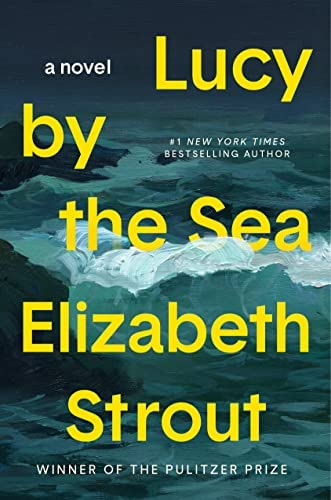
Lucy by the Sea by Elizabeth Strout

It is March of 2020 and Lucy has plans to leave for her promotional book tour. She is a bit taken aback when her ex-husband, William, a parasitologist, calls, insisting on her canceling her trip, packing a bag of clothing and work essentials, and joining him to stay in the house of a friend of his in Maine. He is concerned about this new deadly virus and feels they must leave the congestion of NYC in order to stay safe. She feels he is over-reacting – really, how long can this new virus really be a problem? – but he is also more knowledgeable than she is about this sort of thing, so she goes along with it, for the time being. Little does she know what is to come and how this decision would affect the course of the rest of her life.

Wow, I often don’t like to know what I’m going to be reading about in a book, but I wish I’d been warned about this one! This is definitely a “too soon” situation – since we are still living it. There are 42,000 reported cases per day today according to the New York Times (so presumably so many more, with home testing, states and individual localities not reporting their stats, etc.), thousands hospitalized with it, and hundreds dying of it per day in the US alone. And this is before we all go back indoors because of the approaching colder weather.

And then there’s the story itself, which has a contemplative, diary sort of feel. While Lucy adjusts to life in Maine, she also reflects back to her childhood of poverty and neglect, her strained relationships with her family, and her difficulties managing her success as an author. While it feels like there is not really a story here, the story does evolve gradually and organically and it does, perhaps a bit too slowly, pull you in.

What I appreciate here is that while there is acknowledgement of the political divide in the US at this time, it is done so with extraordinary delicacy. There is a clear understanding that Lucy and William appreciate science, wear masks, isolate, and observe the January 6th attack on the Capitol as a threat to democracy. However, Lucy does express a sensitivity to the anger expressed on January 6th. She relates to how poverty and its indignities can foster deep resentment, which incites violence such as that which erupted on that day. On the other hand, she concludes that this anger cannot justify the support of such radical extremism, Nazism, open racism, and overt hatred that was seen on that day either.

So while this was an interesting read, I cannot, in good conscience, recommend it for now. Maybe in a few years, when we’ve all recovered from our PTSD, it might serve as a warning, as a reminder of some sort. But it’s definitely too soon to be reading about what we’re all still being hit with on a daily basis.