Forbidden Places by Penny Vincenzi

Grace feels literally swept off her feet by her new beau, Charles. He’s way out of her league and she cannot fathom what he sees in her, but she is grateful for his attention. He is just so handsome, debonaire, quite the socialite – it feels hard to keep up. If only his mother and sister would show her just a little more warmth, just a little more approval, she’d feel a bit more comfortable about it all. But he’s so reassuring that she feels marriage to him will work everything out in the end. When she is further overshadowed, even dominated by Charles, she begins to question her judgement, but the oncoming war makes her hesitate to make any changes in her life. When Charles is called to serve, Grace sees herself become empowered to stand more firmly and independently than she ever thought possible.

This is a unique perspective on the second World War: that of the impact on the women “left behind.” While they were often victims of the violence, they were also fighting battles of their own, juggling the care of their homes and families with having to survive both emotionally and financially. As many of them had to earn livings while their husbands were sent off to battle, others also volunteered in the many services that supported the war efforts, bolstering the soldiers’ supplies and also participating in espionage and technical maneuvers. Their support was often disregarded and minimized, but they contributed enormously to the effort, and many discovered a new self-worth through their work. They discovered that there was more to life than being subservient to their husbands, and that they were able to find gratification and fulfillment through work outside the home as well as inside it.

Grace grows tremendously throughout the narrative, and her growth is aided by the characters around her. Her sister-in-law, Florence, is a particularly complex character, who teaches Grace humility in the most unexpected and enlightening way. Florence is brutally frank, curt, and awkward, which Grace interprets as hostile. As the story unfolds, we learn that while Florence is, indeed, awkward and frank, she also has justification for her anger, even if it need not be directed toward Grace. Eventually, Grace learns this as well, and she learns to accept folks more and more for who they are, becoming more accepting, less judgmental. We learn much from Grace’s lessons.

There are so many layers to this story, so many lovely characters, so many threads. I am in awe of how the author has woven the story in such a way as to create a world in which we are so entangled, so engaged that we cannot put the book down and yet are stricken when it ends. This is how all books should be.

Definitely read this one! I guess this is a MUST READ!
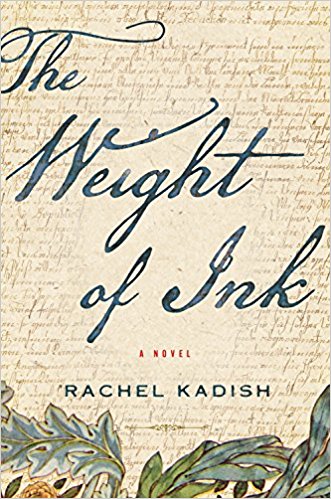
The Weight of Ink by Rachel Kadish

weight of ink

Aaron Levy cannot believe he will have to abide the sullen nature of his new mentor, just to be able to have a peek at the rabbinical documents and letters found under the stairs of an historic home outside London.  Helen Watts, this new professor he’s been asked to assist, seems not to have smiling nor social graces in her repertoire.   In truth, he realizes as time passes, that they both have issues to work out as they work together to uncover the secrets that have been buried under these stairs for centuries…  And centuries ago, in the 16oo’s, after taking 2 orphans to London with him as he fled the Spanish Inquisition, Rabbi HaCoen Mendes, blind, but trying to teach a few students, has compromised and allowed one of these orphans to be his scribe.  Ester, the bookish adolescent who dreams of nothing but to study and learn as much as she can as any boy might, has taken her seat at the writing table and begun to scribe the rabbi’s letters for him.  But as she grows older and reaches the age of marriage, this becomes more and more controversial and Ester devises a plan almost in spite of herself.

This is a magnificently crafted work of historical fiction.  The author weaves the plot by gracefully swinging back and forth between the modern day historians and the original characters, layering each of the characters’ stories on each others’ in order to build the connections — and the suspense as well.  And as the story builds, the characters deepen, and they each become much more sympathetic in their own ways.  As the scribe Ester becomes more and more real to the two historians, both Aaron and Helen become more and more human themselves and discover that each of them has used history as a way to escape their own humanness.

The writing in this book is brilliant.  It is beautiful, rich, and full.  The characters are complicated and imperfect and human and they are hard to leave when you finish the book.

You will also learn a lot of history from this book.  The time is the 1600’s, when there were many who had just fled the Inquisition.  People were terrified to speak their minds, fearing that if they said anything against any church, they’d be tortured and killed.  Women had one role in society and that was to marry and raise a family – and if they did not marry, their lot was to struggle and do housework for someone who was married and it was a hard life if you chose that route.  And then came the plague in London, which devastated much of the population.  It was a gruesome time.

But in spite of the ugliness of the time, the beauty lies in the resilience of the people living through it – and that is what is captured here in this story.

I loved this book – I am confident you will too!

Someone Knows My Name by Lawrence Hill

someone knows my name

Aminata was born free, in the heart of Africa and learned early how to “catch babies” with her mother, who was a midwife in her village.  On their way back from delivering a baby in a nearby village, Aminata was captured, dragged on a 3-month trek over land and then forced onto a slave ship, which she survived within an inch of her life.  She was to go on to become a slave in the south and, like others of her time, become a pawn caught between the colonists and the British.   All she wished for, her whole life, was to return home to Africa – and it seemed as if the Book of Negroes, the book in which she eventually was inscribed, just might be her ticket back.  During her whole ordeal, she fought for freedom for herself and for all Negroes everywhere.  Would she see it finally come to pass?

There are innumerable books about slaves and slavery during the time of the Civil War, but this takes the reader further back, to the time of the American Revolutionary War.  This was a time when both the colonists and the British were inflicting the indignities of slavery onto the Negroes of the time and these people were essentially pawns caught between the two warring factions.  It was unclear which side would deal more fairly with their race and who to trust, and each individual gambled with their life in choosing sides.  We learn, through this story, about the British offer to those Negroes who had worked for the British for at least a year prior to the end of the war the promise of freedom and a new life in Nova Scotia.  But were they really to be trusted? Would they really achieve the independence they were seeking?

This is a powerful story about the inescapability of slavery for Africans of that era, and how globally it was accepted.  This story gave much historical context of the British practices and laws and the involvement of Canada and Nova Scotia as well.  While it was fictionized, much of it was based in fact.  Telling it from Aminata’s perspective highlighted how truly evil it was and her frustration with how she could truly almost never escape it now matter where she fled.  She could not trust anyone and she could not know for sure she would not be taken away and sold back into slavery if she were freed.  How terrifying.

This is an excellent book that truly grips you from the first page and doesn’t let you go until the last.  Historical fiction at its best.