I’m taking this blog to the outer world and seeing where it leads. So the “new” website is now called kindreadspirits.blog.
I hope you’ll continue to read along with me – and tell your friends about the blog!

I’m taking this blog to the outer world and seeing where it leads. So the “new” website is now called kindreadspirits.blog.
I hope you’ll continue to read along with me – and tell your friends about the blog!

Harit does not imagine how he will ever escape the droll and bizarre routine of his life, working in Men’s Accessories in a department store with the tedious and talkative Teddy, and then on returning home each day, having to dress as his dead sister for his mother to appease her denial of the death. This just seems to be his life. Likewise,, on the other side of their Cleveland suburb, Ranjana is questioning how she should adapt to what she has found on her husband’s search history on their shared computer, which suggests the possibility of an affair. Now that their one son is off to Princeton, does this mean that their life together will change? Not that she’s been all that satisfied, as she’s had to express herself through the writing which she’s all but hidden from everyone but her little writing group that she sneaks off to once a week. Eventually, her world collides with Harit’s in an unusual way, and the two of them find what friendship really means and how deeply it can enrich their lives and enable each of them to grow into their best selves.
This is a very quirky, sweet novel that highlights the immigrant experience and shows how important it is to find community and support from others. Neither of these characters has just arrived to the United States and neither is young, but both are still grappling with finding themselves in the context of their families and their histories, given their own talents, limitations, and orientations. They each reach out for friendship and learn that it may be hard to find honesty where you hope to find it.
I believe the strength of this story rests in the character development, as each character is rich and layered and colorful. Each one is traced out at different times in the story and we travel through time and country with each as they track back to the center of the action, successfully reinvigorating the story with a new understanding of each character. It is similar to the experience of getting to know those in our own lives as we ask more and more about them and learn more and more about their past.
This is an interesting read – colorful, quirky and sweet. Enjoy!
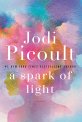
Immediately on learning that both his daughter and his sister are inside the abortion clinic where a gunman is holding hostages, Hugh knows he should recuse himself from the situation and not be the hostage negotiator. He knows he cannot be objective; but nor can he allow anyone else to do this job either. And what are they doing in there anyway? How did he not know they were there and why? What did this say about his relationship with his daughter?
And inside there is a bloody scene. The gunman has killed people but now he’s taking stock of his situation and wondering what comes next. How did he get here? It wasn’t supposed to be this messy. Or this real.
The whole story is told over the course of a day, and actually told mostly in reverse. We learn what happens, mostly, and then we hear the back stories, the histories of each of the characters who create the scene of what makes up this dramatic story of A Spark of Light. The story is steeped in fact. Characters who harass women entering the clinic (whether or not they are actually having an abortion or going there for a PAP smear) but who may have had abortions themselves, when it has suited them. Single abortion clinics trying to survive to accommodate the needs of the women in an entire state, and trying to fulfill the rules imposed mostly by rich, white men on mostly impoverished women of color. Characters like Dr. Louie Ward, depicted intentionally like the real-life hero, Dr. Willie Parker, an abortion provider who does so because of his Christian faith, not in spite of it.
In true Jodi Picoult fashion, this story is shared by many of the characters. It is told from the eyes of each character, and built gradually by adding block by block, minute by minute, how each character perceives the passing of the day and of the experience. We hear each opinion on abortion, religious and otherwise. We hear each legal perspective and each is given credence, such that each perspective can be respected. We also see that these women’s clinics serve as much more than abortion clinics as well. We also develop an appreciation for the various and desperate situations that lead women to require their procedures at a women’s health clinic.
This is an important book and serves as so much more than just a piece of fiction. Jodi Picoult never shies away from difficult subject matters and here conquers yet another. In my opinion, she’s done another great job.
Another MUST READ!
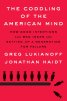
For anyone who works with or parents a young person who has entered college starting the year 2013, you will have noticed a difference from those who started at any time prior. There is a rate of anxiety unlike any generation that has preceded it – and it is compounded by parents who perpetuate the sense of fragility that these students have by continuing to overprotect them and college administrations who do the same. Why? The researchers who have written this book give explanations based on the following 3 “untruths” that get perpetuated by these parents and college administrators:
The book expounds upon these ideas, given fascinating – and often appalling – examples of real incidents on college campuses and some high schools where these theories and ideas have come about. They also expound upon what might have caused this situation and what might improve it.
As someone who not only has children exactly this age and who works professionally with students at a college, I fully appreciate the message of this book. It is a harsh statement about how restricting free play time, scheduling so many activities, making the college application process so all-consuming that it has to start in preschool (!) — this takes away from a persons ability to develop normal self sufficiency. There is no room for failure from which to learn valuable life lessons. And when we don’t learn how to fail, we don’t learn that we can ever be wrong – and that is quite dangerous.
This is an outstanding book that I have to recommend as a MUST READ!
 kindread spirits