Health Justice Now by Timothy Faust

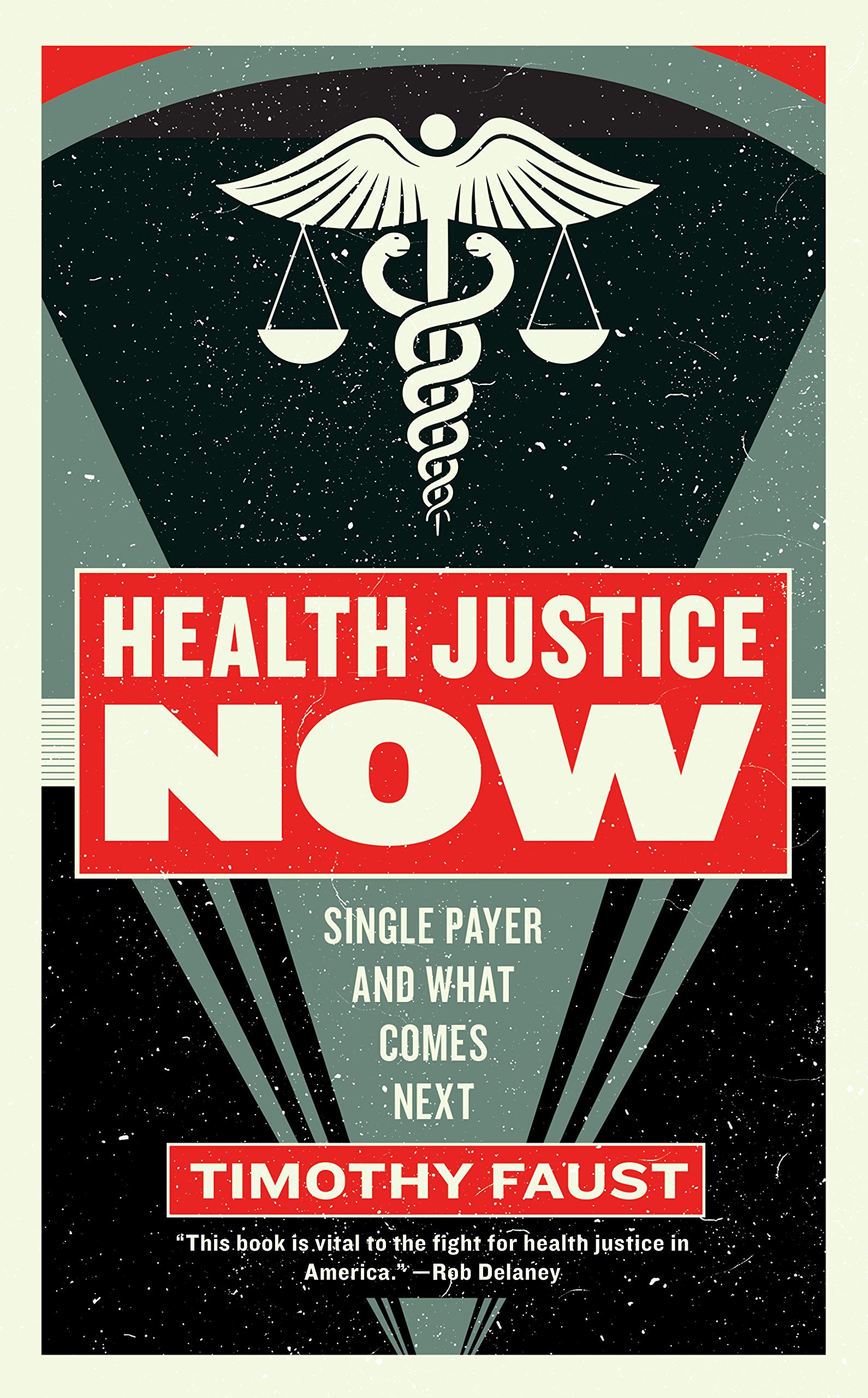
In this book, Timothy Faust surgically cuts through the complicated mess of the American health care system, gives his diagnosis and prescription for a solution:  a single payer system.  In an acerbically articulate and well-researched argument, he outlines the defects in our current systems, which are many.  The ways in which the insurance companies overcharge and deny their customers, the ways in which hospitals and pharmaceutical companies play the system to reap enormous profits at the expense of patients and patient care, and the ways in which even public insurance programs are fallible are all explained in full. And Faust also broadens the definition of health care to include those factors that contribute to one’s health, such as housing, food, poverty, environmental safety, etc. that are often systemically limited by race, gender, class, and ability.  HIs answer?  The single payer.  A single payer system pays for all, regardless of race, gender, class or ability and pays for all needs.  In this scenario, primary care is accessible to all, so that health care is accessed early, when disease may be either preventable or caught early enough to be inexpensive or less expensive to treat.  It makes sense.  And while those who profit from the insurance fraud game and the pharmaceutical industry sham will fight tooth and nail and lobby with every dollar you spend on your medications, it really would bring health care to all and make it the right it should be and not the privilege it has become in our country.

I think this is a timely and crucial reading for us all at this moment in our country, when we are about to embark on the next presidential election, when many of the democratic candidates are supporting a singe payer system.  I think it is incumbent upon us all to learn why this might be a good thing for our country and how this actually might be the only equitable way to provide health care.  I think we have to move away from seeing health care as a commodity and see it as our obligation as humans to care for one another, to allow for the dignity of others, no matter what their medical (or financial!!) situation is.

That said, I do think the tone of the writing might be a bit too angry.  While I agree with all that he’s written here, and I’m probably as angry as he is, I worry that his tone might be too polarizing – a problem that has plagued dialogue in this country on both sides.  If we are to speak to each other, we need to temper ourselves just a bit, in order to open up and let others in.  There are many solid arguments in this text and I worry that someone might not appreciate them because they’ve been alienated by the outright hostility toward the establishment.  Again, I agree with the author in his opinion, but if I didn’t, I might be put off.

I think this is an essential text in this political moment.  it’s dense, it’s not a fun read, but it’s our obligation as American citizens to open our minds and our hearts to learning how we might provide health care to everyone in this country.

Bad Blood: Secrets and Lies in a Silicon Valley Startup by John Careyou

bad blood

This is the fascinating tale of one of the most outrageous scams in Silicon Valley – and the most outrageous part is that it is true!  It is the story of Elizabeth Holmes and her startup, Theranos.  Elizabeth Holmes started out at Stamford, as an engineering student, but impatient to get started earning her first millions, she  quickly decided to drop out and start her own company.  She had in mind that because she had a fear of needles, she would develop a laboratory testing device that could run multiple tests on a small drop of blood from a finger stick specimen, taken by a device that would be relatively painless.  However, what began as a good idea, ballooned into a project that because of blind arrogance, deaf ears to any guidance or advice, paranoia, and pure irrational greed, broke laws and broke lives and caused irreparable harm to so many.  And it appears that, like most narcissists,  Elizabeth Holmes was completely unrepentant, seeing herself as the victim.

What is wonderful about this story is that it is told by the investigative reporter who broke the story for the Wall Street Journal, which gives both credibility and an insider’s perspective.  Careyou writes with vivid detail, laying out the gradual development of the background on Elizabeth Holmes, how she came to start the company, and how she ruled it, along with her henchman (and apparent lover) Sunny Balwani, with an iron fist, firing immediately anyone who disagreed with anything she said or did (even if they were looking out for her benefit and the welfare of the company).  He tracks her ascent to stardom, and it was nothing short of that.  People worshipped her – just as she worshipped Steve Jobs and took on much of his persona, even adopting his notorious black turtlenecks and deeper voice.  And because she had their attention, she was able to convince so many to invest in her dream.  Unfortunately, that is all it was.  She could not make it a reality, and because she could not face this, she faked it and lied to the world that it was.

This is a tragic story of how greed and ego took precedence over peoples’ health and welfare, and lawyers, Silicon Valley giants, politicians, and others bought right into it, swindled by a young, polished liar.  And, as Careyou acknowledges, the true heroes of the story are those who stood up to her and her pit bull lawyers and despite being tormented and hounded, told the public the truth. It is because of these brave people that these crackpot lab testing facilities were not expanded and put into more locations throughout the country and led to hurt even more individuals than they already did.

The details will just astound you!


Becoming by Michelle Obama

becoming

When Michelle Obama was quite young, she began to learn to play the piano, taught by her very strict aunt who lived downstairs.  The piano on which she studied and practiced had chips and imperfections that enabled her always to find the middle C, sort of grounding her and guiding her.  When she had her first formal recital, she suddenly found herself seated at a perfect, symmetric and distinctly un-chipped piano, and had to pause and figure out what to do to find her way.  With the help of her teacher/aunt, she managed to steady herself and to play her piece with great success.  This became a sort of metaphor for her life.  Michelle Obama has always worked hard, relied on important mentors to guide her, and whenever she encountered obstacles, she leaned on those she loved and who loved her to help her regain her center of gravity and succeed in a dramatic fashion.

Mrs. Obama’s story is a rags to riches story in some ways, but in many ways it is not.  It is true that she was raised in a poor neighborhood in Chicago and she may not have had much in the way of what money could buy.  On the other hand, however, she was rich in the ways that really mattered.  She had a loving family with mother, father and brother and many extended family members who were quite close and affectionate.  Her mother strongly advocated for her so that she was able to access an excellent education, which enabled her to attend Princeton and Harvard Law School, where she was able to raise her financial standing, in spite of where she came from.  She acquired an incredibly strong work ethic and was generous about helping others come along with her, rather than stepping on others to get ahead.  Her constant mission was to find mentors to assist her with moving forward, but also to then pay it forward and mentor others in return.  And each position that she held after her first job out of law school helped her to dive deeper and deeper into fields in which she could do good for others, which seemed to always be her driving force.

The discouraging part for me, of course, is the contrast between what was then and what is now.  The Obama’s were devoted to their country, both working so very hard to try to make things better for the people they were serving, both working to expand human rights, to give access to health care, to create jobs and improve the environment and to promote peace.  Barack Obama surrounded himself with wise advisers and listened to the advice of others and was thoughtful and respectful to others and read incessantly to learn as much as he could about an issue so that he could make the most informed decision.

Sadly, this is not what is happening in our White House now.

So while this book was inspiring, it was also quite sad, as it reminded me of what we’ve lost since 2016.

The Obamas were smart, dedicated to our country and to humanity, and were a class act.   I hope we find our way back to this again.


Rising Out of Hatred by Eli Saslow

rising out of hatred

Derek Black has been nurtured from the time he was born until the time he went off to college to be the great white hope for the future of the white nationalist movement.  His father, Don, established Stormfront.com, the earliest and largest promoter of racist propaganda on the internet, and David Duke, his godfather, is the well-known KKK/Nazi politician.  Everyone in this underworld knows Derek and believes he will take over for Don and Duke, as Derek has already begun to co-host their radio show, assist with the website, and even help organize their annual conference.  But as Derek enters college, he decides to keep this part of his identity secret, interacting with the diverse students in his classes and activities, even while he maintains his connection with his radio show daily.  However, what happens very gradually, when Derek is later exposed, ostracized and then quietly invited to the regular Shabbat dinner of an Orthodox Jewish friend of his, begins the process of challenging his deepest convictions — and is absolutely stunning.

This true story has been featured on various podcasts (The Daily is one) and has been written about in various newspapers, so you may know the basic story.  Derek himself has written opinion pieces for the New York Times.  But in this moment of unleashing of hatred and bigotry, this story is a crucial one – and the details matter.  It is crucial because it shows how hatred has been simmering underground for so long among those who are living their very insular lives, among those who think only like they do.  And it is crucial because it demonstrates, most importantly, that if we look at those who think differently from ourselves as human beings, only then can we start to have a civil and respectful enough discourse to come together on ideas.

I am in awe of the courage of the students who showed friendship to Derek even after he was “outed” as the co-host of the morning show on Stormfront.  They stuck by him, braving the derision of most of their peers, showing steadfast friendship to the the hero of the dark side, even as he degraded their racial groups on his radio show, even as they questioned their own wisdom in doing so.

And I am in awe of Derek himself, who has truly shown courage in the thought and heart that he has put into his own journey.  It is so much easier to go along with what your family and community preaches and to stick to your original beliefs.  It is so much harder to go against your family wishes, to turn around what you’ve been taught is right, to go against your indoctrination and open up your heart to other ideas.

But I am also not sorry he has accepted his responsibility to go public with his journey, because he has to share with others that those narrow-minded, absurd ideas about white supremacy are just wrong – and that the harm they do to others can not, under any circumstances, be justified.

In this moment, this book is absolutely a MUST-READ!

A Spark of Light by Jodi Picoult

spark of light

Immediately on learning that both his daughter and his sister are inside the abortion clinic where a gunman is holding hostages, Hugh knows he should recuse himself from the situation and not be the hostage negotiator.  He knows he cannot be objective; but nor can he allow anyone else to do this job either.  And what are they doing in there anyway?  How did he not know they were there and why?  What did this say about his relationship with his daughter?

And inside there is a bloody scene.  The gunman has killed people but now he’s taking stock of his situation and wondering what comes next.  How did he get here?  It wasn’t supposed to be this messy.  Or this real.

The whole story is told over the course of a day, and actually told mostly in reverse.  We learn what happens, mostly, and then we hear the back stories, the histories of each of the characters who create the scene of what makes up this dramatic story of A Spark of Light.  The story is steeped in fact.  Characters who harass women entering the clinic (whether or not they are actually having an abortion or going there for a PAP smear)  but  who may have had abortions themselves, when it has suited them.  Single abortion clinics trying to survive to accommodate the needs of the women in an entire state, and trying to fulfill the rules imposed mostly by rich, white men on mostly impoverished women of color.  Characters like Dr. Louie Ward, depicted intentionally like the real-life hero, Dr. Willie Parker, an abortion provider who does so because of his Christian faith, not in spite of it.

In true Jodi Picoult fashion, this story is shared by many of the characters.  It is told from the eyes of each character, and built gradually by adding block by block, minute by minute, how each character perceives the passing of the day and of the experience.  We hear each opinion on abortion, religious and otherwise.  We hear each legal perspective and each is given credence, such that each perspective can be respected.  We also see that these women’s clinics serve as much more than abortion clinics as well. We also develop an appreciation for the various and desperate situations that lead women to require their procedures at a women’s health clinic.

This is an important book and serves as so much more than just a piece of fiction. Jodi Picoult never shies away from difficult subject matters and here conquers yet another.  In my opinion, she’s done another great job.

Another MUST READ!

The Coddling of the American Mind by Greg Lukianoff and Jonathan Haidt

coddling of american mind

For anyone who works with or parents a young person who has entered college starting the year 2013, you will have noticed a difference from those who started at any time prior.  There is a rate of anxiety unlike any generation that has preceded it – and it is compounded by parents who perpetuate the sense of fragility that these students have by continuing to overprotect them and college administrations who do the same.  Why?  The researchers who have written this book give explanations based on the following 3 “untruths” that get perpetuated by these parents and college administrators:

  1. What doesn’t kill you makes you weaker.  (Actually – it makes you stronger.  But we still strive to shield our young from any and all potential harm.  This of course deprives them of the opportunity to learn how to cope with adversity.)
  2. Always trust your feelings.  (NO!  Our feelings are often inaccurate.  We need to explore and learn and find that there really isn’t a ghost hiding under the bed, and that girl over there looking at us might not hate us, but might just be shy herself.  We need to look at facts, not at just our own perceptions.)
  3. Life is a battle between good people and evil people.  (This may be the most dangerous of the untruths, creating the us-vs-them mentality that informs the current toxic discourse on college campuses today.  There is so much more intolerance of opposing views and so much less ability to have civil conversation about anything at all controversial that even professors are shying away from anything that may smack of real import in their classrooms.  This is actually a threat to education itself.)

The book expounds upon these ideas, given fascinating – and often appalling – examples of real incidents on college campuses and some high schools where these theories and ideas have come about.  They also expound upon what might have caused this situation and what might improve it.

As someone who not only has children exactly this age and who works professionally with students at a college, I fully appreciate the message of this book.  It is a harsh statement about how restricting free play time, scheduling so many activities, making the college application process so all-consuming that it has to start in preschool (!) — this takes away from a persons ability to develop normal self sufficiency.  There is no room for failure from which to learn valuable life lessons.  And when we don’t learn how to fail, we don’t learn that we can ever be wrong – and that is quite dangerous.

This is an outstanding book that I have to recommend as a MUST READ!

Hunger by Roxane Gay

hunger

This memoir by Roxane Gay — an author, celebrated feminist, and educator — is the story of her experience as a person going through life extremely fat.  She reveals early on that she had been raped at the young age of 12 years, and, sadly, did not feel able to tell anyone about it for years.  Her way of coping was to eat in order to gain weight, to make herself unappealing so that she would protect herself from letting that ever happen again.  Unfortunately, it also had an impact on everything else in her life as well.

While the book does tell the story of her life, regrettably it does so in a very rambling, stream-of-consciousness sort of way that is extraordinarily repetitive.  There are segments that wind back around to prior themes and scenes that are repeated over and over again, much like her thoughts.

Nevertheless, it is also extremely enlightening and enables the reader to really understand and what it means to be in the shoes of someone who, as she describes, takes up the space that she does.  Her descriptions of having to research restaurants in advance to assess the seating situation, for example, is something that I might not have appreciated.  Because of her size, she cannot feel comfortable in most chairs with arms, nor in most booths that have a fixed distance between the seat and the table.  Hence, she checks that there will be seating that can accommodate her before she will go to a particular restaurant.  Sometimes, when she doesn’t, and she has to sit in a chair with arms, she sustains bruises that cause her pain that can last for days.

This broke my heart.

There is a daily onslaught of taunts, sidebar commentary from strangers, suggestions – people even taking items out of her shopping cart at the supermarket!  Having to endure the humiliations that people throw at her, both intentionally and unintentionally is both unfair and relentless.

So while the writing and probably more so the editing of this book is not ideal, I think the author is incredibly brave in sharing her experience with all of us.  I think it is important for people to understand how it feels to walk in her shoes so that we can all be a little kinder to those who are different sizes than we are.


The Female Persuasion by Meg Wolitzer

female persuasion

This new, very popular novel centers around Greer Kadetsky, who begins as a young freshman at what she considers a mediocre college in western Massachusetts.  If her disappointing parents had filled out the financial aid forms appropriately, she would have been at Yale, where she was really meant to be.  But then she wouldn’t have met her best friend, Zee, who then wouldn’t have dragged her along to hear Faith Frank, the feminist, speak.  And then she wouldn’t have had that moment with Faith Frank that sparked, really, the trajectory for the rest of her life.

This novel encompasses two stories in one.  On one level, it tells the story of Greer, a smart, ambitious young woman who is seeking love and approval from others because she doesn’t feel  it from her nebulous parents.  She has it from her boyfriend, Cory, who is steadfast, but has his own life and stressors, and she has it from her friend, Zee, but she seeks it from an adult, in the form of Faith Frank.  And as she goes through her journey, she learns that no one is perfect, even those who appear to be.

On the second level, it is also a story of the women’s movement.  In the telling of the story of Faith Frank, the author essentially recounts the story of the fractions of women and the various perspectives, both forward and backward (at least in my opinion) as it is going these days, particularly with regard to availability of women’s choice and control over our bodies.  Faith Frank, in her early days, helps a friend through a life-threatening, almost-botched illegal abortion and it drives her friend in a totally opposite direction from Faith (which is very hard to believe, but I imagine is true of some women).  Faith is empowered by this experience to push hard for women’s access to safe, legal abortion.  In this, I think the author opens up the debate where we stand very precariously now – where women are arguing over the rights over our bodies.  (As an aside, I have to say that I believe that no woman likes the idea of abortion.  On the other hand, I believe that the majority of women in our country do believe that this should be a matter decided by the woman herself and perhaps her doctor, as it is a physical and medical and emotional decision for a woman – NOT a decision to be made by mostly MEN in a back room somewhere having nothing to do with the woman herself.  THIS is what “choice” means.)  And this depressing backlash that we are experiencing here in our country is discussed in the book and lamented.  It’s hard to see it in a book and not just in the news – it gives it so much more permanence, in a way.

What is somewhat disappointing about this book is how it sort of fizzles at the end.  Most of the book is engaging and there are a few twists and major events that turn the plot around on its head.  Most of it grabbed me.  But as it wound down, it really wound down and sort of fell.  Maybe even fell flat.

Otherwise, I think this is an interesting story of a woman’s struggle with finding her place and meaning in the world through the lens of the women’s movement.  An interesting read…

Becoming Nicole by Amy Ellis Nutt

becoming nicole

This is a beautiful, heart-wrenching story that is told with a clinical detachment that is utterly unfortunate.

Nicole, who begins her life as Wyatt, an identical twin to brother Jonas, feels from day one that she is a girl.  Already identifying with female characters in movies they’d watch, she, before even turning 3 years old, told her father that she “hated her penis.”  She consistently yearned to wear girls’ clothing and to play with girls’ toys and fortunately for her, her mother, Kelly, was sensitive to her yearnings and did what she could to support her.  Wayne, her father, had a much harder time accepting this side of her and while he loved her, he took many years to mourn the loss of the second son he thought he had.  Finally, though, he did come around and rallied to her support and both parents fought for her legal right to use the girls’ bathroom in her school (although it did not save her from being horribly bullied by a boy in her school throughout middle school, egged on by his nasty grandfather).   Nicole and her family bravely fought to set legal precedents to protect future trans children from prejudicial and ridiculous harassment because of gender identity, at least in certain states.  Hopefully, they will lead others to continue the fight for equality for these people who only want the freedom to be who they are inside.

The only benefit of the “clinical” aspect of the writing is that there are segments of the book devoted to the scientific evidence for brain differences in transgender individuals.  I think that in addition to being extremely interesting from a clinical point of view, it also fuels the argument that these people are not going through “phases,” nor are they “seeking attention” as they are often erroneously accused of doing.  It gives more objective data for those who cannot just support people for who they believe they are – rather it gives medical justification for those who require this.

On the other hand, it is a shame that the writing could not be as beautiful and as engaging as the story itself was.  There was certainly the material there to work with.  The characters were certainly heroic and beautiful, the setting was pure Americana, and the story was definitely dramatic, culminating with a huge and wonderful courtroom win.  The only tragedy was that the telling of this young woman’s triumph was so terribly dry.

I hope that Nicole and her family know how much we all admire their bravery and hope that she and they do not have to fight any further for her to be accepted for who she is.

The Hate U Give by Angie Thomas

the hate u give

Knowing she’d rather have stayed home watching reruns of Fresh Prince on her laptop, Starr isn’t even sure why she’s agreed to accompany Kenya to the party at which she’s found herself.  But while she is wandering around (Kenya of course has dumped her), she finds Khalil, her old best friend, whom she has not seen in months.  They slip into old comfortable conversation when suddenly gunshots ring out.  She and Khalil run for what she believes will be safety – not knowing that this moment will affect the rest of her life.

This story is a young adult novel, inspired by the Black Lives Matter movement, about the murder of a black boy by a white police officer.  The story invites the reader to step into the life of this friend of the victim, Starr, whose life is already complicated as she is grappling with having to straddle two different communities – the poor neighborhood in which she lives and the affluent school she attends.  Her two worlds require two different personae and this is a lot to juggle for a young woman of 16 years.

As the events unfold, it becomes clearer that Starr is the only witness to the murder that has occurred and it is up to her to come forward and testify.  And here is the difficulty: history has taught us that this is hard – and we’ve seen this again and again particularly in the past few years.  While police have incredibly difficult jobs to do and we owe them a debt of gratitude for what they do every day, there are always a few that take their power too far or have too low a threshold for fear of “other” and assume that the “other” is going to do something harmful to them first.  This is the case in this story, and this is often the narrative in these cases where there is a wrongful death.  There is a presumption of guilt based on race and circumstances when that is an unfair presumption.

There is a lot of humanity to this story.   There is circumstance and perspective on the drug dealing issue and how and why some people get involved – which some might feel is obvious but others might not appreciate.  There is also the recurrent theme of a person’s right to presumption of innocence, and right to life and liberty and so on even if he might be a drug dealer.  This is a serious point.  On the other hand, I do think that dehumanizing the cop that shot the victim by referring to him by only his badge number almost throughout does not serve a purpose.  I think that creates its own bias and one sided perspective and I think presenting the other side would have only made the story stronger.

In any case, I do think this is an important book for most people to read, but especially young readers.  Definitely a must read!