The Last White Man by Mohsin Hamid

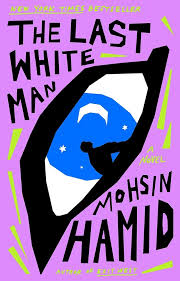
Anders, a white man, one morning awakes to find himself having turned “a deep and undeniably brown.” He notes this first on his arms, then on his body, and in the mirror, sees he is now, completely, dark-skinned. He is, at first, just shocked. Not knowing what else to do, he calls in “sick” to his employment at a nearby gym and just stays home, thinking it might be something temporary, but knowing, deep down, it is not. What will his new lover say? What will his father say? As he begins to move through the world with this new appearance, he learns that he is not alone in his experience.

This is a most unusual book, both in the concept and in its execution – and I’m still undecided if I believe it’s in a good way or not. While the idea is unique, imaginative, and clearly meant to be an allegory, it felt almost too obvious, too blunt to be so. Some may find it even comical, in a perverse way. Moreover, the writing is also bizarre. Hamid is the master of the flip-flopping, run-on sentence, some of which continue for the length of his paragraphs.  Too many of his lines are similar, writing contrary phrases within the same sentence, which sometimes is effective and sometimes is just confusing. While I might have found it an understated and useful technique if used occasionally, it is so overused that it becomes almost tiresome.

Underlying the writing, though, there is a message that is, in fact, powerful. Hamid is making a statement here about the unnecessary social construct of race; that is, how we in America have assigned all sorts of attributes with various ones, and how absurd it all is. He is making race irrelevant here, evening out the playing field, as it were. In this way, I do have a deep appreciation for what he is trying to accomplish. 

I am curious to hear from you all if you feel he has achieved it – or not? I’m still digesting it, I think…


James by Percival Everett

In this retelling of the story of Mark Twain’s Huck Finn, Jim, or James, as he prefers to call himself, is a literate, enslaved man who has been sneaking into the library of his owner to educate himself and to find material to use to educate other enslaved folks around him. Upon learning he will likely be sold and separated from his family, he decides to run away, and Huck, fearing his own demons, follows him. Their journey takes them through crazy and dangerous escapades. Nevertheless, through it all, James believes there is nothing that can frighten him or debase him more than what he’s already experienced: being owned by another human being.

This is an odyssey, a whirlwind of an adventure – absurd and terrifying in equal parts. We learn about both James’ and Huck’s pasts as the story unfolds, and how their pasts have intertwined. More importantly, we learn so much about James’s character, which is deeply complex. He has an abiding love for his family, even as he develops a growing awareness of his fury toward his oppressors. We both love him and fear him, as his compassion for others in need can be compelling even while his rage can be blinding.

It is also a uniquely powerful story from the perspective of this educated, enslaved man. It is striking how everyone in the story, whether Black or White, reacts to James when he speaks in his normal manner vs his affected, “slave” manner. Everyone, including his peers, expects him to use incorrect wording, grammar, etc. Even when a White man is being threatened by James, with a gun pointed directly at him, all he can focus on is how James is speaking – it is such a shock to him. It is symbolic of how a command of words can signify education, influence, even power.

It’s a wild, frightening, and enlightening journey that we take with James. I daresay, a bit different from the “Jim” Twain had in mind…


The Heaven and Earth Grocery Store by James McBride

Moshe never imagined himself worthy of such a catch as Chona, the beautiful daughter of the owner of the grocery store who, because of her limp, was reading in the back more than she was working in her father’s store. He was actually more focused on getting himself settled, out of debt, financing his theater, which he managed to do by inviting in the Negroes of the community of Chicken Hill as well as the Jews (a radical move in the early 1930’s in Pottstown, PA, where the KKK had its annual parade down the town center). But he managed to win her heart with his openness and his respect for her intelligence and free spirit. And they were happy together, their only disagreement being about where they should live, he believing they should move out of town, as most of their fellow Jews had, and she believing they were already home, with their Negro neighbors who had always been their friends and saw no reason for them to leave. Of course, he gave in to her, as he always had, knowing that their closest friends were right there with them, the Black couple who worked with them day in and day out, Nate and Addie. When this couple approached them with a request for a favor, Chona immediately said yes, setting them up for trouble they had no idea they were in for.

James McBride has a magical way of creating the most colorful characters who are flawed in the most gorgeous way possible. Chona, with her limp, her seizures, and her mysterious illnesses, is the most beloved character in all of Pottstown. Nate, with his inner turmoil and fury, has a quiet and kind exterior that earns him deep respect (and, yes, fear) from all who encounter him. And the bonds that form between these beautiful, sometimes comical, sometimes tragic characters, often of different races, are borne of longstanding histories of common suffering and oppression. By necessity, yes, but also by loyalty and friendship as well.

Herein also lies a commentary on how the mentally ill were treated at the time, which is to say that they were not treated at all, but rather locked away from society, and at the mercy of generally untrained, unkind, and unsupervised caretakers. Utter chaos reigned and heaven help anyone who was brought to one of these facilities. Moreover, it was a random path to finding oneself there, as “diagnosis” was random, not scientific at all. One could be physically ill, deaf, speak a foreign language, or just have a different view of life and find oneself declared mentally ill. And if you were not mentally ill when you first got there, the “treatment” there would ensure that you would be after a short time.

This is a powerful story, there are powerful commentaries on life in the US as non-white folks, and it is well worth the read. Don’t miss it!


The Cherry Bombers by Sarai Walker

Sylvia Wren is quite content to hide away from the world in the Santa Fe haven she’s created with her partner, Lola. While the world knows her art, they do not know her, as she has striven to keep herself as private as she possibly can, knowing only the few she’s had to interact with by necessity – her lovely neighbors (who check in on her, especially when Lola is away), her lawyer, and her agent. All her correspondence is taken care of by someone she’s hired to do just that – so she isn’t sure how this one journalist has managed to penetrate this wall she’s build around her. How did she manage to find out anything about her past? How did she manage to connect those very ancient dots, to dig into who Sylvia really is? Might it be time for this to happen?

While using a highly unusual means of doing so, this story quite dramatically illustrates the outrageously imbalanced and distorted view that society has taken throughout the years when it comes to the mental health of women vs men. When women have presented in any way different, unusual or ever-so-slightly out of whatever the box society has chosen to place them at that time or place, they are deemed “crazy” or “insane” and are either locked away, tortured or murdered for who they are. (Look no further than the Salem witch trials to see a perfect example of this.) In this story, when a mother who predicts the danger her daughters are about to encounter, no one listens and worse, even when she’s right, they attempt to explain away her validated predictions and deem HER as the one who is insane. Again and again and again.

There are certainly many unconventional moments that one has to stretch the imagination to abide. And I also know that there are many things that occur in this world that we cannot explain with our current understanding of the world. But there is also kindness, and patience, and learning from our past. And there is also the knowledge that our past is littered with a patriarchy that has dominated society too often to our detriment. (See all the wars that have occurred throughout history…)

This is a wildly inventive story, full of imagery that will spark your creative inclination. It also carries quite a bit of mystery and suspense. Read it with an open mind and you will receive a worthwhile message here.


Four Ways to Wear a Dress by Gillian Libby

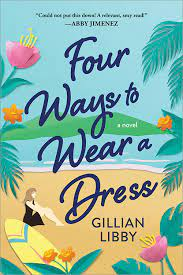
Millie has just lost her PR job in NYC. She really thought this would be her big beginning, when she would show her parents that she’d really become an adult. But alas, once again, in spite of her warnings to the company that their product was impractical and overpriced, they were forced to make cuts – and that included her. So, at least for now, she is going to take her shared, “good-luck” little black dress that her friends are foisting upon her and move out to California, where the final member of their posse, Quincy, is living, helping to run their family-owned hotel. What Millie finds is that Quincy and her friends, social media influencers hoping to bolster the businesses of their tiny coastal town, are living a dual reality: one that is on social media and one that is real life. As Millie tries to find her own way, she has to navigate this duality for herself and figure out where – and if!- she fits into this picture.

My initial reaction to this book for this blog’s purpose is to tell you not to waste your time.

The bulk of this story, which is predictable in almost every way, revolves around the superficial world of social media influencers, which is distracting, disingenuous, and really all about the money. Even the children here are trained to stop suddenly – right on cue, even mid-sibling-rivalry-argument – long enough to plaster lovely smiles on their faces for uploadable photos in a very contrived-but-meant-to-look-natural setting. Any admission of an imperfection is shameful, any hint of real-world troubles is deemed unacceptable. When Millie arrives and begins to be publicly genuine, posting her mishaps and actually getting attention for it, she gets admonished by the local “queen bee.”

That is, of course, the message, though. It is a comment on social media and its influencers. It is a critique of the idea that we must only put our best selves – or a version of ourselves that is “perfect” out there for others to see, and never admit that we are imperfect, or actually human.

But I would suggest that that isn’t good enough. I would suggest that maybe we might not publicize so much of ourselves at all. Maybe we could just be actually living more of our lives; being mindful of, rather than posting, every meal we consume, every outfit we wear, every experience we enjoy. Maybe also, we could be watching less of what others are doing. Certainly research supports this: that is, the more time we spend on social media, the more anxious and depressed we are.

So while the book is not necessarily a worthwhile read, it does get one thinking… which always has value. Lucky for you, I saved you the trouble! You’re welcome! 🙂


The Song of Achilles by Madeline Miller

While still a boy, Patroclus is brought by his father, a king, to compete for the marriage of Helen, considered the most beautiful woman in all of Greece. They bring gifts, and the bashful boy is expected to demonstrate his wit and intelligence measured against the famous princes and demigods around him. While his father speaks up for him, his unabashed disdain for the boy is apparent. It is no surprise when Helen chooses another. Upon their return home, when disaster strikes, Patroclus is not surprised when he is sent away from his home, forced to live in exile, with a king known to take in other exiles like himself. While he does what he can to avoid attention, he inadvertently catches the eye of the son of the king, none other than Achilles, a demigod himself. Their friendship grows and leads to adventures that Patroclus can not even imagine.

Not being so well-versed in Greek mythology myself (having read the Odyssey in high school and little beyond that- not generally a huge fan) I can’t comment with much authority on how this compares to the original . What I can say is that while some of the themes of vanity and hubris are well-preserved, this was certainly a modernized version of the events told in those ancient texts.

What is done so subtly and beautifully, I believe, is while Patroclus tries to uplift the Achilles heroic narrative, he (or the author), in fact, reveals himself as the true hero: the one who maintains humility, kindness, and true loyalty even in the midst of what becomes chaos. While he always folds himself into the background, always shining the light toward Achilles – who accepts this with no hesitation, as his position and stature would dictate – Patroclus meanwhile bolsters, soothes, even guides Achilles toward the proper direction. Few see him for who he really is. Some even hate him – and none more than Achilles’ mother. (Could it be that she hates him because she sees him for who he really is?)

So while I did read The Odyssey quite a long time ago, I did enjoy this adventure much more than that one! I’m curious if you out there in cyberspace did as well! I’d love to hear your opinions!

Less by Andrew Sean Greer

Arthur Less has found an escape route. With the approach of his ex-lover’s wedding, which he cannot bear to attend, he has manufactured a series of commitments — lectures to be given, classes to be taught, awards ceremonies to attend – and all abroad, so that he cannot possibly be present to witness the upcoming nuptials. As he embarks upon his journey and his approaching 50th birthday, he reflects upon his life and what he has to look forward to. Throughout his journey, it seems that as his suitcase appears to become emptier,  his heart becomes fuller.

On the surface, the story of Arthur Less can feel somewhat self-indulgent. He is smoldering over his life, having lived many years in the shadow of a genius. He feels he’s achieved merely mediocrity at best, as an author, as a lover, perhaps even as a human in general. He laments his past works, such as they are, as well as his current attempts at writing and at love. He has imposter syndrome to the nth degree. Sadly, he neglects to see the love that he inspires around him. He has difficulty taking in the admiration of his students, his audiences, and his friends. Only we, the readers, see it.

Can’t we all relate to this? Just as Arthur travels around the world getting swept up in misadventure and blaming himself, many of us travel through life focusing on what we’ve done wrong and where we have erred rather than on what we should be grateful for. I know I often fall into the trap of being my own worst critic and blind to my own blessings. I often feel “less.”

I am not sure I understand how this was a Pulitzer Prize winner, but it certainly does have meaning beyond the surface and is a worthwhile and entertaining read.

I would be so interested to hear what others think about this one! Please comment!

Cloud Cuckoo Land by Anthony Doerr

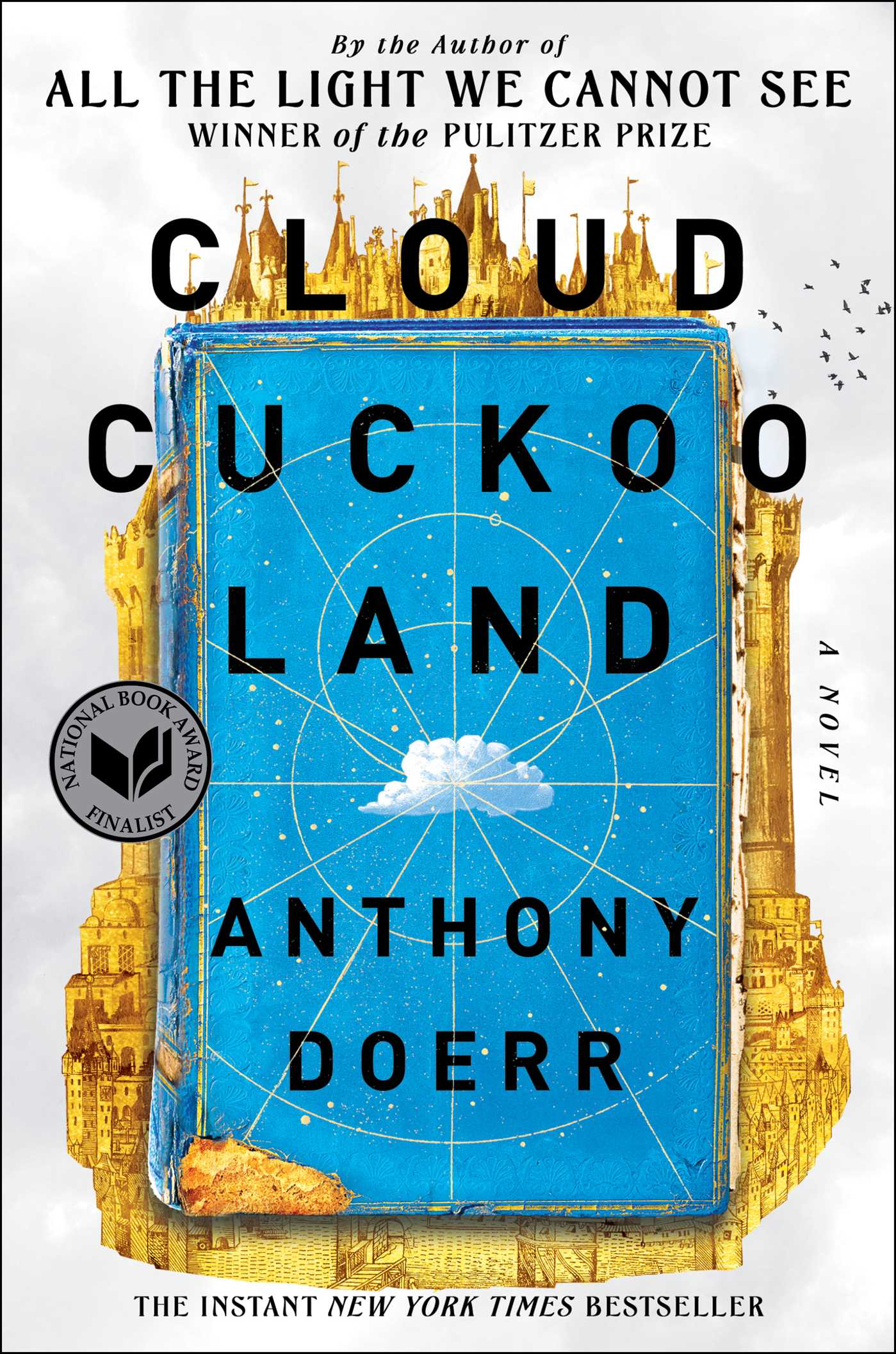
In February of 2020, Seymour is on a mission to fight climate change with his razor focus, his headphones, and a backpack of explosives. Upstairs in the library where Seymour is attempting his strike, Zeno is guiding a pack of 5 excited children as they rehearse a play – their version of an ancient Greek story. In the 1400’s, there are 2 young people on opposite sides of the siege of Constantinople, Anna and Omeir, each dealing with their own version of trauma and poverty. And way in the future, there is a young girl named Konstance who is traveling on a mission to an exoplanet where she’ll be able to survive and restart a new generation of human life. Each of these threads are linked by the tale of the Cloud Cuckoo Land, an ancient, absurd tale carried from antiquity and retold through the ages, to entertain, to sustain, and to give hope.

This is an outrageously imaginative novel that may take a bit of time to get into, but then grips and holds you until the very last page. I am just astounded at how one person can weave together such seemingly disparate tales into one large picture that ultimately ties so tightly together. Writing like this is a gift. Moreover, each tale, in and of itself, is tender and gripping – each character, vulnerable and complex. We love Anna for her deep struggle to care for her ill sister, Maria. And we love Omeir for his tenderness toward his animals. We even understand Seymour’s frustration and anger as he acts out of desperation in a way he sees as his only choice. The author endows every character with so much humanity that we are glued to them, their actions, their struggles.

And the larger message here, that books and learning can bring joy – is the most beautiful. In this moment, when extremists are threatening to burn books, to limit the choices of literature that others read or access, we are reminded about what folks throughout history have lived through just to save our stories. So many have fought to save books, even those that might seem trivial or silly, because books bring light and hope and knowledge to those who take advantage and open their hearts to them.

Banning books is never the answer.

This book may not be for everyone – but if you open your imagination – it just might be for you!


The Dressmaker by Rosalie Ham

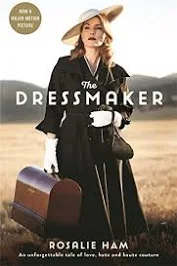
“Mad Molly” has surprisingly been able to survive up there in her house on her hill, but now that her daughter Tillie has returned, everyone wonders how it will go for them. In the past, Tillie has brought nothing but misfortune for everyone around her. Even Tillie doubts that she can bring anything but danger. The one good thing she does bring is her talent for sewing clothes of the latest fashion, and this does not go unnoticed by those who eye her closely as she joins the persistent Teddy McSweeney at her first town dance. One by one, they approach her to become their seamstress, but there is a history that cannot be ignored. And that history comes back to haunt all of them.

This is a mean little novel. I found the writing to be coarse and fragmented and the many characters so unlikable (with a few exceptions) that it was hard work to keep track of who was related to whom. Even Tillie, the heroine of the story, was kept so vague, so distant from the reader, that I felt I barely got to know her. I was granted only tiny morsels of her past life, which were tossed in as tiny gems buried in the muck of the small town politics and gossip that took up most of the novel. While I was told of the intricate details of the dresses she sewed, I was told almost nothing of the life she’d lived before she came home to her mother. One must bond to the characters to feel for them.

A bitter disappointment, this one. Don’t waste your time.


The World to Come by Dara Horn

This fantastical journey sets out as we meet Ben, shattered by recent events in his life – a  nasty divorce and the painful death of his mother – who is encouraged by his twin sister, Sara, to attend a singles event at an art museum. As it happens, he stumbles upon a Chagall painting there that looks very familiar – so familiar that he is driven to do something impulsive, something that will have lasting implications for both him and his sister.

This story is told in layer upon whimsical layer, with narration as chromatic and surreal as a Chagall painting. The author weaves together the family stories of Ben and Sara’s parents, stories written by their mother, stories about Chagall and an author colleague Der Nister, and dream sequences, sometimes blurring what is real and what is fantasy. The prose is poetic and vivid, creating images that shower into the imagination and that will likely stay with the reader long after the last page is turned. 

There is also biblical referencing that reinforces a strong philosophical message here. Without giving too much away, there are many references to meaningful value of life and making the most of our time here on Earth. Sara’s mother tells her, “Everything counts. Don’t ever let anyone tell you that you’re just rehearsing for your life.” We see different attitudes toward life between Ben and his sister, even between Chagall and his colleague, Der Nister. Some who live life while others who watch others live life.

There is much to keep track of here, as the story winds through its circular path. It can sometimes become challenging, even. Nevertheless, it is definitely worth the challenge, worth the swelling of your imagination, this beautiful tale. Like walking into a painting yourself…