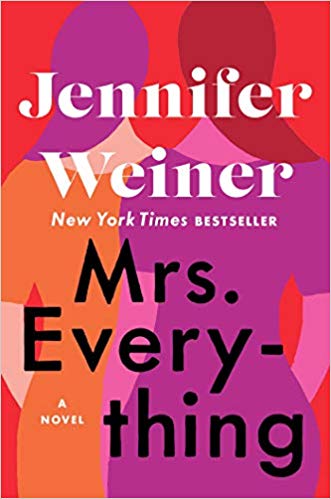
Mrs. Everything by Jennifer Weiner

Jo and Bethie are so excited to move into their new home on Alhambra Street in Detroit in 1950.  It is a very big day for the family.  And once again,  Jo is unable to perform in a “ladylike” way and disappoints her mother.  Why can’t she be more like her sister, who seems to just know how to be the perfect little girl?  From Bethie’s point of view, however, being the pretty little girl may hold some power, but it also comes at some formidable peril.  As the two sisters grow and navigate the decades of the 50’s, 60’s, 70’s, and so on, we have the privilege of following along with them on their turbulent, sometimes traumatic, and occasionally victorious journeys.

This is an epic novel for Jennifer Weiner, who has traced these decades of history with warmth and insight, from the perspective of these two sisters who struggle over these decades to find themselves.  Jo and Bethie, and the other characters woven around them, are so real that when they lose themselves, we feel lost as well, and when they hurt, we hurt.  They are flawed and vulnerable and often become collateral damage in each others’ sisterly wake.  But we find ourselves also moving on when they do and rejoicing at their successes as our own.

Herein Weiner is also giving voice to women, who have evolved over these decades and yet not evolved, whose roles have expanded and yet not expanded.  Weiner addresses the many ways in which women are expected to fulfill all roles – mother, homemaker, breadwinner, and wife, and yet find time for themselves, to feel fulfilled and to fall in line with society’s expectations.  She loops in race and prejudice,  primarily from the perspective of the Jewish experience of a people who have been targeted but who also have their own stereotypical racial biases.  In addition, she also gives voice to the women who have experienced sexual violence and sexual harassment over these decades and how it impacts and informs their entire life experience.  It is quite symbolic that Jell-O, the quintessential 1950’s, traditional Thanksgiving side dish associated with Jo’s worst adolescent evening is later in the novel thrown all over an emblem of her daughter’s supposed progress.  Jell-O becomes a symbolic fuck-you to all of the supposed progress, calling out the hypocrisy in the idea that things have changed enough.

At first glance, this novel might be written off as a simple story of two sisters, but it is in fact an articulate commentary on the struggle of women for power vs being overpowered and for status vs the status quo.  It also directs us to be hopeful for future generations, especially if we stick together and have each others’ backs.


After You by Jojo Moyes

Louisa is just trying to make it through her days, which feels like an uphill battle.  Still reeling from having played a supporting role in her charge/boyfriend, Will’s assisted suicide drama, she feels judged and she continues to judge herself.  And while she’s struggled to live up to the standard she’d promised Will,  having travelled and lived in foreign countries, and is living in a new apartment (barely decorated as it is), she hasn’t really moved on.  One night, after coming home from her dead-end job as a bartender, she has a sudden, terrible accident.  This and a visit from a truly unexpected guest send her life into a whirlwind of change that may finally put her on a path to healing.

I believe the key to Jojo Moyes’ success is the warmth that permeates her characters.  She depicts this with such care, such as in descriptions of subtle movement: a nod here, a touch there, and the reader can intuit the emotions communicated in these tiny gestures.  Once you fall in love with the characters, you of course need to know what happens.  That is the key to being pulled in.

And then there is the layering of the plot, which she also does so well.  There is Louisa’s struggle to cope with her loss.  There is her parents’ issues with their marriage, given her mother’s awakened awareness of her stifled role in the family.  There is a love interest for Louisa that emerges from a support group that Louisa joins – and then the support group itself.  And her job struggle, which is very slightly comical, but really not.  And there is the surprise guest, who comprises a huge sub-plot of the story and who tortures Louisa in some ways but who also helps Louisa in many others.  And all of these plots are so smoothly woven together that the flow is natural and easy and sometimes utterly gripping.

So yes, once again, this second in the trilogy is great.  I can’t wait to read number three!

(For those of you who aren’t aware, the first in the trilogy is Me Before You.  The 3rd is Still Me.)

Little Fires Everywhere by Celeste Ng

Mrs. Richardson thought she’d planned her life out quite well.  She had a beautiful home, a devoted husband, four healthy, intelligent teenage children and even a career, benign as it was.  And in Shaker Heights, a planned community just outside of Cleveland, that is what was expected of a well-to-do, educated woman of her stature. Sure, she’d had her moments of passion – she’d grown up in the 60’s after all –  but there was a reason why rules and laws existed.  Orderliness was necessary,  correct.  (Why couldn’t her youngest daughter, Izzy, appreciate that?  Was that so difficult?) And when Mia, an artist, and her daughter Pearl came to live in the apartment that Mrs. Richardson rented out, it was only the right thing to do, to support the arts in her own way, by renting to them.  However, as the two very different families became intertwined, lines became blurred and rules became fuzzy.  At least in the eyes of Elena Richardson.  Not so, to Izzy.

Thanks to my book club for encouraging me to read this one!  I was reluctant to try another Celeste Ng novel after the relentlessly depressing Everything I Never Told You.  This one, however, was entirely different.  It was so beautifully crafted, with the care and devotion and an eye to her art, much like that of Mia’s.  There are wonderful characters, who are messy and quite real, contrary to Mrs. Richardson’s ideal.  Some who seem superficial, but emerge with more depth, and vice versa, much like people in our real lives.  But the plot is what is most gorgeous, with its many sub-plots, taking the story in directions that are unforeseen, often tender, occasionally cringe-worthy, but always engrossing.  I could not put this book down!

And it is deeply meaningful. I will tread carefully because I do not want to spoil for anyone, but I believe the way that both white privilege and class privilege is illuminated is so carefully and poignantly done that it is digestible and accessible to the reader.  There is history and context and explanation, but there is also the story and what actually happens.  So we understand why, but we still understand that it is wrong.  This gives such power to the message.

I loved this book and believe that many of you will also.  This is a MUST READ, for sure!


Nine Perfect Strangers by Liane Moriarty

Frances was sick and tired…  not just sick with the cold that had lingered for the past many weeks, but really feeling as if life had caught up with her.  With her career suddenly seeming to be turning south and her love life at a mortifying halt, a 10-day “cleanse” at the Tranquillum House seems to be just what she needs to repair.  When she meets Masha, the stunning and passionate guru whose mission is to guide each of the nine newcomers to Tranquillum House through their individual transformations, Frances is a bit wary – but she’s trying her best to be open-minded.  Little does she – or any of them – know how they will, in spite of themselves, be completely transformed ultimately, but not at all in the way that they think.

Some books are plot-driven and some are character-driven.  This book is both.  There are endearing and tragic characters whose layers are gradually peeled off one by one as the story is told via rotating narrative perspectives.  Each has their vulnerability that is seen as something that might be remedied by a diet change, or with some counseling or some meditation. (Who can’t relate to that?)   But there is also a wild plot that is imaginative and suspenseful and runs beyond where at least I expected it to go.  And by the time it is completed, you feel that the nine are no longer strangers, but rather your dear friends.

Better read it before the movie comes out – it’s bound to be a movie!

The Horse Dancer by Jojo Moyes

All Sarah knows is her world of horses and riding and her grandfather’s driving perfectionistic training, and it is a world that protects her from the poverty that immediately surrounds her.

All Natasha knows is that she has to get through the divorce that she’s up against, and it is her constant, imperative work that shields her from having to think too much about what she’s about to lose.

And then suddenly, their two worlds follow a collision course that is as unlikely and unsuitable as it is inevitable. All that is familiar to each of them is turned upside down and neither knows how it will end.  And neither does the reader until that very last page!

This book took some getting into.  Because the two main characters are both obstinate and somewhat introverted, they are difficult to get to know (and to like) – at least from this reader’s perspective.  But much like many who are quieter and take getting to know, it was worth the wait.  As the story became more and more entangled, the characters became more and more endearing somehow – I guess because they showed more of who they were. We also learned more about more of the interesting peripheral characters, some of which were exquisitely colorful.  Cowboy John, for example,  while posing as a somewhat crass, wheeler-dealer type,  actually revealed a very soft heart and was extremely tender and generous when it came to both Sarah and her grandfather, Henri.

And the plot was surprisingly surprising!  There were many punches that came out of left field and that was quite fun.  There were sad moments, heartbreaking moments, and moments when you wanted to yell at a character to warn them about what they could not see.  But that is part of the fun too, no?

A solid read, just in time for summer!  Enjoy!

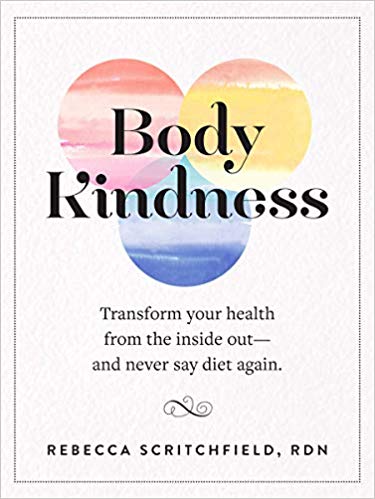
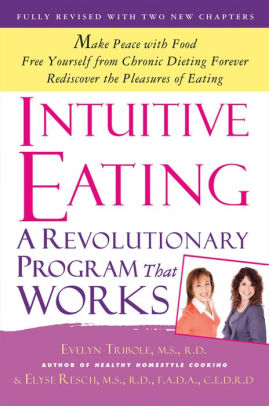
Body Kindness by Rebecca Scritchfield AND Intuitive Eating by Evelyn Tribole

These two complementary books are revolutionary in their importance.  Dieting and dieting culture has overtaken most developed countries and has become a billion dollar industry.  Most importantly, however, it has probably been what has contributed most to what is known today as the “obesity epidemic” among health care providers, and yet, what do most health care providers prescribe as an antidote?  More diets!

The newest and best science is pointing toward the fact that diets cause more harm than good, and just about every diet counts.  Whenever you tell someone not to eat something, what does that person then, instinctively crave?  Whatever it is you’ve forbidden them, of course!  And after restricting whatever it is you’re restricting – calories, carbs, fat – it doesn’t really matter – after losing weight, the body seeks to regain the weight, by doing whatever it takes.  So people tend to regain the weight, plus!  And yo-yoing is worse for you than just being a bit overweight, in terms of causing more inflammation and heart disease, diabetes, hypertension, and the unwanted health consequences of the overweight in the first place.

Because let’s face it, if we’d just accept ourselves in the less-than-“Twiggy”-as-ideal-bodies, we’d not have to worry about the dieting.  Our priority should really be about health.  And if it’s really and truly about health, then we’d throw away the scales and talk about fruits and vegetables and whole foods and exercise and that would be that.  We’d not be supporting Weight Watchers, and NutriSystem, and Jenny Craig and all the others who are making millions and preying on those of us who have fallen for these very smart business models.

So what do these books say?  Basically, that we were born with the internal cues that tell us when we’re hungry and when we’re full and we have to try to reach back in to find those signals and respond again to them.  To do this, we must trust that our bodies are really good at this and it’s ok to respond to them, even if they sometimes tell us that it’s ok to have a slice of cake because it looks delicious and we love this kind of cake and even if they tell us not to finish everything on our plate because we’re actually full.  The books also encourage movement of any kind, not just punishing workouts at a gym and give guidance on how to avoid emotional eating which many find quite challenging.  And they also encourage one to dig deep and find a way to care for oneself – that is, to carve out time to really see to one’s own needs that are being superficially cared for by food but that if tended to more deeply, then food won’t need to serve as a pacifier.

I think that almost every woman I’ve met has dieted at some point in her life.  So many would find either of these interesting and helpful.

Let’s try to move our conversations away from how we look to what we can achieve!!

Shopaholic to the Rescue by Sophie Kinsella

shopaholic to the rescue

After reading so many non-fiction and, frankly, disturbing books in a row, I needed something light and fun – and this was just the thing!

There’s clearly something amiss when Becky is not enthusiastic about shopping.  She and her mother and the shopaholic cast of characters are on a trek to Las Vegas in search of Becky’s father, who’s gone missing on a mysterious “errand” with Becky’s friend Suze’s husband, Tarquin —  and she’s found she’s lost her shopping groove.  She also may have lost her best friend, Suze.  And her father.  As they all set out to find Becky’s father, they learn about her father’s kind-hearted mission to right a past wrong and they find a wild way to support him in the end.

While the previous Shopaholic book was a painful disappointment, I have to admit that this one was adventurous and highly amusing.  None of these shopaholic books will be awarded the Nobel Prize for literature, but they are entertaining, engaging, plot-driven, heartwarming, and endearing – and they are a wonderful escape from these stressful times.

I highly recommend this as a delightful distraction from your everyday routine – and you don’t even have to tell anyone that you’ve indulged, as I’ve admitted to here!

The Summer Wives by Beatriz Williams

summer wives

Miranda Schuyler has just arrived back home to Winthrop Island to hide away from her life just a bit.  She just wants some quiet, to try to repair her relationship with her mother and her half-sister – if possible – and to heal, both physically and emotionally.  What she doesn’t expect is that on arriving back here, all of her memories and the emotions tied to them would come flooding back as well.  And with them, much of her understanding of her world might just be turned upside-down.

Beatriz Williams creates the most wonderful female characters – they are strong, smart, witty, and often rebellious without ever losing their femininity or grace.  They are characters who drive the plot, who outwit the demons, and who, while we guess will be victorious in the end, we never know exactly how.  There are always clever plot twists and there are sometimes dark details, but there is always a lightness and humor in the telling.  And Miranda, with her story, certainly falls in line with this pattern.

Williams also utilizes the shifting of voices and of time to build the story from various vantage points. I love this technique.  I find this builds suspense and keeps the motion of the story moving forward, even when we’re essentially hearing backstory.  It enriches both the story and the people in it and deepens our understanding of both.  Because sometimes it isn’t the “what” that is the mystery of the story but the “why” – and here is a good example of that.

I really enjoyed this book – and am hoping to read all of her books at some point!

The Light We Lost by Jill Santopolo

the light we lost

This is a love story that starts, ironically, when the world feels like it might end – in New York City, on 9/11/01.  Lucy and Gabe feel it too – they reach for each other, barely knowing each other, and then it’s over.  But years later, when they meet again, the spark is reignited, and this begins a heartbreaker for Lucy that she endures quite in spite of herself.

The voice is what is unique in this story and I think is what engages the reader.  It is written from Lucy to Gabe, almost as a letter, which gives it a very intimate feel.  On the other hand, because we only hear Lucy’s voice, it can sometimes feel one-dimensional.  There is no layering of the plot, but rather a single-mindedness of the narrative becomes almost droning as the novel progresses.

What is more deeply troubling about this novel, however, is that once again,  the outwardly independent female character is bound to a male character and jumps to his beck and call each and every time.  I felt myself literally growing angry as Lucy again and again fell into this same pattern.  While Lucy does not go with Gabe when he needs to travel for his life work – hurrah for her –  she then pines for him throughout the rest of the book, answering his calls whenever he deigns to reach out and dropping everything for him when he needs her.  (Really?  We’ve not moved past that?). And while she notices when her new boyfriend, Darren, makes plans without her input- and gets angry about it – she never stands up to him or says anything about it.  Why can’t our female characters be unequivocally strong?  I’m tired of this.

I think this book was off to a great start, and had great potential but was just disappointing on multiple levels.  Oh, well!


Hunger by Roxane Gay

hunger

This memoir by Roxane Gay — an author, celebrated feminist, and educator — is the story of her experience as a person going through life extremely fat.  She reveals early on that she had been raped at the young age of 12 years, and, sadly, did not feel able to tell anyone about it for years.  Her way of coping was to eat in order to gain weight, to make herself unappealing so that she would protect herself from letting that ever happen again.  Unfortunately, it also had an impact on everything else in her life as well.

While the book does tell the story of her life, regrettably it does so in a very rambling, stream-of-consciousness sort of way that is extraordinarily repetitive.  There are segments that wind back around to prior themes and scenes that are repeated over and over again, much like her thoughts.

Nevertheless, it is also extremely enlightening and enables the reader to really understand and what it means to be in the shoes of someone who, as she describes, takes up the space that she does.  Her descriptions of having to research restaurants in advance to assess the seating situation, for example, is something that I might not have appreciated.  Because of her size, she cannot feel comfortable in most chairs with arms, nor in most booths that have a fixed distance between the seat and the table.  Hence, she checks that there will be seating that can accommodate her before she will go to a particular restaurant.  Sometimes, when she doesn’t, and she has to sit in a chair with arms, she sustains bruises that cause her pain that can last for days.

This broke my heart.

There is a daily onslaught of taunts, sidebar commentary from strangers, suggestions – people even taking items out of her shopping cart at the supermarket!  Having to endure the humiliations that people throw at her, both intentionally and unintentionally is both unfair and relentless.

So while the writing and probably more so the editing of this book is not ideal, I think the author is incredibly brave in sharing her experience with all of us.  I think it is important for people to understand how it feels to walk in her shoes so that we can all be a little kinder to those who are different sizes than we are.