The Genius of Israel by Dan Senor and Paul Singer

Out of all the wealthy, first world countries in the world, Israel ranks 4th in how its citizens rate their happiness. This may come as a surprise to anyone who has visited this chaotic, yet vibrant country that is steeped in history, conflict, and challenge. But what it lacks in tranquility, even civility, it makes up for with the strong connections its citizens build through family, the army, its tech world, and through its acceptance and appreciation of diversity of its people. Citizens of Israel share a common bond and purpose – the sheer existence of the State of Israel, which is no small thing. In a world in which people living in many industrial nations are moving further and further apart, the people of Israel are staying closely bound – and this is the key to their happiness.

What is astounding is that this book was written during a time when so much of Israel was as polarized as a country could be – during massive protests against a government that was trying to undo democracy as it had been known to be. Thousands had been taking to the streets on a weekly basis to confront a government that was trying to take away the checks and balances that their Supreme Court provided to curb any potential government overstep. Netanyahu at the helm, again, was leading the charge to remove any obstacles in his way of having full reign over the country. And yet, it appears, the people were still rating their happiness as high, still feeling that their country was worth fighting for and that they had a quality of life they would not give up.

On the other hand, this book was written before October 7th, which has shifted the world as we know it. It changed Israelis’ feeling of security on a granular level and rattled their confidence in the government’s ability to lead like nothing ever before. Never before had the IDF failed the citizens of Israel as it did on 10/7. Nevertheless, I suspect, that if the citizens of Israel were to be polled now, they would still rate their happiness in the same way. After 10/7, the country rallied together like nothing I have ever witnessed. Citizens – not the government – organized makeshift hostels for the displaced kibbutzniks who survived the gruesome attacks and had to be rehoused further north. Citizens are still coordinating efforts to continue to provide shelter, food, clothing, mental health services, schooling, and other services to the thousands of displaced citizens resulting from the war with Hamas. The citizens are bonded in their efforts in surviving an existential threat of survival, with enemies attacking them from all sides and they are bonded together, supporting each other from within. There is nothing more unifying – or community-building – than this.

Because of the timing, it was difficult to be reading about Israel with all that has been going on – but it also gave a positive spin on what is going on as well, if that could possibly be. In the darkest of times, we must find light, and in these pages, one can find that tiny spark.

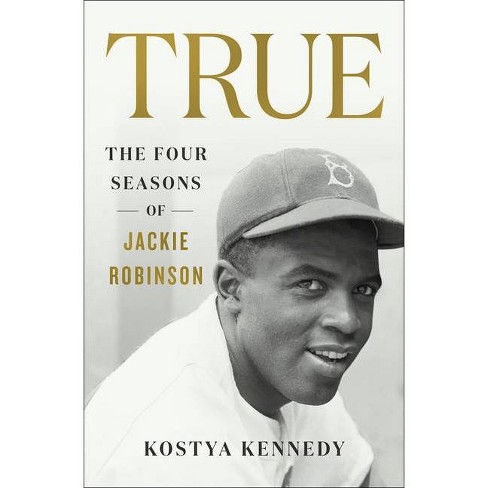
True: The Four Seasons of Jackie Robinson by Kostya Kennedy

Jackie Robinson broke barriers. He broke through barriers when he joined the Montreal Royals, and then he broke through even more dramatically in the US when he joined the all-White, Major Leagues, as a Brooklyn Dodger. With his unique batting stance, his gutsy base-stealing, and his overall agility and competitive exuberance, he was a shining light for his team and for anyone lucky enough to be in the stands to watch him play. And while he encountered innumerable incidents of racism, he always maintained a calm demeanor even as he spoke his mind plainly. Through his larger-than-life image of poise and strength of character, he and his wife, Rachel, became integral to the advancement of civil rights in our country.

In this colorful depiction of the life of Jackie Robinson, we are given an insider’s view of his life and his struggles, his victories and his pain. Kennedy, through extensive research and a clear understanding of the game, gives us not only detailed descriptions of pivotal games played by Robinson – helping us to feel almost as if we ourselves are sitting in the stands – but also how Robinson must have felt during those games. We are deeply disappointed and hurt alongside Robinson during tours in the South, as he eyes his fellow teammates remaining on their bus destined for their all-White luxurious hotels, when he has to get off the bus to stay at a Blacks-only hotel or private home. We feel the resentment he feels as he continues to see, year after year, no Black managers or team officials in spite of his continued advocacy for this. But we are also thrilled by his wins and inspired by his accomplishments.

What I loved about this biography of Jackie Robinson was the tribute given to his wife, Rachel. It seemed that Robinson himself gave her so much credit for his success – and that was evident here in this book. Theirs was a true love story; they seemed to be a genuine team in love and in life. While she was a homemaker for much of his baseball career, she was trained as a nurse and an educator, and she returned to working once their children were grown. Later, she also helped to forge the advocacy and fundraising he began, long after his death.

You definitely have to have an interest in baseball to get through this book, as there are many detailed descriptions of games, plays, and players. But if you do, you will also learn quite a bit about how baseball lived as a metaphor for many, particularly those in the 1940’s and 1950’s, in Jackie Robinson’s heyday, for some movement toward the advancement of civil rights in this country.

Say the Right Thing by Kenji Yoshino and David Glasgow

There have been so many excellent (and some not-so-excellent) books written about racism, how to be an antiracist, and diversity and inclusion. Many of us have been in trainings, whether through work or community opportunities, to inspire and instill in us an understanding of structural racism and power dynamics. But even while we may have come to have a basic understanding of these concepts, few books lay out the tools of how to be an ally and/or to stay in a growth mindset in such a practical, non-judgmental and concrete way as Yoshino and Glasgow have done here in Say the Right Thing. In addition, the advice here is generalizable to all non-dominant groups – not just racial groups. And, as they point out, almost every one of us may find ourselves in a situation where we are the culprits engaging in non-inclusive behavior, and later be either at the receiving end of it or as an ally. Through vivid vignettes, humble stories about themselves, and relevant research concepts, we are given advice on how to handle each of these scenarios.

What I appreciate most about the writing here is the humility with which the authors share this essential information. While they are both highly qualified to be writing this book – both are attorneys, educators, and come from non-dominant communities – they also acknowledge their own privileges and that we all may fall into spaces of privilege relative to others. Their focus, therefore, is not how to understand the position of the “other” but rather to understand our own obligation to react appropriately when issues arise. We are obligated to check our own reaction if we are challenged by someone about an act we may commit – even unwittingly – and to keep ourselves open to learning how to do better always. They also acknowledge how hard this can be, as almost always our unwitting acts are not with evil intent. But of course, good intent does not preclude harm.

It is an easy read, full of concrete suggestions, and utterly important in this moment of divisiveness and fracture – when communication is essential and understanding is the key to bringing this country back together.

Another MUST READ, I believe.

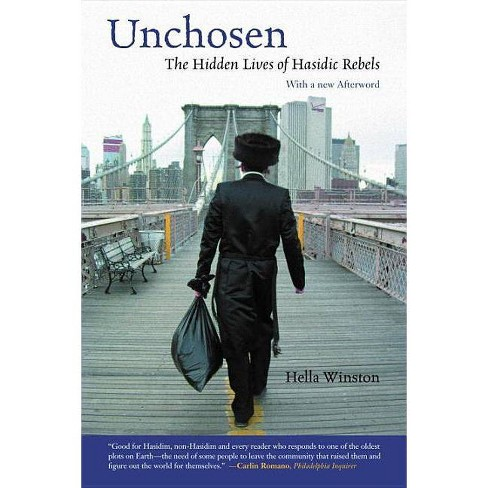
Unchosen by Hella Winston

After spending 2 years gaining the trust and confidence of over 60 individuals in mainly two of the Hasidic communities in Brooklyn, NY, Hella Winston has composed this narrative of their lives and their struggles with the insular lives they lead. She focuses on a few individuals, through whom she communicates the tension between the traditional and the modern, what is considered “safe” and what is occasionally hungered for. And she does so with curiosity and with compassion.

If you are not familiar with their history, the Hasidic community was established here in the US by a few leaders that were survivors of the Holocaust of World War II and that has had a great influence on their philosophy and their attitude toward the outside world. While they looked to the United States as a place of refuge where they were able to be free to practice their religion, they also saw it as a country of strangers who might tempt them into being led away from their customs and traditions. This tension has kept them insulated and isolated from the outside world, as they shun any contact with it – whether through media, language, or even secular education.

What is saddest to me is that so often the root of the difficulty is that the community and the families rule by fear, not by love. The most fundamental fear is of nonconformity. If one is different, it interferes with one’s chances of finding a mate, and the ultimate purpose in one’s life is to form a family and be “fruitful and multiply,” no matter what one’s true dreams or goals are in life. Even if one is not being considered for matching, one’s sibling may be, and so one must conform to ensure the security of one’s family’s matches as well. Any deviation from the norm, any rebelliousness, any questioning, any appearance of difference, can affect one’s standing in the community. Furthermore, there is a sort of underground watchdog system of spies in the community looking out for this deviance. And even when one is a victim of abuse or neglect, especially if one is female, one has little recourse, because, again, it just reflects badly on the perpetrator and on the community, so it cannot be called out or acknowledged.

There is not only bad here, of course. The Hasidic community is a tight-knit community that looks out for its own. No one goes hungry. No one is not cared for. And while the majority live in poverty, they do provide for each other (even if it is with your tax money that they do so!).

It seems to me that it all boils down to this quote, taken from Winston’s Afterward, “…the need to coerce people’s behavior through fear and shame suggests a fundamental weakness in the belief system itself. To feel forced to abuse or reject a loved one for his or her failure to conform to community standards seems to negate any claim to true religiousness. But this is the paradox of fundamentalism.” And Hasidism is absolutely religious fundamentalism, tolerating no deviance, allowing no questioning, and dictating by fear.

An interesting read, for sure. I wish there had been more cases discussed, more examples and more details – but it was certainly eye-opening, even for someone who had been familiar with this community and who’d heard some of these kinds of stories before.

Women in White Coats: How the First Women Doctors Changed the World of Medicine by Olivia Campbell

There are so many women in medicine today – myself included – that we take it for granted. In fact, by 2017, women outnumbered men in medical school classes in the US. However, just like the right to vote and the right to enter many other professions, women had to wage war to gain entry into what was, by men, considered their holy terrain. In fact, it was not until the late 1800’s, when a few brave, brilliant, and brawny young women on both the European and American continents battled over the course of many years to achieve full MD status.

Many authors credit Dr. Elizabeth Blackwell, born in Britain and later moved to America, as a major pioneer in this area, and she is probably the most well-known. But she could not have moved the needle alone, as they say. While she was fighting the battle mostly in America (although doing a good deal of her clinical training and public speaking in the UK), her colleagues, such as Elizabeth (“Lizzie”) Garrett Anderson and Sophia Jex Blake were waging the war on the other side of the Atlantic. While they were each very different women, approaching their mission with different styles, personalities, and tactics, they also relied upon each other for support and guidance. These women suffered not only prejudice, hardship, and a brutally uphill battle, but also physical oppression. Sophia, and her 6 fellow female students in Edinburgh were harassed to the point of having mud and garbage thrown at them on their way into medical school class by their male colleagues – with the support and encouragement of their male professors. In spite of this, these women persevered, overcoming these unspeakable hardships to go on to establish medical schools and hospitals for women.

It is neither surprising nor novel to read about (white) men fearing others being included among their ranks and using their power, influence, and even violence to attempt to maintain their unilateral hold on a particular enterprise. But while they held on, the field of medicine, particularly healthcare for women, truly stagnated. It was only when women were given full medical practitioner status that women’s issues were brought to the fore and women’s health truly advanced. Women were finally able to come forward and speak about their very private complaints, expose how they’d been treated by some male practitioners in the past, and have advocates with any power to make significant scientific advancements in their care.

This is an incredibly well-researched documentation of a dramatic advancement in the care of women for and by women.. Not a light read, but an important one.

Shrill by Lindy West

In this memoir, Lindy West shares her alternatingly traumatic and triumphant experiences as a feminist writer venturing into online journalism. Because she is also fat (her self-description), she also becomes a target in our fat-phobic, one-size-fits-all-definition-of-beauty society and is branded by trolls with repulsive vitriol. When she tries to stand up, for example, against comedians who use rape as a topic for jokes (which is about as funny to most women as I imagine Putin is to most Ukrainians right now), she gets accosted online by the most offensive trolls imaginable, with comments liked by some of her friends. (It is pathetic how quick people are to take sides against those who are perceived as vulnerable.) Lucky for women, she is a strong, smart, and good-hearted person who rises above and sees the forest for the trees, speaking out for all of us. She proceeds to make history in her accomplishments, one troll at a time.

This book is replete with paradoxes. West is vulnerable yet powerful. She puts herself out there, stands up and stands out in a public forum, knowing she’ll open herself up to criticism – and omg, does she – but yet she stands up again and defends herself so strongly that she silences others to a screeching halt. She hears the noise, feels it, but does not allow the noise to infect the clarity of her argument. Despite feeling isolated, she thinks about women in general and not just herself as a woman. She also sees herself as others see her, yet she will not bend to their perception of who she is.

Some may find her story stirring, even jarring. We are not used to hearing women with loud voices. We are not used to hearing women be comfortable and secure in larger bodies. We are not used to hearing women stand up for themselves when they have strong opinions and strong minds, especially when they go against the (male) grain. But I know it’s about time we got used to hearing and appreciating them!

Born a Crime by Trevor Noah

In this tender memoir, Trevor Noah shares his experience growing up during the final edge of apartheid in South Africa. Through vividly narrated vignettes, we learn about his complicated relationship with his mother, who is fiercely devoted to him and yet is independent, stubborn and vulnerable. We learn of his early struggles to find himself, and how he must battle against the vicious cycle of poverty that apartheid has inflicted upon his people.  

It was suggested to me to listen to the audio version of this book – and this was excellent advice.  Hearing Trevor Noah narrate his own story, in his own beautiful, South African accent and fluidly modulating to his family and friends’ voices and accents, is just a gift to yourself. 

Noah is a brilliant storyteller.  He shares his experiences with such warmth and humor, as if he is sitting with you in your living room, over a cup of your favorite hot tea – but as if he’s sharing his deepest, darkest memories, only with you.  He describes in colorful detail some of the most outrageous adventures and unbelievable experiences.  But even as he shares his joy and his pain, it is as if he is flickering a smile at you, as if to say, we can still laugh, even as we hurt.  This is how we cope.

You will be engrossed and amazed — you will gasp and you will laugh out loud.  Don’t just read this one – listen to it!  

It’s a “MUST READ” but more than that, it’s a “MUST LISTEN!”


An Invisible Thread by Laura Schroff and Alex Tresniowski

An Invisible Thread Sews Together An Unusual Friendship – CW50 Detroit


Laura was no stranger to the streets of Manhattan in the mid-1980’s, but something made her stop and turn around after passing a small, skinny, Black boy asking for money on one fateful Monday afternoon.  His name was Maurice, and he was half-starved, and when she invited him for lunch at McDonald’s, he accepted.  Laura was careful not to pry too far, but could see that Maurice was fending largely for himself, and she was unsure if she’d ever even see him again or how that would happen.  To her amazement, though, she did, every Monday from then on.  From this bloomed an unlikely friendship that became a blessing for both Laura and Maurice.  

This is a true story that is told from Laura’s perspective, but gives a great deal of background from Maurice’s family experience as well.  Both of them have experienced a great deal of family trauma, although Maurice’s is quite dire, with most of his family falling victim to the devastating crack epidemic of the 1980’s.  While Maurice is clearly loved by his family, particularly his mother and grandmother, they are both usually too ill to properly care for him and he is often left to his own,  skillful, but youthful devices.  When Laura meets him, he is living in a crowded single room with many drug-addicted relatives where there is no routine, no structure, and never any food in the fridge.  Laura is the first person to ask him what he might consider being when he grows up, giving him a first glimpse of the possibility of a real future for himself, besides what he sees in his family.  

On one hand, this story is inspiring.  Laura speaks freely about how she has gained as much from the relationship as she has given.  While she truly has given, whether in lunches made in brown paper bags – signifying to Maurice a show of love and care for him – or clothing, or just a periodic respite from his tumultuous family life, she has also received.  She has not had relationships where she was able to have children, and I believe Maurice was sort of like a son to her.  She was able to lavish attention, occasional gifts and intermittently share her wisdom with him, the way she might with a son, and she felt gratification in this.  And certainly, Maurice was given something of a lifeline, in that he was shown a different possibility for how his life might be – that he did not have to follow the path of his family and that he could choose a steadier, healthier, and safer path for himself.  And he did.

On the other hand, the story being written as it was also feels a bit self-congratulatory and almost cringe-worthy.  We’re here again, with another white woman “saving'” a Black boy – and it just feels a bit uncomfortable to read about this.  Laura is truly generous and giving – but why does she have to write about it?  While “a portion” of the proceeds from the book are destined for the No Kid Hungry non-profit group, it still feels a bit strange. 

I’d be very curious to hear what others feel about this book and this issue.  I invite your comments!  I am truly torn over this one! 


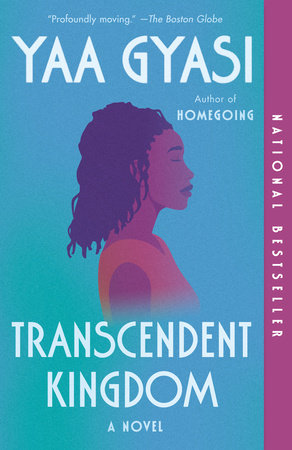
Transcendent Kingdom by Yaa Gyasi

Transcendent Kingdom by Yaa Gyasi: 9781984899767 | PenguinRandomHouse.com:  Books

Gifty is striving to complete her final doctoral thesis in neuroscience on addictive behaviors. She knows she’s obsessing over her data, and that she needs to move on to the writing of the final paper, but her past has come back to haunt her and she is stuck.  It may be that the visit from her mother, drowning in her own pain, will nudge her forward.  Or will it be her sifting through her old journals from her youth?  Somehow, Gifty works through a resolution and confronts the deeply painful religious, emotional and philosophical issues that are holding her back. 

This memoir is a recounting of a second generation immigrant from Ghana who suffers multiple layers of trauma during her childhood,  while seeking and finding little community support in her small town, Southern evangelical church.  Needless to say, her struggle is complicated.

One recurrent theme is the conflict she feels between religion and science.  Having memorized large swaths of scripture for her mother’s approval and having limited experience outside her small, Bible belt town in Alabama until college, she has a deeply ingrained emotional connection to her religion and to a traditional belief in God.  On the other hand, her more cerebral side has rejected much of the dogma the church espouses; whether the narrow views on sexuality, the scorning of evolutionary theory, or the criticism of science in general.  So when a fellow student criticizes those who are religious, she is not quite sure what to feel, but she is simultaneously insulted and embarrassed.  She identifies with those being criticized but also sees why they are being so.   

The other inescapable message here is the devastation that occurs when a family member has an addiction. Not only does the addict suffer, but everyone around him suffers as well.  When Nana, Gifty’s brother disappears, she and her mother spend hours searching for him to try to bring him home to safety.  When he is not functioning, the whole family is not able to function.  And the cycling and unpredictability has devastating effects on everyone for years to come. 

This very real story hits hard and is a hard read.  We are very fortunate that the author has chosen to share her experience with us.  

Heavy by Kiese Laymon

Through this deeply moving memoir, Kiese Laymon shares his experience having grown up as a black male in a larger body in the deep South.  He shares his earlier traumas, his fonder memories, and how he has learned to cope with both the times his mother was absent and the times she was present.  

This is a such a gritty, revealing memoir that reading it feels almost voyeuristic.  Writing it as a letter to his mother, Laymon is so deeply introspective and revelatory that we peer into his private window, we peek inside his heart.  We experience his profound sense of pain and powerlessness as he watches the women in his life become victimized by other men.  His anger is, sadly, directed inward – as it so often is.  It manifests first as binge eating and later as restriction and overexercising.  This coping strategy works for him, however, until it doesn’t.  Meanwhile, he is able to be as resilient as possible, forging relationships,  excelling academically and achieving goals on his terms.  

As a side note, I so appreciate that Laymon has come forward with this memoir, because it defiles so many stereotypes of who struggles with eating disorders.  As he acknowledges himself, eating disorders are thought to exist only in upper class, white women – and this is just not true. Folks of all genders, races, and socioeconomic strata utilize these behaviors to cope with their lives and one can never assume anyone is free or “protected” because of who they are or appear to be.  These are secretive behaviors and cannot be diagnosed by someone’s appearance.  And they can be very painful, distracting, and most importantly, life-threatening – never to be taken lightly.

This is also an important memoir from the perspective of understanding racial issues and racism.   Laymon shares his encounters with racism and digests them with us, his readers.  Both he and his mother, in spite of their obvious intelligence and academic accomplishments, are underpaid and frequently disrespected.   But, again, he also places his experiences into context.  He understands that even when he’s been treated as less than, he is still not at the bottom of the totem pole, being a male as opposed to a female person of color.  His compassionate view of the women in his life enables him to see their utter vulnerability to the forces of bias and power imbalance. 

I deeply appreciate this memoir, for all its raw and painful honesty. This is a hard read but well worth the work of it.