
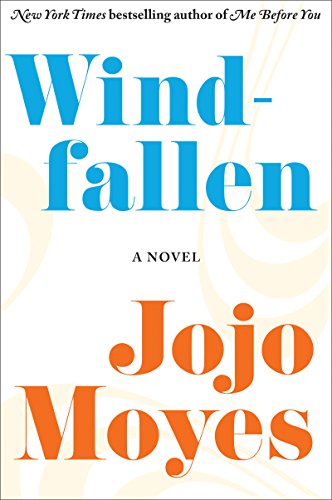
Lottie and Celia are almost as close as sisters – in fact, they’ve been raised as sisters for the past few years, although Lottie is acutely aware that she is only with the Holden family as long as they continue to generously support her. However, when she and Celia stumble into the acquaintance of new, artsy friends at the Arcadia estate, Lottie’s eyes are opened to a new kind of freedom, a new way of living that just might present opportunities – or perhaps danger. She is not quite sure.
Fast forward to the present time, and we meet Daisy, whose life seems to be falling apart. Her partner has walked out on her and her infant daughter, and she is left to sort out their upcoming project of restoring a controversial estate -yes, Arcadia. Will she be able to navigate this overwhelming time in her life? Her sister does not seem to think so, but she must prove her wrong. She has to…
Here is another winner by Jojo Moyes. While it did not grab me immediately, I will admit, it grew more and more magnetic with each chapter. It may be that Lottie’s character, while complex and reserved, was so, perhaps, hardened by her circumstance that she was ever so slightly less likable and therefore less relatable. On the other hand, once we meet Daisy, we find her so much more of an open book, her emotions so raw and apparent, that she breathes a sort of spark into the story, enlivening it with her heart and energy. We love her from the start and root for her until the end. Both characters are beautiful in their own ways, of course, but they differ in how relatable they are, I felt.
Moyes beautifully depicts an undertone here of the social conflict between old/conservative thought and new/liberal perspective. The setting is a small, harbor town in England, where everyone knows everyone and families have long-held histories of judging others’ families for past ills. Arcadia, with its modern design, intrinsically represents– both physically and by its inhabitants — possibility, openness, and forward thinking. The town, and its people, are always whispering against those in Arcadia, fearing what it represents and rising up against it in various ways. And Lottie, for her part, becomes caught in between, at once part of Arcadia and then fighting against it, because of what it represents to her at different junctures of her life.
This is definitely worth reading. I don’t think it rises to a “Must Read” but it comes fairly close!

 kindread spirits