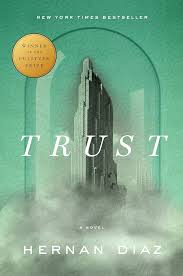
Trust by Hernan Diaz

We first meet Ida as she recounts her visit, later in life, to the home of her previous boss, Andrew, who has hired her to help him write his life story, as he sees it. You see, it has been written, by one Harold Vanner, albeit disguised as fiction. But it carries some accusatory and, as he sees them, misguided details, particularly about his dear, departed wife, Mildred. And he needs to see this story corrected. The story within the story, within the story, becomes clear only as we near the very end, when Ida herself clarifies for us who and what we should actually “trust.”

Not only is this a brilliant telling and, of course, retelling of a story, but it also shows how perspective and motive is key. Everybody has a story they want to tell about themselves, how they would like to be perceived, how their legacy is viewed. And yet, that story may differ from the truth. Do we get to change that truth, or the perception of that truth? What if we have the means to do so? What if we care not about stepping over others in our way to do so? Maybe then, no one will know the truth? What, then, is the cost of our legacy?

Without giving too much away, I think it is important to draw similarities between Ida’s father and her boss. While they would see themselves as completely opposite, because of such differing sociopolitical views, they both use Ida to retell their own stories. They are both dishonest to her and to themselves, while trying to appear to be looking out for her best interest, as if doing her favors. They are both undeserving of her trust.

What is strikingly unique here in the writing is the construction of this novel within a novel within a novel, which builds upon itself to a suspenseful crescendo. It is clear why it is a Pulitzer Prize winner – and I would be remiss if I were not to make it a MUST READ!
The Forgotten Room by Karen White, Beatriz Williams and Lauren Willig

In the midst of the Gilded Age, when most young women are focused on ballrooms and bridal gowns, Olive is focused on revenge. It is clear to her that her father had been wronged, cheated out of his rightful earnings from his hard work as the architect of the magnificent Pratt mansion and she is determined to expose this travesty.

Lucy is also connected to the Pratt mansion, living there when it becomes a boarding house for “respectable ladies” in the 1920’s. She, too, is on a personal mission – to see where her mother’s heart has always been during her lifetime, because it has been apparent to Lucy that it has not fully been with Lucy and her father. In fact, Lucy wonders if the man she knows to be her father is actually, in fact, her true father.

Finally, there is Kate, a doctor during the second World War, linked also to the Pratt mansion when it is again adapted to function as a hospital for wounded soldiers. When a stunning soldier is brought in on a stormy night with a leg infected so severely it may require amputation, she is startled by the way he seems to recognize her and how he feels familiar to her as well.

As the story unfolds, we learn how these three women are connected, how their lives and their loves have been thwarted, and how the Pratt family fortune and misfortune has impacted so many others.

While I am not familiar with the other two authors, I love anything by Beatriz Williams, and this novel is no exception. Each segment of the narrative is captivating as a stand-alone story, with each of these strong, independent women capturing our hearts with their missions, their wills, and their defiance. But to weave the story together with the three of them is quite the ingenious feat – and it is done both smoothly and powerfully.

I highly recommend this book – it has romance, intrigue, and is just beautifully written. Not only a great summer read, but a just a great read.


The Alice Network by Kate Quinn

The dust has barely settled and wounds have certainly not yet healed from the second world war when Charlotte finds herself dragged by her mother across the Atlantic on the way to take care of her “Little Problem” in a clinic in Switzerland. While her mother is determined to erase this “stain” on Charlotte’s reputation, Charlotte has a very different mission in mind. While here in Europe, she sees an opportunity to uncover the whereabouts of her beloved cousin Rose, who has been missing and presumed dead since returning to France just before the German occupation. With the name and address of Eve Gardiner which she has scribbled on a small piece of paper, she unlocks an adventure that leads her to discovering much more than just what happened to Rose. She discovers a network of brave women who risked their lives for their countries and she uncovers her own inner strength as well.

The Alice Network is another suspenseful novel by the author of the Rose Code (see my prior entry), which will similarly have you on the edge of your seat as you turn each page. There is a great deal of historical fact woven into the fiction here, as Quinn celebrates the unsung female heroes of the first and second world wars.  We learn of the undercover spies that wore skirts and makeup instead of slacks and blazers. They were often ignored because they were “just women,” which sometimes enabled them to sneak through borders undetected, but sometimes led to them being ignored even when they carried valuable information that might have saved hundreds of lives. 

The writing here is crisp, acerbic and intricately plotted. We float back and forth between Charlotte’s pursuit in 1947 and Eve’s back story (WW I). The characters are, each of them, hardened and broken, wounded in one way or another by war. When we meet Eve, for example, she is in a drunken rage, threatening Charlotte with a Luger in her face and trying to send her away.  She is emotionally and physically crippled by her experience in her war.  We see so starkly how women were affected by our wars – whether working under cover, nursing, or being on the front lines in other ways – and their wounds are obviously just as deep. 

I highly recommend this novel – it is historical fiction at its best. 

The Rose Code by Kate Quinn

Osla and Mab come from very different backgrounds, but suddenly find themselves on a train headed toward the same, mysterious destination. What with the war on, who knew what they’d be brought in to do to fight the Nazis, who seem to be speedily and frighteningly making their way toward London.  What awaits them is a challenge beyond their imaginations, and an opportunity to prove that they can do more than be “witless debs.”  What also awaits them is a profound friendship that brings its own challenges and heartbreaks as well.

This is an amazing yarn of historical fiction that will keep you on the edge of your seat from the very first page to the last. Do not be daunted by its length, because it will glide by in a heartbeat and you’ll only wish it had lasted even longer (although you will be happy that it didn’t because you’ll finally get some sleep!). The writing is brilliant, with the story structured by flipping back and forth from during the war to just after the war, creating a knot of suspense that keeps getting tighter and tighter throughout. The characters are strong and vulnerable and we come to love them, even when they are imperfect and rash. And even if some of the final scenes are a bit implausible, we believe them anyway, because the drama is right there where we want it – no, need it – to be.

And we learn quite a bit about how the war was actually won against Hitler and his army. It wasn’t necessarily just about sheer force, but rather intelligence, breaking code. Somewhere in a small town outside London, on a compound where secrecy was maintained above all else, codebreakers – often women – were employed around the clock to break the codes the Germans were using to communicate their war plans to each other.  In addition, this base was utilized to enable false messages to be sent back, to mislead the enemy.  Apparently, this was done by those sworn to secrecy on threat of treason to the crown. 

This is another MUST READ – you won’t regret it, I promise!


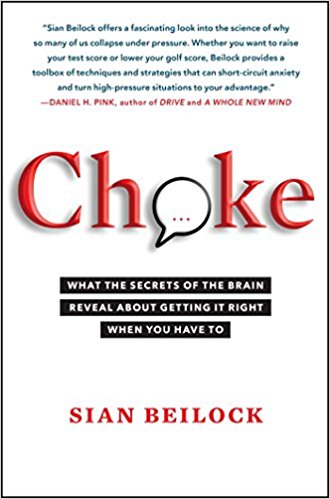
Choke by Sian Beilock

choke

Why would an accomplished, experienced athlete competing for a spot in the Olympics suddenly flub an event?  Why would an A student who has aced all the practice SAT tests get a mediocre score when it really mattered?  That is, why do people choke?  This is what Dr. Beilock examines in the course of this fascinating summary of psychological research done by herself and others on this subject.

The book reviews what is happening when a person “chokes” both behaviorally and neurologically.  It appears that overthinking a situation can actually interfere with the automatic responses that training leads the body to perfect.  Once your attention is drawn to the specific mechanics of a behavior (kicking a soccer ball, playing a piano concerto), what would be done automatically very smoothly is now pulled apart and diverted by the brain’s other areas becoming involved.  Gradually, the book builds into suggesting what can be done to offset the possible risks of choking or remedies for people who have choked and need to get back onto a path of success.  Not surprisingly, these can include focusing on the goal, meditation, writing down one’s anxieties and worries just before a performance/test, and practicing (although this is a gross over-simplification of her findings).

What makes this book readable is the inclusion of many anecdotes.  Dr. Beilock uses both famous legends from sports history and stories from her own personal experiences from people she’s met through her work to enhance the narrative of the book.  This both engages and clarifies and makes the reading fun.  I found the psychological experiments remarkable and often surprising as well.

And for those of you who might be going on interviews sometime soon – well, there are tips for you, too.  And they are really not what you would expect!

A very interesting read for anyone interested in psychology or sports or really being successful when it counts!