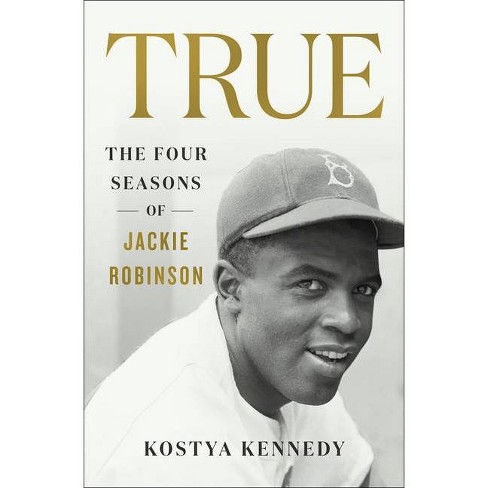
True: The Four Seasons of Jackie Robinson by Kostya Kennedy

Jackie Robinson broke barriers. He broke through barriers when he joined the Montreal Royals, and then he broke through even more dramatically in the US when he joined the all-White, Major Leagues, as a Brooklyn Dodger. With his unique batting stance, his gutsy base-stealing, and his overall agility and competitive exuberance, he was a shining light for his team and for anyone lucky enough to be in the stands to watch him play. And while he encountered innumerable incidents of racism, he always maintained a calm demeanor even as he spoke his mind plainly. Through his larger-than-life image of poise and strength of character, he and his wife, Rachel, became integral to the advancement of civil rights in our country.

In this colorful depiction of the life of Jackie Robinson, we are given an insider’s view of his life and his struggles, his victories and his pain. Kennedy, through extensive research and a clear understanding of the game, gives us not only detailed descriptions of pivotal games played by Robinson – helping us to feel almost as if we ourselves are sitting in the stands – but also how Robinson must have felt during those games. We are deeply disappointed and hurt alongside Robinson during tours in the South, as he eyes his fellow teammates remaining on their bus destined for their all-White luxurious hotels, when he has to get off the bus to stay at a Blacks-only hotel or private home. We feel the resentment he feels as he continues to see, year after year, no Black managers or team officials in spite of his continued advocacy for this. But we are also thrilled by his wins and inspired by his accomplishments.

What I loved about this biography of Jackie Robinson was the tribute given to his wife, Rachel. It seemed that Robinson himself gave her so much credit for his success – and that was evident here in this book. Theirs was a true love story; they seemed to be a genuine team in love and in life. While she was a homemaker for much of his baseball career, she was trained as a nurse and an educator, and she returned to working once their children were grown. Later, she also helped to forge the advocacy and fundraising he began, long after his death.

You definitely have to have an interest in baseball to get through this book, as there are many detailed descriptions of games, plays, and players. But if you do, you will also learn quite a bit about how baseball lived as a metaphor for many, particularly those in the 1940’s and 1950’s, in Jackie Robinson’s heyday, for some movement toward the advancement of civil rights in this country.
The Lager Queen of Minnesota by J Ryan Stradal

Helen and Edith are about as different as two sisters might be. Although both are hard-working, Edith is content to marry her best friend and take life as it comes, while Helen sees everyone around her as a vehicle to achieving her ambition: to create the best and most successful brewery around. Sadly, it is Helen’s ambition and selfish thinking that drives a wedge between the two sisters, forcing them to lead very separate lives. As we accompany the two sisters on their life journeys, we see how their lives are both ultimately dominated by the pursuit of creating that fine brew.

I believe this is another example of a cute idea only moderately well-executed. The characters are likable but a bit dull, actually, with the exception of Edith’s granddaughter, Diana. Diana we meet after she loses both parents in a tragic accident, and she is struggling to help financially support her grandmother with radical means. She is the most interesting, the deepest, the most colorful. We see her grow, mature and blossom.

I think the issue is the writing in general. There is a story here, but it is relayed with such a flat and almost monotone delivery that it lacks the hills and valleys that fine storytelling will have. Even when there is a major development, it feels glossed over so quickly it is barely noted. While I don’t like drama for the sake of drama itself, there is a reason a story is told. In addition, the author got a bit bogged down in the detail of the brewing of the beer such that it distracted from the storyline itself. While some of it was interesting, too much of it was overly detailed and esoteric – more than what the average reader (ie. me) needed to know or could relate to.

So, maybe rather than being like Diana’s creative craft IPA’s, this book was more like Helen’s tired lite beers?


Circling the Sun by Paula McLain

Even at a young age, Beryl is willful and daring, which is probably the thing that keeps her steady, even as her mother deserts both her and her father, taking only her fine clothing and Beryl’s younger brother back to England. But Beryl was built for Kenya, for the open sky and the wild fauna, and her heart seems to heal as she is cared for by the local tribespeople and her father, such as he can. As she grows and becomes a natural horse trainer, she holds on to her innate independence, which casts her as both unique and odd, admired and scorned, loved and hated, invited to the party and gossiped about afterwards. Nevertheless, in her own way, she succeeded in making a name for herself, breaking barriers and changing norms.

In fact, this is a novel based on the true life of Beryl Markham, a woman who was a pioneer both in horse training and in aviation during the 1920’s and 1930’s, mostly in Kenya. She fought against sexism on many fronts, merely yearning for independence, to make her own way. At the same time, she succumbed to love for a man who had the same yearning for freedom, one who could not be tied to anyone. While she understood this at her core, it also brought her as much heartache as it did joy.

What is also unique about the novel is the gorgeous depictions of Kenya. There are only sparse references to the colonization of the country and its impact on the tribes – it might have benefitted the story to have more. But there are rich descriptions of the wildlife, the terrain, and the flora. I have never been but I would love to, particularly after reading about it here.

It’s a beautiful story and an impactful one. Once again, we see how a woman is rendered nearly powerless but manages to overcome the obstacles thrown her way. It is inspiring and hopeful in so many ways.

Remarkably Bright Creatures by Shelby Van Pelt

Tova has been content in her position as the evening cleaner in her seaside town’s aquarium. She takes pride in her work, using her own formula of lemon and vinegar rather than the irritating industrial products provided by the aquarium, cotton instead of polyester to ensure no streaks on the sides of the glass tanks. And it keeps her busy and distracted from her grief, from the losses she’s endured in her life. For while she does have her friends – the Knit Wits as they call themselves – who’ve seen her through her many years, she still has her lonely moments. As she sees her friends moving on and planning for their futures as they age, she starts to try to envision what her future might look like, given she does not have a family who might look after her. She thinks she has a solid plan – that is, until she befriends the giant Pacific octopus who is looking out for her in ways she cannot even imagine.

This is also the story of Cameron, whose life narrative has been about failure in spite of his natural grace and intelligence. He is unable to overcome his low self-esteem because of his family situation and feels he is destined to continue on the path he’s been on his whole life. While he can quote Shakespeare and remember minutia about everything, he cannot remember to get to work on time or to complete paperwork when it matters, and sabotages his own ambitions. How many of us fall into that cycle, in both larger and smaller ways? How many of us get stuck, as it were, in patterns of self-destruction? Are we open to others’ suggestions? Are we open to change? This is an important theme here; one that we can all take a lesson from.

While there is a bit of an element of predictability here, this is a very sweet story that makes for a wonderful summer read. Tova, our protagonist is kind, quiet, and a bit of a perfectionist – but also a good listener and a good friend to those around her. She develops a beautiful bond with the octopus in her care, which evidently can actually happen. (These creatures are apparently able to recognize individual humans and distinguish between those they like and those they do not like and treat them accordingly. While they may not be as remarkably bright as the author has depicted the one here, they are brighter than I had ever imagined. ) When Cameron, comes to town to fill in for her when she’s been injured, she forms a very unlikely but also very endearing bond with him also. Their interactions will inevitably make you smile.

This is a lovely read -enjoyable to the end. Highly recommend it!


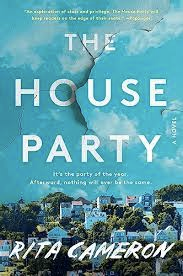
The House Party by Rita Cameron

Aah, the year is finally winding down for the students at New Falls High School and they are ready to party.  Will and his older brother Trip are definitely on board, but when they arrive with the beer, they are a bit surprised to find that this one is taking place at the fancy new house being built on the river. Well, Will deserves to party just like the rest of them, doesn’t he? He’s worked so hard to get to where he is – a senior, with a well-deserved acceptance to Princeton and a scholarship from the town’s board. Little does he know how out of control this particular party would get – and how it would impact the course of his life, his family’s, and the lives of the couple building this new home.

This novel, set in a small suburb of Philadelphia just prior to the economic crash of 2008, is a well-crafted indictment of the “lawnmower parent,” the parent who smooths the way for their child at all cost. (Usually wealthy and/or privileged, these parents don’t allow their children to suffer any consequences of their actions; hence these children do not learn that they are to be held accountable for what they do.) We hear the story from the perspective of the teenagers – who are mostly of age (18 or older) – but we also hear it from the perspective of the homeowners who are building their dream house – which, of course, gets demolished. We feel for the children who, yes, have made a mistake and their futures are at risk. But we also understand that they need to be held accountable and restitution made for the damage they’ve created.

We also feel for those who are more vulnerable, those with less means. Even in a town that prides itself on the peaceful blending of the working class and the “newer money” families at the high school, there is a clear division between who the DA’s office deems disposable and who is protected, who can be targeted and whose reputation must be preserved. Meanwhile, we see how quickly this status can change, with the onset of the troubles of the couple who are building the home. No one is immune to this possibility.

This is such an engaging read with a social commentary so important, I believe, that I would consider this a MUST READ. I’d be curious to hear what others think!


The Reluctant Fundamentalist by Mohsin Hamid

In this novel, we meet Changez, as he relates the story of his youth to an American stranger he meets in a public square in Pakistan. We hear about his journey to Princeton and then to New York, his successes and struggles as he moves forward academically, socially and romantically. We also learn about how his experience as a brown man following the attacks on the Twin Towers become pivotal to his relationship with America as a whole.

What is most unique about this book is the voice used to tell the tale. Changez is sitting with the American, whose name we never learn, and we hear his side of the conversation throughout the narrative. It is a wonderful way to convey the story, in that we can envision the two men, dining at a table in the market square, as the light dims with the passage of time.

While this conversation scene is fairly tranquil, the subject matter is not. Changez is subjected to constant “othering” during his stay in the US. Even prior to the World Trade attacks, he is never quite included in social circles, never quite one of the crowd. Even in his romantic relationship, which is more imaginary than real, he is never loved or appreciated for who he is, but rather tokenized and used. One can certainly understand the rage that gradually builds and builds until he finally, much to his own surprise, implodes.

This is an iconic work. It is a quick read, but has so much to teach us packed into its pages.

The Forgotten Room by Karen White, Beatriz Williams and Lauren Willig

In the midst of the Gilded Age, when most young women are focused on ballrooms and bridal gowns, Olive is focused on revenge. It is clear to her that her father had been wronged, cheated out of his rightful earnings from his hard work as the architect of the magnificent Pratt mansion and she is determined to expose this travesty.

Lucy is also connected to the Pratt mansion, living there when it becomes a boarding house for “respectable ladies” in the 1920’s. She, too, is on a personal mission – to see where her mother’s heart has always been during her lifetime, because it has been apparent to Lucy that it has not fully been with Lucy and her father. In fact, Lucy wonders if the man she knows to be her father is actually, in fact, her true father.

Finally, there is Kate, a doctor during the second World War, linked also to the Pratt mansion when it is again adapted to function as a hospital for wounded soldiers. When a stunning soldier is brought in on a stormy night with a leg infected so severely it may require amputation, she is startled by the way he seems to recognize her and how he feels familiar to her as well.

As the story unfolds, we learn how these three women are connected, how their lives and their loves have been thwarted, and how the Pratt family fortune and misfortune has impacted so many others.

While I am not familiar with the other two authors, I love anything by Beatriz Williams, and this novel is no exception. Each segment of the narrative is captivating as a stand-alone story, with each of these strong, independent women capturing our hearts with their missions, their wills, and their defiance. But to weave the story together with the three of them is quite the ingenious feat – and it is done both smoothly and powerfully.

I highly recommend this book – it has romance, intrigue, and is just beautifully written. Not only a great summer read, but a just a great read.


Caleb’s Crossing by Geraldine Brooks

Bethia is thirsty for knowledge, hoping to absorb anything she overhears her father teaching her brother, Makepeace. Now that she is primarily responsible for the household, since the tragic death of her beloved mother, she is no longer privy to formal education. In fact, she was fortunate to have any at all, given her female status in the 1600’s in Puritanical New England, specifically on the island of what is now known as Martha’s Vineyard. What her father did not know, was that she had also formed a hidden friendship with a native American boy, a “salvage” as they were referred to. It was him with whom she was able to feel her true self, exploring the island, arguing points of philosophy, and exchanging details of their respective cultures. This would prove to benefit them both – as they would both later utilize these skills and mutual understanding to move forward in their lives, and ultimately effect the course of history.

This work of fiction is based on the true life of Caleb Cheeshahteaumuck, the first Native American to attend Harvard College. It is a fictionalized version of his path to obtain the training and the knowledge necessary to matriculate, based on both historical research and the author’s imagination. It is a dramatic story, replete with those who supported him and those who intended him harm. And while we wished him success in his venture, it was unclear if his venture itself was his own undoing.

Throughout the story, the author raises the eternal question of whether integration into mainstream society is a positive or a negative – if it ultimately saves or destroys. For the Native American at this time in their history, when the English were just beginning to overcome them in numbers and in force, it was an extremely dangerous and solemn state. The English were focused particularly on trying to convert the native tribes to Christianity, feeling they were saving the souls of these “salvages,” yet never accepting them fully as their own. On the other hand, the author frequently highlights the ways in which the native cultures uniquely valued the preservation of the land, the full and economical use of the animals they had to kill, and their intimate knowledge of uses of native herbs and plants for food or for healing.

Hearing the story from the perspective of Bethia was also powerful. Women at the time were no more than chattel, and her experience was a strong example of this. Going from a carefree young child who had free range of the island to one who quickly had to adapt to running a household – and worse – we follow her through the full experience of being given little if any agency over her own life decisions.

While the writing here is solid, I have liked other of Brooks’ books more. I believe this book could have been edited down a bit, and more might have happened earlier to keep things moving more quickly. Nevertheless, it is a compelling story and one of tremendous import to tell. A worthwhile read.

Skylight Confessions by Alice Hoffman

Believing strongly in fate, Arlyn takes it as a sign that the lost young man who arrives at her door, on the night of her father’s funeral, is the one she is destined to be with. She believes this so strongly that she follows him back to his dorm room at Yale, convincing him that they are to be together. And while part of him is captivated by her long, blood-red hair and pale white skin, his more rational side feels trapped by her vehemence that they are each other’s destiny. Is it true that they are meant to be together? The way in which this impacts their lives carries forward for generations.

What I found most striking about this book was how disappointed I was in the quality of the writing. Usually a fan of Hoffman’s writing, I found this to be written in a flat, pedestrian tone, using repetitive sentence structure, and with little in the way of variation in description. While some of the imagery was unique, it was droned again and again. The dialogue verged on vacuous.

The characters constructed here are all sad, ensuring that the overall tone remains depressing as well. The most tragic character is Sam, Arlyn’s oldest child, who is brilliant, sensitive, and unique. Because his father has distanced himself from Sam, and Sam is acutely aware of this, Sam has a deeply embedded bitterness. When he loses his mother – the only one who truly sees him and truly loves him – at an early age, it devastates him. He is a lost soul and his only recourse is to numb himself with any substance that will do so. We understand this and pity him for this, even as we see him destroy himself.

Clearly this was not a favorite – I did complete it, but it was hard to do so. Hopefully the next one will be better!

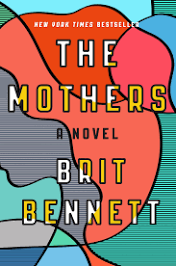
The Mothers by Brit Bennett

As the women (or “mothers”) of the Upper Room, a church at the heart of the Black community in Oceanside, CA look on, Nadia Turner, reeling from the recent death of her mother, drifts from the school where she’s previously been so successful, into the arms of Luke Sheppard, the preacher’s son. They watch as she devolves into a lost soul, wrangling with her grief, unraveling the ties with her friends and even with her father with whom she’d been close. When a crisis arises between Luke and herself, it seems to create a hole in her heart that she spends the next years of her life seeking to fill – and burning bridges and breaking hearts in her wake.

What is most unique about this book is the voice created by “The Women.” We are told this story by the community of women who have been watching Nadia and Luke since they were young, as so often occurs in tightly-knit communities, where everyone knows everyone else’s business – or at least believe they do. The tone is, in this way, kept lighter, and at the same time more familiar. I believe no matter your heritage, we can all relate to that sisterhood of women in some segment of our lives who maintain a running commentary about us: who we’re becoming and what we are thought to be doing – and judging us without trying to appear as though they are doing so. I could not help smiling throughout these sections.

And thank goodness for these sections because the main thread of the story is quite sad. Nadia’s journey is tragic, her life having been pierced by so many losses which she was unable to process with anyone who could be helpful to her. Because her father was so deeply entrenched in his own grief, muddling his way through, he was unavailable to her, leaving her to cope in the only way she could – looking for love and affection from whomever she could find it. She continued to be a lonely figure, unable to fully give of herself because her “self” had become so deeply wounded.

This is an important story, told in a uniquely creative way – an absolutely worthy read!