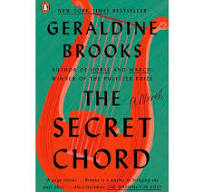
The Secret Chord by Geraldine Brooks

Taken by brute force after the slaughter of his family, Natan, a young boy of ten years, unwittingly reveals his gift as a prophet of the Name. Recognizing his value, David, the leader of the rebel forces being hunted by King Shaul, brings Natan into the fold and keeps him forever by his side as trusted advisor and friend. And it is Natan who narrates this story of David, as he witnesses David gathering strength, power and ultimately the throne over the motley tribes of Israel, revealing David’s wisdom and his failings, his humanity and his vulnerability.

This fictionized version of history is as poetic as it is violent, with scenes of love and of war, scenes of fanfare and of mutiny. The writing is beautiful, with imagery that builds the story in the mind’s eye with crystal clarity. We are given a window into the character of David himself and it is multi-layered and complex. David is a leader, as we all know – but he is deeply flawed, human. He is charismatic, brilliant, musically gifted, and sensitive, and yet his vanity, violence, and blind spots for certain people in his life create his vulnerabilities. Natan becomes his conscience, his guide, and often the only one who will speak truth to him, even as he fears the possible repercussions of his words.

Yet another excellent novel by Geraldine Brooks – though not for the feint of heart. She brings these biblical characters to life and we come to feel what life might have been like at that time for the unstable royalty that was so short-lived in that land.

Caleb’s Crossing by Geraldine Brooks

Bethia is thirsty for knowledge, hoping to absorb anything she overhears her father teaching her brother, Makepeace. Now that she is primarily responsible for the household, since the tragic death of her beloved mother, she is no longer privy to formal education. In fact, she was fortunate to have any at all, given her female status in the 1600’s in Puritanical New England, specifically on the island of what is now known as Martha’s Vineyard. What her father did not know, was that she had also formed a hidden friendship with a native American boy, a “salvage” as they were referred to. It was him with whom she was able to feel her true self, exploring the island, arguing points of philosophy, and exchanging details of their respective cultures. This would prove to benefit them both – as they would both later utilize these skills and mutual understanding to move forward in their lives, and ultimately effect the course of history.

This work of fiction is based on the true life of Caleb Cheeshahteaumuck, the first Native American to attend Harvard College. It is a fictionalized version of his path to obtain the training and the knowledge necessary to matriculate, based on both historical research and the author’s imagination. It is a dramatic story, replete with those who supported him and those who intended him harm. And while we wished him success in his venture, it was unclear if his venture itself was his own undoing.

Throughout the story, the author raises the eternal question of whether integration into mainstream society is a positive or a negative – if it ultimately saves or destroys. For the Native American at this time in their history, when the English were just beginning to overcome them in numbers and in force, it was an extremely dangerous and solemn state. The English were focused particularly on trying to convert the native tribes to Christianity, feeling they were saving the souls of these “salvages,” yet never accepting them fully as their own. On the other hand, the author frequently highlights the ways in which the native cultures uniquely valued the preservation of the land, the full and economical use of the animals they had to kill, and their intimate knowledge of uses of native herbs and plants for food or for healing.

Hearing the story from the perspective of Bethia was also powerful. Women at the time were no more than chattel, and her experience was a strong example of this. Going from a carefree young child who had free range of the island to one who quickly had to adapt to running a household – and worse – we follow her through the full experience of being given little if any agency over her own life decisions.

While the writing here is solid, I have liked other of Brooks’ books more. I believe this book could have been edited down a bit, and more might have happened earlier to keep things moving more quickly. Nevertheless, it is a compelling story and one of tremendous import to tell. A worthwhile read.

Year Of Wonders by Geraldine Brooks

Anna can only imagine what it must be like to have the weight of the whole village upon his shoulders, as does Michael Mompellion, the village vicar. It is he who has carried the prayers, the hopes and dreams as well as the trauma of those who have lived – and died – among them. That is not to say that Anna has not been there as well. Anna, and Michael’s wife, Elinor, who as the time passed, became more of friend and less of an employer to Anna, have nursed so many of the villagers, caring for them and comforting them. But what they saw together, what they experienced, no one should ever have to. And so Anna understands his wrath toward the wealthy family the Bradfords, on their return, after deserting their village when so many relied upon them. What happened after that, however, she did not expect…

Here is another hard and yet utterly addictive novel by Geraldine Brooks. The time is the 1660’s, in a tiny village in the UK where the Plague has been carried into the town by a kindly and unwitting messenger. After he takes ill and gives warning to burn all of his possessions – a warning that goes unheeded – the disease creeps into the homes of those around him and ravages the village over time.

What we see, however, is all too familiar. We see it bring out the best in some and the worst in others. We see a 1600’s version of misinformation and we see people grasping at untruths because they are desperate and have a deep-seated need to blame someone or something for their misery and pain.

Many may feel that this is too soon after our own plague, but it does feel different. To me it highlights our privilege of scientific advancement and evidence-based medicine. It highlights the knowledge we’ve gained over these centuries and the ability to study a new pathogen with logic and with precision- to develop treatments and vaccines to protect ourselves and to prevent the worst outcomes at lightening speed. On the other hand, and most tragically, our most recent plague has also brought to light the continued distrust and misinformation that runs rampant in our communities as well. The cynical and damaging anti-vaccine misinformation that has been circulated by darker forces in our country via social media and Fox News has stirred just as much unrest and backlash toward legitimate science as did the believers in the witches and magical incantations of the 1600’s. (And just like in those times, the motivation is the same: money.)

This is a powerful and elegantly written novel, deeply researched and exquisitely presented. If you have the capacity to read it, it is absolutely worthwhile. I’d call it a MUST READ, if you are able.


Horse by Geraldine Brooks

Jarret, an enslaved Black boy in the South, may be small, but he knows his horses and he knows how their lineage matters. This is what his father has taught him and what he recites with him each night as they sit on their porch on warm, Southern nights. When Jarret witnesses the birth of his newest beauty, Darley, he and the horse form a bond that will last for decades.

Fast forward to 2019, and we meet Jess, who has found herself working at the Smithsonian, far from her home in Australia. From a young age, Jess has been fascinated with the bone structures of animals, and she is now working to prepare them for analysis and study at one of the world’s most venerable American institutions. It is here where her path crosses with Theo, an art history graduate student at Georgetown, writing his thesis and researching articles for a magazine for the same institution. When their research brings them together, they find that there is more that they share than their interest in a horse that lived a very long time ago.

This is one of those novels that you yearn to keep reading to know what will happen, but you also don’t want to keep reading because you don’t want it to end.

There is so much that has been packed into this extensively-researched novel that there is so much to unpack. First, I learned so much about horses and horse racing. Not familiar with this world, I learned about the breeding of the horses, how their treatment and mistreatment has evolved, and how important their anatomy is to how effectively they can race. There is a love of animals that is expressed throughout this novel that I share quite deeply.

The story also depicts racism, as it existed during the 1800’s, when slavery was still legal in this country, and as it still very much exists today. We see how Jarret is treated as an enslaved young man, which varies depending on who has ownership of him (and what they believe they can get from him). We cannot help but compare him to how Theo, our graduate student at Georgetown, is treated in current day, where he experiences almost daily comments, micro-aggressions (which are often not very “micro” at all). Both men are highly intelligent, experts in their fields, and are respected – but over and over again, encounter obstacles purely because of the color of their skin.

But don’t be fooled – the learning is all so easy. It comes through a beautiful story, with beloved characters and a heartfelt and moving plot. And even if you’ve never been on a horse or never watched one race, you will fall in love with Lexington (nee Darley)!

This is 100% a MUST READ! Loved it!