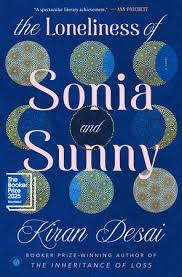
The Loneliness of Sonia and Sunny by Kiran Desai

Sonia is a grad student at an elite college in Vermont. Sunny is an aspiring journalist, working as an editor of news articles in New York. Their lives cross when they each return to India, as their complicated families become connected. There is something of a spark between them – they both feel it. But will their respective demons continue to obstruct their being together?

Somehow, this novel has made it to multiple favorite lists of 2026 and I am a fair bit stunned as to why. Perhaps I am not literary or sophisticated enough to appreciate it, but I found this book to be simply too much work. I could not wait for it to be finished. At its core, there is a valuable story with relevant themes of identity, family, and the immigrant experience. But the author seemed to have sought a way to use 100 words to say what he might have said in 25 – over and over again. In reaching too high for the poetic and the symbolic, the author lost me with with what felt merely aspirational.

An example of this is a tool the author favored: writing a sentence followed by the expression of the opposite. This occurred more times than I could count. If he had utilized this once or twice, it might have carried more weight, might have been thought-provoking. The overuse of this negated its potential profundity. Similarly, the author utilized dreams to communicate the struggle of characters. But, again, overuse of this became tiresome. The reader is kept waiting for something to happen… anything.

The one positive aspect of this tome is that we are exposed to the Indian experience of battling the cultural contrast between their homeland and the US. This is portrayed as both vast and challenging. Both Sunny and Sonia have lived in both countries, but feel somewhat disconnected even as they strive to be more American. I believe their loneliness comes from not only not being with each other, but being away from their family, their home.

I am curious to hear other viewpoints, to know if I am alone in feeling as I do about this book. Any thoughts?

The Boston Girl by Anita Diamant

Addie Baum has been asked by her granddaughter to relay her life story, and, as this is her favorite granddaughter (Shhh! It’s their secret!), she of course complies. She begins her tale with the story of her own parents as they immigrate from Russia, bringing with them trauma that continues to hangs over them and their children. In searching for an outlet from this stressful home life, Addie finds her way to the Saturday Club, a weekly gathering of young girls of varying backgrounds and cultures. When they head out for a weeklong escape to Rockport, MA, Addie sneaks out of her home to join them, and forms friendships that last her lifetime.

What I love most about this tender and heartfelt story is the voice through which it is told. Between the expressions and the phrasing, I can literally hear my own Jewish grandmothers speaking the words written here. The way Addie expresses her love for her granddaughter, the way she excuses herself when she feels she’s behaved, perhaps, unexpectedly, or when she speaks of something she feels guilt for – it all rings so sweetly familiar.

But it’s also a common, generalizable, second generation experience. Addie feels a constant tension between respecting and seeking the approval from her mother, in particular, and needing to reach outside the family for love, guidance, and a way to find her true self. She carries her mother’s trauma because her mother can’t let it go and she simultaneously cannot live with it because it is toxic. Fortunately for Addie, she does find both mentors and friends who she can rely on for safety, advice, and sheer reason, and she learns to navigate through life, utilizing these connections to help herself and to help others.

It’s a truly lovely story. Highly recommend this one!

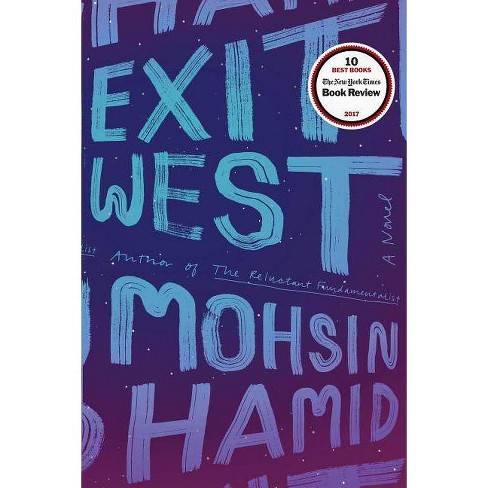
Exit West by Mohsin Hamid

Saeed and Nadia have met at a difficult time.  It is just as their city is being overrun by militants who gradually infiltrate their city.   As the violence worsens, they become more desperate to find a way out.  But do they leave without Saeed’s dear parents?  And how do they escape, when all the exit doors seem to be closed to them?  As they find their way together, they learn about how the world may open up doors, but that there may not be a welcome mat waiting for them at the other side.

I had very mixed feelings as I progressed through the pages of this book.  On one hand, it does open the reader to the very gritty, naked reality of the immigrant experience of these past few years. While we are not told where the couple is running from (and details are vague throughout this book), we can guess Afghanistan or Pakistan as most likely.  As the couple move to new lands, they experience some support, but mostly harsh conditions and resentment and prejudice by the “nativists” in each of the countries to which they flee.  At one point, Nadia even wonders if it was worth running from their oppressors, having only come to another country in which she is being oppressed.

On the other hand, because the writing is so sparse on details, it feels somewhat disconnected from the characters themselves, and I felt almost less invested in their story because of this.  We like them both, Saeed and Nadia, but we don’t get inside their heads.  We don’t feel what is deep in their hearts – they are a sort of neutral territory.  And when random characters are introduced, some from across the world, in random order, with tiny, yet interesting stories of their own with no connection whatsoever to the story at hand – I am just not sure where those come from or why they are included.  It is either strange editing or I am just not smart enough to get it.  (It is probably the latter, I admit.)

On the other hand, again, there are some details I like and think are creative.  I like that Saeed and Nadia are the only characters to be given names, while all the other characters are identified by their descriptions only.  It is a powerfully literary way to  further isolate them – and their experience is certainly isolating — as they travel through each “door” into each new country, into each new opportunity.

As you see, I am truly going back and forth on this one, as I did while I was reading it.  It is an interesting read, but I am still not sure whether I liked it or not. If nothing else, it has stimulated much thought – so that counts for a lot, right?

I’d love to know what others think about this one!