How are four very different women with widely varying histories drawn together in the middle of an earthquake in San Francisco? From the beginning, we meet Gemma, a soprano newly arrived to join the Met Opera Company for a stint in the chorus. We also meet Suling, a young woman promised by her opium-addicted uncle to a much-older doctor, who is saving her pennies by doing extra work as an embroiderer to try to make her escape. These two form an unlikely alliance, along with Gemma’s housemate, Alice, a research botanist to uncover a shocking criminal.
Once again, along with Janie Chang, Kate Quinn has created powerful, unusual, and vulnerable characters for us to love. These women I’ve described, along with a fourth – Gemma’s friend, whom she thought she was following to San Francisco, but who seemed to have deserted her for Colorado – all have creative personalities, complicated circumstances, and strong loyalties. And the twisty plot binds them together into an unlikely kinship that enables them to be there for each other until the very climax of the story.
And while the story does fall into that trap of tying the ends up just a bit too neatly, it also feels right to do so in this case.
I really enjoyed this one. I’d love to hear what you all think!
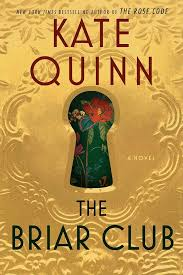
When we are first introduced to the Briarwood House, we are informed that there are 2 dead bodies found within. This is in 1954.
We are immediately transported back to 1950, however, when Grace is first shown the tiny closet of a room on the top floor of this women’s boarding house, when she decides she can make this work, at least for the time being. Her answer to the cold, mean and nosey Mrs. Nilsson who runs the place? To undermine her rules and start a dinner “club” in this tiny room for all the tenants of the house on Thursday nights, when she is out at her regular card game. In this way, Grace creates a community within the house and actually makes the house a home to this disparate group, gets to know their various stories, even as her story remains quite mysterious.
This is yet another astonishing feat created by the extraordinary Kate Quinn. With the disturbing background of the McCarthy era, the oft-ignored Korean War, the pervasive fear of a Russian nuclear attack, and the absence of power that women still had over their lives and livelihood, Quinn sheds light on the fact that the 1950’s were not necessarily “Happy Days.” Her characters are not the sweet and shiny women we often expect from this time period, but they are real and they are hurting and they reflect the life experience they’ve each been through. We learn that there is a reason we are who we are.
The plot is also so intricate and suspenseful that I guarantee you will not be able to put this book down until you turn the final page. I was absolutely kept guessing until the very end.
This may be one of Quinn’s best novels, in my opinion – and that is high praise! It is deeply-researched, with relatable characters, and with a twisty plot that kept this reader’s light on through all hours of the night just to get to the finish line. Here’s one more MUST READ to add to her list!
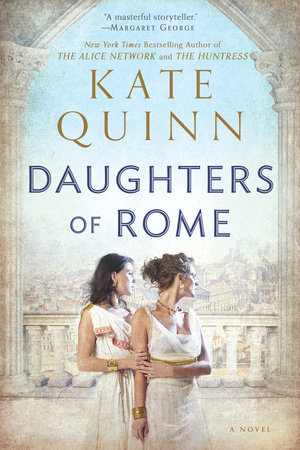
In the year 69 AD, Rome was the center of upheaval and violence, as the title of Emperor became as changeable as the seasons. During this tumultuous time, the “Cornelias,” as they were referred to — two sisters and their two cousins — were very much a part of the events, as they were in the “inner circle” of the elite. The first Cornelia, the eldest and most dignified, was married to a man expected to be named heir to the Emperor, so she saw her place by his side. Her sister, Marcella, the historian, kept occupied recording – and somehow impacting – the historical events of the year. Lollia, one of the cousins, was serially married off to the power-broker of the day by her wealthy and strategic grandfather. And the youngest and wildest, Diana, was one obsessed not by men but by horses. And while each brought vulnerability to each other, each brought strength as well, as they fought to survive the many changes this year brought to their lives.
While it did take me a bit of time to be fully engaged in this story, perhaps because of my own ignorance of the historical details of this era, once I got to know the characters (and appreciate their depth), I was all in. Because I came to love these Cornelias, I became invested in their welfare and as the plot became more entangled, so did my fascination with their story. This plot had intrigue, romance, suspense, and twists that brought both smiles and tears as I got to know these characters better and better.
My favorite character, I have to admit, is Lollia. When we first meet her, she appears, on the surface, to be just that – all surface. She appears vain, coddled by her wealthy grandfather, and only concerned with what she can gain by her marriages. But as we get to know her, we really see her: her generosity, her kindness, her humility, and her ability to love deeply and to look beyond what is expected and to do what is right.
Not only will you fall in love with these beautiful characters and their bond with each other, but you will also learn about this wild year in the history of the Roman Empire, where there were four different Emperors in a brief, bloody period of time. It’s what I love most about historical fiction – and Kate Quinn is the master!
Although he’d found many former Nazi criminals already, Ian was not yet satisfied. No, the Huntress, as he’d come to refer to her, was unique and the quest for finding her burned inside him like none other. So when Nina reappeared before him and his unsuspecting business partner Tony, with her own yearning for revenge against the Huntress, it felt as if they had no choice but to pursue her no matter where it would lead them.
And meanwhile, on the other side of the “pond,” Jordan, a young woman trying to pursue a career in photography but caught up in both her father’s antique business and his personal life, was developing her own concerns. While she was happy and trying to be open-minded about her father’s newfound love, there was something just a bit off about her father’s new lady friend that Jordan could not quite put her finger on. With her camera always at the ready, Jordan followed her instincts and did what she had to do to protect herself and what became her family.
Kate Quinn is an absolute master of combining significant historical fiction with hair-twisting suspense. The characters she creates are ones whom we get to understand almost better than ourselves, and we love them for their failures, their vulnerabilities and their grit. Nina is one such character, who is tough, brusk, even rude – but we understand her because of her history which we gradually become privy to. And because we develop this attachment to her, we cannot bear to see her hurt again. It is because we care so much about each of the characters that the suspense is that much more heightened. And the construction of the plot is woven around these gorgeous characters so well – it just becomes impossible to put this book down.
While this may not necessarily be a MUST READ, it is certainly close – and I’d highly recommend it as a should definitely read if you like suspense, historical fiction – or just want to enjoy a completely engrossing and addicting novel!
Lyudmila Pavlichenko only wanted to protect her son when she went to retrieve him from the shooting gallery, where his usually absent father had brought him. He was only 5 years old, and the foolish boor was trying to impress him with the use of a gun, no less. Well, if that is what made a “good” father, then she would be both a good mother and a good father to her son. In addition to attending her graduate studies, working to earn money, and caring for her son, she also got herself certified as a sharpshooter. Little did she know how useful that would become, how it would equip her for the battles that were to ensue on her home turf during the second World War, and how it would change the course of her life forever.
Though this novel is fictionalized, it is based very closely on the memoir and historical accounts of the life of this true heroine, Lyudmila Pavlichenko (or “Mila”, to her closer friends). While women in Europe and America were only utilized in medical or administrative capacities until very recently in the military, they were occasionally utilized as front line fighters by the Russian military much earlier on. And although these women still faced harassment and were not generally treated as equals, there were a few, such as Mila, who were actually acknowledged for their contributions, which were extraordinary. In her case, she earned her moniker of “Lady Death” as a sniper, with an official head count of 309 Germans killed during the war (and probably more, in reality).
Quinn has become another of my favorite authors, uplifting strong women in history and bringing them into our consciousness. We can now appreciate, for example, how Lyudmila Pavlichenko not only contributed so bravely toward the fight against fascism with her rifle, but she also did so with her honesty and charm. Brought to America in a student delegation to help convince the US to open a second front in Europe to support the war against the Germans, she formed a personal friendship with both Eleanor and President Roosevelt. And though she shied away from the spotlight, she did not shirk her duties when it came to speaking up for gaining support for her fellow military fighters who were out in the field trying to protect what she felt were forces against evil.
I will say, while Quinn’s other novels truly grabbed me from the first page, this one took a bit of time for me to become fully absorbed. There was perhaps a bit more detail about the ammunition, war strategies, and the layout of the stakeouts than I might’ve needed personally (my eyes may have glazed over just a bit). But the suspense definitely built quickly enough, and there were a twists and surprises that caught me off guard, for sure. By the middle I was hooked and by the last few chapters, I was 100% riveted and could not put the book down until I finished it – including the author’s notes!
Quinn’s deeply researched novels consistently highlight how hard it has been for women to be acknowledged for even the most stunning achievements. She does this while keeping us engaged, entertained, and always wanting more.
I say it again – this is the very best way to learn history! And why I loved this book.
The dust has barely settled and wounds have certainly not yet healed from the second world war when Charlotte finds herself dragged by her mother across the Atlantic on the way to take care of her “Little Problem” in a clinic in Switzerland. While her mother is determined to erase this “stain” on Charlotte’s reputation, Charlotte has a very different mission in mind. While here in Europe, she sees an opportunity to uncover the whereabouts of her beloved cousin Rose, who has been missing and presumed dead since returning to France just before the German occupation. With the name and address of Eve Gardiner which she has scribbled on a small piece of paper, she unlocks an adventure that leads her to discovering much more than just what happened to Rose. She discovers a network of brave women who risked their lives for their countries and she uncovers her own inner strength as well.
The Alice Network is another suspenseful novel by the author of the Rose Code (see my prior entry), which will similarly have you on the edge of your seat as you turn each page. There is a great deal of historical fact woven into the fiction here, as Quinn celebrates the unsung female heroes of the first and second world wars. We learn of the undercover spies that wore skirts and makeup instead of slacks and blazers. They were often ignored because they were “just women,” which sometimes enabled them to sneak through borders undetected, but sometimes led to them being ignored even when they carried valuable information that might have saved hundreds of lives.
The writing here is crisp, acerbic and intricately plotted. We float back and forth between Charlotte’s pursuit in 1947 and Eve’s back story (WW I). The characters are, each of them, hardened and broken, wounded in one way or another by war. When we meet Eve, for example, she is in a drunken rage, threatening Charlotte with a Luger in her face and trying to send her away. She is emotionally and physically crippled by her experience in her war. We see so starkly how women were affected by our wars – whether working under cover, nursing, or being on the front lines in other ways – and their wounds are obviously just as deep.
I highly recommend this novel – it is historical fiction at its best.
Osla and Mab come from very different backgrounds, but suddenly find themselves on a train headed toward the same, mysterious destination. What with the war on, who knew what they’d be brought in to do to fight the Nazis, who seem to be speedily and frighteningly making their way toward London. What awaits them is a challenge beyond their imaginations, and an opportunity to prove that they can do more than be “witless debs.” What also awaits them is a profound friendship that brings its own challenges and heartbreaks as well.
This is an amazing yarn of historical fiction that will keep you on the edge of your seat from the very first page to the last. Do not be daunted by its length, because it will glide by in a heartbeat and you’ll only wish it had lasted even longer (although you will be happy that it didn’t because you’ll finally get some sleep!). The writing is brilliant, with the story structured by flipping back and forth from during the war to just after the war, creating a knot of suspense that keeps getting tighter and tighter throughout. The characters are strong and vulnerable and we come to love them, even when they are imperfect and rash. And even if some of the final scenes are a bit implausible, we believe them anyway, because the drama is right there where we want it – no, need it – to be.
And we learn quite a bit about how the war was actually won against Hitler and his army. It wasn’t necessarily just about sheer force, but rather intelligence, breaking code. Somewhere in a small town outside London, on a compound where secrecy was maintained above all else, codebreakers – often women – were employed around the clock to break the codes the Germans were using to communicate their war plans to each other. In addition, this base was utilized to enable false messages to be sent back, to mislead the enemy. Apparently, this was done by those sworn to secrecy on threat of treason to the crown.
This is another MUST READ – you won’t regret it, I promise!




 kindread spirits