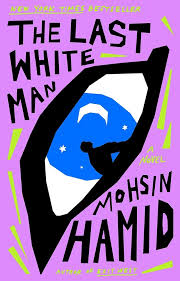
The Last White Man by Mohsin Hamid

Anders, a white man, one morning awakes to find himself having turned “a deep and undeniably brown.” He notes this first on his arms, then on his body, and in the mirror, sees he is now, completely, dark-skinned. He is, at first, just shocked. Not knowing what else to do, he calls in “sick” to his employment at a nearby gym and just stays home, thinking it might be something temporary, but knowing, deep down, it is not. What will his new lover say? What will his father say? As he begins to move through the world with this new appearance, he learns that he is not alone in his experience.

This is a most unusual book, both in the concept and in its execution – and I’m still undecided if I believe it’s in a good way or not. While the idea is unique, imaginative, and clearly meant to be an allegory, it felt almost too obvious, too blunt to be so. Some may find it even comical, in a perverse way. Moreover, the writing is also bizarre. Hamid is the master of the flip-flopping, run-on sentence, some of which continue for the length of his paragraphs.  Too many of his lines are similar, writing contrary phrases within the same sentence, which sometimes is effective and sometimes is just confusing. While I might have found it an understated and useful technique if used occasionally, it is so overused that it becomes almost tiresome.

Underlying the writing, though, there is a message that is, in fact, powerful. Hamid is making a statement here about the unnecessary social construct of race; that is, how we in America have assigned all sorts of attributes with various ones, and how absurd it all is. He is making race irrelevant here, evening out the playing field, as it were. In this way, I do have a deep appreciation for what he is trying to accomplish. 

I am curious to hear from you all if you feel he has achieved it – or not? I’m still digesting it, I think…
 

The Reluctant Fundamentalist by Mohsin Hamid

In this novel, we meet Changez, as he relates the story of his youth to an American stranger he meets in a public square in Pakistan. We hear about his journey to Princeton and then to New York, his successes and struggles as he moves forward academically, socially and romantically. We also learn about how his experience as a brown man following the attacks on the Twin Towers become pivotal to his relationship with America as a whole.

What is most unique about this book is the voice used to tell the tale. Changez is sitting with the American, whose name we never learn, and we hear his side of the conversation throughout the narrative. It is a wonderful way to convey the story, in that we can envision the two men, dining at a table in the market square, as the light dims with the passage of time.

While this conversation scene is fairly tranquil, the subject matter is not. Changez is subjected to constant “othering” during his stay in the US. Even prior to the World Trade attacks, he is never quite included in social circles, never quite one of the crowd. Even in his romantic relationship, which is more imaginary than real, he is never loved or appreciated for who he is, but rather tokenized and used. One can certainly understand the rage that gradually builds and builds until he finally, much to his own surprise, implodes.

This is an iconic work. It is a quick read, but has so much to teach us packed into its pages.

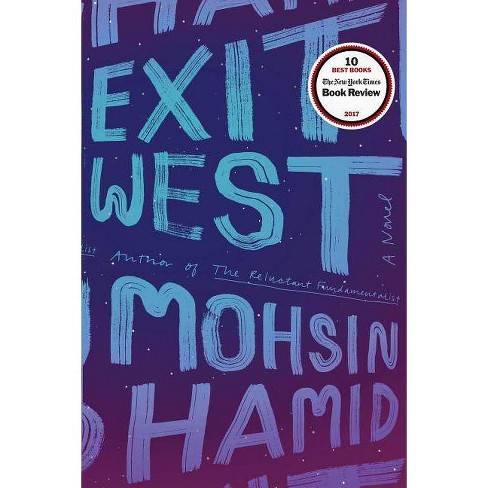
Exit West by Mohsin Hamid

Saeed and Nadia have met at a difficult time.  It is just as their city is being overrun by militants who gradually infiltrate their city.   As the violence worsens, they become more desperate to find a way out.  But do they leave without Saeed’s dear parents?  And how do they escape, when all the exit doors seem to be closed to them?  As they find their way together, they learn about how the world may open up doors, but that there may not be a welcome mat waiting for them at the other side.

I had very mixed feelings as I progressed through the pages of this book.  On one hand, it does open the reader to the very gritty, naked reality of the immigrant experience of these past few years. While we are not told where the couple is running from (and details are vague throughout this book), we can guess Afghanistan or Pakistan as most likely.  As the couple move to new lands, they experience some support, but mostly harsh conditions and resentment and prejudice by the “nativists” in each of the countries to which they flee.  At one point, Nadia even wonders if it was worth running from their oppressors, having only come to another country in which she is being oppressed.

On the other hand, because the writing is so sparse on details, it feels somewhat disconnected from the characters themselves, and I felt almost less invested in their story because of this.  We like them both, Saeed and Nadia, but we don’t get inside their heads.  We don’t feel what is deep in their hearts – they are a sort of neutral territory.  And when random characters are introduced, some from across the world, in random order, with tiny, yet interesting stories of their own with no connection whatsoever to the story at hand – I am just not sure where those come from or why they are included.  It is either strange editing or I am just not smart enough to get it.  (It is probably the latter, I admit.)

On the other hand, again, there are some details I like and think are creative.  I like that Saeed and Nadia are the only characters to be given names, while all the other characters are identified by their descriptions only.  It is a powerfully literary way to  further isolate them – and their experience is certainly isolating — as they travel through each “door” into each new country, into each new opportunity.

As you see, I am truly going back and forth on this one, as I did while I was reading it.  It is an interesting read, but I am still not sure whether I liked it or not. If nothing else, it has stimulated much thought – so that counts for a lot, right?

I’d love to know what others think about this one!