A Town With Half the Lights On by Page Getz

Sid Solvang does not want to discuss why he has come from Brooklyn, New York to the tiny town of Goodnight, Kansas with his wife and daughter. He just knows he must find some way to make enough money to get them back to Brooklyn, and the sooner the better. It just cannot be anything involving a kitchen or cooking – he is done with all of that. Certainly, the locals would be more than happy to see these “outsiders” leave as well. His wife, Scarlet, has been selling off what she can find in the ancient Victorian house and barns she inherited from her recently deceased father, but that will only go so far. However, when the rundown diner, the central gathering place of the town is up for sale, Sid can’t help but think they might be able to help the town by rescuing the diner. Once they begin to get to know their clientele, and the folks get to know him, at least some of them begin to understand that kindness can break down many barriers.

Not only is the plot of this story original, but the telling of this story, exclusively via emails, journal entries, and newspaper articles is unique as well. The writing, with its acerbic wit and gritty imagery, is fantastic. The characters are ornery and angry, and yet warm and sincere, and they will inevitably work their way into your heart. We come to love the wild friend of Sid’s daughter, Disco, known for her glitter, her blue guitar, and her love of country music. While she is ostracized by all of her peers, she has a heart of gold and is the only one who welcomes Sid’s daughter Harlem to the town. I also love the hardened waitress of the diner who keeps everyone in line but has a soft spot for anyone who is kind (including Sid).

While there is some predictability, there are also many surprises. And the beauty of each of the characters wins out over all. You will laugh out loud, choke up, and root for the town in a way that will likely surprise you.

A wonderful read! Very highly recommend this one!

A Thousand Acres by Jane Smiley

Ginny is entirely caught by surprise when her powerful, workaholic father suddenly springs upon her and her sister, Rose, the idea that he is right now giving his entire farmland to just them, leaving out their younger sister, Caroline. While she understands in her heart that Caroline has never been interested in farming all the while both Rose and Ginny’s husbands have been farming alongside Ginny’s father for years now – Ginny still knows that this is a moment of fracture for the family. Where is this coming from? And how will it play out? She cannot even begin to guess…

I believe this is another example of a good idea not ideally executed. The author has attempted to paint a picture of a tyrant – Ginny’s father – who has wielded his power and influence in their insular, misogynistic, community to his supreme benefit. He has abused his children, tormented everyone around him, and then, when he may actually have to pay for his sins, he presents with dementia, so he evades culpability. But in telling this sordid tale, there is so much detail, so many tiny moments that the thrust of the message becomes fogged over, gets somewhat lost.

Even as the author portrays Ginny’s journey to find her own voice, to grow out of her own fog of misguided content, the message is blurred. After being initially blinded by her own will to stay the course, to not see what has been, she begins to awaken to the reality of her past and her actual present. She begins to stand up to her domineering sister, Rose. We begin to see strength. But, again, there are so many details. There is her relationship with Rose, her relationship with her sister, Caroline – such as it is. There is her flirtation with a neighbor who has come back after being away many years, which serves to distract her from her present situation – and distracts us as well. There are also the details of her life, her cleaning of her home, her cooking, her ironing, the everyday living that perhaps imbue reality but also bog us down in minutiae. It becomes too much.

A Thousand Acres becomes a thousand words that could have, perhaps, been a mere hundred.

Penguin Lessons by Tom Michell

At the tail end of a vacation from the Argentinian boarding school where he is teaching English to high school students, Tom Michell is walking on a beach in Uruguay and has stumbled upon a hideous scene: hundreds of penguins lying dead, washed ashore, having been essentially suffocated by an oil spill. Rather than immediately recoiling and turning away, Michell feels drawn to witnessing further this terrible crime, and further surveys the devastation. As he looks around at all these carcasses, he notices in the corner of his eye a brief movement – just one out of all of these many, many poor birds begins to move and lift its head. After running back to his hotel to grab a bag and other equipment (what does one use to rescue a penguin???), he runs back to the spot where he had seen the surviving bird and mangles him into the bag and somehow gets him back to his hotel. Once the penguin sees that this human is not out to hurt him but is actually trying to help get him cleaned of the residual oil and tar that has clung to his feathers, the penguin suddenly becomes docile and friendly. And so begins an unlikely and beautiful friendship.

This memoir is just utterly delightful. I have not yet seen the movie, which I know was released a few months ago, but the book is pure joy. The story of how Michell brings the penguin, ultimately named Juan Salvado (or Salvador), over the border to Argentina, is both charming and outrageous. His acceptance by everyone around him on campus highlights both the generosity of spirit of those who are at the school and the personality of the bird himself. And what the bird brings to both the children and the adults around him is so beautiful to witness, even vicariously. While the bird requires work to keep him, it is clear that everyone who helps care for him absolutely benefits so much from the honor. And there is so much to learn from this.

There have been a number of stories here in this blog that have highlighted the relationship between people and their pets/animal friends – but this one, I believe, takes it to the next level. The fact that the care of Juan Salvado became such a communal effort was of such deep psychological benefit to both the penguin – who demonstrated joy at every human interaction – but also to those who visited him, fed him, washed him, and cleaned his terrace. Anyone who came to see him literally spoke to him as if he were human, confiding in him, even asking advice. It is not a reach to say that we clearly benefit so much from our fellow creatures, and that we must care for both them and the world they inhabit.

This is a beautiful story throughout. Michell has given us a gift, sharing his experiences with Juan Salvado.

The Bee Sting by Paul Murray

Cass has fond memories of her family when she was younger – playing with her father and younger brother, PJ, in the woods in the back of her home. But it is hard to reconcile those memories with her life now, with her father forever working at the car dealership, her mother either complaining or being completely absent, and her brother, well, he’s just annoying. Why can’t they understand that all she wants to do is hang out with her friend, Elaine, who is cool, beautiful, knows how to navigate being a teenager. Later, when we transition to the perspectives of each of the family, we learn the true story of each of them and how their lives lead up to one precarious moment.

This novel begins VERY slowly. The author lays down the bricks one by one to set the foundation for building the characters as well as the plot. He also rotates the perspective of the characters, while mostly still writing in third person, varying the grammar/punctuation with the character, which provides a unique voice and tone for each of the characters. We hear about events from each of their perspectives, learn new details and explanations. Each brings a new “aha” moment, a new enlightenment that gives the story a deeper meaning.

I suppose the question is does it have to be as slow and plodding as it is? Perhaps not, but because it is, it is more and more gratifying when you get each of the “aha” moments. Each one carries with it a reveal, a connection, a wiring of one plot point to the other that makes sense of the whole picture. It is like putting together an enormous puzzle, one piece at a time, which can only be done slowly and methodically. If done haphazardly, one might never quite get it right.

But the story itself is complex, tragic, and ultimately beautifully rendered.

So, if you’ve got the patience and the time, and you’re after an intense and complicated plot with deeply complex characters, this novel is absolutely worth your while. Just keep at it – I believe it’ll be worth it!

The Music of Bees by Eileen Garvin

Each morning when Jacob awakes, he feels it all over again – the shock of not being able to use the legs he once took for granted. He has relived that moment over and over in his mind of going from a normal, if rebellious, adolescent to one who cannot go anywhere without his damned wheelchair. And while his friends have tried to reach out, he has recoiled from their attempts, because, well, what’s the point? And then there is Alice, fairly paralyzed herself, but by the grief she’s felt since the death of her husband. And although she goes to work and cares for her beloved bees, she is really just going through the motions, isn’t she? At the same time, Harry is not far away, despondent since his uncle has been dragged away from their home, trying desperately to figure out where his next meal might come from. It is these three very disparate characters who will, by unforeseen circumstances come together, join forces, and in fact, perhaps even save each other.

This is a truly poignant story. Each character has suffered deep pain and is swimming in his/her trauma, trying desperately not to drown. None can see any sort of hope. It is only when they are together that they are able to bolster each other, to embolden each other. Much like the bees that they come together to care for.

In this novel, we are told much about how the community of bees works constantly for the benefit of the whole hive; how each member has a specific mission, how interdependent they are. How essentially, if a few fail, they all fail. What a lesson for us all, right? In this moment when so many of us are so isolated, so intent on working from home, so avid to avoid communal spaces, we may, actually, be hurting ourselves. When we’re connected with others, we improve our mental health and we improve societal health as well.

Another stunning lesson from nature beautifully transposed through this story.

The Island of Missing Trees by Elif Shafak

It was almost winter break, just before classes were to be let out, and without her even understanding why, Ada did something she could not explain. And it was utterly mortifying. And she would never forget it, especially with social media magnifying it for the world to see. Could it have something to do with her mother’s recent death? With the fact that her father, so dear to her but feeling somewhat cut off because of their separate paths of grief? Or could it be that she has felt cut off from her family’s history, as her parents have rarely spoken of their past lives in the war-torn island of Cyprus? Perhaps the surprise visit by her mother’s sister will reveal the answer she is looking for.

This book had all the potential for an excellent read. It was creative in that it was told from the perspective of both the characters involved as well as a fig tree, an objective observer of both humans and the natural world they inhabit. It provided insight into an island/country about which I knew little and was sad to learn had a violent past; that is, that multiple empires had ruled over the island and most recently the violence was between the islanders themselves: the Turks and the Greeks who had lived there for generations. It also had a personal conflict: that between Ada’s current situation and her past, of which she knew so little but had much curiosity. Her colorful aunt served as the connection between the two.

Sadly, something was sorely missing here. In part, much of the story was predictable. There were few to no surprises. The characters were also not fully developed. I felt that I was left at the door to their hearts but not allowed fully inside. I was told what they had experienced but not what they’d felt. It felt superficial. And yet, at the same time, I also felt that much of the writing was too detailed. I am a fan of science and love learning factoids about nature, but the Fig Tree’s parts were utterly rambling. I often found myself skimming just to get through them.

Another great idea that was not ideally executed. I did learn, however — about Cyprus and its history and culture. That is the up-side! 

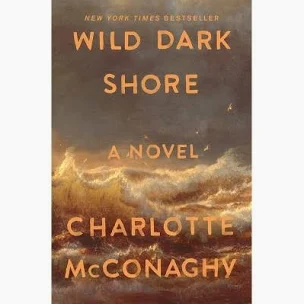
Once There Were Wolves by Charlotte McConaghy

Inti is on a mission here in this sheep farmland of Australia, and these farmers are not going to stop her. Can they not understand that after they had hunted the wolves to extinction, their ecosystem faltered and the forest became unstable because of it? Here she is, with her team of scientists, trying to save the forest with her proven method of rewilding the landscape with the reintroduction of wolves and they are fighting her at every step. Out of fear? Out of ignorance? Who knows? But as Inti battles these townfolk, she is also battling her own demons – hers, and those of her twin sister, Aggie. And maybe, anger and fighting can blind a person, dangerously, to what is right in front of them.

This is a stunning novel with a lofty mission. We are carried into Inti’s story, her mission to save the forest, a suspicious death, and her past that is entangled so deeply with her sister Aggie’s. Complex plot, complex characters, engaging from page one. But we are also afforded a window into the unique and mysterious wonders of the wolf – its habits, its predatory prowess, and its deep loyalty to its pack. We learn how essential the wolf as predator is to the whole ecosystem of the forest, keeping its prey in check in order to maintain the balance that evolved over centuries and that man did his best to try to destroy.

One can read article upon article about our endangered environment, but when we connect with it in a story such as this one, I believe it has a much stronger impact emotionally. By creating characters whom we relate to and who become heroes to us, we become more personally committed. Even the wolves are characters here, and we become attached to them, come to know them and their personality traits as Inti surmises from her tracking of them. And even though we know this is fiction, albeit with much fact woven through, because we are so invested in these characters and their outcome, we are also invested – enlightened, even – in the urgency of saving our planet – so much more than an article could ever accomplish.

It is a lofty mission that is absolutely accomplished, and beautifully so. Very highly recommend this – and if you’re environmentally inclined, consider it a MUST READ.