Maisie Dobbs is pulled in once again to a new case, when she learns of a young boy, a messenger in London during WWII, who is witness to a brutal murder. The problem is that those around her seem to not believe this young boy, who, to her, seems not only trustworthy, but also in danger himself and worthy of protection. So even while she is caught up in clandestine work for the British defense against the Axis forces herself, she cannot resist delving into the details of this case as well, even when it might put her and those around her in potential danger.
I should probably have read this series in the order they were written, because there are recurring characters and continuing story lines. Nevertheless, each book is a stand-alone novel and a story worth reading and I have found each that I have read engrossing, entertaining, and endearing. Each character is written with charm and wit and the relationships between the characters are quite beautiful. For example, the working relationship that has developed between Maisie and her assistant detective, Billy, has grown into a collegial and respectful, and yet tender and caring one. They are a formidable yet wholesome team.
This series is a fun mix of historical fiction and mystery/suspense that always achieves just the right grittiness and never disappoints.
Moshe never imagined himself worthy of such a catch as Chona, the beautiful daughter of the owner of the grocery store who, because of her limp, was reading in the back more than she was working in her father’s store. He was actually more focused on getting himself settled, out of debt, financing his theater, which he managed to do by inviting in the Negroes of the community of Chicken Hill as well as the Jews (a radical move in the early 1930’s in Pottstown, PA, where the KKK had its annual parade down the town center). But he managed to win her heart with his openness and his respect for her intelligence and free spirit. And they were happy together, their only disagreement being about where they should live, he believing they should move out of town, as most of their fellow Jews had, and she believing they were already home, with their Negro neighbors who had always been their friends and saw no reason for them to leave. Of course, he gave in to her, as he always had, knowing that their closest friends were right there with them, the Black couple who worked with them day in and day out, Nate and Addie. When this couple approached them with a request for a favor, Chona immediately said yes, setting them up for trouble they had no idea they were in for.
James McBride has a magical way of creating the most colorful characters who are flawed in the most gorgeous way possible. Chona, with her limp, her seizures, and her mysterious illnesses, is the most beloved character in all of Pottstown. Nate, with his inner turmoil and fury, has a quiet and kind exterior that earns him deep respect (and, yes, fear) from all who encounter him. And the bonds that form between these beautiful, sometimes comical, sometimes tragic characters, often of different races, are borne of longstanding histories of common suffering and oppression. By necessity, yes, but also by loyalty and friendship as well.
Herein also lies a commentary on how the mentally ill were treated at the time, which is to say that they were not treated at all, but rather locked away from society, and at the mercy of generally untrained, unkind, and unsupervised caretakers. Utter chaos reigned and heaven help anyone who was brought to one of these facilities. Moreover, it was a random path to finding oneself there, as “diagnosis” was random, not scientific at all. One could be physically ill, deaf, speak a foreign language, or just have a different view of life and find oneself declared mentally ill. And if you were not mentally ill when you first got there, the “treatment” there would ensure that you would be after a short time.
This is a powerful story, there are powerful commentaries on life in the US as non-white folks, and it is well worth the read. Don’t miss it!
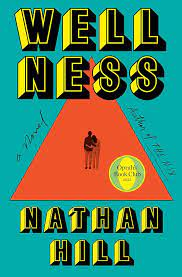
Jack cannot help himself. He cannot look away from his window that faces the apartment across the alleyway from his – into the apartment of a woman who has captivated his heart. Somehow, he has found himself in love with her, or at least with everything he imagines to be her. And when he meets her, months later, Elizabeth seems to be everything he dreamed she would be. They connect on an instinctual level, sharing their affinity for all things non-conformist, radical 90’s music and art, rebellion against capitalism, an overall cynicism toward traditional life. But as they age, they fall into patterns they never expect – marriage, parenthood – that challenge their prior efforts to shed their respective, traditional, pasts. And gradually, their pasts slowly seep back into their present, as a reminder of who they really are, at their fundamental truth.
I honestly had varying reactions to this book as I read through it. There some passages that I felt were so unwieldy and wordy that I felt my eyes glaze over – but then there were other entire sections that were so well-written and brilliant that I was so glad I read the book. Overall, I felt it was worth the read and that it had multiple messages that were important, but it was not without its effort.
There is tremendous symbolism here, so much to learn from these characters. Both Jack and Elizabeth come from families with deep pathology, and both raised with minimal affection or love. This void is apparent both in their inability to communicate effectively and/or honestly to each other, and in the absence of meaning in what each of them do professionally (Jack’s photography without taking pictures and Elizabeth’s use of only placebo to treat her clients). They deal in nothingness, as one character accuses them of – and this deeply resonates.
Where the narrative becomes onerous is in the occasional weedy explanations that feel like rabbit holes the author drags us down. For example, we are taught in mind-numbing detail about the algorithms of Facebook and how they operate to create the echo chambers we find ourselves in. And yes, it allows us to see just how Jack’s father, much to Jack’s chagrin, has become radicalized, step by step, committed to his conspiracy theories and deeply entrenched in a subculture of lies – but we might have learned this in a few paragraphs rather than a few chapters.
Overall, however, it is a clever story, with layers of detail and plot lines, interesting characters, and lessons to learn. Not a MUST READ, as I had been expecting, but it is a worthy read in the end, in my opinion.
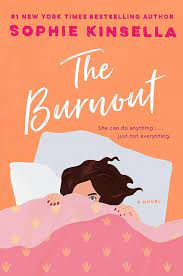
Sasha has reached her limit. She can no longer keep up with the emails, the workload, the exasperating demands that her boss keeps piling on with unrealistic expectations because of their absurdly short staffing. When she tries to express this to his brother, the founder of the company, she is so rudely ignored that her anger drives her to a breakdown of sorts. Within days, she finds herself “getting away from it all” to a beach resort that does not exactly measure up to her memory of what it had been in her youth. But she rises above, goes with the flow, as they say, and she finds that ultimately, she is able to find her way to being more honest both with others and with herself about what she needs to be happy and fulfilled.
This story is one of those lighthearted indulgences that you take with you on a vacation and read with pure pleasure. There is no work to it, there is no deep thought – it is just good, clean fun. Sophie Kinsella is reliable for this – for sweet, charming characters that will soften your heart and make you giggle and give you a chance to escape from our crazy world for just a bit. We know where the story will ultimately lead and we know it will all be ok – and sometimes, we just NEED to know that it will all be ok.
A delightful escape novel for those looking for one…!
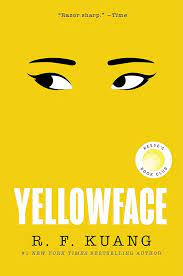
June Hayward is ambitious. She knows in her bones that she was born to be a writer, and in spite of the fact that her family will not see it as a legitimate career, she is determined to prove this to be true. And even as she has faith in her own potential, she cannot help but worship Athena Liu, who has become, straight out of Yale where they met and became friendly, an overnight success. Where June ultimately takes this drive, this deep need for acknowledgement will likely shock you — again and again and again.
This story is an indictment of both the publishing industry and social media. The hoops that potential authors must jump through to get to be seen creates an almost closed loop for so many. If you don’t have an agent, you cannot get your manuscript looked at by an editor – but if you’ve never published, it’s almost impossible to get an agent. If you do succeed in breaking through, you may become either the newest darling of the industry or depending on public opinion, the newest pariah. And it is not necessarily the case that any publicity is good publicity.
And social media, magnifies any controversy ad infinitum. When June is outed for the controversy she starts with her book, for example, the online discourse goes utterly viral. She cannot get out from under this. There are some creative ways in which she attempts to handle the attacks, but they mostly backfire – as they often do. And they are personal, cruel, and, well, yes, true. But we still feel a bit sorry for her, which is the beauty of this book.
In spite of her deeply flawed logic and her repeatedly poor decision-making, we are still sympathetic – at least to a point – toward June. We get her – we are able to see her, at least in part, as an underdog and, in a way, we do sort of root for her, in spite of her persistently absurd choices. Which is what makes this book a fun read in spite of all the cringing we cannot help ourselves undergoing throughout. It verges on funny, on sad and on absurd – all at the same time. But always, consistently, cringeworthy.
Definitely a worthwhile and entertaining book to delve into!
Mariamma is only 12 when she’s told she is to be married off to an older widow. There is nothing to be done, as this is her fate, just as it was for her own mother and those who came before her, in her home in southern India at the start of the 1900’s. She is, in truth, more worried for her dear mother, who herself has been widowed and is now at the mercy of her father’s brother, who perceives her more as a burden than as family. But Mariamma knows she is loved, knows how to love, and this serves her well. She enters her new home with an open heart and embarks upon a journey that brings her both great joys and deep sorrows.
This is a gorgeous family saga that enriches the reader with a deeper understanding of not only Indian culture, but of a bit of the unrest that ensued after the liberation of India from British rule. We immediately bond to Mariamma and her life becomes part of our own. When the plot shifts to focus on Digby, a young Scottish physician who comes to India on a quest to get practical surgical experience, we find ourselves adopting him as well. The characters and their stories are authentic, vulnerable, and gritty and we can’t help but get swept up in their struggles and their joys.
One of my favorite characters here is Mariamma’s husband, who is referred to as Big Appachen. He is a man of very few words, but his actions speak for themselves. He is generous beyond words – he rewards those who are loyal to him (and sometimes those who are not) with land grants and opportunities – and tries to overlook the traditional caste system that divides the people who work for him. While he does not express what he feels verbally, he shows it in the most important ways – through his protectiveness, his generosity, and his kindness. (I know I could learn from this, being one of many words.)
I loved this book. I believe these characters will live on with me for a very long time.
Give yourself the gift of reading it – you will not be disappointed! For sure, a MUST READ!
Lara is aware that there is great suffering in the world, but for the moment, she is counting her blessings. Her three daughters, who’d gone their independent ways, have come back not only out of necessity – to help work their cherry farm, when so many of their usual hands are not available – but because their own lives have been put on hold for now. And since they are together, Lara’s colorful past has become the target of the girls’ interest. What was the actual story of Lara’s romance with this famous actor they’ve been watching in this movie over and over? Who was this larger-than-life Duke and what was it like to act with him? They have had bits and pieces of her story over the years, but now they have the time and maturity to hear more of the details. And Lara now has the patience to tell her story. Well, most of it.
So, once again, we have here a story within a story. Without even mentioning the word Covid once, the author makes it clear that the family is podding together as the world shuts down. But that remains a mere backdrop, and the focus is definitely on the positive of the time the family has together. They are working side by side as they never have before – at least not as adults. And as Lara shares her story, we hear it too. And it is bright with the hope of youth and dark with the heartbreak of young, naive love.
The writing here is typical Ann Patchett-beautiful. There is warmth, nostalgia, and a subtlety that comes from a writer who can portray a story without over-dramatization, without hyperbole. Each character is so genuine they might be your next door neighbor, but their story is nevertheless so tangible it stays with you long past the turning of that last page. Even those characters who do have dramatic presence, such as Duke, have clear vulnerabilities, obvious flaws, such that they are also so human and entirely relatable. This is absolutely a gift.
And we are so lucky to have the opportunity to partake of this gift of Patchett’s. In fact, this may actually be a MUST READ. I’d love to hear if you agree!
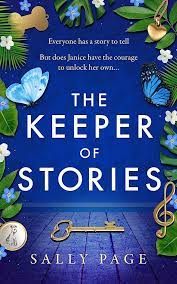
Janice quietly sees herself as a cleaner. She takes pride in her work, and she while she does quite a bit more than just clean for her clients, she contents herself with the knowledge that she does her best. As she does, however, she also quietly collects the stories of the clients she serves, getting to know who they are, what they’ve lived through, and seeing not only who they project themselves to the world but who they are on the inside. When one of her clients asks her to add on her mother-in-law, an elderly but feisty woman with a store of her own stories to share, she ends up opening up the world for Janice in a way she would never have expected.
I found this to be a surprisingly beautiful novel. The multiple layers of stories, the many colorful characters, each with their own quirky tale, add so much without confusing the underlying plot in the least. And while there is true affection that develops between Janice and Mrs. B, the elderly mother-in-law, for example, it is the furthest thing from saccharine-sweet. They are alternatingly vulnerable and deeply sarcastic with each other and you never know if they will be hiding from each other their tears or their smirks. Likewise, the relationship that develops between Janice and her crush, the “geography professor” bus driver. While it develops in fits and starts and you’re never sure if Janice will allow herself the happiness you’re sure she’ll find with him, you root for it with all your heart, because you feel the warmth there. It radiates from the page.
Underlying the story here is how guilt can plague us, hold us back, allow us to punish ourselves indefinitely. So many of us cannot bring ourselves to forgive ourselves for our past, for something we’ve done, for something perhaps even out of our control. Not forgiving ourselves – just as not forgiving others – can be toxic. It is something we have to let go. It is hard to do – sometimes it’s the hardest thing to overcome. But it can be liberating as well, when you come out the other side of it. That is the message here. Something we can all probably use in this moment of division and difficulty even with civil discourse.
Maybe this novel is not quite to the level of a MUST READ, but it’s pretty darn close! You’ll definitely love Janice as she shares all of her stories with you!
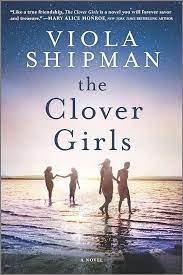
Violet, Rachel and Liz have each just received a letter from their old camp friend, Em. While they’ve all lost touch many years ago over a few deep-cutting, mean-girl incidents, Em has kept track of all of them. In fact, even as she has been dying of cancer, she’s managed to create a plan to entice them back to the camp that had once united them. And even if she is no longer around to witness it, she has taken steps to ensure that they repair the wounds they’ve inflicted.
Sooooo…. I hate to say this, but this novel was one I would NOT recommend wasting time with. Even if you were a die-hard camper, even if you experienced girl drama as a kid – even if you just like women’s fiction – at least in my opinion, this is just not worth your time. I kept hoping that something would not work out perfectly, that something would not be a cliche. It was disappointing, particularly since each of the 3 main characters began as interesting, in and of themselves. Sadly, even as they confronted the conflict in their lives, everything fell much too neatly and predictably into place. Even the boy crush from years past was conveniently the owner of the boys’ camp across the lake and – surprise, surprise! – still available and still interested in the character who’d been pining for him all these years. (Cue eye roll!)
I would have loved to love this book. The intent is clearly to foster women empowerment and to uncover how these women are moved to empower each other as well as future generations, as they overcome their own obstacles. I am all for that. Unfortunately, the means didn’t justify the ends here – the “means” was just too painful.
Cassandra is definitely NOT having a good day. She’s been broken up with by her boyfriend of 4 months, she’s being fired by her boss, and they actually don’t even have banana muffins at her favorite pit stop. How can they be out of banana muffins??? When she learns suddenly on this day that she has the gift of time travel, she wonders, maybe, can she reverse some of these things that have happened? More importantly, can she reverse the bigger things that have affected her life? As she learns about how this new “gift” actually works, she also learns quite a bit about herself.
No one can describe what it’s like to be inside the mind/body of an autistic individual as one who is autistic – and this autistic author gives us the gift of sharing that experience by creating a brilliant, sarcastic, awkward, and deeply lovable autistic character in Cassandra. We feel for her as she struggles with her social interactions and we cringe on her behalf as she is challenged with various overwhelming noises, textures, and changes in her routine. She tries to learn from her prior experiences and she tries to “undo” – as we all wish we could, at times. And her journey is as entertaining as it is endearing. What she learns to appreciate is that she has to be true to herself and treasure who she is and the good she alone can bring to the world.
And don’t we all have this to learn? While we’d all like to change certain parts of ourselves, it may be more valuable to appreciate what we can do instead of trying to change what we cannot.





 kindread spirits