An Undisturbed Peace by Mary Glickman

Abraham has come from England in the early years of American settlement to work with his uncle who has sponsored his transport  He is surprised by the reception he receives:  he is thrown into the barren barracks with the other poor, desperate workers and sent to peddle the wares of the business to surrounding folks, to the best of his ability.  Abe, as he comes to be known, begins his journey as a traveling peddler by landing surreptitiously in the home of a stunning, fiercely independent, Cherokee woman.  She takes him in briefly, cares for him, and although amused by him, does not return his sudden, youthful passion.  As he seeks to reconcile this woman’s past and discover where her heart truly lies, he grows to understand not only himself,  but the complex stratification of the society he sees growing around him.

My first impression of this story was actually incredulity – that a story was being written about a Jewish man falling in love with a Cherokee woman hundreds of years ago in this country.  It just sounded to me an unlikely scenario, given the insular world of the Jews at that time.  As I read further, what I came to appreciate was that it was a clever vehicle through which to describe the era of the Trail of Tears.  This dark period in our American past is when President Andrew Jackson authorized the displacement of thousands of indigenous people from their land and moved them in caravans westward.  This atrocity  was committed under perilous conditions, and thousands of Native Americans perished because of disease, starvation, unwieldy weather conditions and a lack of adequate provisions from the American government.   In telling this story through the eyes of Abe, a Jew and an outsider trying to find where he fit in among the various strata of peoples, there is often a delineation of the pecking order and a redefining of that pecking order as Abe continues to struggle with it.  Where do the slaves of the Cherokees fit in?  Where do the slaves of the Whites fit in?  Where does he fit in relative to them all?  As he is sorting this all out, we see how the groundwork of all of it is being sorted out for future generations – and how some sought to fight against it but, sadly, lost.

So, at first glance, I wasn’t sure about this book, but as I continued through it, it gained more and more value to me and I appreciate it for its very powerful messaging.  I feel it educated me and gave me insight into this bleak blot on our American past.


At Risk by Alice Hoffman

at risk

Polly and Ivan are concerned about their daughter, Amanda.  She’s a gymnast and has an unusual diarrheal illness for the past couple of weeks.  Their pediatrician, who knows them well, can deduce that this is not a good sign and from her low white blood cell count he is extremely worried about the possibility of cancer.  But not in a million years is he expecting that she’d be positive for AIDS, having contracted it from a blood transfusion after a complicated surgery for appendicitis 5 years prior, before blood was screened for the virus.  The paranoia and alienation that the whole family experiences is unexpected and devastating, possibly even worse than the actual diagnosis.

This book, published in 1988, reminds us of the experience that so many went through when HIV first appeared in the 1980’s.  With ads on TV for HIV medications so commonplace and ordinary today, it’s hard to remember that not so long ago, there was mass victimization of those who were infected with the virus.  Children infected via intrauterine transmission or from blood transfusions were sometimes not allowed in school because of fears of casual contact transmitting the virus to others, even when there was early evidence that this was not possible.  Millions of infected adults suffered not only from the disease but from the indignities of being ostracized from a society who rejected them because of their disease.  And we have still not cured it.  [The reason for this has probably more to do with financial incentive than the science – it is more beneficial for pharmaceutical companies to produce medications that sustain patients with the disease than to cure it.  Just as with cancer. But I digress…]

As for the book, I found the story compelling, but the writing a bit awkward.  It is told in the present tense, which I often dislike.  More importantly, though, the narration also shifts from one character to another almost as if they are passing a hot potato from one to another, to another.   This shift occurs so frequently and over so many characters that it dilutes and distracts from the actual plot and it is harder to become attached to the truly important players.   We just can’t feel that sorry for everyone.  So while the story is tragic, it does not cut quite as deeply as it might.

Nevertheless, At Risk is a timepiece and tells a part of the story of our bitter history of the HIV epidemic that is important to remember.  We think of HIV as a disease of adults only, but there were thousands of children affected by the disease as well.  And still are today.

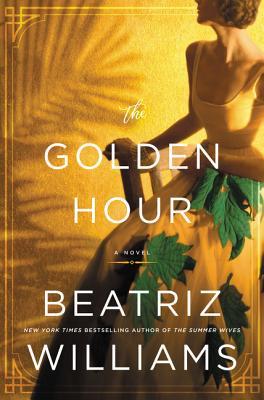
The Golden Hour by Beatriz Williams

Lulu is on a mission to save her husband, Thorpe, who is trapped in a prison camp known for being the harshest and meanest of its kind.  But she knows that the package she’s carrying is so valuable that if she gives it up too freely, there will be no saving Thorpe.  So she does what she has to do and escapes with only this to find shelter with his sister, whom she’s never before met, isn’t even sure she can trust.  With Thorpe’s sister, she is destined to sort out both the future and their very complicated past.

What I love about Beatriz Williams’ writing is that she weaves deeply complex characters into political intrigue/historical fiction using an almost casual and personal voice.  You feel like it’s your old friend who is telling you this lovely story.  And your friend is vulnerable, has had a difficult history, and so your heart goes out to this friend and you want very much to hear so much more.

And while this story occurs during the era of WWII, it is unlike most other WWII stories.  There are only casual references to Jews, camps, and to Pearl Harbor and the Japanese, because much of the story takes place in the Bahamas.  But it is interesting as an example of how the War impacted the world.  Here, we see how British royals may have been involved remotely, for instance, and may have played a role in maneuvering intelligence and power from distant corners of the world.  And it’s not clear if it was for good or for evil.

One of the most prominent and beautiful characters in this novel, Elfriede,  also suffers from post-partum depression.  She is feared, ostracized, even sent away because of her illness.  But she is the kindest of characters, has the most generous heart, and feels passionately about each person she loves.  She is the ultimate hero in the story.  I love that her character, suffering as it is, is celebrated in this story.

Once again, one of my favorite authors has come through for me –  for all of us!  Hope you enjoy this book as I have!


Half of a Yellow Sun by Chimamanda Ngozi Adichie

Ugwu feels quite privileged to have been chosen to work for Master.  Most people in his small village in Nigeria are not given the opportunity to work for someone who provides such fine quarters, good food, and an education as his Master is offering him.  He also has the opportunity to overhear Master’s exuberant  discussions with his regular guests, other professors and intellectuals discussing the political upheaval of their time. And as Ugwu helps Master prepare for the coming of Olanna, Master’s love, Ugwu watches change come not only to their household, but to Nigeria itself.

In some ways this is a monumental saga, portraying one family’s experience of the devastating Nigerian-Biafran war of the late 1960’s. The author is able to illustrate the complexity of the war – the tribalism, the massacres that preceded the war, the sheer indifference with which the world treated those who were starving to death.   In other ways, there is something missing, something somewhat detached in the writing that keeps the reader just this side of being fully invested in the story.  With the exception of Ugwu, who has a sweetness and a naivety to him, most of the characters have a chilliness that seem to keep not only the reader but even each other at bay.

This is not an easy book to read but I’m so glad I did.  I think you will be too.

Daisy Jones and the Six by Taylor Jenkins Reid

For anyone who has ever loved rock music, in all its crazy glory, I give you Daisy Jones and the Six. Written, cleverly, like a Rolling Stone interview, the story chronicles the accidental marriage of Daisy Jones, a gorgeous, lonely, and gifted child of LA in the 60’s with the band, The Six, originally from the East Coast and starting to hit it big.  The personalities, the alliances, the drugs, the romance, the challenges and the drama – it’s all there in an exquisitely crafted story of their rise to fame, fortune and ultimately the realization of some painful truths.

This is just an incredibly fun book to read.  The characters are wonderfully portrayed, with such vulnerability and warmth that you fall in love with them every bit as much as they are falling in love with each other.  The band feels so real.  You almost remember the songs they sing, as if they are hidden somewhere in your brain and not something you’re reading for the first time.  And the ego clashes are reminiscent of every band that Rolling Stone has probably ever interviewed, but are still somehow interesting because we are meeting them behind stage, unplugged, often unmoored and raw.

The idea of writing this story as an interview is brilliant.  My first inclination toward it was, honestly, reluctant.  I thought it might actually get old quick.  But it works!  it actually feels so honest and somehow more powerful, with the narrative coming from each of the characters themselves.  It is quite an unusual technique.

You will laugh, you might cry – but you will absolutely love Daisy Jones and the Six!

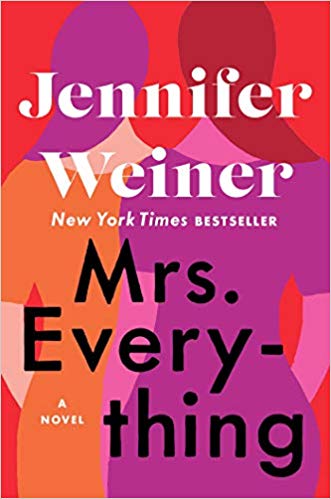
Mrs. Everything by Jennifer Weiner

Jo and Bethie are so excited to move into their new home on Alhambra Street in Detroit in 1950.  It is a very big day for the family.  And once again,  Jo is unable to perform in a “ladylike” way and disappoints her mother.  Why can’t she be more like her sister, who seems to just know how to be the perfect little girl?  From Bethie’s point of view, however, being the pretty little girl may hold some power, but it also comes at some formidable peril.  As the two sisters grow and navigate the decades of the 50’s, 60’s, 70’s, and so on, we have the privilege of following along with them on their turbulent, sometimes traumatic, and occasionally victorious journeys.

This is an epic novel for Jennifer Weiner, who has traced these decades of history with warmth and insight, from the perspective of these two sisters who struggle over these decades to find themselves.  Jo and Bethie, and the other characters woven around them, are so real that when they lose themselves, we feel lost as well, and when they hurt, we hurt.  They are flawed and vulnerable and often become collateral damage in each others’ sisterly wake.  But we find ourselves also moving on when they do and rejoicing at their successes as our own.

Herein Weiner is also giving voice to women, who have evolved over these decades and yet not evolved, whose roles have expanded and yet not expanded.  Weiner addresses the many ways in which women are expected to fulfill all roles – mother, homemaker, breadwinner, and wife, and yet find time for themselves, to feel fulfilled and to fall in line with society’s expectations.  She loops in race and prejudice,  primarily from the perspective of the Jewish experience of a people who have been targeted but who also have their own stereotypical racial biases.  In addition, she also gives voice to the women who have experienced sexual violence and sexual harassment over these decades and how it impacts and informs their entire life experience.  It is quite symbolic that Jell-O, the quintessential 1950’s, traditional Thanksgiving side dish associated with Jo’s worst adolescent evening is later in the novel thrown all over an emblem of her daughter’s supposed progress.  Jell-O becomes a symbolic fuck-you to all of the supposed progress, calling out the hypocrisy in the idea that things have changed enough.

At first glance, this novel might be written off as a simple story of two sisters, but it is in fact an articulate commentary on the struggle of women for power vs being overpowered and for status vs the status quo.  It also directs us to be hopeful for future generations, especially if we stick together and have each others’ backs.


Sold on a Monday by Kristina McMorris

Here’s another interesting find from Bookbub (a daily email letting you know about bargains for your Kindle)…

Ellis was just out taking photos, biding time between what he felt were always trivial journalistic assignments, and came upon a sight that caught at his heart even more than his photographic eye.  After developing it alongside his real photos meant for publication, this picture somehow got slipped in with others submitted to his editor.  He was to learn later that it was the maneuverings of the ambitious Lily, the editor’s assistant, who had always appreciated Ellis’s photos for the stories they told.  She felt this one could not be overlooked.  And apparently, the editor felt the same – because he shocked Ellis by assigning him to investigate the story of the boys in the photo – the brothers who played together under a sign that read, “Children for Sale.”  Publication of this story would change the lives of both Ellis and Lily and of a couple of children who were greatly altered by these two journalists.

This is an impactful piece of historical fiction about the post-Depression era of the late 1930’s.  At this time,  America was still reeling from the devastation of the economic crash, and it was taking years for most people to get back to a livable wage and circumstance.  People resorted to desperate measures to find housing and food for themselves, let alone for their children.  The author gives an authentic account of the era, and treats this delicate issue by giving a very human quality to each of the characters involved.

On the other hand, the story itself, while beginning with a heartfelt premise, becomes a bit convoluted and slightly far-fetched.  It is suspenseful and at times extremely gripping, but often too smoothly tendered.  While this novel is a decent read, it sometimes feels a little Hollywood-ish, as if going for the screenplay from the first chapter.

Again, on the other hand, I can actually see this made into a movie.  I think it would do quite well.


The Only Woman in the Room by Marie Benedict

only woman in the room

When Hedy Kiesler receives her first ostentatiously presented, dozen bouquets of hothouse roses from an admirer after a performance at the theater, she has no idea that it is from the well-known, millionaire, munitions manufacturer, Fritz Mandl.  While she can’t imagine that she’d really be attracted to this older man, she finds she is actually taken in by his charm and charisma.  In actuality, she has little choice, as her father pointedly insists that Hitler’s advances in Germany in 1933 foreboded danger for Jews in Austria as well, and their family needed the protection Mandl might provide.  As Hedy acquiesced, she gradually became trapped in a marriage which was more like a cage.  As she plots her escape, she incurs a stain of guilt that she subsequently spends years of her life trying to repair.

This is in fact, the story of Hedy Lamarr, actress, scientist, and inventor.  After she comes to America, she spends her days behind the camera and her evenings combing physics textbooks in order to master an ideal system to direct torpedoes without being able to be intercepted by an enemy, for use during WWII.  She is not only beautiful and talented, but also brilliant and creative; much to the disbelief of the men around her.  But knowing her secretive backstory gives her inventions context and helps the reader understand her motivations and connections to the war effort.

While this book is based in fact, it is written as fiction, and therefore so easy to read.  Right from Page 1, it draws the reader in and it is difficult to put down until the end.  There is humor and warmth and even a bit of suspense, and certainly anger on Hedy’s behalf.  But overall, there is a great deal of respect for the person she was and the accomplishments she achieved.  It also showed how strongly she had to fight to be respected for her internal beauty and intelligence when she had such striking external beauty.


Green by Sam Graham-Felsen

green

This is a profound commentary on race, masquerading as a coming of age story of a white boy in a predominantly black middle school in inner city Boston.

Dave has terrible anxiety about navigating 6th grade in his challenged, underfunded public school.  He is not only white, but terribly non-“baller” (non-athletic), wears all the wrong clothing, and is afraid to fight physically to defend himself – a proverbial lamb thrown into the lion’s den.  His unlikely defender comes in the form of a short, khaki-wearing, quiet, intellectual, black, fellow 6th-grader named Marlon, who steps in and ultimately becomes his only friend.  The boys communicate mainly through a common love for the “uncool” Celtics, but they bond on a deeper level of shared temperaments and a common goal of getting into the more prestigious middle school, Latin.  While they do grow close, there are still things that Marlon seems to keep to himself.  And even as Dave feels a victim as a minority in his school, he also very gradually faces the reality, in his own middle school understanding, how he actually gleans privilege with his white skin that Marlon cannot.

The voice utilized in the telling of this story is powerful and symbolic.  It is Dave’s voice yet he has fully adopted the vernacular of his black peers.  He is desperately seeking approval from these peers and needs to speak their language, quite literally.  This language brings a raw and gritty texture to the story which feels so honest.  What are also honest are the characters themselves, as they are real and complex and not stereotypical.  Nor are they predictable – and guides the plot toward its both expected and truly unexpected routes.

This novel is a subtly disturbing commentary on our current state of affairs with regard to race.  The American “dream,” as Dave’s “Cramps” (not a typo) spells out late in the book,  is that if a person works hard enough, they can overcome any obstacle and succeed.  This may be true for some, but the truth is that it is not a level playing field and we have to acknowledge this.  People of color are denied advancement at every level compared to whites.  And although there are many groups who are persecuted — my own (and Dave’s) group included, as the rise of anti-semitic violence has been noted to be staggering over the past few years — there is still not clear, daily aggression and micro-aggression toward these groups as there is toward people of color.  The cards are still stacked against them, and we have to stop denying this and start turning this around.  And the first step is for white people to be aware of and acknowledge our privilege.

Maybe more can be enlightened by reading this book?


The Atomic City Girls by Janet Beard

the atomic city girls

June  has just arrived in Oak Ridge, Tennessee, circa 1944.  It is a town that has just been built, but does not exist on a map, and the job she’s been hired to do involves monitoring gauges on machines she is not even told the purpose of.  Her roommate, Cici, is more seasoned and while she could care less about the purpose of her job, her real purpose is to search for a husband among the many soldiers who are stationed right here in Oak Ridge.  Meanwhile, Joe, a Negro construction worker who has also come to the town looking for opportunity, misses his family deeply and just means to keep his head down and earn as much as he can in order to send his good wage home, while trying to keep his younger friend out of trouble.  Eventually, these lives converge as their mission in Oak Ridge comes to a crescendo, and they all become swept up in a historical moment in our dark history.

This is an effective historical fiction novel about a very bleak moment in the history of the world.  While it deals with this global issue, it tells the story through the lens of fictional but realistic individuals who were involved in the production of this most destructive weapon ever created – and used! – on our planet.  It relates the social and political class and racial issues that were on everyone’s minds at the time, whether it was finding a husband for the women who did not have access to higher paying jobs, or accessing decent housing because of one’s skin color.  It also reveals the attitudes towards the final product of Oak Ridge of each of the participants, which varied widely from pride to guilt.  The army’s secrecy throughout the whole project is stunningly creepy.

I’d recommend this book as a both an important piece of historical fiction, and as just an engrossing read.  I listened to it on CD and it held my attention the whole way through!