A Pair of Aces by Marie Benedict and Victoria Christopher Murray

What an unlikely pair to team up to bring down the notorious mob boss, “Lucky” Luciano! First meet Eunice Carter, the first Black woman to serve as a Manhattan’s prosecutor and who was chosen to be on the DA’s team to eliminate the tyranny of the mob in the 1920’s and 1930’s. While she was at first generally ignored and pushed aside, her out-of-the-box thinking and utter ingenuity was the ultimate key to permeating the cracks in the mob’s defense. But she could not do this alone. She was smart enough to enlist the assistance of the most famous madame in Manhattan: Polly Adler. Polly, who came to NY, alone, as a twelve year old Russian Jewish immigrant and worked her way up after much trauma and determination, provided the ultimate material to be used in the trial. This story is the fictionalized version of their dramatic and dangerous teamwork.

Reflecting the teamwork of the actual story was the teamwork required to write this novel. The two authors wrote seamlessly to depict the strain and the challenges of each woman and her role in being caught up in this legal morass. We learn of the toll the investigation and trial took on Eunice’s marriage and family life, as she risked both physical and emotional danger. We also learn of Polly’s determination not to be engulfed by the mob’s plan to centralize all prostitution in the city, primarily because of the toll it would take on the women she was determined to protect.

I also love this narrative, as it demonstrates how we are stronger together. While both women had challenging lives in different ways, and both experienced prejudice and malice and mistreatment, and lived in entirely different worlds, they were able to come to understand each other’s challenges, grief, and resentments. They were able to put aside their differences to come together, to work together and to trust each other in order to accomplish a shared goal. This is a lesson for us all, I believe.

This is a dramatic story – based in actual history – that was meant to be told. I cannot think of two more capable women to do this telling!
Lady Clementine by Marie Benedict

Luckily for Clementine Hozier, who came from modest means but had distinguished herself with her grace and wit, her benefactress was well-connected. At a fortuitous gathering of important guests, Clementine was seated next to the quirky but brilliant bachelor, Winston Churchill. And while Clementine had been engaged before, she never met anyone quite like this man; primarily because rather than being threatened by her intelligence and drive, he was enamored of both. She immediately became his confidant as well as his advisor, and of course, his wife. As she observed many of her peers being shunted into more traditional roles, she was always by his side, guiding him, calming him, and paving the way for him to succeed, even when he didn’t realize she was doing so.

This well-researched novel by Marie Benedict demonstrates how important women were during both world wars. While most history books highlight the men who brokered the strategies and ultimately the treaties, few reveal the role of the women working either alongside them or keeping the countries afloat when the men left for battle. Not only did Clementine Churchill ease the way for Winston to do what he did best, calming those who reacted to his brusque manner, but she also created opportunities for women to support the war efforts, both on the front and behind the scenes. She worked to pave the way for women to expand their possibilities.

We also see what foresight Churchill had about the threat of war and the dangers of certain allies. When no one was paying attention, he noticed the illegal build-up of the German army by Hitler and his Brownshirts. When no one was wary of Russia’s motives in forming an alliance with the US, he maintained his suspicions of their ultimate goal of taking over more territories. He was prescient and wise even when no one was listening.

There is a lot to learn from this novel. There were moments when it became a bit bogged down in the details, a bit repetitive. It was not Benedict’s most suspenseful novel. But it was definitely educational and I am happy I read it.

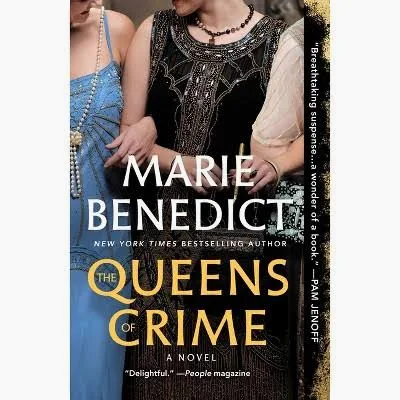
Queens of Crime by Marie Benedict

Dorothy Sayers is tired of men taking control of everything. In spite of the literary accomplishments of her female colleagues, they are being completely minimized by the men who are initiating the new Detection Club. a club for mystery authors seeking to heighten the prestige of the genre. Well, Dorothy will not take this lying down! After her little gathering of five women authors she feels have proven themselves worthy of being included, she hatches a plan to have them inducted into this club as well. Nevertheless, the men continue to ignore, even denigrate them. What if they, as writers of murder mysteries themselves, solve an actual, real-life murder mystery? Perhaps then their male peers will take them seriously. This, however, turns out to be more complicated than she ever imagines.

If you’re looking for a bit of morbid fun, this book is for you! The “Queens” as they call themselves, find themselves deep in the mire of a brutal murder that could potentially stump even them. As they delve deeper and deeper into the details, they learn to work together, to appreciate each other’s strengths and support each other through their weaknesses. We learn that everyone appears to have some sort of secret, some part of themselves that they would prefer be kept hidden from the public eye. They are vulnerable, because particularly at the time this story takes place, the interval between the great wars, women had little in the way of independence and relied not only on their “upstanding” reputations but also, of course, on the men around them. Even women with means. Even women who were as famous for their brilliance and talent as this authors were.

The characters themselves, as well as the plot, hold intrigue, humor, sensitivity, and surprise – keeping at least this reader completely engaged. Once again, Marie Benedict has done it!

Her Hidden Genius by Marie Benedict

Seeking to pursue a career in basic science research in an environment where she would be accepted as an equal to her male peers – not an easy task in post-WWII 1940’s – Rosalind Franklin moved from London to Paris. On arrival, she felt immediately welcomed by all of her fellow researchers in the x-ray crystallography lab. She quickly began her painstaking work of pursuing the identification of carbon-based structures via this type of X-ray imaging, and became known for her meticulousness, hard work, and dedication. After an uncomfortable incident in the lab between herself and one of her superiors, however, she felt compelled to leave this otherwise congenial environment to return to London. There, she was thrust into a competitive race to use her perfected techniques to identify the structure of DNA. Only gender discrimination prevented her from achieving the fame that Watson and Crick did, as it was Franklin’s research that truly uncovered the secret to DNA’s structure.

This deeply researched fictionalized story is a profound tribute to Rosalind Franklin, a woman who contributed so much to what we know about the structure of carbons, DNA and RNA. Only now, decades later, are we understanding the ways in which she was robbed of the respect and acclaim that was her due. The men around her took credit for her work, her discoveries, her hard-won labor, and she had no recourse at the time because she was a woman and would be looked upon as a complainer, a shrew. She was denied the status of a full professorship, and with that, the ability to achieve rights to her own grants and her own laboratory. She was always beholden to the men around her, who were often her intellectual inferiors.

I also never knew her family situation, which came through in this story as well. First, she was Jewish, which influenced where she was able to go and when. During the second World War, she certainly could not go into Paris – not until the Germans were overthrown by the Allies – and so her training began initially in London. Moreover, while she was simultaneously fending off the pressures from her male colleagues in the lab, she was also quelling her family’s efforts to bring her to more “ladylike” pursuits, as they saw them – doing charity work, marrying and raising a family. Because she saw these as being incongruous with her deep ambition to pursue science, she resisted pressure from all sides.

This is a beautiful tribute to a true hero in our history – one who should be acknowledged and celebrated for her brilliance, dedication, and contributions to science, to medicine, and to the betterment of mankind.

The Mitford Affair by Marie Benedict

Nancy Mitford is at a loss. She cannot fathom how her 2 younger sisters, Diana and Unity, have been so sucked into the not-so-underground fascist movement that is brewing among a segment of the British elite in their 1930’s lives in London. It is shocking, that Diana, in particular, once the literal belle of every ball can now be hanging on every word of her precious leader, M. Where will this lead? How far will they take these outlandish and extreme ideas? And will it drive a divide between the once very close sisters? As their story unfolds, so too does the dark history of this movement among the British just prior to the outbreak of World War II.

Based on the lives of a real family of sisters (and a brother) who were among the withering elite of Britain just prior to the outset of the second World War – and who were also, significantly, cousins of Winston Churchill – this fascinating historical fiction novel teaches us much about the existence of fascism in England at this time. The leader of the movement, M, is portrayed as an ego-ridden, single-minded, albeit charismatic speaker who is willing to use any means available to accomplish his goal -allying himself with the despicable likes of Mussolini and Hitler. Because he is so desperate for financial backing, he is manipulated into acceding even to denounce the Jews, whom he had not been against initially.

Parts of this novel were physically painful to read. Depictions of Hitler as charming and cultured went against every fiber of my being, having very personal connections to the destruction that he and his Nazi regime have wrought. But at the same time, I feel it is incumbent upon us to appreciate how history might have swung so easily in a different direction had strong and ethical individuals not stood up to him and his regime and done the right thing, fighting against tyranny and preventing further cruelty and harm that might have occurred.

And it is so relevant today. Do we not see folks voting for those who stand for tyranny just because they also threaten their wallets? Do we not see folks defending fascists who disguise themselves as ordinary Americans just because they might agree with them on issues that make them a bit uncomfortable? We are threatened just as deeply today as the Brits were during those dark hours before the war. We have to be alert for the signs – and reading books like this help us to stay on our toes.

Marie Benedict chooses fascinating people to write about- she has done so once again here. As difficult a read as this is, I would highly recommend it.


The Personal Librarian by Marie Benedict and Victoria Christopher Murray

Belle da Costa Greene is never happier than when she’s holed up among Princeton’s trove of ancient texts, soaking in the artistry of the lettering inside these relics and conjuring up the historical context in which they were printed. Since childhood, she’s been passionate about the art and literary relics of the Medieval and Renaissance eras, and so when her old friend, Junius is about to show her a unique specimen in the Princeton library, she almost shudders to think how fortunate she is to be able to see this ancient text up close. She is not prepared, however, for his offer of a recommendation for the position that will, ultimately change the course of her entire life: to be the personal librarian to his uncle, the one and only JP Morgan. For any woman, this would be an intimidating position, for this was not a position women were offered. But for Belle, there is a complicating factor that would make her uniquely unsuited – so she is bound to keep her true identity hidden from the world. But can she do this when it is so dangerous for both her and her family?

This is the fictionalized story of an actual woman, born Belle Marion Greener, who made her way into New York society by virtue of her ardent passion for the preservation of art, her intellectual prowess, and her social guile. Her earliest memories were of leafing through art history textbooks with her father, and her curiosity for learning that sprouted from this never waned. Though a woman, she was granted access to the library at Princeton, working with the trove of sacred texts that were housed there, and from there she was referred to interview with the larger-than-life collector of art and ancient texts and artifacts, JP Morgan. Impressed with both her fund of knowledge and her pure moxie, he not only hired her but gave her license to maintain and expand his collection as she saw appropriate. Together, they amassed one of the world’s largest and most impressive collection of ancient texts, bibles, and artwork.

What I will not spoil here is the secret that Belle must keep – I will keep that secret along with her. But suffice it to say, that this secret stays with her and directs the course of her life. She is not free to do as she wishes nor is she free to be who she really is in order to secure her career and maintain the security of her family. Because of the era she lives in, she is tied to the social mores and prejudices of the moment and cannot risk revealing her true identity. She is caught between two worlds and she must make her choice, which she does for the sake of herself and for others who depend on her. Even while she struggles, she finds that it is the way it must be and she ultimately makes a sort of peace with it. But at many junctures, it impacts heavily upon her in very deep and cutting ways.

On the lighter side, this story does give an insider peek into the life of the Gilded Age of art and high society and how social status was brokered at this time. It was a sort of precarious time, whether you were in or out, depending on what people were saying about you, whether you bought the appropriate art, had the “right” taste, or your money came from the right source. There was also the beginning of hope for women, suffrage and equality, with women like Belle who broke into what had been a man’s world. She was certainly a pioneer in her field, showing that she did not have to relinquish her femininity to be successful in her dealing in the art world.  She just had to be so much smarter – which she apparently was!

This is an entertaining and educational read, both. Great fodder for all you historical fiction fans!!

The Only Woman in the Room by Marie Benedict

only woman in the room

When Hedy Kiesler receives her first ostentatiously presented, dozen bouquets of hothouse roses from an admirer after a performance at the theater, she has no idea that it is from the well-known, millionaire, munitions manufacturer, Fritz Mandl.  While she can’t imagine that she’d really be attracted to this older man, she finds she is actually taken in by his charm and charisma.  In actuality, she has little choice, as her father pointedly insists that Hitler’s advances in Germany in 1933 foreboded danger for Jews in Austria as well, and their family needed the protection Mandl might provide.  As Hedy acquiesced, she gradually became trapped in a marriage which was more like a cage.  As she plots her escape, she incurs a stain of guilt that she subsequently spends years of her life trying to repair.

This is in fact, the story of Hedy Lamarr, actress, scientist, and inventor.  After she comes to America, she spends her days behind the camera and her evenings combing physics textbooks in order to master an ideal system to direct torpedoes without being able to be intercepted by an enemy, for use during WWII.  She is not only beautiful and talented, but also brilliant and creative; much to the disbelief of the men around her.  But knowing her secretive backstory gives her inventions context and helps the reader understand her motivations and connections to the war effort.

While this book is based in fact, it is written as fiction, and therefore so easy to read.  Right from Page 1, it draws the reader in and it is difficult to put down until the end.  There is humor and warmth and even a bit of suspense, and certainly anger on Hedy’s behalf.  But overall, there is a great deal of respect for the person she was and the accomplishments she achieved.  It also showed how strongly she had to fight to be respected for her internal beauty and intelligence when she had such striking external beauty.