All The Ways We Said Goodbye by Beatriz Williams, Lauren Willig, and Karen White

Three women in three different time periods: Aurelie in 1914, Daisy in 1942, and Barbara (“Babs”) in 1964 – all connected through unknown ties at The Ritz in Paris. Each trying to survive the havoc that has been wreaked upon their lives because of war and keeping safe an heirloom that is thought to bring safety to France. Each trying to find her place in the world. And each finding that love wins out every time.

If you’ve read any of my posts, you know that I am a HUGE fan of Beatriz Williams’s books, and this older one of hers is no exception. While these characters are not quite as snarky as hers usually are, they are still sharp, kind, and utterly likable. We are caught up in each of their stories, puzzling how they’re connected, and rooting for them as they each battle their challenges. And as each story builds in tension, the switch to the alternate plot line serves to both relieve tension when it becomes taut. But switching also builds suspense, as we must wait further to learn the fate of our beloved characters. Nevertheless, the connections and the intersections gradually come to light, and we get the very satisfying “aha” moments we crave.

As usual, for this author – and her co-authors – this novel is masterfully constructed, artistically drawn, and hard to part with when it ends. Once again, I am in awe of her writing and can’t wait to read the next one!

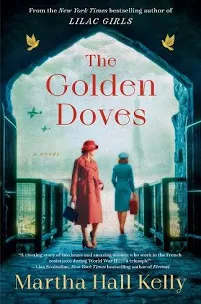
The Golden Doves by Martha Hall Kelly

Josie is not happy about her assignment in 1950’s Texas – enabling ex-Nazi scientists to be coddled within the secretive, US government research program – but what is she to do? Allow the Soviets to access their expertise first? She knows she must go along with it, given that her mentor, Karl, has been pressuring her to not let her past at Ravensbruck cloud her judgement as an agent. She finds she is truly missing her days working with her unlikely best friend, Arlette.

We then meet Arlette as she works alongside other Ravensbruck survivors in a tiny cafe in Paris, outwardly appearing content with her lot, just about making ends meet. But inside, she is still struggling day in and day out, not knowing if her son, Willie, lost to her in the camp, is dead or alive. When a handsome stranger walks into the cafe, promising information on her son, she is given a new hope that feels both unreal and terrifying.

This is a brilliantly written historical fiction novel about a time when those who committed some of the most heinous crimes of the twentieth century literally got away with (worse than) murder. Nazi war criminals responsible for the maiming and murders of thousands were given a pass by sympathizers across Europe who funneled them by way of Austria or Italy (sometimes even the Vatican) through the Alps, into hotels where they waited, often for months in plain sight, until receiving false papers to get to South America (often Argentina), to live out their days in peace. Even some of the most notorious, such as Mengele, known for his unconscionable experiments on humans, escaped justice in this way. There were many agents who did seek justice, however, to try to bring these gutless criminals to justice.

But even if the story were not about such a monumental topic, it would still be a standalone epic novel. The crafting of the plot, the gradual reveals in the “before” and “current” (with current being 1952) telling, the way we can’t help falling in love with both Josie and Arlette, and the way we are continuously surprised by the plot up to the very final page – all make for an outstanding, suspenseful page-turner of a book.

And yes, you’ve guessed it: this one is absolutely a MUST READ! Because although it is a painful subject, and some of it is truly hard to read, I feel you absolutely must read it. If not for the historical value, for the literary value alone!

The Martha’s Vineyard Beach and Book Club by Martha Hall Kelly

World War II is currently raging and the US has just been drawn in as well. Feeling somewhat removed, on the island of Martha’s Vineyard, are the Smith sisters, are Candace and Briar, who are just trying to get through their days. But Briar in particular is keenly aware of the rumors of German U-boats encircling the island and when she reports seeing them, she’s merely ridiculed for it. After a stranger washes up onto their beach and soldiers move to the island to begin training maneuvers, their lives become more complicated than they could have ever imagined.

Fast forward to today, we meet Mari Starwood who has just arrived onto the Vineyard. She has given herself 24 hours to take advantage of a golden opportunity to have an art lesson with the famous but reclusive Elizabeth Devereaux and she plans to turn right back around, back to her life in LA. While her passion is art and painting, her real life is weighed down by her tedious employment as a barista and a very lukewarm relationship. What she finds on the island is a story that is as unexpected as it is enchanting, and she finds it may be harder to leave than she ever thought possible.

This is an historical fiction novel – loosely based on actual events and real individuals – written so beautifully that it will have you burning that proverbial midnight oil until the end. You will come to relate to each of the characters, appreciate them for their quirky New England ways (and I can say that as an original New Englander). You will appreciate the suspense that the plot builds, as we are continuously guessing who can be trusted, who might potentially give away the dark secret the sisters must hide. And you will love the characters for their loyalty, particularly as the sisters grow closer as the strain of their situation necessitates their cooperation.

This novel is yet another great work by the author Martha Hall Kelly. I am a true fan!

Forbidden Places by Penny Vincenzi

Grace feels literally swept off her feet by her new beau, Charles. He’s way out of her league and she cannot fathom what he sees in her, but she is grateful for his attention. He is just so handsome, debonaire, quite the socialite – it feels hard to keep up. If only his mother and sister would show her just a little more warmth, just a little more approval, she’d feel a bit more comfortable about it all. But he’s so reassuring that she feels marriage to him will work everything out in the end. When she is further overshadowed, even dominated by Charles, she begins to question her judgement, but the oncoming war makes her hesitate to make any changes in her life. When Charles is called to serve, Grace sees herself become empowered to stand more firmly and independently than she ever thought possible.

This is a unique perspective on the second World War: that of the impact on the women “left behind.” While they were often victims of the violence, they were also fighting battles of their own, juggling the care of their homes and families with having to survive both emotionally and financially. As many of them had to earn livings while their husbands were sent off to battle, others also volunteered in the many services that supported the war efforts, bolstering the soldiers’ supplies and also participating in espionage and technical maneuvers. Their support was often disregarded and minimized, but they contributed enormously to the effort, and many discovered a new self-worth through their work. They discovered that there was more to life than being subservient to their husbands, and that they were able to find gratification and fulfillment through work outside the home as well as inside it.

Grace grows tremendously throughout the narrative, and her growth is aided by the characters around her. Her sister-in-law, Florence, is a particularly complex character, who teaches Grace humility in the most unexpected and enlightening way. Florence is brutally frank, curt, and awkward, which Grace interprets as hostile. As the story unfolds, we learn that while Florence is, indeed, awkward and frank, she also has justification for her anger, even if it need not be directed toward Grace. Eventually, Grace learns this as well, and she learns to accept folks more and more for who they are, becoming more accepting, less judgmental. We learn much from Grace’s lessons.

There are so many layers to this story, so many lovely characters, so many threads. I am in awe of how the author has woven the story in such a way as to create a world in which we are so entangled, so engaged that we cannot put the book down and yet are stricken when it ends. This is how all books should be.

Definitely read this one! I guess this is a MUST READ!

Small Island by Andrea Levy

Hortense and Gilbert, essentially strangers, have made an unusual deal: Hortense has offered to pay Gilbert’s passage from Jamaica to England so that he can pave the way for her to follow him there. She would love to fulfill her dream of becoming a teacher in that faraway, fairytale land, as she perceives it. And for his part, Gilbert, feeling claustrophobic himself on that tiny, Carribean island, he agrees to it, even at the price of marrying this haughty and serious, albeit beautiful, young woman.

On the other side of the world, in London, Queenie and Arthur have had their share of challenges. Queenie has had no choice but to run a boarding house while caring for her father-in-law. Her husband, Arthur, has been MIA since the end of the second WW, after being stationed in India. She is ready to declare him dead and try to move on with her life, but she is quite distracted with all the goings on in her own home, such as it is. Getting flak from her neighbors because of whom she is renting to is frustrating enough, but managing all of their comings and goings isn’t what she’s signed up for either. And now with the advent of Gilbert’s wife to add to the mix. Where will it all lead?

This is a fascinating dive into London’s WWII and post-WWII world, where there remained as much hostility toward anyone who was considered “foreign” as there is today. Anyone of color who moved into a neighborhood was considered to be “taking over,” and White folks complained, moved out, and sought out their own. While Gilbert thought this was purely an American issue, a “Jim Crow” problem, he learned the hard way that it was just as alive and well in England, even if it didn’t have an official name. When Queenie defends sitting with Gilbert in a movie theater, rather than having him seated in the rear, it ends in terrifying violence. Sadly, things haven’t changed much, right???

What is interesting is how the story is told. We learn each of the stories from the perspective of each of these characters: Queenie, Arthur, Hortense and Gilbert. They each have a history, a story to tell. They are each complicated, with their own fears, anxieties, and challenges. Through them we also learn about the tension between the British and its island of Jamaica; that is, how hardly anyone in Britain knew where Jamaica even was, while those in Jamaica were taught to worship the crown as if Buckingham Palace were situated right there on its shores.

While the overall message is clearly heavy, it is told with warmth, wit, and with a Jamaican lilt that gives it just enough lightness to make it enjoyable, surprising, and a worthwhile read.

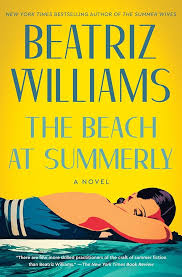
The Beach at Summerly

Emilia, whom most on Winthrop Island know as Cricket, has had something of an idyllic upbringing. Although her family works for the Peabody family, who only grace the island during the summer, she has always seen no difference between herself and the Peabody boys with whom she and her siblings were constant companions from Memorial until Labor Day. But things appear changed for all of them now that each family has lost a son in the second world war, and the sons who have returned have done so having seen what the world could impose. When the Peabodys’ aunt shows up with her children and an offer of a job for Cricket, this opens up possibilities – and danger – for Cricket and for her family.

Once again, Beatriz Williams has written a wonderfully crafted novel with all the ingredients of a MUST READ. We love Cricket, because she is smart, loving, and trying her best to do what is right. Nevertheless, she is of course caught up in a tangle of historical fictional intrigue and there are more than a few sections that even I, who tries to really read every word of a book, found myself glossing over some to try to find out what happens, because I NEEDED to know!

In this novel, we also see how the “bad guys” are not always necessarily “bad,” but just victims of their own ideals. It can be quite easy to be swayed by ideas that feel right or pure. There was a time, for example, particularly after the market crash of the 1930’s when Marxism and communism may have appeared to be a sound alternative to economically vulnerable capitalism. An “equal” society might have seemed to be a fairer way to live when there was such a stark difference between the rich and the poor. It might even appeal today. Nevertheless, the countries who reign under these Marxist/communist theories obfuscated what was really going on in order to maintain these regimes – which was that any opposition of opinion or thought was being rooted out and violently suppressed. It was going on then, during and just after WWII, when Russia was considered an ally, and it is absolutely going on now.

This is both a well-researched, valuable historical perspective and an un-put-down-able work of fiction. The best combination, in my book!

The Consequences of Fear by Jacqueline Winspear

Maisie Dobbs is pulled in once again to a new case, when she learns of a young boy, a messenger in London during WWII, who is witness to a brutal murder. The problem is that those around her seem to not believe this young boy, who, to her, seems not only trustworthy, but also in danger himself and worthy of protection. So even while she is caught up in clandestine work for the British defense against the Axis forces herself, she cannot resist delving into the details of this case as well, even when it might put her and those around her in potential danger.

I should probably have read this series in the order they were written, because there are recurring characters and continuing story lines. Nevertheless, each book is a stand-alone novel and a story worth reading and I have found each that I have read engrossing, entertaining, and endearing. Each character is written with charm and wit and the relationships between the characters are quite beautiful. For example, the working relationship that has developed between Maisie and her assistant detective, Billy, has grown into a collegial and respectful,  and yet tender and caring one. They are a formidable yet wholesome team. 

This series is a fun mix of historical fiction and mystery/suspense that always achieves just the right grittiness and never disappoints.   

City of Girls by Elizabeth Gilbert

Vivian was never exactly interested in following in the path her nuclear family had laid out for her: school, perhaps a temporary job before she settled down to a marriage, and of course motherhood, thereby maintaining the social status comparable to that which she was born into, in her upstate NY, 1940’s, upscale community. So, when, at the age of 19, she failed out of Vassar after essentially never having attended any classes — clearly flouting this path — she was shipped down to Manhattan to live with her equally unconventional Aunt Peg. Here in the heart of the theater district (well, almost), Vivian found her freedom – the ability to explore the city, the ability to express herself in ways she could never have imagined, and also the ability to make mistakes she would gradually learn and grow from.

This novel is just as entertaining as the theater world itself, opening the curtain to both the comedy and tragedy of NYC in wartime 1940’s, the challenges of managing a theater production with all its moving parts, and underneath, the struggle of a young girl finding out who she really is in the midst of all this frenetic drama. As Vivian falls in love with the city and with her newfound theater family, we find ourselves falling in love with each of the characters. Vivian’s Aunt Peg, with all her vulnerabilities, is as generous and forgiving as anyone might be and teaches us the beauty of living in this way. Her “secretary,” Olive, a no-nonsense, teetotaler, who never hesitates to remind everyone how little money they all have, demonstrates loyalty in the most understated and compassionate ways. Peg and Olive become both the liberators and the anchors for Vivian.

The voice of the narration is also quite clever. The story is told by Vivian to Angela, and we only discover late in the game who Angela actually is. We hear her name periodically as the story unfolds, and this reminds us that we are being told a story from Vivian’s perspective to someone in particular with a particular goal. It is a confession of sorts, but without the remorse or regret a confession has because there is no sin, no misdeed. It is just an honest telling. And we love Vivian for her living her life without apology and without regret, as she has lived, for most of her life, an honest life.

This is a beautiful book of historical fiction – highly recommend this!

The Magnificent Lives of Marjorie Post by Allison Pataki

Marjorie Post, daughter of the famous CW Post ,had a modest beginning. We meet her as she begins her trip to Battle Creek, MI, in the family’s quest to heal her ailing father. He’d been wasting from a severe depression and sought out the famed Dr. Kellog, to see if he might benefit from the diet, exercise, and fresh air treatment he was known to prescribe. Little did they know that the one who would heal him and be the most inspiring for him was their family’s hostess, who rented the rooms to Marjorie and her mother while CW received his tasteless treatments. She cooked him healthful meals and nursed him with her spiritual inspirations, enabling his soul to be revived. What lay ahead, both for CW and for Marjorie, was a growth of spirit and of creativity that would open their worlds to both unimaginable successes and tragic failures.

This historical fiction is based on the truly impressive and accomplished life of Marjorie Post, daughter of the famed CW Post, inventor of the breakfast cereal – Grape Nuts being the first! – and the founder of the General Foods Empire. Marjorie grew the business, creatively adding their many other types of foods and related products, finding ways in which to make a mother’s life more convenient, and hoping to provide nutritious foods to more families at a reasonable cost. She had an acute business acumen and would not give up on an idea once it worked its way into her brain, and she risked her reputation, her business, even her personal relationships when she knew she was onto something that might help others.

For this she paid a price, most often in her personal life, as many took advantage of her generous nature. Whether it was in her relationships- and she collected a few – or the press, who delighted in using her personal scandals as fodder for their gossip columns. But her true joy was her daughters, her work, and her volunteerism, which she threw herself into with gusto.

A little tidbit I learned from this also: she is the one who built the 126-roomed Mar-a-Lago. I have to confess, I had a hard time being excited to hear about the planning of its layout and the decoration of its rooms knowing who would be its future occupant, but I swallowed it in the name of history and fiction. I went with the spirit of the book. Marjorie was generous with her money, gave to many causes and was all in when times were rough for her country (unlike its current occupant) She was inspiring, actually (again, unlike the current occupant!).

If you are interested in historical fiction and want to know more about this very impressive woman, take a few days to peruse this novel. You’ll meet a lot of famous people, suffer a few heartbreaks along with her, and bask in her successes along with her as well.


The Guernsey Saga by Diana Bachmann

This trilogy begins with the joining together of the Ozanne and Gaudion families, traditional families living on the small island of Guernsey off the coast of England beginning in the early 1930’s. They are joined by the marriage of Sarah to Greg, with Sarah reluctantly giving up living with her boisterous family to join Greg’s elderly parents in his more staid household. Fortunately, her older sister, Ethel, often comes round to cheer her. Sarah and Ethel had shared a room as well as a close bond and a sense of humor, which often got them into uncontrolled giggles during their family meals. The trilogy follows the family through three generations: during the Nazi occupation of the island, during cultural upheaval of the 1960’s, and during the financial fluctuations of the 1970’s.

This is a warm and beautiful family saga, with moments of solemn strife alternating with times of tearful tenderness. While the circumstances of the family are unique, the underlying issues are timeless. Adolescent rebellion, inter-generational miscommunication, internal loyalty battles, spousal mistreatment, dishonesty – all issues that we can all relate to no matter the era, no matter the culture. The characters are relatable as well: the self-doubting, tongue-biting mother; the critical and self-righteous husband; the quiet and studious son – there are so many likable (and unlikable) and colorful characters who we come to know over the three books so well and over their years that we are sad to leave them when the third book ends.

The writing here is also poignant and effective. We really come to know the characters so intimately that we feel their pain, their stress. When they are starving because of the limited food on the island during the Nazi occupation, we feel their hunger. When we learn about Sue’s loneliness during the war, when she’s been sent with her school to Wales for safety, we yearn as she does for the love of family. And when Stephanie rages against her mother, we feel the deep cut of hurt that Sue feels.

Living in a small town where everyone knows everything about you and your family – your history, accomplishments and failures – might be challenging. But I can’t help wondering what a trip to seaside Guernsey would be like -it sounds magical!