Atmosphere by Taylor Jenkins Reid

It’s 1984 and Joan finds herself in direct communication with the team of astronauts in the shuttle trying to remedy a defective part. She is guiding them as they approach this seemingly simple fix, but suddenly something goes irrevocably wrong.

Back in 1979, we learn how Joan works her way toward this impressive seat. Starting out as a professor of astronomy, not being taken seriously by her fellow male faculty members, she surprises even herself when she fulfills her dream and applies to be an astronaut trainee. When she is admitted, she knows the competition is stiff, but she maintains her confidence, her calm demeanor, and her priorities. And it is this balance and calm, even in the face of extreme stress, that allows her to learn not only what she has to for her program, but more importantly, what she has to learn about herself.

This is a beautiful story, with a dual message of liberation for Joan. Not only does she find where she is meant to be, among the scientists, engineers, and military personnel at NASA, but she also finds who she is supposed to love. She has always explored so many interests, had so much talent in so many different areas, but has never ventured into the realm of love because it just has never felt right for her. She never understood it. Until now. Here she finally meets someone with whom she can connect, to whom she is attracted, and with whom she feels she can be herself. And while she is so happy, she knows she also has to keep it under wraps, because it can compromise her entire career.

I also love how Joan’s connection with her niece is depicted. Joan’s sister, she realizes, is quite self-absorbed – has always been so – but she and her family have always enabled her in this. But her niece is the one to suffer because of it, and the problem only grows as she does. How this affects Joan grows as well, and it shows us just who Joan is, how deeply she can feel.

This novel will reach down into your heart and grab you and take hold. And the characters will live with you long after the last page has been turned. It’s just what you want from a novel, no?

Absolutely read this one!!

In the Dream House by Carmen Maria Machado

In this memoir, Machado shares her experience of a relationship with a beautiful woman that begins as dream-like and erotic and devolves into terrifying and abusive. Through a course of poetic essays, with the Dream House imagery as theme, she portrays how she is entranced, then entrapped, and then, finally, enraged enough to free herself from the woman who has gripped her heart and fractured it in two.

This is, apparently, one of the rare portrayals of queer relationship violence/abuse that is documented by literary means. While books about heterosexual abuse abound, the queer community has been more silent on this topic. It is not uncommon for a marginalized community to feel a loyalty such as this, to hold itself to a higher standard, to try to appear to have achieved a higher ideal. Doing so is an understandable way to try to protect those in the community from further criticism, because, surely, they receive enough as it is. However, by doing so, it denies those who identify as queer as having others believe them , understand their plight, and have others who openly support and identify with them when it does occur. And spousal abuse/relationship abuse can happen to anyone – anyone is vulnerable, no matter your gender identity, your sexual preference, your race, your religion, your ability, your size. This is the harsh reality.

The writing here is poetic and ethereal. The image of the Dream House as both positive and negative images captures the internal struggle of the victim of abuse and the subsequent gaslighting. There can be so much wonder and love and light, but there is also so much darkness and hatred and doom – and it can change in a heartbeat from one extreme to the other. The victim walks on eggshells, constantly apologizing for her own existence. She feels she must have brought this on herself, she must deserve what is happening, because, really, what else could it be? How could someone love her so much in one moment but then hate her so much in another? Maybe if she just acts better, IS better, she can make it right. But of course, it is not her – it is her abuser who is at fault. This is so painfully hard to see when you are in it.

Machado has very generously opened her heart to us. I hope that others come forward with their stories as well in order to create the supportive community that is necessary to acknowledge that this can happen to anyone, queer or otherwise.


Mad Honey by Jodi Picoult and Jennifer Finney Boylan

Olivia has done what she can to protect her son, Asher. Raising him as a single mom, providing him a safe home even when money was tight – she has given him all that she could. And he has seemed to flourish, excelling privately in art and more outwardly both socially and in hockey, a sport quite popular among his peers in his New Hampshire high school. When attractive, somewhat shy, newcomer to the school, Lily, arrived, he was in the right place at the right time, introduced to her by his closest, oldest friend and they immediately hit it off. Little did anyone know how it would lead to a fatal incident and a court case that would upend all of their lives.

Out of a literal dream of Boylan’s, grew the coming together of two talents to compose a powerful and insightful work of literature. In this novel, we find every important element: complex character development, the spinning of a suspenseful plot that is constructed both backwards and forwards – and actually works! – and an opportunity to learn. We learn about beekeeping – which is interesting at times but does get perhaps a bit too detailed at other times, in my opinion – and we learn about the experience of being trans, which is, also in my opinion, invaluable.

I find it fascinating how two authors can come together and write a novel that reads so seamlessly. It demonstrates collaboration at its finest. Clearly they have each edited each other’s work such that there is a united style that is woven throughout and it gives the novel a single tone and clear voice.

I also deeply appreciate what we learn from the perspective of the trans voice. While I have personally worked some in this area, I feel I always have more to learn and I always appreciate when I am helped by those who are generous enough to share their experience with those of us cis folks who have had the privilege to have not struggled with these issues. It is not their responsibility to do the work for me, and at the same time, I am grateful to be able to benefit from their thoughts and experience so that I may become better.

This is an important story in so many ways, not the least of which is that it’s a gripping, powerful, and enlightening read. Highly recommend this one!!

Say the Right Thing by Kenji Yoshino and David Glasgow

There have been so many excellent (and some not-so-excellent) books written about racism, how to be an antiracist, and diversity and inclusion. Many of us have been in trainings, whether through work or community opportunities, to inspire and instill in us an understanding of structural racism and power dynamics. But even while we may have come to have a basic understanding of these concepts, few books lay out the tools of how to be an ally and/or to stay in a growth mindset in such a practical, non-judgmental and concrete way as Yoshino and Glasgow have done here in Say the Right Thing. In addition, the advice here is generalizable to all non-dominant groups – not just racial groups. And, as they point out, almost every one of us may find ourselves in a situation where we are the culprits engaging in non-inclusive behavior, and later be either at the receiving end of it or as an ally. Through vivid vignettes, humble stories about themselves, and relevant research concepts, we are given advice on how to handle each of these scenarios.

What I appreciate most about the writing here is the humility with which the authors share this essential information. While they are both highly qualified to be writing this book – both are attorneys, educators, and come from non-dominant communities – they also acknowledge their own privileges and that we all may fall into spaces of privilege relative to others. Their focus, therefore, is not how to understand the position of the “other” but rather to understand our own obligation to react appropriately when issues arise. We are obligated to check our own reaction if we are challenged by someone about an act we may commit – even unwittingly – and to keep ourselves open to learning how to do better always. They also acknowledge how hard this can be, as almost always our unwitting acts are not with evil intent. But of course, good intent does not preclude harm.

It is an easy read, full of concrete suggestions, and utterly important in this moment of divisiveness and fracture – when communication is essential and understanding is the key to bringing this country back together.

Another MUST READ, I believe.

Less by Andrew Sean Greer

Arthur Less has found an escape route. With the approach of his ex-lover’s wedding, which he cannot bear to attend, he has manufactured a series of commitments — lectures to be given, classes to be taught, awards ceremonies to attend – and all abroad, so that he cannot possibly be present to witness the upcoming nuptials. As he embarks upon his journey and his approaching 50th birthday, he reflects upon his life and what he has to look forward to. Throughout his journey, it seems that as his suitcase appears to become emptier,  his heart becomes fuller.

On the surface, the story of Arthur Less can feel somewhat self-indulgent. He is smoldering over his life, having lived many years in the shadow of a genius. He feels he’s achieved merely mediocrity at best, as an author, as a lover, perhaps even as a human in general. He laments his past works, such as they are, as well as his current attempts at writing and at love. He has imposter syndrome to the nth degree. Sadly, he neglects to see the love that he inspires around him. He has difficulty taking in the admiration of his students, his audiences, and his friends. Only we, the readers, see it.

Can’t we all relate to this? Just as Arthur travels around the world getting swept up in misadventure and blaming himself, many of us travel through life focusing on what we’ve done wrong and where we have erred rather than on what we should be grateful for. I know I often fall into the trap of being my own worst critic and blind to my own blessings. I often feel “less.”

I am not sure I understand how this was a Pulitzer Prize winner, but it certainly does have meaning beyond the surface and is a worthwhile and entertaining read.

I would be so interested to hear what others think about this one! Please comment!

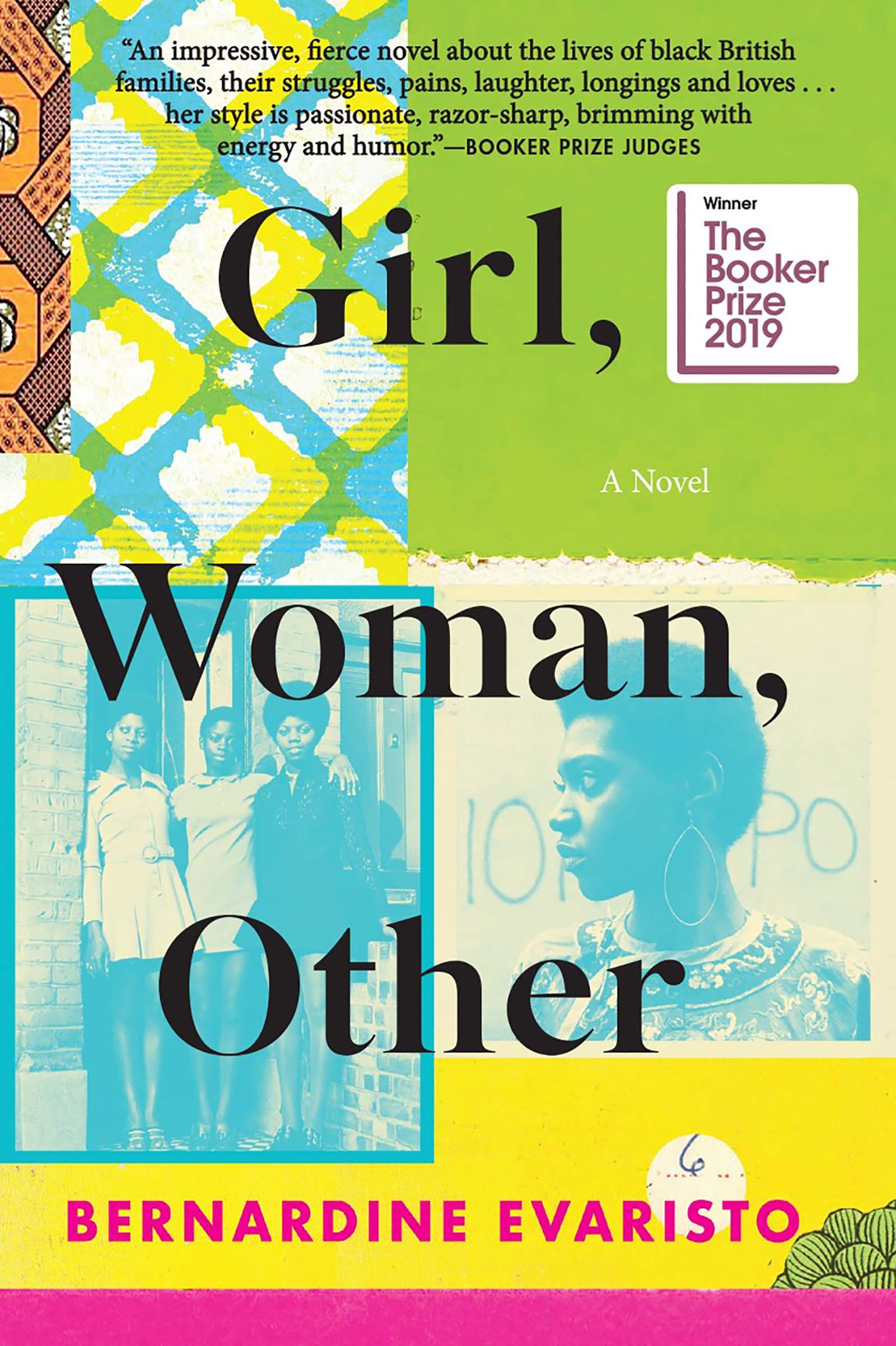
Girl, Woman, Other by Bernadine Evaristo

Amma is anxious.  Tonight is the opening of her newest play, and although she’s been doing this for years, she’s never before opened in the National Theatre.  This feels so much more colossal, so more auspicious than anything else she’s undertaken.  She thinks back to her modest beginnings, when she partnered with Dominique, an independent, creative woman like herself with ambitious dreams and a personality to match.  And she thinks about all the people who will be there for her.  And we will meet many of these people as the book unfolds, and we will hear each of their stories unwind through the pages as they all wind back to Amma.

Everything about this book is unique.

The writing is almost without punctuation, written as if it is one, very long, run-on, but poetic sentence.  However, it is divided by starting new lines,

very

strategically.

While I admit this took a bit of getting used to at first, I found it worked – and actually made the writing extremely powerful.

Most of the characters are women of color, often of mixed heritage, and often identify as LGBTQI – and each is given a deeply vivid story to tell.  While most experience racism of some kind, they confront it in many different ways, and most finding a way to either rise above or cut right through.  There are many characters – and to be honest, I did find it sometimes hard to keep track of them all – but each had her/their beauty, each was sympathetic in some way, and each was was someone you came to think of as an actual, tactile person.

It is easy to see how this book won the Booker Prize in 2019, as it is beautifully composed, with gorgeous characters and with a memorable round of stories to tell.  It will keep you glued and it will warm your heart.

I”ve got another MUST READ for you!

The Seven Husbands of Evelyn Hugo by Taylor Jenkins Reid

Monique cannot understand why she has been personally requested to conduct the interview of the legendary movie star, Evelyn Hugo for Vivant Magazine.  It is not as if she’s made a shining name for herself there.   Beside her one truly great piece about assisted suicide, she hasn’t written all that much she’s terribly proud of — but perhaps this is finally her big break.  And what a story this should prove to be!  Seven husbands!  (Monique cannot abide her even one…) This should get someone’s attention…

Taylor Jenkins Reid seems always to employ an inventive method of telling a story.  Here it is a story within a story, as we sit side by side with Monique, drinking in Evelyn’s pour.  And it enables us to get to know both women, their stories and their struggles, as they get to know each other. And what stories they have to share!

Both characters defy the stereotype, the norm.  Evelyn is unapologetically ambitious, which I love seeing in a female heroine.  So refreshing!  Evelyn Hugo aggressively goes after what she wants, is smart about it, and knows who she is dealing with at all times.  And while she suffers consequences of her actions sometimes, she does not wallow in self-pity.  She pulls herself up and moves on.  She is the ultimate cool, and we love rooting for her.

This is a warm, engaging, and honest read with characters who you will miss as soon as you come to the final page.  Even the husbands are ok (well, some of them ..!)


Becoming Eve by Abby Stein

Born to what was considered a royal Hasidic family —  a descendant of the Baal Shem Tov — Abby Stein was raised as a boy in one of the most gender-segregated societies on earth.  From an early age, she knew she was a girl and when she, at the age of 4 years, expressed this to her mother, she was given the very clear message that this was never to be spoken about again.  Throughout her childhood, she rebelled, against god, against her restrictive society, and against a world that did not allow her to be herself.

This memoir was so detailed and heartfelt – until it wasn’t.  We hear about every moment in Abby’s early life.  Her journey from one yeshiva to the next, from one rebellion to the next.  There are very intimate passages, revealing her first love for a young man who is obviously struggling with his own sexuality.  This episode is quite tenderly written and the reader feels such empathy for these two who cannot pursue their love in the restrictive society in which the two “boys” live.   We hear about the details of the study in which Abby immerses herself, how she advocated to learn about law and ultimately about mysticism.  And some of the details about Hasidic life are quite interesting.  And we hear about her marriage to Fraidy, which is actually quite sweet and hopeful, to some degree.

But suddenly, when she describes Fraidy giving birth to their son, and all of a sudden, it is as if she drops off a cliff and, POOF! she is a woman.  There is little to no mention of how she disengages from her prior life, with the exception of an epilogue, which tells only of how she tells her father she is a woman. We do not hear about her connection with her child, we do not hear about she experiences the transition from her insular world of Hasidism to the outer world, we do not hear about much of anything else.  This I find unbelievably disappointing and a sorely missed opportunity.  After hearing so much detail, the absence of detail is astounding.

I did learn from this book, but I was disappointed by the ending.  On the other hand, I do hope that Abby finds peace with her family and can connect with them.  She obviously loves them dearly and they do her.  I hope they can find a way to see that she is exactly who she always was.


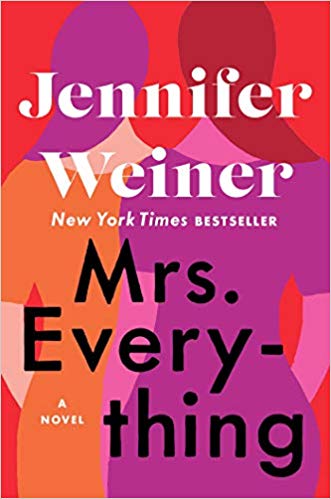
Mrs. Everything by Jennifer Weiner

Jo and Bethie are so excited to move into their new home on Alhambra Street in Detroit in 1950.  It is a very big day for the family.  And once again,  Jo is unable to perform in a “ladylike” way and disappoints her mother.  Why can’t she be more like her sister, who seems to just know how to be the perfect little girl?  From Bethie’s point of view, however, being the pretty little girl may hold some power, but it also comes at some formidable peril.  As the two sisters grow and navigate the decades of the 50’s, 60’s, 70’s, and so on, we have the privilege of following along with them on their turbulent, sometimes traumatic, and occasionally victorious journeys.

This is an epic novel for Jennifer Weiner, who has traced these decades of history with warmth and insight, from the perspective of these two sisters who struggle over these decades to find themselves.  Jo and Bethie, and the other characters woven around them, are so real that when they lose themselves, we feel lost as well, and when they hurt, we hurt.  They are flawed and vulnerable and often become collateral damage in each others’ sisterly wake.  But we find ourselves also moving on when they do and rejoicing at their successes as our own.

Herein Weiner is also giving voice to women, who have evolved over these decades and yet not evolved, whose roles have expanded and yet not expanded.  Weiner addresses the many ways in which women are expected to fulfill all roles – mother, homemaker, breadwinner, and wife, and yet find time for themselves, to feel fulfilled and to fall in line with society’s expectations.  She loops in race and prejudice,  primarily from the perspective of the Jewish experience of a people who have been targeted but who also have their own stereotypical racial biases.  In addition, she also gives voice to the women who have experienced sexual violence and sexual harassment over these decades and how it impacts and informs their entire life experience.  It is quite symbolic that Jell-O, the quintessential 1950’s, traditional Thanksgiving side dish associated with Jo’s worst adolescent evening is later in the novel thrown all over an emblem of her daughter’s supposed progress.  Jell-O becomes a symbolic fuck-you to all of the supposed progress, calling out the hypocrisy in the idea that things have changed enough.

At first glance, this novel might be written off as a simple story of two sisters, but it is in fact an articulate commentary on the struggle of women for power vs being overpowered and for status vs the status quo.  It also directs us to be hopeful for future generations, especially if we stick together and have each others’ backs.


Every Day by David Levithan

How would you feel if you woke up inhabiting the body of a different person each and every morning?  You awake and have to adjust to their world, access their memories, and go along with their life, relating to their families and friends, doing their homework, going to their parties, and then the next day, move on to the next person.  This is how A lives.  And A is fine with this, until A meets Rhiannon, who changes everything.  Because, for the first time, A has fallen in love. What this does to A and what this does to Rhiannon creates a very beautiful, if not difficult love story that is imaginative and a little insane all at once.

This young adult novel has been around for a bit of time (has already been made into a movie even), but I have only just had a chance to read it – and I’m happy I did.  The premise is so creative, and while you might think it would get “old” after a few times of switching, it does not because of how wildly varied each of the lives are that A inhabits .  It is, of course, implausible, but because it doesn’t take itself too seriously, it is quite fun.  The author also creates a slight undercurrent of threat that adds a little suspense to the plot, which enhances the story and enables the twists that occur.  Along the way, too, there are many opportunities to wax poetic about the ways in which we are all fundamentally similar, whether it is with regard to gender, sexuality, religion, or culture, which the author never passes on – and which I appreciate.  This is the beauty of the story, I believe.  (I will say that because of this, I am quite surprised when A is quite stereotypically critical of the body A inhabits that is extremely overweight.  He shames him to no end, even lowering to accusing it as stemming from laziness –  so surprisingly pedestrian.  Amidst all the other open-mindedness, this is an utterly disappointing moment in the book.)

I think it’s a very cute story, with a very creative premise.  A quick, fun read.  Great for the young teen in your world!