No More Tears: The Dark Secrets of Johnson & Johnson by Gardiner Harris

Johnson & Johnson is probably the most venerated pharmaceutical company in the US. They may not even be thought of as a pharmaceutical company (which we normally associate with prescription drugs), because most know them best for their baby products, bandages, and skin care lines. Their story, as they love to tell it, is more about how they are the most honest, most trustworthy, family-run company, having recalled their tainted Tylenol decades ago, at great cost to them. Well, this revelatory, painstakingly-researched book will call into question everything we have believed about this company, reducing their golden reputation to a mythology. Time and again, this company has chosen to spend billions of dollars on litigation defending their repetitive deceptions rather than admit that a product is harmful. They have released products before being tested, not tested enough subjects, hidden data that has not been favorable, and have falsified data on tests they have submitted for review. Their executives have lied under oath about their products. Even after seeing horrific harm result from their products, they have continued to conceal evidence in order to continue to make money. No matter the human toll (including deaths in the millions). Because, of course, it is always about the money.

This book is, of course, a MUST READ. It is relevant not only to anyone in the medical or pharmaceutical field. lt is relevant because it is a perfect example of how money and power are so inextricably linked. As J & J grew, so too did its influence and lobbying power. We see how the independence and integrity of the FDA, for example, has been compromised to the detriment of all of us – because those who make decisions on what drugs and devices are approved for use are also the ones who benefit financially from them being approved. How can anyone possibly be objective when these decisions affect whether or not they may keep their job? Or perhaps their future one? In addition, the company uses FDA approval (for what it’s worth) to shield them from litigation. And those medications and/or devices that are approved by this compromised agency will be used by you, or by your family member, or by your best friend. Are you comfortable with that?

I would encourage everyone to read this book. It’s distressing, yes, but so important to be informed. This “trustworthy” company may no longer be so. And there is much to be done to fix the system that has allowed it to become this way.

Coming Up Short by Robert Reich

This non-fiction memoir by Robert Reich is an accounting of how America failed to maintain the middle class, from the boom of the post-WWII era to current times. Having grown up being taunted and abused by bullies because of his short stature, Reich was particularly sensitive to protecting the underdog, and since he could not do so physically, he did so with his economic wisdom and understanding. He taught at Harvard and he also served in the Department of Labor in the Clinton administration, advocating for policies that in his view would protect the middle class and thereby narrow the gap between the very rich and the very poor. Much to his dismay, he was undermined at each turn, and over the course of the ensuing years, regulations over high finance and banking only relaxed, the highest earners became taxed at a lower rate, and the gap only widened. We are now left with a country that has an enormous wealth gap in spite of his efforts and it is a dismal outlook ahead.

I have to confess that I did not complete this entire book. I usually do not blog when I’ve done that, but I felt that I’d read enough to 1) learn quite a bit from it already and 2)get the gist of what he is trying to say from what I did read. While it is definitely readable, and he makes the economic parts very accessible (even to someone like me who never studied economics for very good reason…!), it was also quite repetitive. Perhaps that is a function of his frustration with everyone who did not listen to his advice -as he tried over and over to push for more decency in the policies and laws that were being passed. It was also quite hard to see how so many leaders, including Clinton and Obama, both of whom I had admired, came under the spell of Wall Street and its powerful lobbyists, who led them to pass such irresponsible and dangerous legislation. Worse, this deregulation of Wall Street and the disaster of 2008 did not teach us anything at all. Deregulation has only continued – to the point where folks are now predicting another similar bubble from AI. Will we never learn?

In any case, I believe this book carries much insight, much wisdom and even a bit of humor as it guides us through the past couple of decades of economic downfall. It gives us a window into how we’ve narrowed the middle class and why billionaires exist when the rest of society has seen little to no increase in wealth.

I would have liked to see answers to what we can do about it – perhaps how we can make changes for a brighter future.

Maybe that will be his next book? Or that is the book for the next generation to write…

The Lion Women of Tehran by Marjan Kamali

Ellie, aged 7, has just lost her father and feels as if her whole world has changed. She and her mother can no longer stay in their enormous home in the center of Tehran and must move to the “down” side of town. Nevertheless, while her mother is distraught over this and worries about their place in society, Ellie is actually excited to see children playing in the street, thrilled at the possibility of learning to play hopscotch, and dreams of meeting her ideal, best friend. When she walks in on the first day of her new school and is greeted by a spunky girl with dark, curly hair who shocks her with her outgoing nature, she thinks that this is not who she imagines will be her best friend. Ellie learns quickly that Homa, this warm, bright, honest, and fiercely loyal girl might just be that very friend.

This is a beautiful story of friendship, hardship, and loyalty. The two unlikely friends, Ellie and Homa, are as different as two girls might be – but perhaps it is because of this that they are amused by each other and get along. Ellie, self-aware in her materialism and superficiality, is nevertheless caught up in their friendship and feels a bond with Homa in spite of her absence of passion for the politics of the day. Nevertheless, she admires Homa – and is worried for her – for her passion and strength in seeking to promote human rights, particularly women’s rights. This is at the heart of both their friendship and their schism.

I actually love the way Ellie portrays herself as superficial, wanting what many want, and being self-aware about it. She is terrified of having to go back to being dependent on someone to pay her bills, to live in squalor, to have to need/want. She fears poverty, lack of power. And she admits to being afraid of being imprisoned, as we all are, at heart. So many novels are written with the main character as the brave one, the fighter, the hero. I love that in this one, the main character is the one who is the worrier, the caregiver, the friend. She is the one who has faults, is honorable, honest, and self aware, but who is supportive and can be helpful when the time is right. While many are brave and undertake righteous causes, fighting for freedom against oppressive and suppressive governments (such as that of the Shah’s and later that of the Ayatollah’s), not everyone is meant for that. I think that by creating an admirable, honorable, human and faulty main character for this tale, we can perhaps see ourselves identifying with that fear and relate to those that can help, those who support the heroes, the fighters.

This also gives a background to the story of the women of Iran. It is not only a historical context but a warning to all of us. It happened in Iran with extremists who toppled a democratically elected government, violently forcing themselves into power and overturning years of fighting for women’s rights in just moments. We in the US think we are so safe from this, but here we are, already fighting for power to make medical decisions over our own bodies. It starts there. Where will it end? If it happened in Iran, it can happen here as well.

I think this is an important read for not only women but men everywhere, and particularly here in the US and particularly now in this uncertain moment. We are experiencing no less than an undoing of our democracy in small (and not-so-small) steps. We need to pay attention and learn from other countries and other individuals’ experiences. Or there may be no where else to go…

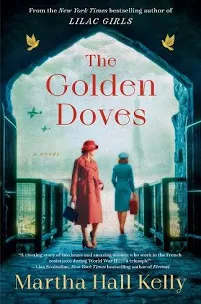
The Golden Doves by Martha Hall Kelly

Josie is not happy about her assignment in 1950’s Texas – enabling ex-Nazi scientists to be coddled within the secretive, US government research program – but what is she to do? Allow the Soviets to access their expertise first? She knows she must go along with it, given that her mentor, Karl, has been pressuring her to not let her past at Ravensbruck cloud her judgement as an agent. She finds she is truly missing her days working with her unlikely best friend, Arlette.

We then meet Arlette as she works alongside other Ravensbruck survivors in a tiny cafe in Paris, outwardly appearing content with her lot, just about making ends meet. But inside, she is still struggling day in and day out, not knowing if her son, Willie, lost to her in the camp, is dead or alive. When a handsome stranger walks into the cafe, promising information on her son, she is given a new hope that feels both unreal and terrifying.

This is a brilliantly written historical fiction novel about a time when those who committed some of the most heinous crimes of the twentieth century literally got away with (worse than) murder. Nazi war criminals responsible for the maiming and murders of thousands were given a pass by sympathizers across Europe who funneled them by way of Austria or Italy (sometimes even the Vatican) through the Alps, into hotels where they waited, often for months in plain sight, until receiving false papers to get to South America (often Argentina), to live out their days in peace. Even some of the most notorious, such as Mengele, known for his unconscionable experiments on humans, escaped justice in this way. There were many agents who did seek justice, however, to try to bring these gutless criminals to justice.

But even if the story were not about such a monumental topic, it would still be a standalone epic novel. The crafting of the plot, the gradual reveals in the “before” and “current” (with current being 1952) telling, the way we can’t help falling in love with both Josie and Arlette, and the way we are continuously surprised by the plot up to the very final page – all make for an outstanding, suspenseful page-turner of a book.

And yes, you’ve guessed it: this one is absolutely a MUST READ! Because although it is a painful subject, and some of it is truly hard to read, I feel you absolutely must read it. If not for the historical value, for the literary value alone!

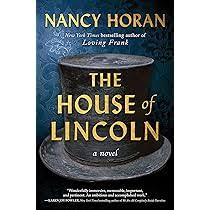
The House of Lincoln by Nancy Horan

1851 in Springfield, IL could be a terrifying time, depending on the color of your skin, your heritage, and your politics. While Illinois was a northern state, there was the constant threat of slave hunters prowling around, searching for the bounty they would earn for themselves if they tracked down runaways. In fact, having arrived into this country as a Portuguese refugee herself, Ana finds herself with her friend Cal, witnessing a frightening scene that she must keep to herself in order to protect those she has come to love and respect. This comes to help form her views as she moves forward through her life, becomes a nanny and cleaner for the Lincoln family and follows the rise and tragic fall of the most impactful presidents our nation has ever seen.

Told through the eyes of this young woman, we glimpse into the home of the Lincolns, seeing their experience of both personal and national tragedies. We view the life of Mary Todd Lincoln, who experienced loss after loss, and, understandably, struggled with her mental health because of it. Yet she still fought so hard to encourage her absent-minded but brilliant and kind husband to fight for what he felt was the best for the Black slave – emancipation. Through Ana, we see how he agonized, how he sought the argument, the magical words that would not only convince his enemies to join him, but how to bring the fractured country back together. Through Ana, we also view the backlash, so quick to happen, so easily sprung back. Even in the hometown of Abraham Lincoln, where he was beloved, or so one would think, there was an evil backlash of hatred.

Not only is this an important part of our history, providing details that one might not know, but it is frighteningly relevant to what is happening today. While we might have made some progress toward freedoms, there is much in the way of backsliding and backlash happening now as well. Not only from people in the streets, but it is being supported and legitimized by our Conservative legislators and the courts. The civil rights of marginalized people are being chipped away and the highest court in our land is jubilantly cementing this in. I fear it will take years to undo the damage they are doing now.

We are growing less and less the “land of the free and the home of the brave” our founders sought for us. Shame on those who are perpetrating this backlash (and the current conservative members of the Supreme Court). This is why it is so important to know what has happened in our past. So that we can do our best to prevent the extreme backsliding to this segregation, this hatred, this fear of the “other” for our future.


Them by Ben Sasse

I believe it’s important to know that the full title of this book by the former, conservative Republican senator from Nebraska, Ben Sasse, is actually: Them; Why We Hate Each Other and How To Heal. I am not conservative, nor have I ever voted Republican – but this is exactly why I was curious about reading this book.

What Sasse observes in this book, and what we can all see quite clearly, is that our country is so painfully divided, so diametrically polarized. We are distrustful of the news outlets that are available to us either because 1) they are run by an intellectual elite or 2) they have become faithful only to the almighty dollar, dependent on the outrageous and extremism that is clickbait. Those who turn to social media for their news are even more vulnerable, because they are most likely getting their information from Russian bots or from some creative teenager in the basement of their midwestern parents’ home. Furthermore, the idea of community, from which we derive identity, security, – happiness even – has all but dissolved as we become more mobile in search of the perfect job, the ideal opportunity to earn more money, the next best thing.

Not to worry, though. There are answers. Of course, they don’t come easily and they don’t come quickly. The answers take time, effort, energy and lots of commitment. We have to want to heal. We have to want to come back together. We have to want to have those difficult conversations that will enable us to find what we have in common that will bring us together. We have to be able to say, “OK, I disagree with you on X and Y, but I agree with you on Z, so let’s start there.” We have to be able to come together with folks we have differences with and be in community with those people, because we are stronger together than we are apart.

The bottom line is that if we continue along this fractured, divided path – we become vulnerable to our real enemies. Putin is just sitting and watching with glee, noting all of our polarization and waiting for just the right moment to pounce. United we stand, remember?

So, I figured that reading literature such as this, written by someone who comes from a world so different from mine, with a political philosophy so opposite from mine, was a first step. And it was a good one. There was much more that I agreed with than I disagreed with, to my surprise. While I completely disagree with his opinions on abortion or the ACA, I agree with his overarching premises and I hope that others will read what he has to say here.

I think this is a MUST READ. I think work like this will do much to save our country. We are in deep need of more like this.

Looking for Jane by Heather Marshall

It is 1960 and Evelyn is terrified. She has no choice but to accommodate her parents’ wishes and move to the home for unwed mothers where she’ll work and live until she gives birth to the child that she is now carrying. It would have been completely different had her boyfriend not died of a heart attack just before she found out she was carrying his baby. But now, she is trapped. Literally.

Fast forward to 2017 and Angela, working in her aunt’s antique store, stumbles upon a letter received years prior, meant for the tenant in the upstairs apartment. She opens the letter, just to see how she might be helpful to the sender, and she sees a heartbreaking plea. How can she be helpful in this situation? Should she try to help in this situation?

Meanwhile, in the 1970’s, we meet Nancy, who is struggling to assert her independence from her overbearing mother. They frequently clash, given her mother’s overpowering personality and ability to ignore most of what Nancy actually says. So Nancy learns to hide her self in a way that is detrimental. She learns to keep secrets. When a cousin asks Nancy her for help in a crisis, she keeps that secret as well, in spite of the trauma that it leaves her with. But she also learns a tidbit of information at that time that will have an impact on her future in a way that she cannot possibly imagine.

This is a particularly relevant read for this moment. In a time during which access to safe, legal abortions is threatened in too many areas of our country, this book should be read by everyone. This book touches upon the issue of women forced to carry pregnancies against their will (and then forced to give up the babies when they do deliver), women compelled to undergo dangerous procedures that endanger their lives, and women and medical providers who are threatened with arrest for having life-saving procedures such as D&C’s for natural miscarriages. And ironically, as it is pointed out in this story repeatedly, it is generally men making these decisions about women’s bodies!! What an absurd world we live in! [Of note, this story takes place in Canada, but the situations can and do happen here all the time in the US as well. Fortunately for Canadians, their country has not reneged on their commitment to women’s health the way we have here.]

This is an intricately constructed story and the way in which these very realistic, very human characters are portrayed and come together will captivate and engage and surprise you until the very final page. I could not put this book down. I loved it not only for its relevance but for how personally connected I felt to these beautiful characters. They are each products of their times, their circumstances, and yet connected by the fact that they are women who love.

Enjoy this book! I know I did!

Dreams of Joy by Lisa See

Already reeling from the death of the man she’s known to be her father,  Joy has also just learned some shocking news about her mother, Pearl. These two events challenge Joy’s identity to her core. At the same time, as the 1950’s American government is targeting those suspected of being Communists, some, particularly those on college campuses, feel that Socialism can be the ideal of equality and fairness. Following this ideal,  Joy makes the impulsive decision to leave the comforts of what she’s known as home to embark on a journey to find her true birth father, to seek her Chinese roots, to relinquish her capitalist excesses, and to enter Mao’s People’s Republic of China. What she finds there shocks her even more.

With her usual skillful style, Lisa See has managed to compose yet another beautiful family saga, depicting family relationships at both their worst and their best, while incorporating a significant historical moment that is not frequently highlighted. Her mother, Pearl, on learning that Joy has left for China, follows her daughter there, even if it may put her own safety in jeopardy. She knows that Joy is young, that does not understand the consequences of her actions to the fullest, that she has never experienced the heavy hand of Communist rule. And if she is being honest, finding Joy’s father is of interest to her to, as they have a complicated history as well. The relationships depicted here are tender, beautiful, and authentic.

History plays a large role in this saga as well. China’s “Great Leap Forward” is anything but — but this is the era in which Joy finds herself. Initially, she tries to find the grace in it: the idealism of the communal life, the simplicity of the farm, the romance in the hard work. She also finds meaning in the art she’s able to produce there through which she can express herself, at least within the confines of the dictated rules. As time progresses, however, she sees the rampant deception. She begins to see that even when the rules are failing the people miserably, they are forced to abide the whims of their dictator, even at the cost of their very lives. When Joy becomes responsible for the life of another, this is where she can no longer abide this lie.

There is much darkness depicted here, but it is a frighteningly timely and realistic story. We are now in a moment when so many are following another wannabe fascist – a worshipper of Putin, of Kim Jong Un, of Hitler – and these followers are ignoring the harm he has done and has the potential to continue to do. He has already threatened to imprison his enemies – a classic fascist move. People make excuses for him – but we’ve seen him do this already in his first presidency. It’s an authentic threat. We need to learn both from other countries’ pasts such as that depicted here and our own past. This can happen again and this can happen here. We have the power to stop it with our votes. But this may not be the case for long if he is elected…

I hope you will read this novel. It is a beautiful family saga as well as a harsh warning for the world and for our country in particular.  A MUST READ for this moment!


The Gates of Gaza by Amir Tibon

On the eve of October 6th, 2023, Amir Tibon and his wife Miri thought that all they had to worry about was how their 3-year old daughter, Galia, would perform in her dance for their kibbutz celebration the next day. She’d rehearsed with her kindergarten that evening but no one knew how these little ones would do in front of an audience, even among the familiar faces of their close-knit community. They had no idea that the next morning would begin the most harrowing ordeal of their lives: the invasion of the lush, peaceful green of their kibbutz by hundreds of armed Hamas terrorists who had the mission of killing, maiming, burning, and capturing as many Israelis as they possibly could. Amir and Miri rushed immediately into Galia’s and Carmel’s(1 year old) bedroom, also their “safe room,” a room built to protect them against rocket shelling but certainly not machine gun blasts or fire explosions (many safe rooms did not have locks on the doors). This is where they waited, in the dark, with a few water bottles, no bathroom, food or electricity for 9 hours while they heard screaming and gunshots just outside their door. All they knew was that Amir’s father was coming to rescue them. But when? And how?

This is not only a MUST READ, but should be compulsory for everyone who believes they have formed an opinion about the conflict between Israel and Hamas/Iran/Hezbollah. For while Tibon, a journalist for Haaretz for many years tells his and his family’s heroic story, he also tells the backstory of Hamas, of Israel, of Netanyahu, and how it came to be that we are here in this hideous quagmire in which we find ourselves. He of course tells his own story from his own perspective. He cannot do otherwise. But he tells the historical perspective with journalistic integrity, having done extensive research, interviewed many on all sides, and does so with an honesty that is almost uncomfortably brutal.

What comes to light, is that there have been clear and present signs, over the past many years, that have been ignored, most shamefully by Netanayu and his enablers, that this attack by Hamas was inevitable and imminent. Qatar had been funding Hamas for years, with the tacit agreement -even encouragement – by Netanyahu. While this funding was supposed to go to the civilians of Gaza to improve their lives, to build schools, parks, businesses, hospitals, community centers, etc., it instead went to the construction of the notorious, massive, high-tech tunnel system. Hamas used these tunnels not only to import ammunition and money, but also to hide its planning, readying for this military attack on Israel. And while it did not accomplish all it set out to do, it accomplished the capturing of hundreds of hostages, many of whom are still, a year later, being held down in cages in these dark, dank, airless, food-less tunnels to this day.

And it is clear that while both sides have a claim to the land, and there are some on both sides who seek peace, the years of wars and militancy have pushed more to the extreme on both sides. Even while hundreds of thousands of Israelis have been protesting in the streets against the extreme right-wing government in Israel, there are still thousands of Israelis who are extremists in their own right. Many of the settlers in the West Bank have carried out horrific terrorist attacks on their Palestinian neighbors – a disgrace in the name of religion. But just as evil, if not more so because of scale and scope, is the terrorism that has been ongoing by Palestinian extremists, Hamas included, who have been holding their own citizens hostage, in a sense, using them as human shields, as well as carrying out horrific terrorist acts on Israelis in the name of their religion as well.

Bottom line, this is a fraught, complicated, nuanced issue where many have sought to establish compromise and too many have interfered. Extremists on both sides have refused to accede the middle ground, to see any path to compromise. On the few monumental occasions when we’ve bravely come close, extremists have thwarted these attempts. It feels hopeless.

But all we have is hope, so we have to continue to hope.

There is a solution: there could be 2 states, side by side, if extremists on both sides would lay down their arms and compromise. It would take a replacement of both current governments – Hamas and Netanyahu’s government – to proceed to that ideal. It would take Iran’s government changing and staying out of the current mix.

It might take a miracle to open those Gates of Gaza.

The Women by Kristin Hannah

Frankie wants to make her parents proud. The idea that women can be heroes too, whispered in her ear by her brother’s friend, has never occurred to her before, but when it is uttered, it hits her like a breath of fresh air. What better way to make her father, especially, proud than to join his “wall of heroes” by enlisting and serving her country as an army nurse in Vietnam? What she finds, as she disembarks from that first plane, is nothing like she’d ever imagined. And what she encounters there, whether she likes it or not, will stay with her for the rest of her life.

Here is yet another MUST READ, gifted to us from Kristin Hannah. It is not an easy one. It is harsh but realistic in its graphic detail of the horrors of the Vietnam war. It is a constant reminder, again and again, of what is lost in each and every battle. It also is historically and acutely accurate in its documentation of how horrifically veterans of this war were treated upon return to their country after their service, as if it were their choice to continue the war that most were drafted to serve in. More importantly, for this story, it documents how horrifically the WOMEN veterans of the war were treated. These women were denied their very existence there. Frankie was told, again and again, “There were no women in Vietnam,” when in fact, there were thousands of women in Vietnam – nurses, and support staff – serving their country, endangering their lives, and witnessing the trauma every day of their lives there.

Is the story all doom and gloom? No, of course not. It is also a story about love. Frankie finds so many versions of love. She finds beautiful friendships that last her lifetime. She opens her heart enough to have it broken time and again, which hurts but also helps her to grow. She also learns to appreciate that love can be demonstrated in many ways, even if it is not how we’d prefer. Frankie also learns to love herself, as she succeeds and fails and succeeds again.

It is an inspiring, gruesome, and heartwarming saga of a woman’s search for meaning and for herself. It is hard – perhaps impossible –  not to love this book.