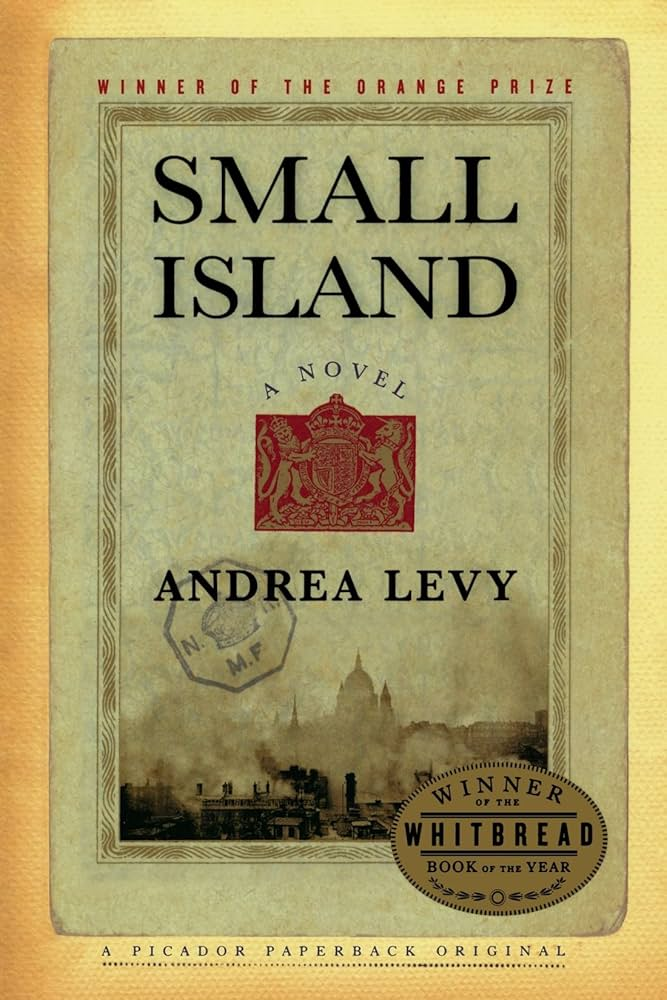
Small Island by Andrea Levy

Hortense and Gilbert, essentially strangers, have made an unusual deal: Hortense has offered to pay Gilbert’s passage from Jamaica to England so that he can pave the way for her to follow him there. She would love to fulfill her dream of becoming a teacher in that faraway, fairytale land, as she perceives it. And for his part, Gilbert, feeling claustrophobic himself on that tiny, Carribean island, he agrees to it, even at the price of marrying this haughty and serious, albeit beautiful, young woman.

On the other side of the world, in London, Queenie and Arthur have had their share of challenges. Queenie has had no choice but to run a boarding house while caring for her father-in-law. Her husband, Arthur, has been MIA since the end of the second WW, after being stationed in India. She is ready to declare him dead and try to move on with her life, but she is quite distracted with all the goings on in her own home, such as it is. Getting flak from her neighbors because of whom she is renting to is frustrating enough, but managing all of their comings and goings isn’t what she’s signed up for either. And now with the advent of Gilbert’s wife to add to the mix. Where will it all lead?

This is a fascinating dive into London’s WWII and post-WWII world, where there remained as much hostility toward anyone who was considered “foreign” as there is today. Anyone of color who moved into a neighborhood was considered to be “taking over,” and White folks complained, moved out, and sought out their own. While Gilbert thought this was purely an American issue, a “Jim Crow” problem, he learned the hard way that it was just as alive and well in England, even if it didn’t have an official name. When Queenie defends sitting with Gilbert in a movie theater, rather than having him seated in the rear, it ends in terrifying violence. Sadly, things haven’t changed much, right???

What is interesting is how the story is told. We learn each of the stories from the perspective of each of these characters: Queenie, Arthur, Hortense and Gilbert. They each have a history, a story to tell. They are each complicated, with their own fears, anxieties, and challenges. Through them we also learn about the tension between the British and its island of Jamaica; that is, how hardly anyone in Britain knew where Jamaica even was, while those in Jamaica were taught to worship the crown as if Buckingham Palace were situated right there on its shores.

While the overall message is clearly heavy, it is told with warmth, wit, and with a Jamaican lilt that gives it just enough lightness to make it enjoyable, surprising, and a worthwhile read.

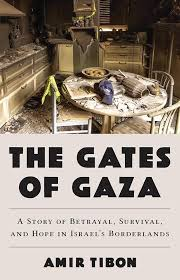
The Gates of Gaza by Amir Tibon

On the eve of October 6th, 2023, Amir Tibon and his wife Miri thought that all they had to worry about was how their 3-year old daughter, Galia, would perform in her dance for their kibbutz celebration the next day. She’d rehearsed with her kindergarten that evening but no one knew how these little ones would do in front of an audience, even among the familiar faces of their close-knit community. They had no idea that the next morning would begin the most harrowing ordeal of their lives: the invasion of the lush, peaceful green of their kibbutz by hundreds of armed Hamas terrorists who had the mission of killing, maiming, burning, and capturing as many Israelis as they possibly could. Amir and Miri rushed immediately into Galia’s and Carmel’s(1 year old) bedroom, also their “safe room,” a room built to protect them against rocket shelling but certainly not machine gun blasts or fire explosions (many safe rooms did not have locks on the doors). This is where they waited, in the dark, with a few water bottles, no bathroom, food or electricity for 9 hours while they heard screaming and gunshots just outside their door. All they knew was that Amir’s father was coming to rescue them. But when? And how?

This is not only a MUST READ, but should be compulsory for everyone who believes they have formed an opinion about the conflict between Israel and Hamas/Iran/Hezbollah. For while Tibon, a journalist for Haaretz for many years tells his and his family’s heroic story, he also tells the backstory of Hamas, of Israel, of Netanyahu, and how it came to be that we are here in this hideous quagmire in which we find ourselves. He of course tells his own story from his own perspective. He cannot do otherwise. But he tells the historical perspective with journalistic integrity, having done extensive research, interviewed many on all sides, and does so with an honesty that is almost uncomfortably brutal.

What comes to light, is that there have been clear and present signs, over the past many years, that have been ignored, most shamefully by Netanayu and his enablers, that this attack by Hamas was inevitable and imminent. Qatar had been funding Hamas for years, with the tacit agreement -even encouragement – by Netanyahu. While this funding was supposed to go to the civilians of Gaza to improve their lives, to build schools, parks, businesses, hospitals, community centers, etc., it instead went to the construction of the notorious, massive, high-tech tunnel system. Hamas used these tunnels not only to import ammunition and money, but also to hide its planning, readying for this military attack on Israel. And while it did not accomplish all it set out to do, it accomplished the capturing of hundreds of hostages, many of whom are still, a year later, being held down in cages in these dark, dank, airless, food-less tunnels to this day.

And it is clear that while both sides have a claim to the land, and there are some on both sides who seek peace, the years of wars and militancy have pushed more to the extreme on both sides. Even while hundreds of thousands of Israelis have been protesting in the streets against the extreme right-wing government in Israel, there are still thousands of Israelis who are extremists in their own right. Many of the settlers in the West Bank have carried out horrific terrorist attacks on their Palestinian neighbors – a disgrace in the name of religion. But just as evil, if not more so because of scale and scope, is the terrorism that has been ongoing by Palestinian extremists, Hamas included, who have been holding their own citizens hostage, in a sense, using them as human shields, as well as carrying out horrific terrorist acts on Israelis in the name of their religion as well.

Bottom line, this is a fraught, complicated, nuanced issue where many have sought to establish compromise and too many have interfered. Extremists on both sides have refused to accede the middle ground, to see any path to compromise. On the few monumental occasions when we’ve bravely come close, extremists have thwarted these attempts. It feels hopeless.

But all we have is hope, so we have to continue to hope.

There is a solution: there could be 2 states, side by side, if extremists on both sides would lay down their arms and compromise. It would take a replacement of both current governments – Hamas and Netanyahu’s government – to proceed to that ideal. It would take Iran’s government changing and staying out of the current mix.

It might take a miracle to open those Gates of Gaza.

The Women by Kristin Hannah

Frankie wants to make her parents proud. The idea that women can be heroes too, whispered in her ear by her brother’s friend, has never occurred to her before, but when it is uttered, it hits her like a breath of fresh air. What better way to make her father, especially, proud than to join his “wall of heroes” by enlisting and serving her country as an army nurse in Vietnam? What she finds, as she disembarks from that first plane, is nothing like she’d ever imagined. And what she encounters there, whether she likes it or not, will stay with her for the rest of her life.

Here is yet another MUST READ, gifted to us from Kristin Hannah. It is not an easy one. It is harsh but realistic in its graphic detail of the horrors of the Vietnam war. It is a constant reminder, again and again, of what is lost in each and every battle. It also is historically and acutely accurate in its documentation of how horrifically veterans of this war were treated upon return to their country after their service, as if it were their choice to continue the war that most were drafted to serve in. More importantly, for this story, it documents how horrifically the WOMEN veterans of the war were treated. These women were denied their very existence there. Frankie was told, again and again, “There were no women in Vietnam,” when in fact, there were thousands of women in Vietnam – nurses, and support staff – serving their country, endangering their lives, and witnessing the trauma every day of their lives there.

Is the story all doom and gloom? No, of course not. It is also a story about love. Frankie finds so many versions of love. She finds beautiful friendships that last her lifetime. She opens her heart enough to have it broken time and again, which hurts but also helps her to grow. She also learns to appreciate that love can be demonstrated in many ways, even if it is not how we’d prefer. Frankie also learns to love herself, as she succeeds and fails and succeeds again.

It is an inspiring, gruesome, and heartwarming saga of a woman’s search for meaning and for herself. It is hard – perhaps impossible –  not to love this book.


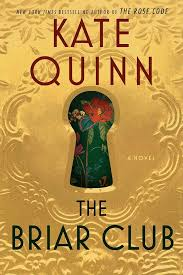
The Briar Club by Kate Quinn

When we are first introduced to the Briarwood House, we are informed that there are 2 dead bodies found within. This is in 1954.

We are immediately transported back to 1950, however, when Grace is first shown the tiny closet of a room on the top floor of this women’s boarding house, when she decides she can make this work, at least for the time being. Her answer to the cold, mean and nosey Mrs. Nilsson who runs the place? To undermine her rules and start a dinner “club” in this tiny room for all the tenants of the house on Thursday nights, when she is out at her regular card game. In this way, Grace creates a community within the house and actually makes the house a home to this disparate group, gets to know their various stories, even as her story remains quite mysterious.

This is yet another astonishing feat created by the extraordinary Kate Quinn. With the disturbing background of the McCarthy era, the oft-ignored Korean War, the pervasive fear of a Russian nuclear attack, and the absence of power that women still had over their lives and livelihood, Quinn sheds light on the fact that the 1950’s were not necessarily “Happy Days.” Her characters are not the sweet and shiny women we often expect from this time period, but they are real and they are hurting and they reflect the life experience they’ve each been through. We learn that there is a reason we are who we are.

The plot is also so intricate and suspenseful that I guarantee you will not be able to put this book down until you turn the final page. I was absolutely kept guessing until the very end.

This may be one of Quinn’s best novels, in my opinion – and that is high praise! It is deeply-researched, with relatable characters, and with a twisty plot that kept this reader’s light on through all hours of the night just to get to the finish line. Here’s one more MUST READ to add to her list!

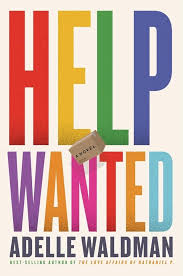
Help Wanted by Adelle Waldman

A change in store management is imminent in this big-box store in this upstate NY small town, and there is a buzz about this in Movement. The whole department, responsible for unloading the trucks of merchandise and distributing it throughout the store, is discussing how this might impact them. Perhaps they can find a way to rid themselves of Meredith, their patronizing, misguided supervisor who does more to hinder than help them throughout their shifts. When Val comes up with a plan, it feels like they suddenly have a purpose. But will it work?

Imagine “The Office” for a Target-like warehouse, with characters with real-life problems (such as trying to stretch their paychecks at the end of the month by checking in at the local church’s food bank when their food stamps aren’t working) — and this is that story. These characters work together, rely on each other to ensure that their assembly line functioning runs smoothly, and they get to know each other as we get to know them. We become familiar with their quirks, their senses of humor, their short tempers, their vanities, and their personal sources of shame. But we also see how they unite toward a common goal, and how this energizes and inspires them. Even for a moment.

I love this story because it is about the Americans who truly run this country. It is about the folks who are behind the scenes, working their day-to-day jobs, following the rules, but who are at the mercy of our economy. They are the ones who suffer when companies cut back hours and cut back on benefits, not allowing for overtime pay, for healthcare, for earning a living wage. But at the same time, these companies expect hard work and loyalty, even when they do not show this in return. And heaven forbid these employees unionize in order to gain these benefits.

I may sound like a socialist here. I’m not. But I do believe that folks have a right to earn a living wage. I do believe folks have a right to healthcare. And I believe that treating employees well does foster a healthy, energized, and loyal workforce that creates better businesses. Not every decision should be about dollars and cents. Some business decisions should be about sense.

An interesting story, great characters, and so true to life.

Trust by Hernan Diaz

We first meet Ida as she recounts her visit, later in life, to the home of her previous boss, Andrew, who has hired her to help him write his life story, as he sees it. You see, it has been written, by one Harold Vanner, albeit disguised as fiction. But it carries some accusatory and, as he sees them, misguided details, particularly about his dear, departed wife, Mildred. And he needs to see this story corrected. The story within the story, within the story, becomes clear only as we near the very end, when Ida herself clarifies for us who and what we should actually “trust.”

Not only is this a brilliant telling and, of course, retelling of a story, but it also shows how perspective and motive is key. Everybody has a story they want to tell about themselves, how they would like to be perceived, how their legacy is viewed. And yet, that story may differ from the truth. Do we get to change that truth, or the perception of that truth? What if we have the means to do so? What if we care not about stepping over others in our way to do so? Maybe then, no one will know the truth? What, then, is the cost of our legacy?

Without giving too much away, I think it is important to draw similarities between Ida’s father and her boss. While they would see themselves as completely opposite, because of such differing sociopolitical views, they both use Ida to retell their own stories. They are both dishonest to her and to themselves, while trying to appear to be looking out for her best interest, as if doing her favors. They are both undeserving of her trust.

What is strikingly unique here in the writing is the construction of this novel within a novel within a novel, which builds upon itself to a suspenseful crescendo. It is clear why it is a Pulitzer Prize winner – and I would be remiss if I were not to make it a MUST READ!

The Best Minds by Jonathan Rosen

When Jonathan Rosen moved to Mereland Rd. in New Rochelle at the age of 10 and met Michael Laudor who lived down the block, their friendship was immediately kindled. Jonathan was taken by the brilliant, athletic, and charming personality that Michael exuded, and he felt constantly challenged, entertained, even a bit intimidated by him. While they remained close friends through elementary, middle and high school, their friendship took on a bit of a competitive edge, and when they both were accepted to Yale University, they remained friendly but found divergent paths. Jonathan now writes about his friend not because of this friendship, but because of the perspective that this friendship lends him. Because eventually, Michael, while truly brilliant and charming, was also diagnosed with schizophrenia, and this became Michael’s ultimate challenge.

This is a topic of epic importance, particularly in this moment when so many are suffering from mental health disorders. It is vital that we acknowledge that these conditions are prevalent, need appropriate high-quality treatment, and should not be treated as if they do not exist. And it is urgent that it is brought to the attention of the masses, so that there can be discourse on how best to address the needs of the most ill among us, particularly those with the possible propensity to lack control over their actions, even to the point of violence toward others or themselves.

This book, was disappointing in its efforts to accomplish this, however. I found it utterly frustrating in the overwhelming number of detailed tangents, distractions, and offshoots, while the gist of the story kept getting lost. Whether it was the writing or the editing – likely a combination of the two – I am not sure, but I had a very difficult time getting through. (If I were not reading this for a book club, I would have given up much less than halfway through.) I did not need to know the background of everyone who weighed in on every detail of Michael’s life. I did not need to know every painstaking detail of every historical backstory of everything that was going on at the time each event occurred. I did not need to know every comment from everyone Michael ever met. It was painful. 

I had approached this book with much anticipation. Since I have lived in New Rochelle, have children who went to the middle school and high school here, was familiar with the barbershop and the local toy store Jonathan refers to, I was excited to read about them all in a now-famous book. Moreover, knowing the urgency of this topic, I was thrilled that someone was championing this cause in an accessible story. Sadly, I found this to be neither accessible nor a “story” in the true sense of the word. It was more a textbook with a theme, riddled with too many facts, muddled by an attempt to achieve too much.

I am glad that Michael’s story is told. I am disappointed that his story is so hidden underneath so much data.


Rubyfruit Jungle by Rita Mae Brown

Molly is smart and she is tough. She knows she’s different from those around her but she truly doesn’t care. While her mother, Carrie, and her best friend, Leroy, try in their own ways to convince her to bend to what is “acceptable,” especially when it comes to both gender and sexual stereotyped norms, she remains true to herself.  And this is no simple task, not in the early 1950’s and not in rural Pennsylvania, nor on the Florida coast.  It is clear to Molly that she must make it out of her small town to survive, but how she accomplishes this and what she finds when she gets there shows that life can be challenging wherever we may find ourselves.

This was a groundbreaking book in 1973, but of course it was initially ignored and kept underground because of its unabashed celebration of lesbian sex. Only a few years later, when a more established publisher took on the title did the book become more widely sold and gain something of its current notoriety. Now, of course, there are many books about this topic and it is less of a standout, but it must be acknowledged for its pioneering spirit and daring language. Few ventured into this terrain at the time; few were brave enough to “out” themselves when it was not only not fashionable but it could actually be quite dangerous to do so. But doing so clearly spoke to millions of folks who either identified with the characters or felt they needed to learn more. Doing so opened up a world of dialogue about the topic, freeing many to speak their truth and to acknowledge what might be in their hearts. 

That said, the story itself is quite depressing. It feels as if there is a constant tugging at the heart, a constant thrum of defeat. Molly has high hopes, high expectations of herself and while she works hard and keeps herself focused on her goals, she has one obstacle thrown at her after another. Whether her family, her friends, her lovers, or her so-called mentors, everyone seems to disappoint. However realistic it is, in her world at that time, it is a hard story to take in. No matter her incredible achievements,  she lived in a world where men ruled unchecked and women had no legal protections. 

This novel functions as a crucial reminder of some rights we take for granted – and some that we should be continuing to fight for. 


The Thing Around Your Neck by Chimamanda Ngozi Adichie

Here I have fallen again into another book of short stories – but luckily so. While, again, I am generally not a fan of them, these stories are virtually novels unto themselves. Not in physical length, but in the depth of characters the author creates and in the lives and experiences they convey. We have a writer attending a workshop surrounded by writers afraid to stand up to the man in charge who is inappropriate and sexist and racist, out of fear they will threaten their own opportunities. We read about a young bride of an arranged marriage, newly brought to New York from Nigeria, about her disappointments and resentments. And we read about a young woman trying to come to terms with the death of her brother, so many years prior.

The many characters and the many stories here bring us closer to understanding the African experience in America and the African experience in Africa. We are exposed to the conflict that often arises from clashing cultures, religions, origins, and beliefs – and how each character must struggle to identify where they fit into the world where these conflicts exist. Just as exists anywhere, there is conflict between old and young, between man and woman, between one culture and another. The human experience, on display so vividly in these pages, is finding what our role is in that morass and how we resolve our differences with those around us. It is both specific to these cultures and generalizable to almost anyone living in the world.

Of course there are some stories I enjoyed more than others, but that is to be expected. On the whole, however, I found these stories to be powerful, deeply moving, and well worth the experience of going out of my comfort zone to read short stories in spite of myself. I encourage you to do the same!


One Way Back by Christine Blasey Ford

Within these pages, Christine Blasey Ford reclaims her narrative – without distortion by the media, by politicians, or by any outsiders – of the facts of her experience of sexual assault by the man who is now sitting on the highest court of our land, Brett Kavanaugh. It is here, with a clear mind, a clear conscience, and clear focus, that she is able to communicate her backstory, her patriotic motivation, and the attempts she made to tell her story earlier in order to prevent Kavanaugh from coming to the point of being nominated in the first place (and in so doing, having to be exposed as he was). She tells about her experience of presenting her testimony and the abhorrent dereliction of duty of the FBI in their non-investigation of the case against Kavanaugh. She also bears her soul about the way in which she endured death threats, shaming, and other hateful acts against her that so many other survivors of sexual assault share – the backlash and the victim-blaming that comes with coming forward. She also shares the moments of support, from those whose names we recognize and those we may not. It is an inspiring, albeit painful, recounting of her journey.

It was our hope, at least that of those in my circle, that we in our country had learned our lesson after Anita Hill. That after our horrific treatment of that courageous woman who stood in front of a panel of old White men who battered her with ignorant questions and brazenly shamed her and disregarded her – we hoped we’d do better when another woman so bravely came forward to challenge the character of a man we were choosing for the highest court in the land. But no, we did not. One might argue that we did worse. We instead chose to discredit, shame, and mock Blasey Ford, who so boldly came forward to do her civic duty, who gave up her own quiet, private, comfortable existence to reveal such personal, intimate details of her life in order to bring a man’s questionable background to light. And it was worse because of social media, the 24-hour news cycle, and the internet access to personal information that enabled thousands to send her hate mail and death threats via so many different routes.

In a country of how many millions, we couldn’t find anyone better than Kavanaugh? There was really no one we could find who HADN’T sexually molested anyone??? Seriously? Oh, but of course we had to choose him. Because we have to only choose those farmed and nurtured by the Federalist Society in order to ensure the most conservative justices to make the most civil rights-limiting decisions on the bench. Because heaven forbid that anyone except White men have any power.

And yes, I am using this platform to rant because Blasey Ford needs to have others support her, to hear her, and to acknowledge that she did the right thing by coming forward and speaking up for herself, for women, and for this country. Because she is right. If little by little, woman by woman, each brave soul comes forward (in spite of the vicious backlash and victim-blaming that so often occurs), perhaps our daughters might have a spitting chance of having a better world. Perhaps our daughters will live in a world in which there are men who are more aware of consent and what defines assault. Perhaps when a woman comes forward, the folks in the room – however large that room may be – will actually hear her.