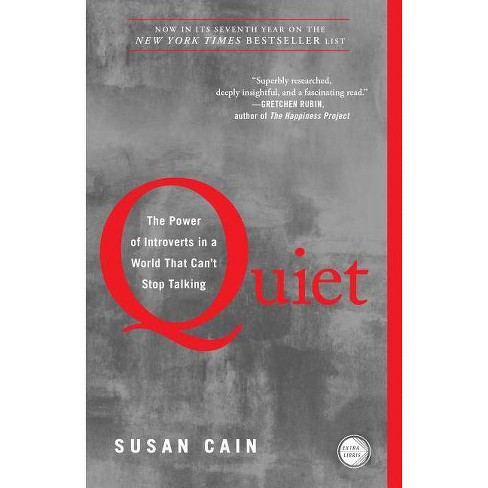
Quiet: The Power of Introverts in a World that Can’t Stop Talking by Susan Cain

Image result for image of quiet by susn cain

Do you ever crave an escape from the noisy world we live in? Do you thrive in quieter settings, when you’re either alone with a good book or just engrossed in deep conversation with one friend? Have you worried there was something wrong with you when you panicked at the thought of having to speak up in a group of co-workers or a study group? If you have, you may actually be an introvert – and that is not a bad thing! While our society seems to prize the extrovert, the one who is the outspoken, confident leader — think Homecoming Queen, for example — it may be the introvert who really is behind so many of our major advancements (think Steve Wozniak, co-founder of Apple). It is the introvert who may allow for the quiet time during which thoughts can generate and percolate, and who may seek deeper conversation that brings people close. To be clear, it is not that introverts do not seek to be with others, but their connections are generally in smaller groups, on their terms, and more intimate. Nor is there a judgement that being introverted vs extroverted is better or worse – this is just a variation in personality style and a way of relating that can be every bit as effective. This book helps to identify and elevate those who are introverts to allow for all of us to prize introverts for their unique value just as we do extroverts for theirs.

An important impact of how society values extroversion is on our educational system. More and more, classrooms are being set up to promote group activity, with desks moved into circles rather than in the classic rows. This is great for those who function well in groups, the extroverts, but those who learn better with time to themselves, this may be more challenging. It is up to the teachers to appreciate and value both personality types and learning styles and to accommodate both.

I wish I had had the opportunity to read this book years ago. I learned so much about both myself and members of my own family through the pages of this book. I now understand why after caring for patients and interacting with my colleagues all day at work, all I am usually able to do by the end of the day is to get into bed and read. I realize that while I feel privileged to have the interactions I have both with my patients and my colleagues and I do feel passionate about what I do and enjoy it, it does take all of my energy to maintain the level of human interaction that it requires. At the end of the day, I need to refuel. Apparently, I am a true introvert.

This is an important book for so many of us to read. It gives us a much deeper understanding of our family, our colleagues, and our friends and enables us to value each of them for their unique styles of interaction. It may also give us a deeper understanding of ourselves. It certainly did this for me.

I recommend this as a MUST READ!
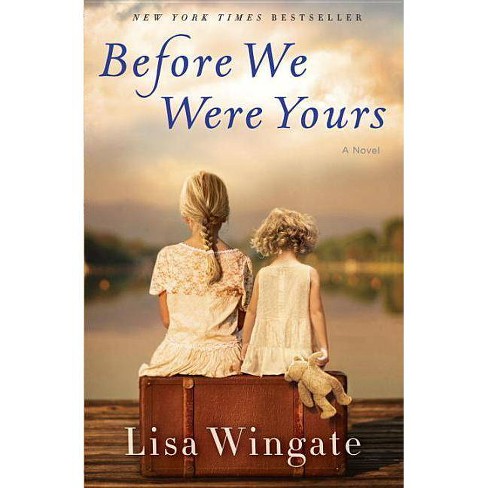
 

Before We Were Yours by Lisa Wingate

Before We Were Yours - By Lisa Wingate (Hardcover) : Target

Avery Stafford is finding her place, as she’s come back to the south to possibly carry on the family’s senatorial dynasty. When she visits a nursing home during a publicity event, she stumbles upon a woman she fears may hold a family secret that may threaten all that she and her family have worked for.

Then flash backward and we meet Rill Foss, a precocious 12 year old living with her poor but happy family in their river shanty. Rill is thrust suddenly into being responsible for her 4 younger siblings, for keeping them together and safe, and we watch as she is torn apart as adults attempt to destroy the family she fights to save.

As these two stories unfold side by side, we are breathless to know how they intersect.

This was an excruciating story to read at times, but at the same time, it was one that I could not put down. And while Rill herself is not an actual person, her story is based on historical events and children’s experiences that have been documented from the 1920’s to the 1950’s. That is, a woman named Georgia Tann, ran an adoption center in Memphis that actually bought and sold children as if they were property. Some of these children were actual orphans, but many were stolen from their homes, kidnapped while walking home from school, or worse. Some were placed in high profile homes, such as in homes of celebrities and politicians, but many were mistreated and hundreds are thought to have actually died under her care. She apparently made thousands of dollars from this business and had politicians and law enforcement in her pockets and avoided any legal confrontation to her dying day. Georgia Tann is the one non-fictional character in this book.

The writing in this book is gripping, particularly Rill’s story. On the other hand, it at times can be so utterly painful that some is extremely hard to read. It’s that same feeling one gets seeing a terrible car accident – can’t look but can’t look away. I personally have the hardest time hearing/reading about abuse of children and tend to avoid books like this. I have to admit, though, that the author handled it well. Just as it reaches a moment of peak discomfort, the story switches to Avery’s story line to lighten the mood and give the reader a chance to breathe. This is the only way I was able to get through, I think.

And in Rill, the author has created an extraordinary character. Though young, she is wise, cautious, kind, and she fights for her family with a passion that brings tears to your eyes and a lump to your throat. There is no way not to love and empathize with this character.

This is an extraordinary tale, told well. Isn’t that all we want in a book???


Nothing to See Here by Kevin Wilson

Nothing to See Here by Kevin Wilson

Lillian and Madison go way back – having been roommates at boarding school in high school. And while they’ve not seen each other in years, they’ve been in touch, with Lillian offering minimal details of her dull unaccomplished life, while receiving letters from Madison filled with details of her picture-perfect marriage to the senator, her picture-perfect home and her picture-perfect little boy. Now, finally, as Madison has written to ask Lillian to visit because she has a favor to ask of her, she will finally see her again in the flesh. Will it be the same between them? Will Madison really be as perfect as she has always seemed? What is this mission she is being asked to do? Will Lillian be able to live up to Madison’s expectations? Will she be able to live up to her own?

Spoiler alert: The mission involves Lillian caring for two children who spontaneously combust. Yes, they burst into flames when they are upset. They are not harmed but they can cause harm to what may be around them. They are awkward kids and are clearly affected by this inconvenient trait, but inside, they are just kids. Lillian appreciates them for who they are, in spite of this trait, but others fear them and have difficulty accepting them for who they are.

While I appreciate a dramatic metaphor as much as the next reader, I just find this entire story too incredulous to swallow. Even beyond the flaming children, there is the history between Lillian and Madison that leads one to question why Lillian would come running at Madison’s behest. And then there is the question of how, with such a neglectful mother as Lillian is demonstrated to have, she has such a knack for mothering challenging children that no one else seems to be able to handle.

I think the author had an interesting idea that started well but went so beyond the boundaries of reality that it was no longer viable. And this, at least for me, was a disappointment. Much of the story felt ridiculous and I had difficulty envisioning at least parts of it. While I did develop affection for some of the characters, such as the 2 flaming children, I wondered always what the attraction was that Lillian had for Madison, as Madison was quite the selfish, and eternally self-serving character. And while the message clearly was one I respect – that we should all be appreciated for our weirdness and quirks as well as what we can do for others —  it was delivered at too a high price.

So, unfortunately, I have to say for Nothing to See Here – nothing to read here, at least in my opinion.  


Her Last Flight by Beatriz Williams

Amazon.com: Her Last Flight: A Novel (9780062834782): Williams, Beatriz:  Books

As a photojournalist, Janey Everett has learned how to use everything she has to get information. In pursuing the backstory of the perilous crash of Sam Mallory, whom, she knew, was considered the best pilot of his time, she is determined to stop at nothing to get to the details. She knows that her only hope is to find the elusive Irene Foster, once his co-pilot, and thought to be lost at sea years prior. But Janey follows her instincts as well as the trail of rumors that she may just be alive. And as Janey chases her story, we are also brought back in time to follow Irene’s. Both women, through their narratives, reveal how courage and grit can lead to a life lived as one’s true self.

Once again, Beatriz Williams has knocked it out of the park with this book. Don’t let her breezy, familiar, and accessible style fool you. This is a heavy book – historical fiction, fully researched and chock full of detail that make it feel as real as any biography might. There is subtle reference to blood and war and the ugliness of humanity, just as in other historical fiction novels. But here, because the references are kept so subtle, they really hit you more when you look back on the story and realize all that you’ve just taken in.

Usually what I love most about Williams’ writing is her gorgeous, fallible, earthy characters. Generally, the main character is a strong female, who is in full control (how refreshing!!). She may make a few less-than-ideal choices, but she is smart, witty, somehow vulnerable, courageous and resilient. Nevertheless, in this novel, I was enthralled by the plot as well, as there were as many twists to it as I imagine there were in a flight demo by Mallory himself. It was as driving as it was passionate.

There is no question whether I’d recommend this book. I’d say it’s even a MUST READ!


.


The Warmth of Other Suns by Isabel Wilkerson

The Warmth of Other Suns: The Epic Story of America's Great Migration:  Wilkerson, Isabel: 8580001042800: Amazon.com: Books

Ida Mae Brandon Gladney, Robert Joseph Pershing Foster, and George Swanson Starling never knew each other, nor did they live in the same time or place — yet they all had something in common: they each participated in the Great Migration and for parallel reasons. Through this gritty chronicle of their lives, we earn a deeper appreciation for how the Jim Crow south drove millions of black folks northward and westward, in desperate search of freedom and civil rights.  We also see how they experienced both successes and failures when they arrived.

This impressive work of non-fiction reads like part novel/part PhD thesis, but as a whole, it works. The parts that tell the story of each of these individuals’ lives are profoundly beautiful and what drive the book forward.   The author delivers their stories with such tenderness and detail that she lifts each of them off of the page and brings them into the room with you, bringing with them their hopes and their heartaches.  And interwoven with their stories is the historical context in which they are living.  The author zooms out to portray the larger picture of what is happening — what wars, economic factors, or local social affairs, sometimes graphic, are impacting our 3 protagonists at the time.  This sometimes gets quite dense, but it definitely contributes a great deal to the depth of the story.  

The larger question is this:  Did those who risked their lives, often sneaking out in the middle of the night,  to migrate to the north/west fare better than those who stayed in the south? I believe this is a complex question and one the author was seeking to answer with the writing of this book.  Those who left were desperately seeking a chance to be recognized as individuals who deserved their civil rights under the law, to be seen as equal to everyone else.  When they arrived in the north and/or west, they were allowed to sit anywhere on the bus and to drink at any water fountain.  But they definitely were not treated as equals to everyone else in their their job searches or their housing purchases.   

I’d be very interested to hear your opinion about the conclusions drawn in this book.  It’s an important discussion.  

The Girl with the Louding Voice by Abi Dare

The thirst for learning instilled into Adunni by her mother has been the driving force for everything she’s done, including continuing attending her small school even when she’s the oldest student there. While her best friend fantasizes about marriage, Adunni only worries about improving her academic skills, so that she can continue to teach others, as she’s done since she was very young. But her dreams come crashing down when her father reveals a proposal he’s made on her behalf – one that threatens not only her education, but any degree of autonomy as well. This sets her on a trajectory that both threatens her but also strengthens her as she sees what she has to do to set herself free.

This very powerful story ignites our deepest sense of injustice and we find ourselves loving and rooting for this heroine, Adunni, at every turn. Because of the poverty into which she was born, her gender, and her cultural milieu in rural Nigeria, she has no power and no agency over her own life. What she does have is intellect, stamina and utter grit, though, and these all serve her well. We love cheering for her and hating her oppressors, and while each character is portrayed with a realistic abundance of depth, we know who is on her side and who isn’t.

What I loved also about this book was the insight into the cultural strata of Nigeria, in both the rural/small town and the big city. There is apparently a vast chasm between the upper class and the lower class, and much corruption filling the space in between. (Pretty much like here in the United States, but I digress…) . Adunni observes more than once, also, that wealth, while it may wield power, it does not, in fact, bring happiness. This is starkly evident to her from observations of her extremely successful but painfully disgruntled boss, Big Madam.

The writing is also striking. It is written as Adunni might think, with her grammar and syntax. It has the singsong, innocent structure of a 14 year old Nigerian girl with an elementary education struggling to be respected. And as she struggles to pursue an education in whatever form she may, the writing develops as she does, and eases subtly into more sophisticated structure.

There are definitely some painful parts to read, and they are not where you expect to find them. There are also many tender moments from characters that are just beautifully written. And throughout, you will be inspired and sad and connected with this young heroine in a way that will surprise you.


Dear Edward by Ann Napolitano

Dear Edward by Ann Napolitano

As the Adler family proceeds to boarding for the flight to LA from NY, Jordan, Eddie’s brother, creates a scene. Feeling empowered by his newfound sense of being an almost-adult, he refuses to walk through the security scanner, holding up the line just enough to inspire annoyance in his parents. The others on the plane have taken notice as well, but proceed to contemplate their own lives, as one does on the “time out” that a flight offers. As the story progresses, and we learn about many of the colorful people on the flight, we also learn how it tragically ends – and how the lone survivor learns to cope.  

In this surprisingly moving story, the author deftly captures the mental paralysis, the constant feeling of being under water, that trauma can instill.  Edward, the teenager who survives, teeters on the verge of falling apart, but is held together by his aunt and uncle and his dear friend next door.  And while this might sound bleak, the story is kindly balanced with the lighter stories of the various passengers of the imperiled flight.  

The writing is quite poignant.  While there are a few moments that are a little unrealistic, we are drawn to Edward and suffer along with him.  But we also drawn to the kind folks who surround and bolster him as he muddles through.   I found myself particularly liking his principal, who, rather than forcing Edward to talk about what was going on inside, just allows Edward to come into his office and help him care for his treasured ferns.  In this quiet, kind act, he offers Edward an island of peace where he can escape the noise of the school he attends.   It is a place where Edward can just be, and not be alone, but just be.  Sometimes this is the most generous and sensitive way in which we can support someone who is in pain.  It is not always easy to do, but it might be the kindest path.

I found myself very choked up by the end of the story, as Edward seems to find his way.  I suspect you will be too.  


Lily and the Octopus by Steven Rowley

Lily, Ted’s 12 year old dachshund, has been the love of his life from that very first moment when she chose him, by tugging on his shoelace.  She may have been the runt of the litter, but she was brave and wise and she’s been perfect company ever since.   They’ve shared walks on the beach, Saturday night movies and pizza, and discussions about cutest guys – and Ted was very content to continue his life with her.  That is, until, the advent of the octopus, who invaded their lives and turned everything utterly upside down.

This is a very unusual story about love and loss, told as a medley of poetic license, imagination and great tenderness.  Anyone who has ever lived with a pet can relate to the deep bond that forms, and the dependence that runs in both directions.  It appears that Ted may have elevated this bond to a higher level, but the way it is depicted is engaging and endearing and we can all relate to some degree.  And loss is hard, no matter whether what kind of living creature it may be.

My only hesitation in fully recommending this book is that it is somewhat monochromatic.  It is missing a secondary plot line, a more layered approach.  It might have benefitted from a side story about his best friend, Trent, to make him more interesting?  Maybe more about Ted’s sister?  Something…

On the other hand, it was incredibly sweet, it had an ironic crescendo, and quite a bit of heart.  And you will definitely also fall in love with Lily.

Cork Dork by Bianca Bosker

What would it be like to quit your job and spend a year studying wine?  No, I mean, really studying it – not just drinking it.  Learning how to appreciate the various aromas, textures, degrees of alcohol, tannins, and acidity and be able to blind taste them and name the grape, the label and the year it was made without peeking at the label!  What might it be like to hang with the sommeliers of New York’s finest restaurants to learn what is considered important in the service of these wines?  Or to research where all these crazy, lofty ways of describing wines came from.  Well, Bianca Bosker has done this and she’s been kind enough to share her journey with us in the pages of Cork Dork.

In her quest to become a sommelier, Bosker smells everything in her kitchen in her home and in her city.  She insinuates herself in the world of the sommelier by befriending a top somm who brings her to blind tastings and allows her to witness the training that each somm puts themself through.  Trailing other waiters, working in a wine cellar in a restaurant, getting to taste a vast quantity of fancy and less than fancy wines, Bosker widens her scope of experience very quickly.  She travels around the country and around the world in this quest, visiting restaurants, vineyards, and scientists who help her understand how she can best go about understanding and perfecting her art.

What makes a good wine good?  What makes a good sommelier good?  What makes a good wine description good?  These are questions she seeks to answer during the course of the book and she seeks out answers from many different sources.  Throughout the whole time, she is studying and practicing and honing her tasting and olfactory skills, trying to prep for the certification exam.  And while she learns, so do we, as she sketches out for us her findings.

I do have to confess, that I do think some of the descriptions are bullshit, as she even cops to; however, I do respect the devotion and the obsession that the sommelier does have to go through to become certified in this field.  And now I have a newfound appreciation of exactly what that entails!

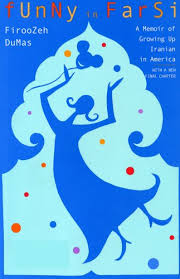
Funny in Farsi by Firoozeh Dumas

funnyinfarsi

It is hard enough to be a seven year old girl, navigating family, friends, and school.  But in 1972, a little girl named Firoozeh had to navigate a move from Iran to a suburb of LA, where she did not know the language, was not familiar with the food, did not have the extended family around for support, and had to function as her mother’s interpreter as well as find her own way.  Fortunately for her, her intelligence, her family’s support (mostly!), and probably most importantly, her humor, enabled her to adapt and do so very successfully.  This book is essentially a collection of her memories of growing up in this colorful family challenged by the immigrant experience of balancing their own culture and tradition with integrating into the society into which they’ve landed.

First, I have to say that this was a good, light distraction from the other reading I’ve had to do these past 2 weeks!  If you’ve been like me, you’ve done more reading about viruses and epidemiology and how pandemics can be mitigated in the past 2 weeks than you’ve ever had in your life – even if you’re in Public Health.  So I am thankful that I’ve had something like this to alleviate the anxiety that all of that other reading has caused.  I implore you to use this time for more solitary reading — it will be therapeutic for you and it will socially distance you from others, helping to mitigate the spread of this awful coronavirus.

As a memoir, this book was amusing and entertaining to a point, but, I believe, a missed opportunity.  Dumas did enrich her stories with the rich flavors and aromas of Iranian cuisines, ceremonial customs, and, in particular, her father’s often comical and endearing personality quirks.  And we did get a sense of the warm acceptance into the community her family experienced in 1972, which contrasted drastically with the reception she received when they returned just after Iranian Revolution and the American hostage situation. But other vignettes, such as those about her father’s fascination with Denny’s Restaurant or her uncle’s dieting fads were much less engaging.  While an opening into her culture was an opportunity, peeking through a curtain into their family secrets felt almost voyeuristic.

This was less a memoir than a collection of short stories.  As such, it was entertaining enough, but did get a bit old after a bit.

Not a “Must Read” but good for a few chuckles.