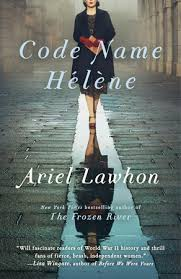
Code Name Helene by Ariel Lawhon

The dual timeline here:

1944: Helene (aka Nancy) finds herself being flown back into France, under the cover of night. From the get-go, she learns that the “rules” don’t count here on the ground and survival is what is of the utmost importance. That and arming, feeding, clothing, and paying the Resistance fighters she is here to safeguard.

1936: Nancy Wake her younger self, one who has boldly talked her way into a job as a journalist (no formal training), one of her first interviews having been with a then little-known, arrogant and aloof politician named Adolf Hitler. Soon after, we are with her as she bears witness to the evil work of his disciples, torturing Jews in a characteristic gruesome fashion in a public square in Vienna. She is immediately spurred on to do something, anything, to fight against this evil force. At the same time, she also attracts the gaze of one of France’s elite and most eligible young men. So as Europe gears up for war, Nancy is falling in love.

This is another magnificent work of historical fiction from the author of The Frozen River (reviewed here relatively recently). We follow larger-than-life Nancy Wake, an Australian national who lived in Paris before the war, just long enough to be tutored by her best friend in the language, the look, and the poise of the French. But Nancy’s accomplishments were all her own. She proved herself in the early days of the occupation by the Nazis, enough to be noticed by the right men in the right positions. Most impressive was the fact that Nancy was able to garner the respect, loyalty, and support of the thousands of men she led in their unofficial battalions of the French Resistance. It was a testament to her courage, bravado, and willingness to put herself in harm’s way for those fighting for justice.

This is most definitely a MUST READ, not only because it is an utterly addictive novel, replete with emotion and suspense, but because it is our duty to honor individuals (and particulary women, who are so often ignored in war stories) who fought so bravely for justice, civility, and democracy.
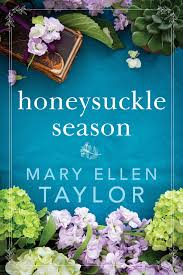
Honeysuckle Season by Mary Ellen Taylor

Two timelines and intersecting stories:

In 1941 we begin with Sadie, running from the sheriff of her small, Virginia town, fearful for her life. Forced to abandon the baby she hardly was prepared to birth, she is trying to escape not only the sheriff, but her doomed past.

In 2020, we meet Libby, newly divorced after having survived three miscarriages, she is trying to rebuild her life in the small town where she grew up. She feels just a bit of promise when she is invited to photograph a wedding at the beautiful garden estate she visited annually as a young girl with her late mother. So begins her new connection with this estate and with Elaine, its owner.

This is a moving, sometime painful work of historical fiction, that is simply written and yet engaging. We are drawn in to these sympathetic characters, as both Sadie and Libby have experienced their own versions of trauma. We are also drawn in by our curiosity about how these stories are intertwined. While we might have been kept waiting longer to learn this, in my opinion, there are still surprises that are revealed up until the very end.

One topic addressed here is that of eugenics, the practice of surgically blocking the reproductive capacity of those who are deemed “less than” by whatever group holds power. This reprehensible practice was allowed, even encouraged in many areas of our country – and likely continues in other parts of the world today. It is utterly staggering to conceive of the hubris of those who feel they are empowered to deny others’ freedoms, that they should be allowed to literally play God. It is also not unimaginable in our current, divided, and hate-filled moment that those in power might believe they are entitled to this.

On the more positive side, we are given the gift of meeting strong women characters, such as that of Olivia. Olivia has survived The Blitz in London and has come to the US as a newly married woman. She defies social norms and befriends Sadie, showing her kindnesses and generosity that shock Sadie, who is used to being treated with scorn because of her poverty and lack of education. They develop a truly beautiful friendship that lasts for decades, despite the pressure surrounding them to be apart.

Overall, while the writing is plain, the story a bit predictable, it is still a worthwhile and enjoyable read, in my opinion.

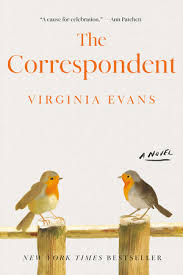
The Correspondent by Virginia Evans

Sybil, at the age of 73, is struggling to come to terms with her life. She is living alone in Annapolis, her days busy with gardening, walks along the river, and the writing of letters to family, friends, politicians and writers, just as she has since the age of 9. But with her gradually diminishing vision and her fractured relationships, these activities are becoming more challenging. When circumstances, which include threats from an aggrieved victim of a long-ago judgement, a gift from her son of a DNA test kit, and the terminal illness of her ex-husband, force her to more actively confront her past, she sees that she must come to terms with both her accomplishments and her failures, and seek resolution for her future.

This is a thoroughly engaging story, told entirely via correspondence, both letters and emails. The tone of the letters is both revelatory and entertaining, as Sybil’s honesty, wit and intelligence shine through. While she is a strongly-opinionated and brilliant woman, she also shows compassion for those less fortunate, knowing that she has her own shortcomings, her own awkwardness.

The relationship between her and her friend’s son, Harry, is most moving. Harry is an autistic youth who has painful social interactions, is tortured by his fellow classmates, and has occasional outbursts. But he is also brilliant and compassionate in his own way, as we see in his curiosity about Sybil and her life. Because his father works so much (and minimizes his challenges) and his mother struggles with mental illness, he really has no other outlet than his letters to Sybil. They develop a unique closeness – deeply understanding each other and showing a beautiful allegiance to each other.

This is a gorgeous multi-layered narrative, told in a most creative and endearing way. A MUST READ for sure!

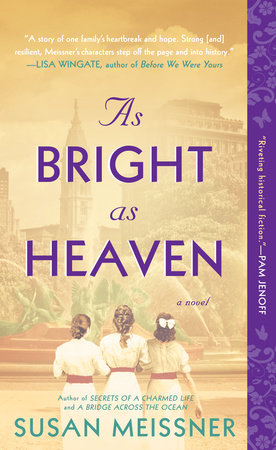
As Bright as Heaven by Susan Meissner

As Bright as Heaven by Susan Meissner: 9780399585975 |  PenguinRandomHouse.com: Books

Pauline and Thomas Bright have uprooted their young family from their rural tobacco farm to the city of Philadelphia. The Great War is still raging and yet it feels like the right move. They have just suffered the loss of their youngest child from a heart defect and a fresh start might be just what they need. Moreover, there is opportunity, as Thomas’s uncle Fred has agreed to bring him into his funeral home business and, as Uncle Fred is himself a bachelor, he has plenty of room in his large home for the Bright family. When the Spanish flu descends upon the city, it wreaks havoc on the family, however. On the other hand, it also brings new joy, in the form of baby Alex.

This is an emotional piece of historical fiction, blending the impact of both the first World War and the Spanish flu pandemic – a mighty double blow to our country. While we have the Covid pandemic fresh in all our minds, we forget that we have been here before, coping with a terrifying disease for which we have no immediate cure or vaccine, and from which there were thousands of deaths. While science has moved forward quite a bit since the Spanish flu, and we do have flu vaccines, this story reminds us that we never know what may be around the corner, lurking and waiting to challenge our knowledge, challenge our resources.**

That said, the story on the whole is well-written, providing details through a rotating narration, predominantly via the three remaining sisters in the Bright family. They are poignant characters, both vivid and endearing. Evie, the eldest is the most academic, setting her sights on medicine as a career. Maggie is more the maternal one, interested in helping her mother prepare the bodies for visitation. And the youngest, Willa, gradually finds her (musical) voice and seeks pleasure where she can find it. We come to love them, root for them, and pray for their happiness.

Not quite a “MUST READ” but this novel will move you and engage you.

**Which is why it is terrifying that our current administration has cut back on research funding, particularly for vaccine research. One would imagine that having had such a recent pandemic, we’d be smarter than this…!

The Griffin Sisters’ Greatest Hits by Jennifer Weiner

Zoe has always been the outgoing sister, the one for whom social situations have been easy to navigate. On the other hand, Cassie, with her shy awkwardness, her larger body, and without the beauty that nature seems to have bestowed upon her sister, human interaction has always been a challenge. And for most of their formative years, Zoe has been protective of Cassie, admonishing those who insulted her, including her against others’ wishes. But there is one thing Cassie has that Zoe doesn’t – that innate musical gift, that magical voice. When Zoe enters a local battle of the bands, she knows that having Cassie by her side will virtually guarantee her a win – and this is where they begin their journey together. For better or worse…

This is an incredibly moving story, not only about the sisters’ meteoric rise to fame and sudden crash, but also about love and trust and what can become blinding drive for notoriety. It is told from the perspective of both sisters as well as from Zoe’s daughter. It is also told in 3 different time periods. While this might seem confusing, it is not – rather, it is an effective means of building suspense up to the point of discovery of exactly what has fractured the sisters’ relationship, the band disaster, and Cassie’s subsequent self-isolation.

This is also a poignant depiction of how size discrimination can impact one’s entire self-perception. While Cassie is likely autistic, her discomfort with social interactions is hugely magnified because of bitter memories of the many children who picked on and alienated her because of her size. Years later, it is perpetuated by those in the music business, as she is constantly compared to (and compares herself to) her thin, beautiful sister. For example, while her sister is provided with hundreds of wardrobe options, she is given one or two, always black, always ugly – merely efforts to make her appear smaller, disappear. What she can’t see is how inspirational she is to so many girls throughout the country who can identify with her and her challenges.

I worried that this would be a too-light book, a bit of fluff that would not be meaningful. I was quite wrong: it brought me to tears by the end.

I hope their story moves you too, the way it moved me.

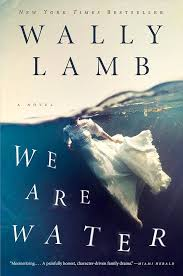
We Are Water by Wally Lamb

This novel opens with the tragic tale of Josephus Jones, who, living in a shack on the property of his employer, creates art that is only truly appreciated after his tragic death. Years later, on the same property, a new family with its own artist is coming to terms with their changed circumstance: that Annie, the wife, has left her husband, Orion, for her art dealer in Manhattan and they are planning to marry. As the upcoming nuptuals near, they set in motion a collision course that opens wounds and exposes secrets that have been suppressed for decades.

This novel is another brilliant saga, a gift to us from Wally Lamb. There are so many layers to unpack here, but the overarching message, I believe, is the corrosive damage done to us by keeping secrets from loved ones, and avoiding confronting our demons. Annie’s past, while dark and shameful (in her eyes), has been kept secret for so long, but it eats at her and erupts in dangerous ways. The secrets she then imposes upon her children are also damaging, both for her and for them. We see how each of her children cope, often dysfunctionally, in their own ways.

Lamb’s narration is outstanding. By rotating perspective from each of these colorful and dynamic characters and smoothly conforming the phrasing to their unique personalities, we are allowed inside the minds of each one. This enriches the story in a profound way and helps to build suspense as we see what each character sees and doesn’t see, knows and doesn’t know. The build into the later scenes left me breathless, to be honest.

An outstanding novel in so many respects. Do yourself the kindness of allotting time for this one. It’s also a MUST READ, so you kind of have to, right???

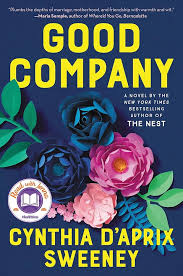
Good Company by Cynthia D’Aprix Sweeney

Flora is determined to find the photograph she’s looking for – she really wants to put it on display at her daughter, Ruby’s, high school graduation party. The photo means so much to her, having captured her family with their best friends at the summer theater production they orchestrate every year. Unfortunately, her search leads her not only to the photograph, but also to the wedding ring her husband, Julian, had told her he’d lost years ago swimming in a lake. What could this signify, exactly? How could Julian threaten the marriage she’d felt was so secure for the past 20 years?

While the idea of a marriage at risk because of an affair is fairly cliche, the author does embellish it with the twist of this affair occurring in the context of the theather/acting world. Although many careers are challenging to balance with raising a family, this is one where there is no certainty or security. Each role is cast and can be altered, ended on a whim. Added to that the hundreds vying for each role, the emphasis placed on one’s appearance, the changes in locations and schedules that may be unpredictable – there are certainly unique factors in this business that can stress a marriage more than others. Bottom line, though? There is no solid marriage where trust is broken. Full stop. No matter what business they are in. The question is, can trust be repaired? That is the question asked in this novel.

This is a solid read. I enjoyed it while reading it, but it is not the type of story that stays with you, as more unique novels do.

The Names by Florence Knapp

As Cora pushes the pram with her newborn son to the Registry Office, having been informed by her husband that registering the baby’s name is today’s mission, she discusses this concept of name choice with her daughter, Maia. Her husband, Gordon, has chosen the name Gordon, because, after all, his father was Gordon and therefore this was certainly going to be the boy’s name. Cora, has secretly harbored the wish to name him Julian, and Maia fancies the name Bear. As we read on, we learn how this one decision can potentially impact what happens not only to this baby, but to their whole family.

This is a brilliant idea exquisitely executed. We actually follow the family down the path of each possibility: one name foisted on the baby by the manipulative and frighteningly abusive father; one name chosen by the mother in the hopes that it will liberate him from the fate she fears for him; and the third an imaginative and spirited name chosen by his sister. There are consequences for each choice, which we learn as we follow each story over time. One might think this would become confusing, but the author does a magnificent job of keeping the details of each plot line so illuminated in our minds that each remains separate and equally intriguing.

The novel also highlights how domestic abuse affects not only the victim, but all those around her. Children, even if not directly physically hurt themselves, become victims just being in the home where violence is occurring. Their lives are directly impacted by the examples that are set for them, their personalities formed around this. In addition, the depiction of the father is incredibly thoughtful and realistic. As eerily calculating and evil as the father is in the home, particularly over Cora, he is equally charming and charismatic toward everyone else. This compounds Cora’s entrapment, as no one can imagine that he is capable of cruelty.

There is so much to unpack in this novel – but I will leave the rest to you. I cannot recommend this book enough – and yes, we have another MUST READ here.

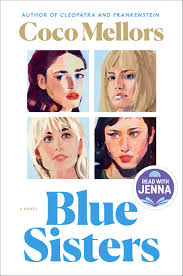
Blue Sisters by Coco Mellors

Avery, Lucky, and Bonnie are all too well aware of what day it is – and not just because it’s the Fourth of July. They have been acutely aware of this date since last year on this dark day, when they lost their treasured sister, Nicky. She was the extroverted, kind, and “girly” one of the quartet, the one everyone loved. Ever since her death, each sister has been grieving her loss, each in her own way. Making matters even worse, the sisters receive an email from their mother alerting them that she will be selling the family apartment where Nicky lived, and that this apartment needs to be emptied by the end of the month. This insurmountable challenge – dealing with Nicky’s belongings no one has had the courage to dispose of – may in fact be just what the sisters need.

This is a beautifully written account of the unique relationship between siblings and how a loss can be traumatic, even during adulthood. The sisters, each prone to coping by utilizing self-destructive habits, have been suffering over the year since Nicky’s death. Not having their parents’ support – and having turned away from each other – has only added fuel onto their inner fires. And because each sister’s character is painted so artfully, we become entangled in each story, every challenge. We are compelled to keep turning the pages because we HAVE to learn what happens next.

I highly recommend this novel. While it sometimes feels as if you’re watching a car accident about to happen – and you want to jump in front of the car – it also has moments of such raw tenderness that it is worth every tear you might shed.

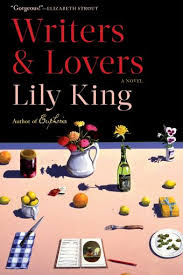
Writers and Lovers by Lily King

Still reeling from her mother’s death, Casey has been trying to battle her demons and feels she is losing. Overwhelmed by college debt and a recently failed relationship, she is trying just to put one foot in front of the other, keeping to her schedule of writing in early mornings, and waiting tables days and evenings. As she finds herself caught between two budding relationships, she also finally completes her first novel – and she is utterly unsure, and of course terrified, how any of it will turn out.

I have to admit that this book took some degree of patience, at least for me. I found it was a very slow build, with the beginning baldly depressing and flat. As it progressed, however, as more happened and the characters grew, and I began to feel more invested. I am glad I stuck with it, but it was a bit of work.

I think the issue was that Casey was hard to get to know and to like. We see flickers of her warmth, her kindness when she banters with other waitstaff at her restaurant. We also see this really shine when she connects deeply with one of her boyfriend’s two sons. But for so long, all we see is a doleful existence: her panic attacks, her worries, her fears. When her wit and personality only come through so much later, it’s almost too late. We’re surprised we like her so much. Perhaps the point is that she doesn’t like herself enough to be this person. I am not sure…

We also have here another writer writing about writing. Yes, write what you know, but I also think this topic has been covered already. Perhaps unfair of me, but as someone who is not a writer but a reader, I like variation. What can I say???

Ultimately, it is readable, a decent novel. But if you’re limited on time, I’d focus elsewhere.