Dani and Alex used to be in love. Dani and Alex used to have the kind of marriage where communication was rarely even necessary because they could read each others’ minds. Now, it seems, that what’s on their minds is that the other is just wrong and they are speeding, headlong into divorce. As they work out the details of this new life with their two boys, they find they may be able to actually communicate on a whole new level.
This is a sweet story that will have you engaged from the very start. It is told from both Dani’s and Alex’s perspective, which deepens our understanding of both how they became a couple and their demise. We empathize with their overtures to connect as well as their despair when they feel defeated. We also hear their attempts to move forward with their lives, and how they are impeded by their deep love for each other.
I will warn that you will experience a major emotional rollercoaster here, as there are sudden twists and unexpected dips that will throw you. Nevertheless, you are well cared for by the author; even when you are grieving, you are handled gently and beautifully.
I liked this book quite a lot – I believe you will as well.
Susan is pretty confident she knows what she likes: she likes order and predictability, she has found a career that suits her skills, and while her childhood has been challenging, she’s even managed to maintain a decent relationship with her complicated family. Nevertheless, when her brother, Edward calls her to tell her that her mom has died, Susan is quite shocked. She knows that her mom has had two strokes, that she’d been a bit out of sorts, but she’d been living solidly on her own, albeit with the inconsistent “help” from her brother Edward. Susan is a realist, though, and understands that this is what happens. What she cannot understand is how her mother could have come up with the terms of her will she is now hearing read, once the funeral is over. Susan is convinced there is foul play and is determined to fight her brother over this – battling again, as they’ve done their whole lives. Only this time, it will be before the eyes of the court. There are just a few complications that may hinder her in the process…
It is hard to believe this is a debut novel, as it is as delightful and entertaining as its characters. Susan’s character, in particular, is one that I believe will stay with me for awhile. While Susan prefers to be alone, she is also a deeply kind person, and though blunt, she is always honest. Sadly, she has learned from life that others can bring pain, so she has built a shell around herself. Much like the cactus, she has grown thorns not to pose a threat to others, but merely to protect herself. But as she gradually begins to let others in – her neighbor, her brother’s friend, even her annoying aunt – she begins to see that it is not always to her detriment.
I would highly recommend this book – it is engaging story, with lovely characters, and your heart will melt for Susan and her predicaments. I look forward to Haywood’s next project!
Already reeling from the death of the man she’s known to be her father, Joy has also just learned some shocking news about her mother, Pearl. These two events challenge Joy’s identity to her core. At the same time, as the 1950’s American government is targeting those suspected of being Communists, some, particularly those on college campuses, feel that Socialism can be the ideal of equality and fairness. Following this ideal, Joy makes the impulsive decision to leave the comforts of what she’s known as home to embark on a journey to find her true birth father, to seek her Chinese roots, to relinquish her capitalist excesses, and to enter Mao’s People’s Republic of China. What she finds there shocks her even more.
With her usual skillful style, Lisa See has managed to compose yet another beautiful family saga, depicting family relationships at both their worst and their best, while incorporating a significant historical moment that is not frequently highlighted. Her mother, Pearl, on learning that Joy has left for China, follows her daughter there, even if it may put her own safety in jeopardy. She knows that Joy is young, that does not understand the consequences of her actions to the fullest, that she has never experienced the heavy hand of Communist rule. And if she is being honest, finding Joy’s father is of interest to her to, as they have a complicated history as well. The relationships depicted here are tender, beautiful, and authentic.
History plays a large role in this saga as well. China’s “Great Leap Forward” is anything but — but this is the era in which Joy finds herself. Initially, she tries to find the grace in it: the idealism of the communal life, the simplicity of the farm, the romance in the hard work. She also finds meaning in the art she’s able to produce there through which she can express herself, at least within the confines of the dictated rules. As time progresses, however, she sees the rampant deception. She begins to see that even when the rules are failing the people miserably, they are forced to abide the whims of their dictator, even at the cost of their very lives. When Joy becomes responsible for the life of another, this is where she can no longer abide this lie.
There is much darkness depicted here, but it is a frighteningly timely and realistic story. We are now in a moment when so many are following another wannabe fascist – a worshipper of Putin, of Kim Jong Un, of Hitler – and these followers are ignoring the harm he has done and has the potential to continue to do. He has already threatened to imprison his enemies – a classic fascist move. People make excuses for him – but we’ve seen him do this already in his first presidency. It’s an authentic threat. We need to learn both from other countries’ pasts such as that depicted here and our own past. This can happen again and this can happen here. We have the power to stop it with our votes. But this may not be the case for long if he is elected…
I hope you will read this novel. It is a beautiful family saga as well as a harsh warning for the world and for our country in particular. A MUST READ for this moment!
In the aftermath of a terrifying scenario, Ben, a young boy, is brought to an ER in downtown Providence, where he is seen briefly by senior resident, Lucy, whose main focus is to stabilize patients and send them to wherever they need to go next. While Ben is clearly in shock and does not have any memory of the traumatic incident, he also seems to not even know who he is. As much as Lucy tries to disconnect from Ben, she cannot help being drawn to this sweet, vulnerable child even in spite of herself.
Meanwhile, in a nursing home in a RI suburb, we meet Clare, a woman approaching her 100th birthday, who remains an enigma to all around her. She rarely speaks, and when she does it is never about herself, fending off anything that might give herself away. But it appears that a new tenant, despite her younger age and her independent attitude, might be just the one to break through the hard shell Clare has built around herself.
It takes time and patience to learn how these two stories connect, and once you do, you still need some degree of faith and imagination. Nonetheless, this is a beautiful story, written with such tenderness that you cannot pull away from its pages until the end. Each character, down to the philosophical alcoholic with “worms in his knees” who shows up to the ER on a regular basis, is depicted with love. We adore the awkward, inquisitive Ben, who cannot help asking about the world. We adore Lucy, as she navigates her lonely, newly single life. We even adore Clare, even as she snaps at those around her. Each story is compelling in itself. And as their stories meld together, we are filled with compassion for each of them, because we cannot help but be so.
I suppose I have a particular affinity for this narrative. Since I am from Providence, I love the local references: fishing in Point Judith and Rocky Point, the 3-family houses on the short streets off of Hope Street, or a College Hill book store. Novels are rarely based in Providence, so I appreciate when they are. In addition, the grueling schedule, the span of patients, and the absence of an outside life that Lucy experiences is real – I can attest to that as well. Though I was a pediatric resident a thousand years ago, I can still feel the painful exhaustion I felt coming home after taking care of deathly ill patients for 36 hours straight. I could not have a social life because there was barely time for me to have a life at all.
That said, while the book spoke to me in particular, it will speak to you as well. I encourage you to let yourself be taken away by this tale.
Caleb thinks it will be a usual morning, getting ready for his day on his Amish farm, urging his nephew, Jonah, to get off to the neighbor’s farm to do his part in helping with the chores there. However, when one of the neighbor’s children come running back to alert them to the accident that befalls his nephew, he has no idea that his entire world will be turned upside down in a single moment.
Meanwhile, in central Philly, Reese finds herself in the ER, amidst the incoming trauma where she is a fourth-year student. She is trying not to connect with each patient who comes in, but finding herself connecting nonetheless. She cannot understand how the staff are able to get so involved with the patients for the intensive, momentary care and then send them off, to the OR, to the ICU, or home, without being able to know what comes next. But this is the life she’s chosen. Or has she? Is it not really the life her parents, successful doctors both, have chosen for her, from her very inception? How does she break out from under their domineering force and decide for herself? When she meets Caleb, transfixed by his very different manner and lifestyle, she sees an alternative to the treadmill she’s been living her life on.
While this is a bit of a predictable story, it is so very sweet and the characters so likable that it almost doesn’t matter. Who doesn’t love an unlikely love story? Who can resist a Romeo and Juliet? Reese and Caleb come from two different worlds, speak two different languages, and have very different life experiences. But fundamentally, they have similar values. They appreciate love, family, and the freedom to choose their own path, which binds them together more than even they realize.
The story also highlights something I’ve discussed before: when a community is insular, it can be very close-knit in a good way. It can mean that folks are there for each other in good times and in bad. But it can also mean that folks hide the bad stuff to the point of endangering others. It can mean that when someone is suffering, there is denial in the name of religion or righteousness, and that evil-doers can be protected to a fault. This can be dangerous in any community, but particularly when a community colludes in that hiding, in that burying of the guilt. Abuse of women and children are notoriously hidden in such communities, and this is can be dangerous.
I’d recommend this book, as a way to learn about the Amish, as a way to learn about the way we are all more similar than different, as a way to learn about the world.
Frankie wants to make her parents proud. The idea that women can be heroes too, whispered in her ear by her brother’s friend, has never occurred to her before, but when it is uttered, it hits her like a breath of fresh air. What better way to make her father, especially, proud than to join his “wall of heroes” by enlisting and serving her country as an army nurse in Vietnam? What she finds, as she disembarks from that first plane, is nothing like she’d ever imagined. And what she encounters there, whether she likes it or not, will stay with her for the rest of her life.
Here is yet another MUST READ, gifted to us from Kristin Hannah. It is not an easy one. It is harsh but realistic in its graphic detail of the horrors of the Vietnam war. It is a constant reminder, again and again, of what is lost in each and every battle. It also is historically and acutely accurate in its documentation of how horrifically veterans of this war were treated upon return to their country after their service, as if it were their choice to continue the war that most were drafted to serve in. More importantly, for this story, it documents how horrifically the WOMEN veterans of the war were treated. These women were denied their very existence there. Frankie was told, again and again, “There were no women in Vietnam,” when in fact, there were thousands of women in Vietnam – nurses, and support staff – serving their country, endangering their lives, and witnessing the trauma every day of their lives there.
Is the story all doom and gloom? No, of course not. It is also a story about love. Frankie finds so many versions of love. She finds beautiful friendships that last her lifetime. She opens her heart enough to have it broken time and again, which hurts but also helps her to grow. She also learns to appreciate that love can be demonstrated in many ways, even if it is not how we’d prefer. Frankie also learns to love herself, as she succeeds and fails and succeeds again.
It is an inspiring, gruesome, and heartwarming saga of a woman’s search for meaning and for herself. It is hard – perhaps impossible – not to love this book.
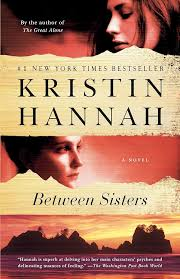
To say that sisters, Meghann and Claire, have not had the best relationship since Meghann’s teen years is an understatement. While Meghann mothered Claire through her early years much more than their narcissistic mother had ever done, their separation years back was painful for both of them, creating a chasm that has remained ever since. Any communication between them seems to end up in miscommunication, which just frustrates them both. It is only when a shocking incident occurs in Meghann’s life that she is forced to make a change. And when she does, it is Claire whom she is forced, by circumstances, to turn to.
I believe that Hannah’s literary talent lies not only in her ability to tell a story, which she certainly can do, but in her ability to create characters which we come to adore. While Meghann is brilliant and powerful, witty and successful, she is also mistrusting, cynical, and heartbreakingly lonely. We see her first as the aggressive advocate, a fighter on behalf of the wronged women of the world. And she is damned good at it, too. Eventually, however, she comes to see that perhaps she is too good at it. Perhaps she is, in her zeal to be the best, to win, she may be causing some harm as well. When she begins to see a bigger picture, to open her heart and her vision to other possibilities, she begins to see what might be better, not only for her clients, but perhaps for herself as well.
An important theme here is trust: trust in others, trust in oneself. While both sisters were essentially abandoned by their mom, they each chose different ways to cope. Claire, likely because she did have more parenting during her youth, has chosen trust and love. Meghann has been unable to do either in any real way. She has been burned just too many times to believe it is wise or even possible to do so. Her profession, a divorce attorney, is actually perfect for her. We see how this plays out in their lives and in how they love.
While the story overall is a bit corny and predictable, it does remain engaging throughout. It will definitely satisfy those of you who like the occasional snarky dialogue, a hand-wringing middle, and a nice, happy ending tied up in a bow. While the ending was a bit too neat for me, I am sure there are many who’d be too sad for it to have been any different.
Bottom line, it is a strong read, with lovely characters. Hope you enjoy it!
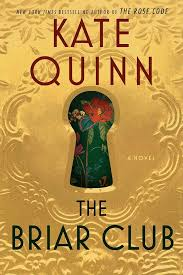
When we are first introduced to the Briarwood House, we are informed that there are 2 dead bodies found within. This is in 1954.
We are immediately transported back to 1950, however, when Grace is first shown the tiny closet of a room on the top floor of this women’s boarding house, when she decides she can make this work, at least for the time being. Her answer to the cold, mean and nosey Mrs. Nilsson who runs the place? To undermine her rules and start a dinner “club” in this tiny room for all the tenants of the house on Thursday nights, when she is out at her regular card game. In this way, Grace creates a community within the house and actually makes the house a home to this disparate group, gets to know their various stories, even as her story remains quite mysterious.
This is yet another astonishing feat created by the extraordinary Kate Quinn. With the disturbing background of the McCarthy era, the oft-ignored Korean War, the pervasive fear of a Russian nuclear attack, and the absence of power that women still had over their lives and livelihood, Quinn sheds light on the fact that the 1950’s were not necessarily “Happy Days.” Her characters are not the sweet and shiny women we often expect from this time period, but they are real and they are hurting and they reflect the life experience they’ve each been through. We learn that there is a reason we are who we are.
The plot is also so intricate and suspenseful that I guarantee you will not be able to put this book down until you turn the final page. I was absolutely kept guessing until the very end.
This may be one of Quinn’s best novels, in my opinion – and that is high praise! It is deeply-researched, with relatable characters, and with a twisty plot that kept this reader’s light on through all hours of the night just to get to the finish line. Here’s one more MUST READ to add to her list!
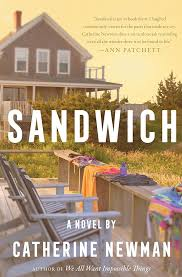
Rocky is new to this “empty nester” thing and it’s not going well. She is trying to recapture her “nest” as her family gathers for a week of vacation on Cape Cod, in the house they’ve stayed in year after year. She is thrilled she and her husband are with their son, daughter and their son’s girlfriend – and also that her parents will be joining them for a couple of days – but her feelings keep getting in the way. Why is she so angry all the time? And sad? And then remorseful? And then so full of love? It isn’t just that she’s menopausal, is it? Even while she pines for her past, she admits that it may not have been as perfect as she likes to think it was. Perhaps it is ok to live in the present.
I love the title of this novel for its very apt dual meaning. While it correctly summons the image of the quaint town that greets you as you travel over the bridge to Cape Cod, the town where the family vacation takes place, it also likely refers to the “sandwich generation” in which Rocky is a bit stunned to find herself. Rocky expends a tremendous amount of energy reminiscing about her exhausting but loving days when her children were small; on the other hand, she is also anxiously watching over her parents, who, in her mind, are suddenly gray-haired and frail. She rues the fact that her children are independent, intelligent adults, and simultaneously acknowledges that her parents now need attention they never needed before. This is a hard place to be, as there are demands still on both sides. It requires heart, humor and a great deal of tact. And while Rocky is blessed with the first two, she seems to still be working on that last one…
What is abundant here in the writing, however, is the love she feels for her family. There is so much of it that it spills over into the heart of the reader and one cannot help feeling what she feels as well. The warmth, the humor, the tender moments and goofy conversations are quite authentic and relatable. While her specific circumstances may be unique to her, the relationships are almost universal – and I feel (hope!) that many readers will relate to the characters here.
This is a fun summer read that runs deeper than one might expect.
2022: Mallory has essentially had her life on hold, since her son had that terrifying accidental ingestion of poisonous mushrooms that changed his life (and his kidney). Will his only hope be a kidney from the father that he doesn’t even know is his father?
1951: Hannah Ainsworth has a troubling past that she’s managed, until now, to put behind her. Her unhappiness has, so far, been masked by her new, wealthy husband, and his recent posting in a fancy hotel in Cairo, Egypt. Unfortunately, there is unrest here as well, between the spies from Israel and its unhappy neighbors as well as its own citizens who are unhappy with the local British presence. Hannah’s heart seems to find distraction in her hotel, however, that leads her to both danger and heartache.
How the two stories are connected are the source of the intrigue that Williams is so deservedly known for.
This is yet another masterpiece by one of my favorite authors, as you must know by now, if you’ve read any of my posts. Williams has a magical way of incorporating history into romance to create stories that are as captivating as they are suspenseful. There is layer upon layer here that keeps the reader completely enraptured. She also writes strong female characters that do not bend to social pressures, no matter the time period, no matter the circumstances. Her characters have brains, brawn, and banter – the dialogue is always sharp. And even when there is an ending we wish for, it does not feel sappy because it is always so hard-won.
I would place all of her books in the MUST READ category – she is a MUST READ author!




 kindread spirits