The Lies that Bind by Emily Griffin

It is summer 2001 and Cecily has been living in NYC for 4 years now. She’s been working for a small newspaper and has made a couple of friends, but her life feels like it’s just been put on hold since her breakup with her boyfriend, Matthew. Since her best friend in the world is still back home in Wisconsin, she feels she needs to get out of her own head, and, leaving her cellphone at her small apartment, she takes herself to a nearby bar, alone. She is truly not looking to meet anyone – it’s far too soon for that – but as it happens, someone does join her at that bar, and they immediately just click. What happens from there begins a journey that takes Cecily through a maze of both lies and truths that she learns she will ultimately have to sort out for herself.

While this story is a bit of a stretch in terms of plausibility, if you’re able to sort of “go with it,” it’s an easy, fun read that is mostly satisfying. I think what saves it is that we really come to like our protagonist, Cecily, even as we suffer her naivete, her blind trust in what those around her tell her. While we can guess what is happening, she doesn’t – and it feels almost like watching an accident that is waiting to happen where you want to yell, “Watch out!!” but cannot. The point is, we do care enough about her to want to yell. (At least I did.)

So while this is not the great American novel, it is a lighter read that broke up some of the more intense novels I’ve read recently. Gotta do that sometimes!



Them by Ben Sasse

I believe it’s important to know that the full title of this book by the former, conservative Republican senator from Nebraska, Ben Sasse, is actually: Them; Why We Hate Each Other and How To Heal. I am not conservative, nor have I ever voted Republican – but this is exactly why I was curious about reading this book.

What Sasse observes in this book, and what we can all see quite clearly, is that our country is so painfully divided, so diametrically polarized. We are distrustful of the news outlets that are available to us either because 1) they are run by an intellectual elite or 2) they have become faithful only to the almighty dollar, dependent on the outrageous and extremism that is clickbait. Those who turn to social media for their news are even more vulnerable, because they are most likely getting their information from Russian bots or from some creative teenager in the basement of their midwestern parents’ home. Furthermore, the idea of community, from which we derive identity, security, – happiness even – has all but dissolved as we become more mobile in search of the perfect job, the ideal opportunity to earn more money, the next best thing.

Not to worry, though. There are answers. Of course, they don’t come easily and they don’t come quickly. The answers take time, effort, energy and lots of commitment. We have to want to heal. We have to want to come back together. We have to want to have those difficult conversations that will enable us to find what we have in common that will bring us together. We have to be able to say, “OK, I disagree with you on X and Y, but I agree with you on Z, so let’s start there.” We have to be able to come together with folks we have differences with and be in community with those people, because we are stronger together than we are apart.

The bottom line is that if we continue along this fractured, divided path – we become vulnerable to our real enemies. Putin is just sitting and watching with glee, noting all of our polarization and waiting for just the right moment to pounce. United we stand, remember?

So, I figured that reading literature such as this, written by someone who comes from a world so different from mine, with a political philosophy so opposite from mine, was a first step. And it was a good one. There was much more that I agreed with than I disagreed with, to my surprise. While I completely disagree with his opinions on abortion or the ACA, I agree with his overarching premises and I hope that others will read what he has to say here.

I think this is a MUST READ. I think work like this will do much to save our country. We are in deep need of more like this.

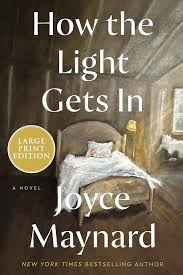
How the Light Gets In by Joyce Maynard

Even though her ex-husband has now passed away, and there is much water under the bridge, she still has difficulty moving past that fateful moment when it felt like her entire life changed: when her youngest child, Toby, suffered a brain injury after being found face-down in their pond for who-knows-how-long. She cannot help but think what would have been had her husband not fallen asleep that day when he was supposed to be ensuring his safety? But as her life unfolds, she begins to learn to appreciate the beautiful person Toby becomes, rather than mourn who he might have been.

This is ultimately a beautiful story, but I feel that it takes unnecessary work to get there. There is quite a bit of repetition, such an unfortunate belaboring of points that the story could have been told in a much more succinct and effective way. Whether it was the writing or the editing – likely a combination of the two – I believe it is a drawback of this book.

Nevertheless, there is a lovely story underneath all this tautology. The unfolding of Toby’s story as told through Eleanor’s perspective is truly meaningful. Many overlook or dismiss Toby because he does not speak or walk or dress the way his peers might; but those who see him for who he is have the honor of getting to know someone who is warm, honest, loyal, and who is the kindest person they will ever know. He pays attention to details that few notice. He sees the potential in folks that others don’t see, appreciating what it is like to not be seen. And he accumulates family, friends, and fans along the way who deeply appreciate who he is. 

I believe this book is worthwhile, but you have to be willing to accompany Eleanor, Toby and their extended family on this long journey, even with all its detours and corollaries.


Looking for Jane by Heather Marshall

It is 1960 and Evelyn is terrified. She has no choice but to accommodate her parents’ wishes and move to the home for unwed mothers where she’ll work and live until she gives birth to the child that she is now carrying. It would have been completely different had her boyfriend not died of a heart attack just before she found out she was carrying his baby. But now, she is trapped. Literally.

Fast forward to 2017 and Angela, working in her aunt’s antique store, stumbles upon a letter received years prior, meant for the tenant in the upstairs apartment. She opens the letter, just to see how she might be helpful to the sender, and she sees a heartbreaking plea. How can she be helpful in this situation? Should she try to help in this situation?

Meanwhile, in the 1970’s, we meet Nancy, who is struggling to assert her independence from her overbearing mother. They frequently clash, given her mother’s overpowering personality and ability to ignore most of what Nancy actually says. So Nancy learns to hide her self in a way that is detrimental. She learns to keep secrets. When a cousin asks Nancy her for help in a crisis, she keeps that secret as well, in spite of the trauma that it leaves her with. But she also learns a tidbit of information at that time that will have an impact on her future in a way that she cannot possibly imagine.

This is a particularly relevant read for this moment. In a time during which access to safe, legal abortions is threatened in too many areas of our country, this book should be read by everyone. This book touches upon the issue of women forced to carry pregnancies against their will (and then forced to give up the babies when they do deliver), women compelled to undergo dangerous procedures that endanger their lives, and women and medical providers who are threatened with arrest for having life-saving procedures such as D&C’s for natural miscarriages. And ironically, as it is pointed out in this story repeatedly, it is generally men making these decisions about women’s bodies!! What an absurd world we live in! [Of note, this story takes place in Canada, but the situations can and do happen here all the time in the US as well. Fortunately for Canadians, their country has not reneged on their commitment to women’s health the way we have here.]

This is an intricately constructed story and the way in which these very realistic, very human characters are portrayed and come together will captivate and engage and surprise you until the very final page. I could not put this book down. I loved it not only for its relevance but for how personally connected I felt to these beautiful characters. They are each products of their times, their circumstances, and yet connected by the fact that they are women who love.

Enjoy this book! I know I did!

James by Percival Everett

In this retelling of the story of Mark Twain’s Huck Finn, Jim, or James, as he prefers to call himself, is a literate, enslaved man who has been sneaking into the library of his owner to educate himself and to find material to use to educate other enslaved folks around him. Upon learning he will likely be sold and separated from his family, he decides to run away, and Huck, fearing his own demons, follows him. Their journey takes them through crazy and dangerous escapades. Nevertheless, through it all, James believes there is nothing that can frighten him or debase him more than what he’s already experienced: being owned by another human being.

This is an odyssey, a whirlwind of an adventure – absurd and terrifying in equal parts. We learn about both James’ and Huck’s pasts as the story unfolds, and how their pasts have intertwined. More importantly, we learn so much about James’s character, which is deeply complex. He has an abiding love for his family, even as he develops a growing awareness of his fury toward his oppressors. We both love him and fear him, as his compassion for others in need can be compelling even while his rage can be blinding.

It is also a uniquely powerful story from the perspective of this educated, enslaved man. It is striking how everyone in the story, whether Black or White, reacts to James when he speaks in his normal manner vs his affected, “slave” manner. Everyone, including his peers, expects him to use incorrect wording, grammar, etc. Even when a White man is being threatened by James, with a gun pointed directly at him, all he can focus on is how James is speaking – it is such a shock to him. It is symbolic of how a command of words can signify education, influence, even power.

It’s a wild, frightening, and enlightening journey that we take with James. I daresay, a bit different from the “Jim” Twain had in mind…


This Used to be Us by Renee Carlino

Dani and Alex used to be in love. Dani and Alex used to have the kind of marriage where communication was rarely even necessary because they could read each others’ minds. Now, it seems, that what’s on their minds is that the other is just wrong and they are speeding, headlong into divorce. As they work out the details of this new life with their two boys, they find they may be able to actually communicate on a whole new level.

This is a sweet story that will have you engaged from the very start. It is told from both Dani’s and Alex’s perspective, which deepens our understanding of both how they became a couple and their demise. We empathize with their overtures to connect as well as their despair when they feel defeated. We also hear their attempts to move forward with their lives, and how they are impeded by their deep love for each other. 

I will warn that you will experience a major emotional rollercoaster here, as there are sudden twists and unexpected dips that will throw you. Nevertheless, you are well cared for by the author; even when you are grieving, you are handled gently and beautifully.

I liked this book quite a lot – I believe you will as well.

The Cactus by Sarah Haywood

Susan is pretty confident she knows what she likes: she likes order and predictability, she has found a career that suits her skills, and while her childhood has been challenging, she’s even managed to maintain a decent relationship with her complicated family. Nevertheless, when her brother, Edward calls her to tell her that her mom has died, Susan is quite shocked. She knows that her mom has had two strokes, that she’d been a bit out of sorts, but she’d been living solidly on her own, albeit with the inconsistent “help” from her brother Edward. Susan is a realist, though, and understands that this is what happens. What she cannot understand is how her mother could have come up with the terms of her will she is now hearing read, once the funeral is over. Susan is convinced there is foul play and is determined to fight her brother over this – battling again, as they’ve done their whole lives. Only this time, it will be before the eyes of the court. There are just a few complications that may hinder her in the process…

It is hard to believe this is a debut novel, as it is as delightful and entertaining as its characters. Susan’s character, in particular, is one that I believe will stay with me for awhile. While Susan prefers to be alone, she is also a deeply kind person, and though blunt, she is always honest. Sadly, she has learned from life that others can bring pain, so she has built a shell around herself. Much like the cactus, she has grown thorns not to pose a threat to others, but merely to protect herself. But as she gradually begins to let others in – her neighbor, her brother’s friend, even her annoying aunt – she begins to see that it is not always to her detriment.

I would highly recommend this book – it is engaging story, with lovely characters, and your heart will melt for Susan and her predicaments. I look forward to Haywood’s next project!


Dreams of Joy by Lisa See

Already reeling from the death of the man she’s known to be her father,  Joy has also just learned some shocking news about her mother, Pearl. These two events challenge Joy’s identity to her core. At the same time, as the 1950’s American government is targeting those suspected of being Communists, some, particularly those on college campuses, feel that Socialism can be the ideal of equality and fairness. Following this ideal,  Joy makes the impulsive decision to leave the comforts of what she’s known as home to embark on a journey to find her true birth father, to seek her Chinese roots, to relinquish her capitalist excesses, and to enter Mao’s People’s Republic of China. What she finds there shocks her even more.

With her usual skillful style, Lisa See has managed to compose yet another beautiful family saga, depicting family relationships at both their worst and their best, while incorporating a significant historical moment that is not frequently highlighted. Her mother, Pearl, on learning that Joy has left for China, follows her daughter there, even if it may put her own safety in jeopardy. She knows that Joy is young, that does not understand the consequences of her actions to the fullest, that she has never experienced the heavy hand of Communist rule. And if she is being honest, finding Joy’s father is of interest to her to, as they have a complicated history as well. The relationships depicted here are tender, beautiful, and authentic.

History plays a large role in this saga as well. China’s “Great Leap Forward” is anything but — but this is the era in which Joy finds herself. Initially, she tries to find the grace in it: the idealism of the communal life, the simplicity of the farm, the romance in the hard work. She also finds meaning in the art she’s able to produce there through which she can express herself, at least within the confines of the dictated rules. As time progresses, however, she sees the rampant deception. She begins to see that even when the rules are failing the people miserably, they are forced to abide the whims of their dictator, even at the cost of their very lives. When Joy becomes responsible for the life of another, this is where she can no longer abide this lie.

There is much darkness depicted here, but it is a frighteningly timely and realistic story. We are now in a moment when so many are following another wannabe fascist – a worshipper of Putin, of Kim Jong Un, of Hitler – and these followers are ignoring the harm he has done and has the potential to continue to do. He has already threatened to imprison his enemies – a classic fascist move. People make excuses for him – but we’ve seen him do this already in his first presidency. It’s an authentic threat. We need to learn both from other countries’ pasts such as that depicted here and our own past. This can happen again and this can happen here. We have the power to stop it with our votes. But this may not be the case for long if he is elected…

I hope you will read this novel. It is a beautiful family saga as well as a harsh warning for the world and for our country in particular.  A MUST READ for this moment!


Small Island by Andrea Levy

Hortense and Gilbert, essentially strangers, have made an unusual deal: Hortense has offered to pay Gilbert’s passage from Jamaica to England so that he can pave the way for her to follow him there. She would love to fulfill her dream of becoming a teacher in that faraway, fairytale land, as she perceives it. And for his part, Gilbert, feeling claustrophobic himself on that tiny, Carribean island, he agrees to it, even at the price of marrying this haughty and serious, albeit beautiful, young woman.

On the other side of the world, in London, Queenie and Arthur have had their share of challenges. Queenie has had no choice but to run a boarding house while caring for her father-in-law. Her husband, Arthur, has been MIA since the end of the second WW, after being stationed in India. She is ready to declare him dead and try to move on with her life, but she is quite distracted with all the goings on in her own home, such as it is. Getting flak from her neighbors because of whom she is renting to is frustrating enough, but managing all of their comings and goings isn’t what she’s signed up for either. And now with the advent of Gilbert’s wife to add to the mix. Where will it all lead?

This is a fascinating dive into London’s WWII and post-WWII world, where there remained as much hostility toward anyone who was considered “foreign” as there is today. Anyone of color who moved into a neighborhood was considered to be “taking over,” and White folks complained, moved out, and sought out their own. While Gilbert thought this was purely an American issue, a “Jim Crow” problem, he learned the hard way that it was just as alive and well in England, even if it didn’t have an official name. When Queenie defends sitting with Gilbert in a movie theater, rather than having him seated in the rear, it ends in terrifying violence. Sadly, things haven’t changed much, right???

What is interesting is how the story is told. We learn each of the stories from the perspective of each of these characters: Queenie, Arthur, Hortense and Gilbert. They each have a history, a story to tell. They are each complicated, with their own fears, anxieties, and challenges. Through them we also learn about the tension between the British and its island of Jamaica; that is, how hardly anyone in Britain knew where Jamaica even was, while those in Jamaica were taught to worship the crown as if Buckingham Palace were situated right there on its shores.

While the overall message is clearly heavy, it is told with warmth, wit, and with a Jamaican lilt that gives it just enough lightness to make it enjoyable, surprising, and a worthwhile read.

The Possible World by Liese O’Halloran Schwarz

In the aftermath of a terrifying scenario, Ben, a young boy, is brought to an ER in downtown Providence, where he is seen briefly by senior resident, Lucy, whose main focus is to stabilize patients and send them to wherever they need to go next. While Ben is clearly in shock and does not have any memory of the traumatic incident, he also seems to not even know who he is. As much as Lucy tries to disconnect from Ben, she cannot help being drawn to this sweet, vulnerable child even in spite of herself.

Meanwhile, in a nursing home in a RI suburb, we meet Clare, a woman approaching her 100th birthday, who remains an enigma to all around her. She rarely speaks, and when she does it is never about herself, fending off anything that might give herself away. But it appears that a new tenant, despite her younger age and her independent attitude, might be just the one to break through the hard shell Clare has built around herself.

It takes time and patience to learn how these two stories connect, and once you do, you still need some degree of faith and imagination. Nonetheless, this is a beautiful story, written with such tenderness that you cannot pull away from its pages until the end. Each character, down to the philosophical alcoholic with “worms in his knees” who shows up to the ER on a regular basis, is depicted with love. We adore the awkward, inquisitive Ben, who cannot help asking about the world. We adore Lucy, as she navigates her lonely, newly single life. We even adore Clare, even as she snaps at those around her. Each story is compelling in itself. And as their stories meld together, we are filled with compassion for each of them, because we cannot help but be so.

I suppose I have a particular affinity for this narrative. Since I am from Providence, I love the local references: fishing in Point Judith and Rocky Point, the 3-family houses on the short streets off of Hope Street, or a College Hill book store.  Novels are rarely based in Providence, so I appreciate when they are. In addition, the grueling schedule, the span of patients, and the absence of an outside life that Lucy experiences is real – I can attest to that as well. Though I was a pediatric resident a thousand years ago, I can still feel the painful exhaustion I felt coming home after taking care of deathly ill patients for 36 hours straight. I could not have a social life because there was barely time for me to have a life at all.  

That said, while the book spoke to me in particular, it will speak to you as well.  I encourage you to let yourself be taken away by this tale.