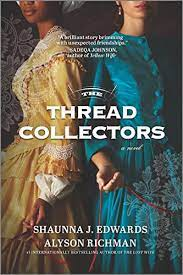
The Thread Collectors by Shaunna J Edwards and Alyson Richman

When Stella and William say a passionate farewell at the beginning of this story, they have no idea if they will ever reunite. William is an enslaved Black man in the South, escaping his master at the outset of the Civil War, and Stella is an equally indentured Black woman who technically is free but is “kept” by a White man for his “pleasure.” All William has is his flute and his magically musical ear, but this wins him a place by the side of his newfound friend, Jacob. Likewise, Jacob, a Jewish New Yorker, who has signed up on the side of the Union, with the dream of fighting to end slavery, has also bid goodbye to his true love, Lily. He also has no idea if he’ll be able to return to her, fearing the worst as he moves closer and closer to the front. All he can hope for is that her continued correspondence and her love for him will help him through his arduous fight.

This narrative was apparently based on true characters in the history of the two authors’ families. Each of them is writing about the marginalization and, particularly in the case of the Black men who fought for the Union, dehumanization, experienced by these soldiers. And how relevant is this story now? With the rise of antisemitism and racism that is rampant in this country – and worldwide – it is both tragically and unsurprisingly, unchanged. Both Jacob and William experience the feeling of being treated as less-than, socially, financially (William is paid less than his White counterparts in spite of doing their scut work), and in terms of supplies, food and healthcare. Moreover, I feel that many of us can, sadly, relate to the schism in Jacob’s family, as he finds that his brother sides with the South and defends the vile institution of slavery, while Jacob and Lily fight for abolition.

As a novel in itself, however, I feel it is just ok. While it tells an important story, and there are some gritty and heart-rending scenes, it is mostly on the predictable side and just a bit corny. A few coincidences are just too perfect and a few situations turn out just too well to believe.

On the whole, however, it is a worthy read and one can learn quite a bit about this slice of history, from a more insider, less glamorized perspective.

The Lost Wife (migrated from bookblogger)

The Lost Wife by Alyson Richman

This is the beautifully written saga of Lenka and Josef who fall in love in the late 1930’s in the romantic city of Prague, just prior to the onset of WWII.  The war separates them tragically and the story tells the tale of their lives during and after the war.  Lenka is caught in the Nazi web of ghetto, deportation, and concentration camps.  The reader feels her hunger and filth and cold along with her, it is made so real.  Josef manages to escape to America, but the loss of his family is a silent ache that he secretly bears his whole life.  Eventually, life brings them together but only after they have lived thinking the other had died during the war.

This book is a love story but it is filled with well-researched historical fiction, with more history than fiction.  Some of the characters that the author has woven into the story were real people that the author learned about in her research of the Holocaust.  The author highlights, in particular, the artwork that was done by both the children and the adults in Theresin, the showcase camp set up by the Germans.  These brave souls depicted, in their art, the hideous conditions in which they were living and some of their paintings and drawings were able to be leaked out to the world for publication.  Many more were uncovered after the inmates were liberated.  This book celebrated the many brave souls, both Jewish and non-Jewish, who fought their own artistic battle with their Nazi captors.

What was also unique about this book was how the author highlighted the tragedy not only of those who lived through the concentration camps but also those who escaped but lost family, homes and all that was familiar to them.  While those who lived through the camps suffered unimaginable horrors, those who were forced to leave their homes, their possessions, their birthplaces, were also displaced and    traumatized in their own ways.  Those who came to America had to learn a new language, become familiar with an entirely different culture and learn to cope with the losses they inevitably endured.  In addition, the “survivors guilt” must have been overwhelming.  I love that this book brought this to light,  showing further how the Holocaust caused such far-reaching suffering and tragedy.