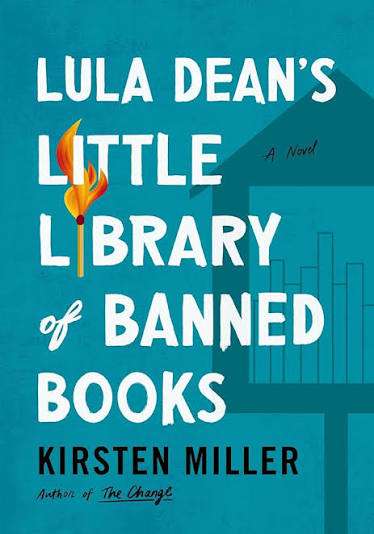
Lula Dean’s Little Library of Banned Books by Kirsten Miller

Ronnie can’t believe his luck. After waiting for Lindsay for hours in the town square, she’s finally come to join him. Even better, she has asked him to join her in a bit of a prank. You see, Lula Dean, nobody’s favorite, self-righteous snoop in the town, has set up a little box of “free” library books in front of her home. While she had led a crusade against “dangerous” books being available in the schools and the library of their small, Georgian town, she has decided to establish a more “appropriate library” for the townspeople to use. Unbeknownst to Lula, however, Lindsay has what she feels might be a creative solution to the problem of Lula’s book banning. However, she has no idea what she might have unleashed on the town from this little prank…

What starts off as vignettes about the various characters who borrow the books Lula has left out in her library evolves into a more connected, linear story about a Southern town afflicted by its sordid past. The town has celebrated, with a huge statue in its town square, its deep roots in the enslavement of Black folks and in the extremist groups fostered there. Some of the characters here feel threatened by any sort of change, any progression toward inclusiveness; on the other hand, there are many who seek to move on from their history, to do better. The message here is clear: those who read, open their minds, and learn about others, become more empathetic to the plight of those who have been marginalized for whatever reason.

This is a clever novel, with amusing characters as well as a surprisingly complex plot. My only complaint is that the ending is, once again, a bit too neat. Perhaps it is the hope of the author that by reading this book, one will open their minds and learn that doing so will lead to happy endings. A sweet message if perhaps a bit naive. (I may just be cynical, given our world right now, though.)
The Thread Collectors by Shaunna J Edwards and Alyson Richman

When Stella and William say a passionate farewell at the beginning of this story, they have no idea if they will ever reunite. William is an enslaved Black man in the South, escaping his master at the outset of the Civil War, and Stella is an equally indentured Black woman who technically is free but is “kept” by a White man for his “pleasure.” All William has is his flute and his magically musical ear, but this wins him a place by the side of his newfound friend, Jacob. Likewise, Jacob, a Jewish New Yorker, who has signed up on the side of the Union, with the dream of fighting to end slavery, has also bid goodbye to his true love, Lily. He also has no idea if he’ll be able to return to her, fearing the worst as he moves closer and closer to the front. All he can hope for is that her continued correspondence and her love for him will help him through his arduous fight.

This narrative was apparently based on true characters in the history of the two authors’ families. Each of them is writing about the marginalization and, particularly in the case of the Black men who fought for the Union, dehumanization, experienced by these soldiers. And how relevant is this story now? With the rise of antisemitism and racism that is rampant in this country – and worldwide – it is both tragically and unsurprisingly, unchanged. Both Jacob and William experience the feeling of being treated as less-than, socially, financially (William is paid less than his White counterparts in spite of doing their scut work), and in terms of supplies, food and healthcare. Moreover, I feel that many of us can, sadly, relate to the schism in Jacob’s family, as he finds that his brother sides with the South and defends the vile institution of slavery, while Jacob and Lily fight for abolition.

As a novel in itself, however, I feel it is just ok. While it tells an important story, and there are some gritty and heart-rending scenes, it is mostly on the predictable side and just a bit corny. A few coincidences are just too perfect and a few situations turn out just too well to believe.

On the whole, however, it is a worthy read and one can learn quite a bit about this slice of history, from a more insider, less glamorized perspective.