Under Pressure: Confronting the Epidemic of Stress and Anxiety in Girls by Lisa Damour, PhD

under pressure

Working exclusively with young women over the past 15 years, I have seen a frightening trend of increased anxiety among them.  There are many explanations of why this is so, but there are few answers as to how to help them cope.  In this concise, articulate, and surprisingly upbeat book, Lisa Damour guides primarily parents in how to gently and supportively help their daughters to confront the sources of their stress and anxiety and in doing so, to combat them.  As she points out, quite aptly, when one shies away from the cause of the anxiety, most often that anxiety only builds.  Significantly, too, Damour does not demonize stress and anxiety.  She points out that without stress, we might not push ourselves to do our best to achieve our goals; likewise, without the anxiety response, we might not be alert to dangerous situations.  Stress and anxiety are only bad when they reach such high levels as to interfere with our normal functioning – that is when we need intervention.

The writing is insightful, readable, and filled with vignettes that engage the reader.  Damour relates experiences with her clients as well as her own daughters, which make the issues she discusses come alive and tangible.  She divides the issues into those that relate to girls in the home, girls in relationships with other girls, girls in relationships with boys, girls at school and girls as they are portrayed in our culture – and each of the stressors that are inherent to each of these realms.  There are helpful tips along the way, lots of analogies, and very wise, concrete suggestions.

One takeaway I loved was her response when a young woman wasn’t sure how to respond to a conflict.  Our culture conditions women to be agreeable and girls are expected to be and generally are particularly sensitive to others’ feelings.  She summarized peoples’ responses to conflict as being either a bulldozer, a doormat, a doormat with spikes (passive aggressive responder), or (the desirable response) a pillar (stands up for herself without stepping on anyone else).  I thought this was a great way to think about how we respond to conflict and and how we can guide others to do so in a constructive way.

I don’t think all of the advice in this book is exclusive to only girls.  Some of it is generalizable to boys as well.   But there is certainly plenty of evidence that girls experience more stress and anxiety than boys and that it is taking its toll on this generation of girls.  Here are, finally, tools to utilize to help them resist this scourge and be resilient.

Educated by Tara Westover

educaated

Deep in the hills of Idaho, among the potato farms and tiny villages, poverty reigns over large families like the Westovers, who cling to their Mormon faith for the little bit of truth that they can believe in.  Dad preaches to his children his beliefs that the government is part of a socialist plot to undermine the Lord’s will and public education is just a manifest of this.  So while the older children might have benefitted from having gone to school, the younger ones, Tara being the youngest of those, did not.  So the kitchen where Tara mixes herbs with her mother and the junkyard where Tara sorts metals with her father and brothers become Tara’s classrooms.   And the random, outdated history or mathematics textbooks that left around the house became her only source of book learning, such as it was. Sadly, her emotional learning was blunted by the abuse at the behest of her brother Shawn, and her ability to survive in her home was made possible only by quelling any feeling or reaction to what was going on around her. When she finally did allow herself to feel, she realized there was just too much rage at her whole family to do anything with it.  This was the face of mental illness and this was the face of her family.

This is the true account of the life of Tara Westover – and it’s truly a miracle that all of the children actually survived, especially Tara.  The severity of the neglect and abuse at the hand of her father (and her mother) is staggering.  It is really not entirely their fault, as they clearly are mentally ill – at least her father is severely so.  The most egregiously violent and abusive one, however, is her brother Shawn, who is viciously violent and his parents repeatedly turn a blind eye to his cruelty.

I find that the one I am most angry with by the end of the book, interestingly, is Tara’s mother.  She has so many opportunities to come through for Tara.  There are moments when it appears she just might finally side with Tara.  That she might stand up against Tara’s father, or against Shawn, and say that Tara may be right in accusing Shawn of acting violently toward Tara, or of Dad having mistreated Tara when she was younger, not having given her opportunities or believed her when she was telling the truth (that she was NOT a whore, as she was so often accused of being).   Even later, when her mother had more financial success and independence and might have had a chance to break free and it might have appeared she’d stand up for herself.  But no, she did not.  Such. a disappointment for Tara.  No wonder there was such heartbreak and fury.

The fact that Tara has achieved the success that she has is miraculous and I applaud her intellect and courage.  I only pray for her that she is able to find the support that will allow her to find kindness toward herself that will allow her to heal from all the hurt.

I thank her for sharing her story with all of us.  It has been so powerful.  Mental illness rears its ugly head in so many ways.  Sadly, the worst is toward children.


Chiefs by Stuart Woods

chiefs

In looking for something different to read, I stumbled upon this thriller from the 1980’s, which was so much more substantive and nuanced than I ever imagined.

It begins in 1919, when Will Henry Lee is appointed the Chief of Police in the tiny town of  Delano, Georgia.  Things are fairly quiet until the first body turns up – that of a young boy, naked, with suspicious marks on him.  This case is niggling at him but life goes on and he is forced to move on with the times.  As the years pass, the case becomes buried deeper and deeper in layers of race, power, politics, and in simple human nature and the ultimate resolution is a shock to everyone.

This story is so carefully delivered, over time, even over generations, and the reader’s patience is rewarded with an exquisitely intricate plot.  There is a horrifying overlay of the deep south’s history of racial bias which, sadly, is quite poignant and relatable today.  So too, are the political power plays, the small town alliances, and injustices.  Timeless, apparently.

The writing, too, is sharp and clear, with poignant dialogue and a few great scenes.  My particular favorite scene is one in which the wife of Billy, Will Henry’s son, buys a shotgun and shows what a woman can do all by herself to protect herself from the nasty Klansmen who are out to get her and her husband.  I won’t give it all away, but I’d say that scene alone is worth reading the book for!

This book is a definite page-turner and one that will stay with me for awhile.  I’m not sure it’s a “must read” but it’s close!


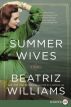
The Summer Wives by Beatriz Williams

summer wives

Miranda Schuyler has just arrived back home to Winthrop Island to hide away from her life just a bit.  She just wants some quiet, to try to repair her relationship with her mother and her half-sister – if possible – and to heal, both physically and emotionally.  What she doesn’t expect is that on arriving back here, all of her memories and the emotions tied to them would come flooding back as well.  And with them, much of her understanding of her world might just be turned upside-down.

Beatriz Williams creates the most wonderful female characters – they are strong, smart, witty, and often rebellious without ever losing their femininity or grace.  They are characters who drive the plot, who outwit the demons, and who, while we guess will be victorious in the end, we never know exactly how.  There are always clever plot twists and there are sometimes dark details, but there is always a lightness and humor in the telling.  And Miranda, with her story, certainly falls in line with this pattern.

Williams also utilizes the shifting of voices and of time to build the story from various vantage points. I love this technique.  I find this builds suspense and keeps the motion of the story moving forward, even when we’re essentially hearing backstory.  It enriches both the story and the people in it and deepens our understanding of both.  Because sometimes it isn’t the “what” that is the mystery of the story but the “why” – and here is a good example of that.

I really enjoyed this book – and am hoping to read all of her books at some point!

We Were the Lucky Ones by Georgia Hunter

we were the lucky ones

Addy Kurc tried desperately to make it home from France to his small Polish town of Radom for Passover, but in March of 1939, as Hitler and his German army was blocking travel through Europe, this was not to be.  The Kurc family tried to feign normalcy, going through the familiar seder rituals, but each of the members of this tight-knit family sensed that there was something about to change in their world.  Never, could they have imagined the horrors they would be facing, however, as Poland would be complicit in the anihiliation of millions of Jewish people along with Germany.  And never would they believe how far they’d travel and how many years it would be until they would be celebrating Passover together again as a Kurc family.

I wasn’t looking for a Holocaust novel, and when I realized that that is what this was, I almost put it aside.  But the writing was so compelling I couldn’t.  There was something about this story, about these characters, that I had to continue with it.  I had to know if Addy was reunited with his family.  I had to know if each of his siblings (and there were 5 altogether) survived the war, and if his baby niece actually made it through as well.  And how, if it were at all possible, would his parents survive the war, as they were elderly although not frail when the war broke out.  The characters were very compelling and each went through such harrowing experiences.

And that was even before I knew that the story was true!  Addy was the grandfather of the author!

I know that especially in this very difficult time, when we hear about hate in the news almost every day, with racial tensions, police brutality, shootings, and hate and bias incidents, it is hard to read about the Holocaust.  On the other hand, I feel it is crucial in this time not to forget what it can grow to be.  We cannot  get complacent and think the it can’t get there again.

That’s what they believed in Radom in 1939.


The Light We Lost by Jill Santopolo

the light we lost

This is a love story that starts, ironically, when the world feels like it might end – in New York City, on 9/11/01.  Lucy and Gabe feel it too – they reach for each other, barely knowing each other, and then it’s over.  But years later, when they meet again, the spark is reignited, and this begins a heartbreaker for Lucy that she endures quite in spite of herself.

The voice is what is unique in this story and I think is what engages the reader.  It is written from Lucy to Gabe, almost as a letter, which gives it a very intimate feel.  On the other hand, because we only hear Lucy’s voice, it can sometimes feel one-dimensional.  There is no layering of the plot, but rather a single-mindedness of the narrative becomes almost droning as the novel progresses.

What is more deeply troubling about this novel, however, is that once again,  the outwardly independent female character is bound to a male character and jumps to his beck and call each and every time.  I felt myself literally growing angry as Lucy again and again fell into this same pattern.  While Lucy does not go with Gabe when he needs to travel for his life work – hurrah for her –  she then pines for him throughout the rest of the book, answering his calls whenever he deigns to reach out and dropping everything for him when he needs her.  (Really?  We’ve not moved past that?). And while she notices when her new boyfriend, Darren, makes plans without her input- and gets angry about it – she never stands up to him or says anything about it.  Why can’t our female characters be unequivocally strong?  I’m tired of this.

I think this book was off to a great start, and had great potential but was just disappointing on multiple levels.  Oh, well!


Bridge of Clay by Markus Zusak

bridge of clay

Markus Zusak, the author of The Book Thief, has proven once again to be part writer, part poet, and part craftsman in his newest, breathtaking novel.  The story is about 5 brothers who are raising each other, the parents who raised them first, and the complicated history of how these parents came to be.  It is a story of love and relationships and loss and not really coping and, well, trying to cope;   And while its a bit of an effort to get to know each of the characters at first (as in real life), it’s ultimately well worth the time.

The narrative here is stunning – and must be appreciated for its understated beauty.  There is raw emotion and silence and pain and beauty and love and everything in between that is utterly palpable and with a feeling of air between each word so that the reader has time to experience each of these right there beside each character.  Each word, each sentence is painstakingly chosen and there is poetry on each page of this prose.  By the later chapters, the reader feels the characters are so real that one might just walk in and sit on the couch and watch the bad, 1980’s movies with the boys and tussle with them as they do with each other.  And the love of storytelling by the main character, Clay, allows for the  actual storyteller, Matthew (the oldest brother) to switch gracefully back and forth between the boys’ adventures and the parents’ earlier experiences so that have the privilege of getting to know all of them.

But be warned – it is a slow start and a bit beyond midway it feels like it is finished when it is not.  This book requires patience and calm.  But like most things in life, patience is heartily rewarded here.  I literally could not speak for awhile after reading the ending of this story, feeling absolutely washed over by its utter warmth and love.

This is a masterpiece of subtlety and a very large poem of the heart.

I hope will allow yourself the privilege of loving it as I did.


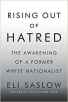
Rising Out of Hatred by Eli Saslow

rising out of hatred

Derek Black has been nurtured from the time he was born until the time he went off to college to be the great white hope for the future of the white nationalist movement.  His father, Don, established Stormfront.com, the earliest and largest promoter of racist propaganda on the internet, and David Duke, his godfather, is the well-known KKK/Nazi politician.  Everyone in this underworld knows Derek and believes he will take over for Don and Duke, as Derek has already begun to co-host their radio show, assist with the website, and even help organize their annual conference.  But as Derek enters college, he decides to keep this part of his identity secret, interacting with the diverse students in his classes and activities, even while he maintains his connection with his radio show daily.  However, what happens very gradually, when Derek is later exposed, ostracized and then quietly invited to the regular Shabbat dinner of an Orthodox Jewish friend of his, begins the process of challenging his deepest convictions — and is absolutely stunning.

This true story has been featured on various podcasts (The Daily is one) and has been written about in various newspapers, so you may know the basic story.  Derek himself has written opinion pieces for the New York Times.  But in this moment of unleashing of hatred and bigotry, this story is a crucial one – and the details matter.  It is crucial because it shows how hatred has been simmering underground for so long among those who are living their very insular lives, among those who think only like they do.  And it is crucial because it demonstrates, most importantly, that if we look at those who think differently from ourselves as human beings, only then can we start to have a civil and respectful enough discourse to come together on ideas.

I am in awe of the courage of the students who showed friendship to Derek even after he was “outed” as the co-host of the morning show on Stormfront.  They stuck by him, braving the derision of most of their peers, showing steadfast friendship to the the hero of the dark side, even as he degraded their racial groups on his radio show, even as they questioned their own wisdom in doing so.

And I am in awe of Derek himself, who has truly shown courage in the thought and heart that he has put into his own journey.  It is so much easier to go along with what your family and community preaches and to stick to your original beliefs.  It is so much harder to go against your family wishes, to turn around what you’ve been taught is right, to go against your indoctrination and open up your heart to other ideas.

But I am also not sorry he has accepted his responsibility to go public with his journey, because he has to share with others that those narrow-minded, absurd ideas about white supremacy are just wrong – and that the harm they do to others can not, under any circumstances, be justified.

In this moment, this book is absolutely a MUST-READ!

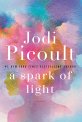
A Spark of Light by Jodi Picoult

spark of light

Immediately on learning that both his daughter and his sister are inside the abortion clinic where a gunman is holding hostages, Hugh knows he should recuse himself from the situation and not be the hostage negotiator.  He knows he cannot be objective; but nor can he allow anyone else to do this job either.  And what are they doing in there anyway?  How did he not know they were there and why?  What did this say about his relationship with his daughter?

And inside there is a bloody scene.  The gunman has killed people but now he’s taking stock of his situation and wondering what comes next.  How did he get here?  It wasn’t supposed to be this messy.  Or this real.

The whole story is told over the course of a day, and actually told mostly in reverse.  We learn what happens, mostly, and then we hear the back stories, the histories of each of the characters who create the scene of what makes up this dramatic story of A Spark of Light.  The story is steeped in fact.  Characters who harass women entering the clinic (whether or not they are actually having an abortion or going there for a PAP smear)  but  who may have had abortions themselves, when it has suited them.  Single abortion clinics trying to survive to accommodate the needs of the women in an entire state, and trying to fulfill the rules imposed mostly by rich, white men on mostly impoverished women of color.  Characters like Dr. Louie Ward, depicted intentionally like the real-life hero, Dr. Willie Parker, an abortion provider who does so because of his Christian faith, not in spite of it.

In true Jodi Picoult fashion, this story is shared by many of the characters.  It is told from the eyes of each character, and built gradually by adding block by block, minute by minute, how each character perceives the passing of the day and of the experience.  We hear each opinion on abortion, religious and otherwise.  We hear each legal perspective and each is given credence, such that each perspective can be respected.  We also see that these women’s clinics serve as much more than abortion clinics as well. We also develop an appreciation for the various and desperate situations that lead women to require their procedures at a women’s health clinic.

This is an important book and serves as so much more than just a piece of fiction. Jodi Picoult never shies away from difficult subject matters and here conquers yet another.  In my opinion, she’s done another great job.

Another MUST READ!

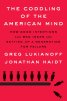
The Coddling of the American Mind by Greg Lukianoff and Jonathan Haidt

coddling of american mind

For anyone who works with or parents a young person who has entered college starting the year 2013, you will have noticed a difference from those who started at any time prior.  There is a rate of anxiety unlike any generation that has preceded it – and it is compounded by parents who perpetuate the sense of fragility that these students have by continuing to overprotect them and college administrations who do the same.  Why?  The researchers who have written this book give explanations based on the following 3 “untruths” that get perpetuated by these parents and college administrators:

  1. What doesn’t kill you makes you weaker.  (Actually – it makes you stronger.  But we still strive to shield our young from any and all potential harm.  This of course deprives them of the opportunity to learn how to cope with adversity.)
  2. Always trust your feelings.  (NO!  Our feelings are often inaccurate.  We need to explore and learn and find that there really isn’t a ghost hiding under the bed, and that girl over there looking at us might not hate us, but might just be shy herself.  We need to look at facts, not at just our own perceptions.)
  3. Life is a battle between good people and evil people.  (This may be the most dangerous of the untruths, creating the us-vs-them mentality that informs the current toxic discourse on college campuses today.  There is so much more intolerance of opposing views and so much less ability to have civil conversation about anything at all controversial that even professors are shying away from anything that may smack of real import in their classrooms.  This is actually a threat to education itself.)

The book expounds upon these ideas, given fascinating – and often appalling – examples of real incidents on college campuses and some high schools where these theories and ideas have come about.  They also expound upon what might have caused this situation and what might improve it.

As someone who not only has children exactly this age and who works professionally with students at a college, I fully appreciate the message of this book.  It is a harsh statement about how restricting free play time, scheduling so many activities, making the college application process so all-consuming that it has to start in preschool (!) — this takes away from a persons ability to develop normal self sufficiency.  There is no room for failure from which to learn valuable life lessons.  And when we don’t learn how to fail, we don’t learn that we can ever be wrong – and that is quite dangerous.

This is an outstanding book that I have to recommend as a MUST READ!