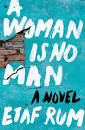
A Woman is No Man by Etaf Rum

Isra has the dreams typical of a young teenager, but hers, she finds, are thwarted time and again, by her mother’s insistence on her adhering to the strict rules of her people. Traditional Palestinian women do not have choices – they are born into the world as disappointments – disappointments first that they are not boys, and disappointments second that they must be groomed forever to be married off as soon as they can be readied. She has been told this ever since she can remember and even though she has dreams of romance, fostered by the books she sneaks into her home, she knows, deep down, that her fate is as her mother’s – she will be a wife, a mother, and no more.

Fast forward, we also follow her daughter, Deya, who is struggling with the same challenges. She is an avid reader, wants desperately to attend college rather than just to get married, but the grandmother who is raising her is insistent that she must marry. This is what traditional Palestinian women do and if she does not, the whole family is shamed. It would affect not only her but her younger sisters as well. And then where would they be? Is Deya trapped? Is Isra trapped? How is one woman’s fate tied to the other?

While I found this story a bit repetitive and almost as predictable, it was, at that same time, a powerful dive into the lives of women of this insular world. Just as with women in extreme Orthodox Jewish communities, women in these isolated Muslim communities are treated as if they have only one purpose – to serve the men in their lives and to procreate to produce, ideally, more men. They are not valued as individuals but rather for their ability to cook, clean, and to service the men. Worse, because they are not valued, they are also not treated with respect and the physical, verbal and psychological abuse they endure can be overwhelming, if not fatal. Of course, this does not represent all Palestinians – just as it does not represent all Jews – but there are communities of insular, extremely religious sects for which this does apply and it is important for these issues to be brought to light. Not just for the young women whose lives are at risk, but for society as a whole.

What I found so fascinating was how very similar the cultures are – Palestinians and Jews in their extreme, religious forms. While politically there are so many tensions between Palestinians and Israelis, religiously there are so many parallels. To those who hold on to the strictest interpretation of their religious texts, whether the Torah or the Quran, life remains as it was centuries ago. There is no value to educating women because they have a specific and limited role in the home and the community and must be guarded at all times. The purity of the woman is the ultimate value and if she stains that in any way (and any stain is her fault, even when it’s not)- even if it is by the pursuit of education alone – that brings a shame upon the family that is a black mark and taints her (and any further siblings’, of course) ability to marry, her ultimate purpose. Any adverse event is covered up in secrecy, denied, and buried so as to avoid any shame to the family – again, to maximize the marriageability of the children.

And escape is hard – because they are not given any opportunity to develop skills that they can use in the outside world.

I think this is an important read to expose this underbelly of a culture that can be colorful and beautiful and otherwise rich with historic value.


Early Autumn by Louis Bromfield

Olivia Pentland has been caught up in her old-world, New England, Puritanical family since marrying into it many years ago. While she has had financial security, she has given up all else – independence, originality, and most of all: love. She has been able to cope mainly with the support of her father-in-law, whom she perceives as a wise ally. But with the advent of her cousin by marriage, Sabine, who has been away in Europe for the past twenty years, her world is shaken to its core. Sabine, in her malevolent, selfish, and direct manner, bursts upon the family’s tautly held secrets and slices them wide open at their core. Can Olivia save at least her daughter, if not herself, from the chaos that will ensue?

This is another Pulitzer-prize-winning disappointment, I have to say. It begins with the creation of an atmospheric setting and mysterious characters that are colorful and captivating. We come to appreciate Olivia for her patience and her balance, even as she tolerates the weakness of her single-minded husband, the impudence of her husband’s intrusive aunt, and frustration of her own feelings of being trapped in a life of stagnation. But this also creates the expectation that something monumental is about to happen. And while there are things that do happen, the monumental thing we expect really doesn’t ever occur. I found that a let-down.

Maybe that was the point? Maybe Olivia’s expectation was that in her life she’d have opportunities, given her wealth and the prestige of her husband’s background. Maybe she thought she’d have the chance for romance, for excitement, for fulfillment. She was on the brink – but she had to pull back for her family’s sake and for her own. And maybe that is how life can just be sometimes and we have to accept that. Maybe that is the lesson we are to learn.

Lesson or not, though, to me it fell short and I felt, as the reader, short-changed.

I’d be curious to know if others had a similar reaction to this novel. Any opinions out there?

Windfall by Penny Vincenzi

Although she’d given up quite a bit for her family, Cassia had felt fairly content with her life. She has a lovely family, a husband who is a respected, community doctor, and she is even allowed to assist him once in awhile in his practice. What she doesn’t often acknowledge, even to herself, is how much she’s missed practicing medicine herself, after having trained at the same medical school as her husband. But now that she’s inherited quite a large sum of money from her beloved godmother, perhaps now she can make something of her education. Perhaps now she can realize some of the dreams she has had for herself. How this plays out seems to have a ripple effect, for her family and for the many people she cares about and who care about her.

In my opinion, this author, Penny Vincenzi, is a master craftswoman. She has a gift of being able to create an entire community of fully developed characters with whom we become intimately connected, interweave their stories so that they tie together but also function as engaging subplots, and all while keeping each character and story solidly lucid and memorable in and of themselves. It is not heavy descriptives or overwhelming detail that keep the characters clear and identifiable, but our own emotional commitment to each of them because of their deeply human feel. We are compelled to know what comes next because they feel as tactile as we do, we need to know because they become our family, our friends. We feel almost a part of the intricately woven plot, that we are almost a part of the fabric of their lives. We are vulnerable to the suspense, the sharp dialogue, the exotic scenes, and most poignantly, the human emotions the novel elicits.

There is also a theme of fighting convention by the many strong women herein. Women were just starting to battle against the norm of having to stay home and care for children as their only option – and at the same time they were also starting to rebel against the presumption that they, in fact, had to have children at all. Contraception was just then becoming a possibility, which liberated women from the burden of just being baby factories. At one point, Harry, a very complex character with whom Cassia has a very complicated relationship, laments that he is forever destined to be attracted to very strong women. As it happens, most of the women in this novel are strong, each in their own ways.

If you’re looking for a fun, substantive read – a truly healthy addiction because you will not be able to put this one down! – this is the novel for you!


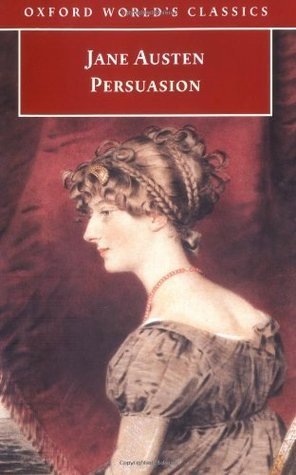
Persuasion by Jane Austen

Anne has led a quiet life, since the breakup of her engagement 8 years ago. She has not questioned the wisdom of the advice her dear friend, Lady Russell had given her, knowing that it was only out of the best of intentions that her friend advised her so. But she has wondered just how her Captain Wentworth had been faring since that time. As it happens, she may now find out – because he is returning to them! Now that her father has outspent his fortune and has to rent out his estate to Captain Wentworth’s sister and brother-in-law, she may be seeing him once again. But it won’t be that simple to learn what his thoughts are – and to whom his heart belongs.

Every so often I love going back to the classics – especially ones I’ve never had the opportunity to read. While I found this one a bit confusing in that it was challenging to keep track of the characters and their connections – every male character was named either Charles or William and everyone was a cousin! – I did find it amusing and entertaining. So many of the classics are heart-wrenching and tragic and it is refreshing to know that at the time of Jane Austen – the later 1700’s/early 1800’s – it was permitted, even appreciated, to have a sense of humor!

So while this was not a deeply profound or moving novel, it was certainly a fun change of pace.

I wouldn’t call this a MUST READ but it is definitely on the list of classics to get to at some point…


Year Of Wonders by Geraldine Brooks

Anna can only imagine what it must be like to have the weight of the whole village upon his shoulders, as does Michael Mompellion, the village vicar. It is he who has carried the prayers, the hopes and dreams as well as the trauma of those who have lived – and died – among them. That is not to say that Anna has not been there as well. Anna, and Michael’s wife, Elinor, who as the time passed, became more of friend and less of an employer to Anna, have nursed so many of the villagers, caring for them and comforting them. But what they saw together, what they experienced, no one should ever have to. And so Anna understands his wrath toward the wealthy family the Bradfords, on their return, after deserting their village when so many relied upon them. What happened after that, however, she did not expect…

Here is another hard and yet utterly addictive novel by Geraldine Brooks. The time is the 1660’s, in a tiny village in the UK where the Plague has been carried into the town by a kindly and unwitting messenger. After he takes ill and gives warning to burn all of his possessions – a warning that goes unheeded – the disease creeps into the homes of those around him and ravages the village over time.

What we see, however, is all too familiar. We see it bring out the best in some and the worst in others. We see a 1600’s version of misinformation and we see people grasping at untruths because they are desperate and have a deep-seated need to blame someone or something for their misery and pain.

Many may feel that this is too soon after our own plague, but it does feel different. To me it highlights our privilege of scientific advancement and evidence-based medicine. It highlights the knowledge we’ve gained over these centuries and the ability to study a new pathogen with logic and with precision- to develop treatments and vaccines to protect ourselves and to prevent the worst outcomes at lightening speed. On the other hand, and most tragically, our most recent plague has also brought to light the continued distrust and misinformation that runs rampant in our communities as well. The cynical and damaging anti-vaccine misinformation that has been circulated by darker forces in our country via social media and Fox News has stirred just as much unrest and backlash toward legitimate science as did the believers in the witches and magical incantations of the 1600’s. (And just like in those times, the motivation is the same: money.)

This is a powerful and elegantly written novel, deeply researched and exquisitely presented. If you have the capacity to read it, it is absolutely worthwhile. I’d call it a MUST READ, if you are able.


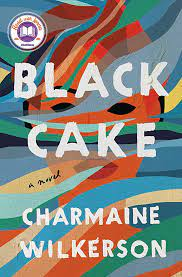
Black Cake by Charmaine Wilkerson

Bennie and Byron are both devastated over the loss of their mother. Still, they cannot imagine why they are here, sitting with Mr. Mitch, their mother’s lawyer, just a day before her funeral. What could he possibly have to tell them that they do not already know – she’s their mother, after all. And just because Bennie has felt she’s had to separate herself from her home and family for the past several years after a hurtful Thanksgiving feud, that doesn’t mean she doesn’t know her own mother. Or does it? As Benny and Byron listen to the recording their mother prepared for them just prior to her death, they learn about her real past and how this will impact their lives in the future.

I should have loved this novel. It was told from a 360 degree narrative that I love – the perspective of different voices, involving different time periods. It is enriched with sensory descriptions and with beautiful cultural imagery, particularly when describing Eleanor’s (their mom’s) Caribbean roots. There are messages of environmental and political importance that were worthy of being elevated.

But what was missing, at least for me, was a deep connection to the characters. Maybe it’s that we are told about a palpable anger and resentment between the siblings that permeates the tone of the story, but I feel we don’t really get to know those siblings all that well. We get quick peeks into their lives, brief snippets of their struggles.  Byron in his constant state of sullenness is the overachieving Black male, having to outrun his peers just to get ahead. Bennie is the opposite: trying to find herself because she doesn’t fit neatly into any box. But not only is the storytelling somewhat dispassionate, but it is also choppy. We don’t really get to feel their feelings, we don’t see their more tender sides. Little wonder we (or I at least) can’t connect.

What I find here is a great idea with such rich potential, but I do not believe it was as well-executed as it deserved. The story deserved characters served up with deep love, empathy and much more heart. I just didn’t feel that here.


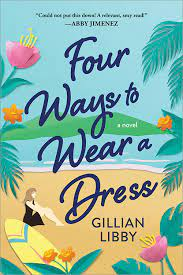
Four Ways to Wear a Dress by Gillian Libby

Millie has just lost her PR job in NYC. She really thought this would be her big beginning, when she would show her parents that she’d really become an adult. But alas, once again, in spite of her warnings to the company that their product was impractical and overpriced, they were forced to make cuts – and that included her. So, at least for now, she is going to take her shared, “good-luck” little black dress that her friends are foisting upon her and move out to California, where the final member of their posse, Quincy, is living, helping to run their family-owned hotel. What Millie finds is that Quincy and her friends, social media influencers hoping to bolster the businesses of their tiny coastal town, are living a dual reality: one that is on social media and one that is real life. As Millie tries to find her own way, she has to navigate this duality for herself and figure out where – and if!- she fits into this picture.

My initial reaction to this book for this blog’s purpose is to tell you not to waste your time.

The bulk of this story, which is predictable in almost every way, revolves around the superficial world of social media influencers, which is distracting, disingenuous, and really all about the money. Even the children here are trained to stop suddenly – right on cue, even mid-sibling-rivalry-argument – long enough to plaster lovely smiles on their faces for uploadable photos in a very contrived-but-meant-to-look-natural setting. Any admission of an imperfection is shameful, any hint of real-world troubles is deemed unacceptable. When Millie arrives and begins to be publicly genuine, posting her mishaps and actually getting attention for it, she gets admonished by the local “queen bee.”

That is, of course, the message, though. It is a comment on social media and its influencers. It is a critique of the idea that we must only put our best selves – or a version of ourselves that is “perfect” out there for others to see, and never admit that we are imperfect, or actually human.

But I would suggest that that isn’t good enough. I would suggest that maybe we might not publicize so much of ourselves at all. Maybe we could just be actually living more of our lives; being mindful of, rather than posting, every meal we consume, every outfit we wear, every experience we enjoy. Maybe also, we could be watching less of what others are doing. Certainly research supports this: that is, the more time we spend on social media, the more anxious and depressed we are.

So while the book is not necessarily a worthwhile read, it does get one thinking… which always has value. Lucky for you, I saved you the trouble! You’re welcome! 🙂


Horse by Geraldine Brooks

Jarret, an enslaved Black boy in the South, may be small, but he knows his horses and he knows how their lineage matters. This is what his father has taught him and what he recites with him each night as they sit on their porch on warm, Southern nights. When Jarret witnesses the birth of his newest beauty, Darley, he and the horse form a bond that will last for decades.

Fast forward to 2019, and we meet Jess, who has found herself working at the Smithsonian, far from her home in Australia. From a young age, Jess has been fascinated with the bone structures of animals, and she is now working to prepare them for analysis and study at one of the world’s most venerable American institutions. It is here where her path crosses with Theo, an art history graduate student at Georgetown, writing his thesis and researching articles for a magazine for the same institution. When their research brings them together, they find that there is more that they share than their interest in a horse that lived a very long time ago.

This is one of those novels that you yearn to keep reading to know what will happen, but you also don’t want to keep reading because you don’t want it to end.

There is so much that has been packed into this extensively-researched novel that there is so much to unpack. First, I learned so much about horses and horse racing. Not familiar with this world, I learned about the breeding of the horses, how their treatment and mistreatment has evolved, and how important their anatomy is to how effectively they can race. There is a love of animals that is expressed throughout this novel that I share quite deeply.

The story also depicts racism, as it existed during the 1800’s, when slavery was still legal in this country, and as it still very much exists today. We see how Jarret is treated as an enslaved young man, which varies depending on who has ownership of him (and what they believe they can get from him). We cannot help but compare him to how Theo, our graduate student at Georgetown, is treated in current day, where he experiences almost daily comments, micro-aggressions (which are often not very “micro” at all). Both men are highly intelligent, experts in their fields, and are respected – but over and over again, encounter obstacles purely because of the color of their skin.

But don’t be fooled – the learning is all so easy. It comes through a beautiful story, with beloved characters and a heartfelt and moving plot. And even if you’ve never been on a horse or never watched one race, you will fall in love with Lexington (nee Darley)!

This is 100% a MUST READ! Loved it!

Tomorrow and Tomorrow and Tomorrow by Gabrielle Zevin

Sadie is full of resentment, even though she can’t admit it. She’s given up her summer to be with her sister – and that’s ok, I mean, her sister is battling cancer, for god’s sake. She’s doing her best to be out of everyone’s way, when she comes upon a quiet boy named Sam, who, it appears, likes to game as much as she does. In fact, as his nurse has observed, Sadie is the first person Sam has actually spoken to since his horrible accident and his multiple foot surgeries. When the nurse requests that Sadie come back and game with him some more, trying to pry him further out of his shell, she encourages the development of a friendship that will go through many lives – almost like those of the characters they become in their games.

I am not a gamer, in any way, shape or form. But I loved this book and found it relatable on all of its levels. While gaming is the language the characters use to communicate, we sense their vastly deeper connection to each other, the love they feel. We also experience their pain and understand how they rely on gaming to escape this pain – to dive into worlds that are dreamlike, fantastical and utterly distracting in order to just get through. As they create games for others, they use this knowledge to create alternate realities for others to escape as well.

I also love how the plot unfolds. It surprises, interrupts, detours, and restarts – almost as if in a game itself. Because of this, it captures our imagination but also feels as real as one’s own heartbeat. It is simultaneously lyrical and tactile. The characters are both idyllic and deeply flawed.

I believe this is a MUST READ – a creative, imaginative, and very modern love story!

Whereabouts by Jhumpa Lahiri

In Whereabouts, we are introduced to the narrator, a single woman in her mid-forties who is a writer and professor, an astute observer of life around her. With each brief chapter, she shares with us a glimpse of this life, a series of sometimes ordinary, sometimes unsettling experiences that range from a visit to the shore for a friend’s baby’s christening to a trip to the local stationary store that has, to her acute disappointment, suddenly been repurposed as a luggage store. Woven through these stories is an undertone of a guilty resentment toward her aging mother, for feeling criticized all her life for being who she is and for being who she is not.

There are many fascinating aspects of the way Lahiri has chosen to approach the writing of this novel. Leaving her narrator without a name, for example,  universalizes her character – potentially makes her the everywoman of her age and circumstance. She may speak for the middle-aged woman, mulling on her past while contemplating her future.

She is admired by the young and by her peers for her uncluttered independence, but yet she simmers with inner rage. Her mother who is now small and frail looms large and loud in her memory, the ancient critical and jarring comments from her past playing on repeat in her mind, as if they are being uttered today still. It is impossible to forgive but so hard to live with this resentment too.

She participates in groups of friend gatherings, but reports on them as if from afar. She is with them but not of them. It feels as if her rage prevents her from truly connecting to anyone beyond the surface and she cannot overcome this. There is contemplation without real insight, or so it feels. Does this come from the narrator herself or from the fact that she speaks to us through vignettes as opposed to telling us a linear story? Is this disconnect intentional?

And so the telling is as unique as the character herself, which makes for an original, contemplative, and, apparently, Pulitzer-Prize-winning read.

I’m so curious to hear what others think about this one!