I rarely reread novels because generally I feel there is so little time and so many books – but this one is an exception. I have already reviewed this novel previously (please search my former review), and I stand by my initial recommendation as a MUST READ.
There are few novels written with such insight, such kindness, and such a generous outlook on the foibles of mankind as this one. The character embodied in the Count is utterly endearing, for his humility, his wisdom, and his humor. While he has been accustomed to wealth and opportunity, he also, shaped as we learn by his grandmother, has a deep appreciation for everyone, no matter their station in life, no matter their role. And so, even as he is sentenced to house arrest (albeit in the nicest hotel in Moscow), he befriends most of the staff, the guests, and even finds a helpful role for himself so that he may be productive. Still we see his most tender aspect as we observe his interactions with the children he befriends and cares for. He treats even then with the utmost respect – and earns theirs in return (along with most others’ as well).
We can all learn so much from his character – and from this incredible novel that I might just read again at some point!
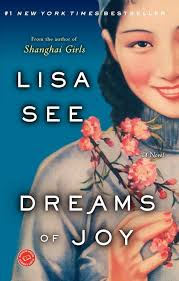
Already reeling from the death of the man she’s known to be her father, Joy has also just learned some shocking news about her mother, Pearl. These two events challenge Joy’s identity to her core. At the same time, as the 1950’s American government is targeting those suspected of being Communists, some, particularly those on college campuses, feel that Socialism can be the ideal of equality and fairness. Following this ideal, Joy makes the impulsive decision to leave the comforts of what she’s known as home to embark on a journey to find her true birth father, to seek her Chinese roots, to relinquish her capitalist excesses, and to enter Mao’s People’s Republic of China. What she finds there shocks her even more.
With her usual skillful style, Lisa See has managed to compose yet another beautiful family saga, depicting family relationships at both their worst and their best, while incorporating a significant historical moment that is not frequently highlighted. Her mother, Pearl, on learning that Joy has left for China, follows her daughter there, even if it may put her own safety in jeopardy. She knows that Joy is young, that does not understand the consequences of her actions to the fullest, that she has never experienced the heavy hand of Communist rule. And if she is being honest, finding Joy’s father is of interest to her to, as they have a complicated history as well. The relationships depicted here are tender, beautiful, and authentic.
History plays a large role in this saga as well. China’s “Great Leap Forward” is anything but — but this is the era in which Joy finds herself. Initially, she tries to find the grace in it: the idealism of the communal life, the simplicity of the farm, the romance in the hard work. She also finds meaning in the art she’s able to produce there through which she can express herself, at least within the confines of the dictated rules. As time progresses, however, she sees the rampant deception. She begins to see that even when the rules are failing the people miserably, they are forced to abide the whims of their dictator, even at the cost of their very lives. When Joy becomes responsible for the life of another, this is where she can no longer abide this lie.
There is much darkness depicted here, but it is a frighteningly timely and realistic story. We are now in a moment when so many are following another wannabe fascist – a worshipper of Putin, of Kim Jong Un, of Hitler – and these followers are ignoring the harm he has done and has the potential to continue to do. He has already threatened to imprison his enemies – a classic fascist move. People make excuses for him – but we’ve seen him do this already in his first presidency. It’s an authentic threat. We need to learn both from other countries’ pasts such as that depicted here and our own past. This can happen again and this can happen here. We have the power to stop it with our votes. But this may not be the case for long if he is elected…
I hope you will read this novel. It is a beautiful family saga as well as a harsh warning for the world and for our country in particular. A MUST READ for this moment!
This is the whimsical, weird, and sometimes wieldy love story of Tomas and Tereza, set mostly in Prague during the Russian invasion. They meet while Tomas is visiting the small town where Tereza is working at a small inn, when she serves him his dinner. After a bit of flirting, and circumstances that Tereza interprets as prescient, Tereza appears with her large suitcase at Tomas’s door and so they begin their lives together.
What is sometimes the charm of this story and sometimes the bane of the story is the perpetual tangent. Most authors will backtrack to fill in context and background about the characters, and we see that here as well. Occasionally, Kundera manages to create a lyrical lightness when he does this in this story. Alternatively, while many authors will thread in an occasional plot line that seems disconnected but then ties in later unexpectedly, this book is plagued with so many tangents that do not tie in anywhere. I feel as though this makes the book unnecessarily harder to read.
I will say that each of the characters is unique and colorfully drawn. In choosing a third person narrator, Kundera provides almost a side door entrance into the minds of each of the characters and lets us know what each is thinking in his own, idiosyncratic way. One fascinating character is Sabina, who is Tomas’s mistress. She is an artist, very independent, and has her own lovers. Through her, Kundera waxes very philosophical on what is light and what is heavy in life. Through her we also see some of the consequences of the Communist regime changes, and she is the one character who manages to be free in her life choices and be free of the Communists ultimately.
I think this is another of those books I would have liked to read in an English class, during which I might’ve digested more of the symbolism with others who were smarter than I and who were more familiar with the historical context than I. I might’ve benefitted from that and appreciated the book more. As it was, I did enjoy some of the writing, the creativity, and philosophical musings of the author, even while I found it occasionally onerous and hard to get through.



 kindread spirits