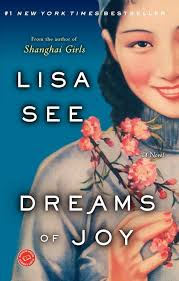
Dreams of Joy by Lisa See

Already reeling from the death of the man she’s known to be her father,  Joy has also just learned some shocking news about her mother, Pearl. These two events challenge Joy’s identity to her core. At the same time, as the 1950’s American government is targeting those suspected of being Communists, some, particularly those on college campuses, feel that Socialism can be the ideal of equality and fairness. Following this ideal,  Joy makes the impulsive decision to leave the comforts of what she’s known as home to embark on a journey to find her true birth father, to seek her Chinese roots, to relinquish her capitalist excesses, and to enter Mao’s People’s Republic of China. What she finds there shocks her even more.

With her usual skillful style, Lisa See has managed to compose yet another beautiful family saga, depicting family relationships at both their worst and their best, while incorporating a significant historical moment that is not frequently highlighted. Her mother, Pearl, on learning that Joy has left for China, follows her daughter there, even if it may put her own safety in jeopardy. She knows that Joy is young, that does not understand the consequences of her actions to the fullest, that she has never experienced the heavy hand of Communist rule. And if she is being honest, finding Joy’s father is of interest to her to, as they have a complicated history as well. The relationships depicted here are tender, beautiful, and authentic.

History plays a large role in this saga as well. China’s “Great Leap Forward” is anything but — but this is the era in which Joy finds herself. Initially, she tries to find the grace in it: the idealism of the communal life, the simplicity of the farm, the romance in the hard work. She also finds meaning in the art she’s able to produce there through which she can express herself, at least within the confines of the dictated rules. As time progresses, however, she sees the rampant deception. She begins to see that even when the rules are failing the people miserably, they are forced to abide the whims of their dictator, even at the cost of their very lives. When Joy becomes responsible for the life of another, this is where she can no longer abide this lie.

There is much darkness depicted here, but it is a frighteningly timely and realistic story. We are now in a moment when so many are following another wannabe fascist – a worshipper of Putin, of Kim Jong Un, of Hitler – and these followers are ignoring the harm he has done and has the potential to continue to do. He has already threatened to imprison his enemies – a classic fascist move. People make excuses for him – but we’ve seen him do this already in his first presidency. It’s an authentic threat. We need to learn both from other countries’ pasts such as that depicted here and our own past. This can happen again and this can happen here. We have the power to stop it with our votes. But this may not be the case for long if he is elected…

I hope you will read this novel. It is a beautiful family saga as well as a harsh warning for the world and for our country in particular.  A MUST READ for this moment!
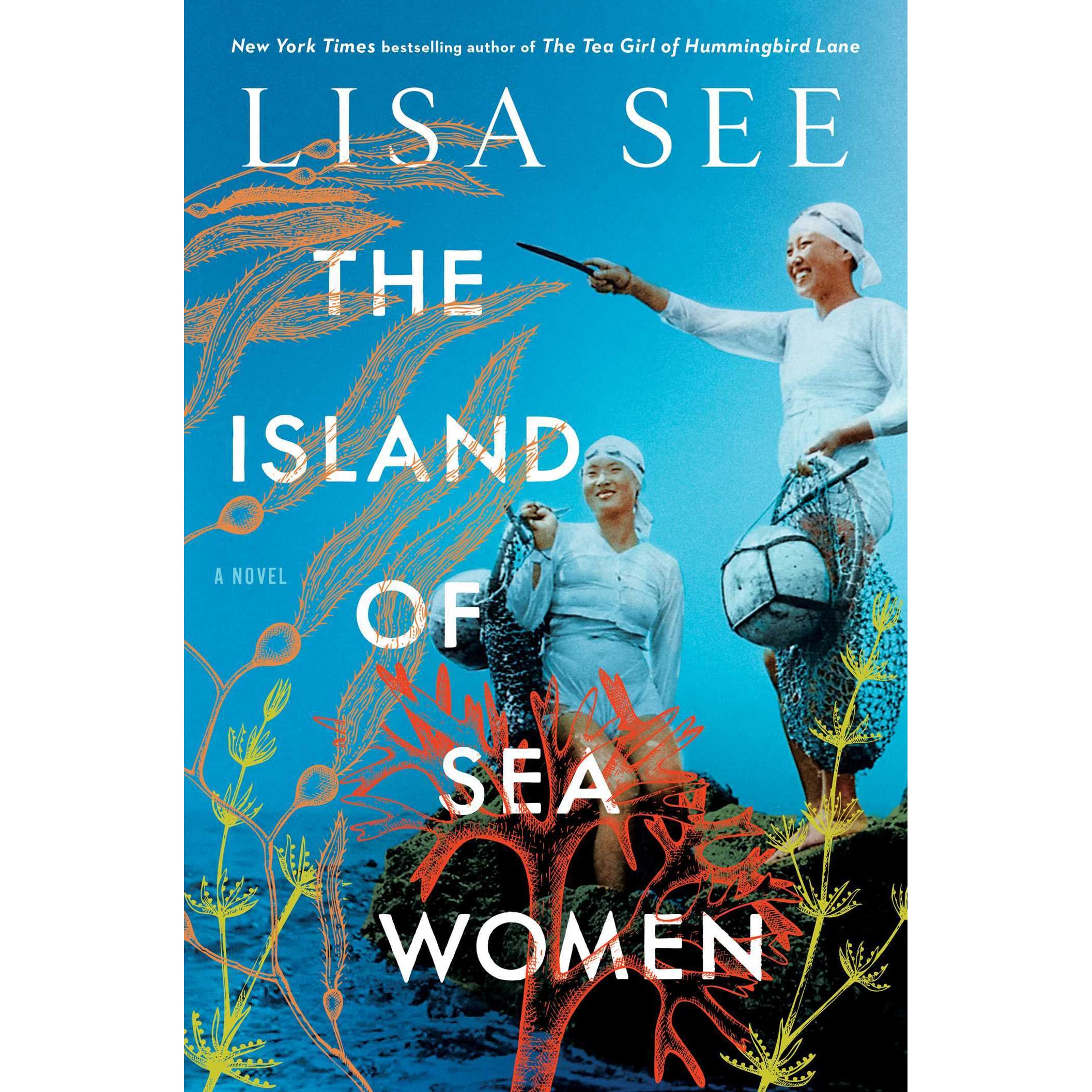


The Island of Sea Women by Lisa See

Young-sook has no time for talking – she has always busied herself with diving and collecting food from the sea on her Korean island of Jeju, and today is no different.  She usually has no patience for the tourists, but this family who is approaching her is different.  This family appears familiar, somehow.  When they begin to question her and mention the name of a woman from her past, they wash her whole personal history back to her in a wave that crashes over everything she ever understood about herself.

Lisa See has a gift for depicting historical fiction and here, again, she paints vivid cultural details into the well-researched,  deeply emotional saga of Young-sook.   By going back through the history of this fictional character, See recounts the history of the island of Jeju, caught in the middle of the two world wars, the Korean War, and the division of the Koreas.  She recounts the impact of the colonialism of the Japanese and then, essentially,  of the Americans on Korea, and the massacres that occurred on the island of Jeju during the power disputes.   This is history about which I personally have been quite ignorant and I am thankful I have learned, painful as it was.

What was beautiful was the passion with which See imbues her characters, which gives the story its energy.  The women of the island are the breadwinners, who dive in the ocean for food – with no oxygen tanks, no equipment, just each other as their safety net.  They are the farmers, who toil the land for the food they grow to support the families as well.  While the women were not normally educated, they supported the family in a practical way, and made the fundamental decisions for the family, such as the matchmaking, and saw themselves as responsible for the survival of the families in every sense of the word.  They also have a fiery passion for each other, as in the love that Young-sook and her friend Mi-ja have for each other- not a lovers’ passion, but a pure and devoted friendship that may even surpass many lovers’ relationships in their depth and trust.

This is a beautiful story in every way – the story itself and the telling of it.  Give yourself this gift!


Snowflower and the Secret Fan by Lisa See (migrated from bookblogger)

I was supposed to love this book!  I was embarrassed that I hadn’t read it yet…

I did not love this book.

This story is about a girl, Lily, raised in China during the 19th century, who is pledged to be the “lautong” of a girl of higher social standing, Snow Flower.  A lautong is a sort of soul sister, to whom a friendship is pledged that transcends any other commitment, including marriage, and is to last their entire lives.  The story takes the reader through the girls’ very difficult lives together, as they experience the excruciating pain of foot-binding, the preparation of their dowries for marriage, and their experience as married women of differing statuses.

What I did not like about this book was that it was unrelentingly depressing.  Just when you think it can’t get any sadder, worse tragedy strikes.  There is a constantly nagging foreboding throughout the book which makes it just onerous to read.   I also felt as though the main character, also the narrator, was not very likeable, which made it more of a chore to read about her plight.

I did appreciate learning about the Chinese customs and traditions that are described in the story.  It was painful to learn about the nightmare of footbinding and how women were only valued based on the men they birthed.  Girls are described as worthless and a burden on their families, when they were the ones to do all the work to maintain the households.  The marital traditions are extremely colorful and interesting, however.

I know this is book is a favorite of many… but not mine.

China Dolls by Lisa See (migrated from bookblogger)

Three Asian girls — Helen, Grace and Ruby — seeking to reinvent themselves, meet as they each are auditioning for a dance club in San Francisco’s Chinatown in 1938.  They instantly develop a friendship, a new experience for each of them.  The story follows them through the second world war, during which the paranoia over the Japanese, as well as each of their own secrets/ghosts, almost tear them apart.

Lisa See creates a heart-wrenching experience for the reader – each character is so lovingly portrayed and it is easy for the reader to be drawn in.  She also creates a real experience of the time in our history, the impact of a cruel war and its resultant prejudices on each of its individual citizens.

I heartily recommend this book – a definite “must read,” especially for those of us obsessed with historical fiction!