Penguin Lessons by Tom Michell

At the tail end of a vacation from the Argentinian boarding school where he is teaching English to high school students, Tom Michell is walking on a beach in Uruguay and has stumbled upon a hideous scene: hundreds of penguins lying dead, washed ashore, having been essentially suffocated by an oil spill. Rather than immediately recoiling and turning away, Michell feels drawn to witnessing further this terrible crime, and further surveys the devastation. As he looks around at all these carcasses, he notices in the corner of his eye a brief movement – just one out of all of these many, many poor birds begins to move and lift its head. After running back to his hotel to grab a bag and other equipment (what does one use to rescue a penguin???), he runs back to the spot where he had seen the surviving bird and mangles him into the bag and somehow gets him back to his hotel. Once the penguin sees that this human is not out to hurt him but is actually trying to help get him cleaned of the residual oil and tar that has clung to his feathers, the penguin suddenly becomes docile and friendly. And so begins an unlikely and beautiful friendship.

This memoir is just utterly delightful. I have not yet seen the movie, which I know was released a few months ago, but the book is pure joy. The story of how Michell brings the penguin, ultimately named Juan Salvado (or Salvador), over the border to Argentina, is both charming and outrageous. His acceptance by everyone around him on campus highlights both the generosity of spirit of those who are at the school and the personality of the bird himself. And what the bird brings to both the children and the adults around him is so beautiful to witness, even vicariously. While the bird requires work to keep him, it is clear that everyone who helps care for him absolutely benefits so much from the honor. And there is so much to learn from this.

There have been a number of stories here in this blog that have highlighted the relationship between people and their pets/animal friends – but this one, I believe, takes it to the next level. The fact that the care of Juan Salvado became such a communal effort was of such deep psychological benefit to both the penguin – who demonstrated joy at every human interaction – but also to those who visited him, fed him, washed him, and cleaned his terrace. Anyone who came to see him literally spoke to him as if he were human, confiding in him, even asking advice. It is not a reach to say that we clearly benefit so much from our fellow creatures, and that we must care for both them and the world they inhabit.

This is a beautiful story throughout. Michell has given us a gift, sharing his experiences with Juan Salvado.

I’m Glad My Mom Died by Jennette McCurdy

This memoir, with its shocking title, was an irresistible read. Jennette McCurdy, a child star on iCarly, a 1990’s Nickelodeon hit, reveals her lived experience growing up with her mom, Debra McCurdy. From her earliest memory, Jennette learned that pleasing her mother would bring approval, peace and possibly even love – so this became her constant obsession. Whenever Jennette had her own thoughts or preferences, she would find that it was easier to suppress those and just go along with whatever her mother’s preferences were, even when it meant her doing the things she hated – including acting!

As shocking as the title is, so, too, are many of the details of Jennette’s life. So as not to give too much away, I will hold back on these, but suffice it to say, her mom was a narcissist, a hoarder, a pathological liar, and an abusive wife and mother. Nevertheless, this story is told with an admirable dose of humor, humility, and compassion, even when resentment and anger would be entirely justified. Jennette pays a heavy mental health toll for her upbringing and I am hopeful that writing this book was cathartic and therapeutic for her. I have to imagine it was.

One of the consequences for her that I will reveal – skip this paragraph if you plan to read it and don’t want to know anything about her before you do – is that she developed an eating disorder. In fact, at age 11, her mother actually instructed her in exactly HOW to have an eating disorder, which is more the point. They co-restricted, rejoiced together in how little they ate, almost competing in how few calories they might consume in a day, and monitored Jennette’s weight together as a mutual obsession. Her weight became a measure of how “good” she was, in every way possible. And this is how she learned to define herself, her weight truly defined her.

If you’ve read any of my other entries in this blog, you’ll know that this is not the usual genre that I read. I do not generally read about TV or pop stars. But this memoir had its own merits, not because of how famous Jennette is but more because of what she endured and what she fought to overcome. She is an admirable young woman and I hope that she continues to fight the good fight. I hope she succeeds in finding who she is underneath it all.

Born a Crime by Trevor Noah

In this tender memoir, Trevor Noah shares his experience growing up during the final edge of apartheid in South Africa. Through vividly narrated vignettes, we learn about his complicated relationship with his mother, who is fiercely devoted to him and yet is independent, stubborn and vulnerable. We learn of his early struggles to find himself, and how he must battle against the vicious cycle of poverty that apartheid has inflicted upon his people.  

It was suggested to me to listen to the audio version of this book – and this was excellent advice.  Hearing Trevor Noah narrate his own story, in his own beautiful, South African accent and fluidly modulating to his family and friends’ voices and accents, is just a gift to yourself. 

Noah is a brilliant storyteller.  He shares his experiences with such warmth and humor, as if he is sitting with you in your living room, over a cup of your favorite hot tea – but as if he’s sharing his deepest, darkest memories, only with you.  He describes in colorful detail some of the most outrageous adventures and unbelievable experiences.  But even as he shares his joy and his pain, it is as if he is flickering a smile at you, as if to say, we can still laugh, even as we hurt.  This is how we cope.

You will be engrossed and amazed — you will gasp and you will laugh out loud.  Don’t just read this one – listen to it!  

It’s a “MUST READ” but more than that, it’s a “MUST LISTEN!”


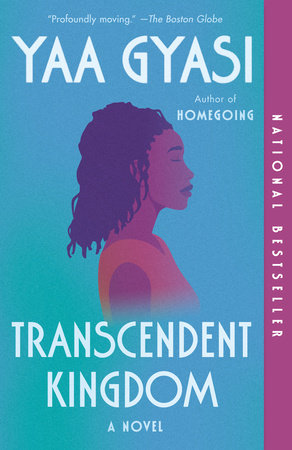
Transcendent Kingdom by Yaa Gyasi

Transcendent Kingdom by Yaa Gyasi: 9781984899767 | PenguinRandomHouse.com:  Books

Gifty is striving to complete her final doctoral thesis in neuroscience on addictive behaviors. She knows she’s obsessing over her data, and that she needs to move on to the writing of the final paper, but her past has come back to haunt her and she is stuck.  It may be that the visit from her mother, drowning in her own pain, will nudge her forward.  Or will it be her sifting through her old journals from her youth?  Somehow, Gifty works through a resolution and confronts the deeply painful religious, emotional and philosophical issues that are holding her back. 

This memoir is a recounting of a second generation immigrant from Ghana who suffers multiple layers of trauma during her childhood,  while seeking and finding little community support in her small town, Southern evangelical church.  Needless to say, her struggle is complicated.

One recurrent theme is the conflict she feels between religion and science.  Having memorized large swaths of scripture for her mother’s approval and having limited experience outside her small, Bible belt town in Alabama until college, she has a deeply ingrained emotional connection to her religion and to a traditional belief in God.  On the other hand, her more cerebral side has rejected much of the dogma the church espouses; whether the narrow views on sexuality, the scorning of evolutionary theory, or the criticism of science in general.  So when a fellow student criticizes those who are religious, she is not quite sure what to feel, but she is simultaneously insulted and embarrassed.  She identifies with those being criticized but also sees why they are being so.   

The other inescapable message here is the devastation that occurs when a family member has an addiction. Not only does the addict suffer, but everyone around him suffers as well.  When Nana, Gifty’s brother disappears, she and her mother spend hours searching for him to try to bring him home to safety.  When he is not functioning, the whole family is not able to function.  And the cycling and unpredictability has devastating effects on everyone for years to come. 

This very real story hits hard and is a hard read.  We are very fortunate that the author has chosen to share her experience with us.  

Waiting to Be Heard: A Memoir by Amanda Knox

Waiting to Be Heard: A Memoir by Amanda Knox

In the fall of 2007, Amanda Knox joined the many college juniors who left their campuses to study abroad, Amanda choosing a small town, Perugia, in Italy for her experience. Because her chosen university did not have a dorm for her to live in, she felt fortunate when she stumbled upon an apartment she would ultimately share with 3 other women. Life with the others began quite peacefully, and she formed a comfortable relationship with each of them. What she never imagined was that one of them would be brutally murdered by a stranger, and that she, Amanda, would be wrongfully accused of being the twisted ringleader of this murder.

I felt compelled to read this story, as I’d felt compelled, years before, to listen to this story every time it came on the news, in each of its permutations. When it first was announced in the media, the story was quite bizarre, filled with seedy details of sex and drugs that sounded questionable even back then. And the more it was discussed, the more bizarre and unlikely it sounded.

Reading the actual story was much more painful, however. It was no longer someone far away – it was now someone I was getting to know and empathize with. I hadn’t remembered so many of the actual details of the story – or probably never was given the true ones — nor learned about her personal life before the murder or during the trials. I also didn’t know how much time she served in prison, before she was finally found to be fully innocent. And I also didn’t how the prosecution obtained their evidence and how willfully they pursued a feeble motive/explanation for the events against the weight of the evidence for the defense. It was truly like watching a car wreck – you can’t look at it and at the same time, you can’t look away.

And honestly, even though I knew the ending, there was still a great degree of suspense. The ups and downs were wildly intense and I felt the ride right along with her. When she was trapped inside those walls of the prison, I felt almost as if I was inside there with her.  It was almost hard to breathe. At the same time, she showed a courage and hopefulness I’m not sure I would have had.

This was a very quick read that I’d definitely recommend!


Inheritance by Dani Shapiro

Dani Shapiro, an author of both fiction and memoirs, has agreed to her husband’s request to both send off their saliva specimens to Ancestry.com – quite on a lark.  Just a curiosity – something she could have just as easily decided not to do.  The results, however, turned her world upside down.  This is her true story of the fallout from that single decision.

Spoiler alert:  If you don’t want to know anything more and you might read this book, please don’t read on.

What Shapiro learns is that her father is actually not her biological father.  The person she felt closest to, proudest of, particularly with regard to her heritage – as he’d come from a line of well-respected, learned, Orthodox rabbis – was actually not related to her biologically.  On the other hand, the mother with whom she had a strained, even fearful relationship, was.  And this rocked her world.

While I cannot fully relate to the situation, I have to admit that I had a hard time completely sympathizing with the author. Yes, this must have been a shock and yes, it must have thrown her.  But when she repeatedly referred to this as a “trauma,” I could not help feeling as if this was melodramatic.  The word, trauma, I believe, has become so over-used that its potency has become diluted.  Her year of worrying about her son with a near-fatal disease – THAT was traumatic, I’m sure.  This discovery about her father, I do not think rises to the level of trauma.  And while I agree, to live in a family with secrets was not ideal, it was certainly not uncommon at that time.  The 1950’s and 1960’s were fraught with a different philosophy about what was appropriate to discuss with children.  To apply today’s standards to what was standard then is unfair.

I also thought that this story might have been told in a much shorter format – such as an article in the New Yorker, for example.  As a full-length memoir, it was somewhat drawn out and sometimes actually dull. I was waiting for something truly extraordinary to happen and it did not.  What did begin to capture my interest was her discussion about the Farris clinic, the infertility clinic in Philadelphia where her mother was inseminated.  The doctor went rogue, was practicing without a license, and inventing new techniques in infertility treatments.  Some were actual advancements and some were truly unethical and this would have been fascinating to explore further.  Unfortunately, there was only limited exploration of this clinic and details were doled out sparingly.  This is where I was hoping the story would lead.

All in all, I was left somewhat disappointed.  I’m curious to hear what others think…!


The Bright Hour by Nina Riggs

bright hour

Wow, this is a book you definitely have to prepare yourself for.   Written by an actual descendent of Ralph Waldo Emerson, this memoir is a beautiful, almost poetic reflection on dying.   Not only does the author contend with the death of her mother from multiple myeloma (a form of cancer), but then she has to face her own impending mortality, as she battles her own aggressive form of metastatic breast cancer.  As we follow her through her musings and her fears, we glimpse into her very heart — sometimes full of self-deprecating humor, sometimes of abject sadness, and sometimes of sheer tranquility.

There is, of course, a lot of sadness here.  You cannot escape that when you’re talking about cancer.  But there is a lot of sweetness and humor as well.  Nina did not have a polyannish view of life at all – on the contrary, she was fairly sarcastic – but she did keep a faith and a hope for her future that was positive while still being realistic.  Her discussions with her 2 boys are honest and yet often comical, maintaining the innocence that young boys deserve.  She includes some details of her pain and suffering without dwelling on these.  She chooses to appreciate the days she has rather than lament those she has not.  This is something I think we can all learn from!

So while your heart will inevitably break from this book, it will also be touched in important ways, if you choose to read this one.