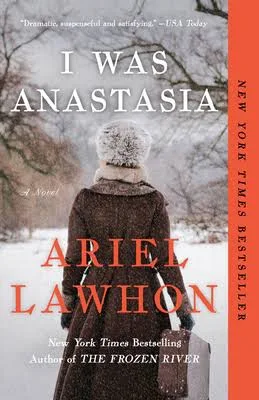
I Was Anastasia by Ariel Lawhorn

It’s been years, decades even, that Anna has been fighting in a German court to establish her identity as the Grand Duchess of the Romonov family. She’s been grateful for the support of her loyal childhood friends, who have shuffled her around from sympathizer to sheltering sympathizer. But she resents that she’s been abandoned by her extended family and her former teacher, who have accused her of being an imposter. Through this dual timeline, we learn both of Anna’s traumatic experience of living through the cruelty of the Russian revolutionaries, as well as her fight to survive the aftermath.

A huge fan of this author, I was somewhat disappointed by this particular novel of hers. I am always game for a dual timeline as well as most historical fiction. I was interested in the history and fate of Tsar Nicholas and the Russian Revolution. However, because this timeline skipped around so much, both in time and location – and never in a linear fashion – it became onerous to keep track of. Moreover, the story was relentlessly heartbreaking, with little in the way of lightness. Of course, it is a brutal story, but even the most brutal history can be relayed with moments of tenderness, some expressions of wit. There was poor little of relief in this telling and, so, a heavy load to carry.

That said, I absolutely learned from it and was, in fact, surprised at the ending. Glad I read it? I’m still not sure. But I certainly feel a bit smarter for having done so.
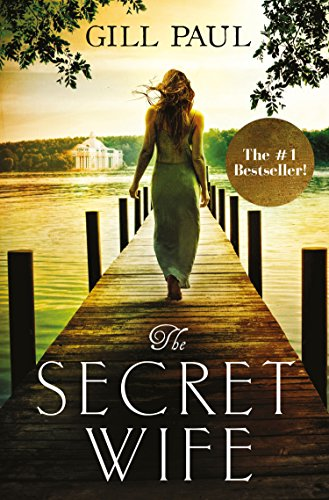
The Secret Wife by Gill Paul

After stumbling upon her husband’s phone, left in full view with evidence of an affair, Kitty finds herself boarding a plane for the States without telling either her husband or her best friend – or anyone, for that matter – where she is headed. She just has to get away to sort out her thoughts and her next steps and fortunately, for her, she’s got a perfect place to do just that. Coincidentally, a few weeks prior, the papers came through confirming her inheritance of a cottage on a lake near Albany, NY, from a great grandfather she has known almost nothing about. As it turns out, while she sorts out her own situation, she also becomes curious to learn about her great grandfather, Dmitri, the prior owner of this cottage. Why has she never heard about him? Why did she not know there was another writer in the family? And from whom is this very expensive Faberge pendant she’s found in the cottage? As she pieces together the mystery of her great grandfather’s past, she finds she also learns quite a bit more about herself.

By pivoting between Kitty’s story and that of Dmitri’s, we learn about what did happen and what could have been. Dmitri’s story begins in 1914 at the start of the Russian revolution when he is first injured and is tended to by one of the Tsar’s daughters, Tatiana. The original historical legend is a horror. This one has its horrific moments as well, for sure, but the author also intermixes it with love, hope and much imagination.

There are a few themes that resonated throughout the narrative and over which I struggled. One was that of loyalty and the other was forgiveness. Kitty is crushed by her husband’s failure of loyalty, and evades and then contemplates a path to forgiveness. Likewise, Dmitri is fiercely loyal to Tatiana, but when he finds another love who lifts his spirits when he believes he is lost, his loyalty to his new family is questioned by others. Some forgive and others cannot – and this impact lasts for generations. What this story highlights to a dramatic degree is that things may not be as they appear to be. While we think we know someone, their circumstances, their history – we may know nothing at all about what is going on inside their heads or their hearts, their truth.The only genuine path to forgiveness is to hear someone out, to give an opportunity for them to voice their truth. To get there, that requires having an open heart to what they have to say – and that may or may not be achievable.

This is why I believe reading is crucial. If we read and take in what we read, we, in turn, open our hearts and minds to other ideas. This is what makes us more human, more compassionate. We understand others’ perspectives, others’ voices. I have a long way to go yet, but this is one of the ways in which I strive to grow and move forward.