My Friends by Fredrik Backman

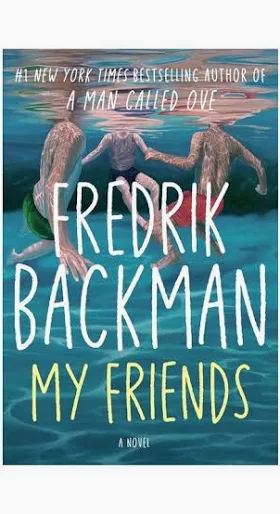
Louisa has a plan. If only her human, Fish, were still around to help her carry this one out, she’d have more confidence, but she knows she’ll have to do this on her own. She just has to stay calm and keep quiet (neither being her strong suit, unfortunately). As she works her way into the church where the auction is being held and finds herself near the painting, she is more overwhelmed by it than she ever could have imagined. It is so much more than the picture on her postcard, so much more alive. And when she finds herself bursting to express herself, she nearly gets herself thrown back into her foster home or worse. But luckily for her, the stranger outside helps her evade being caught and her journey toward change begins.

It is the rare book that has ever moved me quite like this one. In the pages of this novel, Backman encapsulates love and art and youth in words so beautifully, it feels like he is painting with his prose. The juxtaposition of the hardened but naive Louisa with the ornery but kind Ted is the perfect way to present the story of the painting that Louisa has set out to see up close. And it is the telling that is the journey itself.

Each sentence is a masterpiece. On the surface, the words may appear simple, but in the simplicity there is meaning, thoughtfulness, kindness, sensitivity, humanity. Two examples:

“Nothing weighs more than someone else’s belief in you.”

“Art is what we leave of ourselves in other people.”

These are just two, but there are so many more.

And beyond the philosophical there is the emotional. You will feel all the feelings: heartbreak, joy, worry, fear, and anxiety, because you will come to love each and every character in this novel as well. You will find each of the friends become your friends, your humans.

Is this a MUST READ? You bet it is.

Jane Eyre by Charlotte Bronte

Poor little Jane has found herself orphaned, mistreated by her cousins, and unloved by her aunt who is her only surviving adult relative. While she has been educated, fed (just barely), clothed (in castaway clothing), and housed, she has also been the target of their physical and emotional abuse as well as their general disdain since her arrival at their home following her parents’ sudden death. After a particularly traumatic incident, she is sent away to a boarding school, where her life continues to be difficult but where she finds an inner strength that carries her through her continuous search for happiness and love.

Many of you have likely read this classic – I had not. But after finding myself reading so many novels that referenced it, I felt almost an obligation to enhance my apparently deficient education. So here it is – Jane Eyre, read and appreciated. While I did need a dictionary beside me to ensure I didn’t miss any of it – Bronte’s vocabulary far surpasses mine! – I did find it quite beautiful. The heroine herself is strong, blunt, and unapologetically intelligent. While she is diminutive in size, she is enormous in integrity, humility and character. She is industrious enough to give more than take; wise enough to listen more than speak. She is one we can only aspire to be.

And though the story is a bit far fetched, with coincidences beyond what we might expect to happen in the real world, it is still a plot that captures the imagination and keeps the reader wanting to know what could possibly come next. We are with Jane and her exploits, her journey, all the way. And we root for her until the very end.

This is an old tale, yes, but also timeless. If you haven’t read it, it is absolutely worthwhile. If nothing else, to at least bolster your vocabulary!

By Any Other Name by Jodi Picoult

Melina has just been trying to find her voice, mainly through telling stories, composing plays. She has viewed Professor Buford only as a supportive mentor, encouraging her and recommending her to submit her plays to contests, even at the cost of snide looks and remarks from most of her peers. That is, until now, when she suddenly and heartbreakingly sees through his gestures, his attention. But why is it that she must rely on these men around her – mentors, critics, producers – to herald her into the world of theater? When she learns from her father about an ancestor, many generations prior, who was the first female poet to publish in England, she becomes a bit obsessed to research more about her, and finds, to her shock, that she was more than just a minor poet. She finds evidence that her predecessor, Emilia Bassano, may have struggled, just as she is, to be given a platform. It may be that she actually did succeed, however – and it may be that she did so through the name of the most famous poet/playwright of her time.

This is a thoroughly researched, courageous argument that suggests that William Shakespeare had ghostwriters – and that it is quite likely that at least one of them, if not the primary one, was Emilia Bassano. As the plot unfolds through both Emilia’s and Melina’s stories, we hear cogent explanations of how Emilia had more insight, exposure, and concrete, detailed knowledge of the history, characters, and locations of the plays that Shakespeare himself would not have had privy to. (And there was, of course, no internet then for him to access this information…) I will not go into these details, as this is part of the joy of reading this novel, but suffice it to say, I was convinced of the need to question everything I’ve ever understood to be the “works of William Shakespeare.”

Even if you’re not convinced to at least question the origin of the works – and I would find it hard to believe you could not – there is still a beautiful, tragic, and thoughtful story embedded here in this novel. Both Emilia’a and Melina’s characters are passionate and strong and yet vulnerable. We love them, cheer for them, even cry for them. Each story is powerful in its own right; but the idea to cast them as parallels is, in my opinion, pure genius. It highlights the problematic issue that, my god, even when we think things have changed so much after all these decades – centuries! – things have really not changed all that much after all.

I think that, for many reasons, this is a MUST READ. I think as a stand-alone novel, it is outstanding. But for its historical and literary significance, its brave questioning of what we know to be the suppression of women’s voices throughout the ages, it is enlightening and essential.


Dreams of Joy by Lisa See

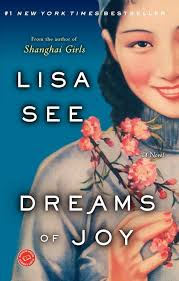
Already reeling from the death of the man she’s known to be her father,  Joy has also just learned some shocking news about her mother, Pearl. These two events challenge Joy’s identity to her core. At the same time, as the 1950’s American government is targeting those suspected of being Communists, some, particularly those on college campuses, feel that Socialism can be the ideal of equality and fairness. Following this ideal,  Joy makes the impulsive decision to leave the comforts of what she’s known as home to embark on a journey to find her true birth father, to seek her Chinese roots, to relinquish her capitalist excesses, and to enter Mao’s People’s Republic of China. What she finds there shocks her even more.

With her usual skillful style, Lisa See has managed to compose yet another beautiful family saga, depicting family relationships at both their worst and their best, while incorporating a significant historical moment that is not frequently highlighted. Her mother, Pearl, on learning that Joy has left for China, follows her daughter there, even if it may put her own safety in jeopardy. She knows that Joy is young, that does not understand the consequences of her actions to the fullest, that she has never experienced the heavy hand of Communist rule. And if she is being honest, finding Joy’s father is of interest to her to, as they have a complicated history as well. The relationships depicted here are tender, beautiful, and authentic.

History plays a large role in this saga as well. China’s “Great Leap Forward” is anything but — but this is the era in which Joy finds herself. Initially, she tries to find the grace in it: the idealism of the communal life, the simplicity of the farm, the romance in the hard work. She also finds meaning in the art she’s able to produce there through which she can express herself, at least within the confines of the dictated rules. As time progresses, however, she sees the rampant deception. She begins to see that even when the rules are failing the people miserably, they are forced to abide the whims of their dictator, even at the cost of their very lives. When Joy becomes responsible for the life of another, this is where she can no longer abide this lie.

There is much darkness depicted here, but it is a frighteningly timely and realistic story. We are now in a moment when so many are following another wannabe fascist – a worshipper of Putin, of Kim Jong Un, of Hitler – and these followers are ignoring the harm he has done and has the potential to continue to do. He has already threatened to imprison his enemies – a classic fascist move. People make excuses for him – but we’ve seen him do this already in his first presidency. It’s an authentic threat. We need to learn both from other countries’ pasts such as that depicted here and our own past. This can happen again and this can happen here. We have the power to stop it with our votes. But this may not be the case for long if he is elected…

I hope you will read this novel. It is a beautiful family saga as well as a harsh warning for the world and for our country in particular.  A MUST READ for this moment!


The Covenant of Water by Abraham Verghese

Mariamma is only 12 when she’s told she is to be married off to an older widow. There is nothing to be done, as this is her fate, just as it was for her own mother and those who came before her, in her home in southern India at the start of the 1900’s. She is, in truth, more worried for her dear mother, who herself has been widowed and is now at the mercy of her father’s brother, who perceives her more as a burden than as family. But Mariamma knows she is loved, knows how to love, and this serves her well. She enters her new home with an open heart and embarks upon a journey that brings her both great joys and deep sorrows.

This is a gorgeous family saga that enriches the reader with a deeper understanding of not only Indian culture, but of a bit of the unrest that ensued after the liberation of India from British rule. We immediately bond to Mariamma and her life becomes part of our own. When the plot shifts to focus on Digby, a young Scottish physician who comes to India on a quest to get practical surgical experience, we find ourselves adopting him as well. The characters and their stories are authentic, vulnerable, and gritty and we can’t help but get swept up in their struggles and their joys.

One of my favorite characters here is Mariamma’s husband, who is referred to as Big Appachen. He is a man of very few words, but his actions speak for themselves. He is generous beyond words – he rewards those who are loyal to him (and sometimes those who are not) with land grants and opportunities – and tries to overlook the traditional caste system that divides the people who work for him. While he does not express what he feels verbally, he shows it in the most important ways – through his protectiveness, his generosity, and his kindness. (I know I could learn from this, being one of many words.)

I loved this book. I believe these characters will live on with me for a very long time.

Give yourself the gift of reading it – you will not be disappointed! For sure, a MUST READ!


The Reluctant Fundamentalist by Mohsin Hamid

In this novel, we meet Changez, as he relates the story of his youth to an American stranger he meets in a public square in Pakistan. We hear about his journey to Princeton and then to New York, his successes and struggles as he moves forward academically, socially and romantically. We also learn about how his experience as a brown man following the attacks on the Twin Towers become pivotal to his relationship with America as a whole.

What is most unique about this book is the voice used to tell the tale. Changez is sitting with the American, whose name we never learn, and we hear his side of the conversation throughout the narrative. It is a wonderful way to convey the story, in that we can envision the two men, dining at a table in the market square, as the light dims with the passage of time.

While this conversation scene is fairly tranquil, the subject matter is not. Changez is subjected to constant “othering” during his stay in the US. Even prior to the World Trade attacks, he is never quite included in social circles, never quite one of the crowd. Even in his romantic relationship, which is more imaginary than real, he is never loved or appreciated for who he is, but rather tokenized and used. One can certainly understand the rage that gradually builds and builds until he finally, much to his own surprise, implodes.

This is an iconic work. It is a quick read, but has so much to teach us packed into its pages.

Persuasion by Jane Austen

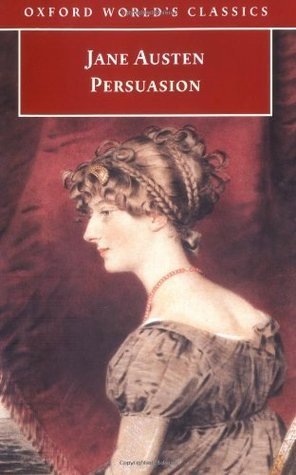
Anne has led a quiet life, since the breakup of her engagement 8 years ago. She has not questioned the wisdom of the advice her dear friend, Lady Russell had given her, knowing that it was only out of the best of intentions that her friend advised her so. But she has wondered just how her Captain Wentworth had been faring since that time. As it happens, she may now find out – because he is returning to them! Now that her father has outspent his fortune and has to rent out his estate to Captain Wentworth’s sister and brother-in-law, she may be seeing him once again. But it won’t be that simple to learn what his thoughts are – and to whom his heart belongs.

Every so often I love going back to the classics – especially ones I’ve never had the opportunity to read. While I found this one a bit confusing in that it was challenging to keep track of the characters and their connections – every male character was named either Charles or William and everyone was a cousin! – I did find it amusing and entertaining. So many of the classics are heart-wrenching and tragic and it is refreshing to know that at the time of Jane Austen – the later 1700’s/early 1800’s – it was permitted, even appreciated, to have a sense of humor!

So while this was not a deeply profound or moving novel, it was certainly a fun change of pace.

I wouldn’t call this a MUST READ but it is definitely on the list of classics to get to at some point…


The Keepers of the House by Shirley Ann Grau

William Howland was one of many William Howlands, the name being passed down over generations of owners of his large plantation in his southern town. And knowing he had a family name to uphold, he navigated his position with care, guiding those in his life using his money and influence quietly and sparingly. But politics in the south were never easy, especially when they were mixed with racial tensions, and William Howland and his family were not immune to this conundrum, no matter what his influence might bear. Just one small slip, just one small move and your whole life can be blown up before you.

This is a Pulitzer Prize-winning novel that blew me away – not in how amazing it was but in the fact that it won a Pulitzer. Yes, it ultimately was moving and yes, it ultimately was powerful. But my goodness it took getting through about 80% of the story to get to anything that was at all moving or powerful. One should not have to work that hard to get to the “good part!” I can understand that an author has to set the story up and build the foundation. But it should not take 80-85% of the story for anything of any significance to happen.

Moreover, the characters felt distant, not anyone we were able to get to know. William Howland seemed to float through life in a fog – so much so that we were kept from knowing him as well. As for his love and partner, Margaret, another main character, we know great detail about her origins but once she enters his life, she suddenly becomes a figure, a shadow – we lose her, sadly. She loses herself, her identity. This is a wasted opportunity, in my opinion, because she is probably the most interesting character in this story. On the other hand, the author opts rather to focus on William’s granddaughter, Abigail, who is shallow, dull and only seems to wake up at the very end of the story.

I will note that ultimately we do get there. It does build into a climax that is powerful and interesting. It just takes WAY too long to get there.

I apparently differ greatly from the Pulitzer judges of 1965. I’d be curious to hear what others think.


Homegoing by Yaa Gyasi

This epic tale begins with the birth of Effia, born during a fire that devastated her father’s crops, a harbinger of the impact that fire would have on generations to come. And as we learn about the generations that follow, we also learn about the history of the warring tribes that inhabit the Gold Coast of Africa as well as the movement of enslaved Black men and women to America and their experience through generations there.

This is another work of genius by Gyasi. Through many endearing characters and colorful and impassioned scenes, we learn about the history of the peoples of current day Ghana as well as how so many came to be enslaved in America. We learn, too, about their experience of continued oppression beyond the years of slavery in the US as well. The stories are so tactile and sharply painted, the reader cannot help but feel a connection to the many characters, as if we are traveling along the family’s lineage ourselves, through each generation.

And Gyasi omits nothing. She includes the dark reality for those who migrated north seeking relief from enslavement only to find continued prejudice and rejection in different forms. She includes the ugly truth about our history of replacing slavery with mass incarceration. She writes about our American reality now and how, in spite of some change and advancement, divides persist.

It’s a beautifully rendered portrait of the not-so-beautiful history of Ghana and the history of our country. Yes, another MUST-READ.


Lila by Marilynne Robinson


Lila (Oprah's Book Club): A Novel - Kindle edition by Robinson, Marilynne.  Literature & Fiction Kindle eBooks @ Amazon.com.

Lila is still trying to reconcile that she is here, now, in Gilead, married to the “old man,” John Ames, the respected preacher of this tiny village, especially given her meandering, even sordid past. If he knew the details, would he have so quickly and without judgement have been willing to baptize her? Would he still love her?  Is she willing to risk telling him her secrets? Lila continues to hold herself close, even as she gradually learns about love and trust from the very gentle and kind John Ames.

This is a beautiful prequel to Gilead, very gently revealing the traumatic story of Lila’s youth. We gain insight into her quiet and independent nature, reading about the tender but precarious relationship she had with her beloved Doll, the woman who snatched her away from her house of origin and who raised her and protected her as a mother lioness would protect her young.  We also are with Lila as she struggles to reconcile the ironies of organized religious precepts with the practical realities of the everyman’s day-to-day life.

Once again, Robinson’s writing is exquisite. She is able to quietly release the painful details of Lila’s life just as one might accidentally drop a pearl every now and then from a fine string. She creates images and characters that are imprinted in Lila’s mind, and so too, are imprinted in ours. We feel her loneliness and we are empathetic when Lila can only feel mean, because we are entirely with her in her lived experience. And the intermixing of philosophy and theology and storytelling is so subtle that we are contemplating it without even being aware.

If you’ve read Gilead, you must read Lila – it will only enhance your understanding of the story and of yourself.