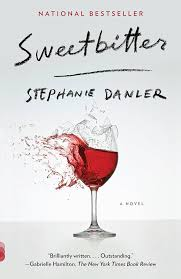
Sweetbitter by Stephanie Danler

Tess is likely more shocked than anyone that she’s just been hired by Howard to work in one of the most historic, upscale restaurants in New York City. She’s only just arrived, a fugitive from her lonely, motherless life, and barely figured out how to get herself to and from work, but she’s landed this new gig and she’s determined to make it. While she will always be considered “New Girl,” she will conquer this job, she will work her way into the complicated cliques of the staff, and she will learn the intricate business of tastes and flavors of both food and drink in which she is now immersed – that is, if it doesn’t do her in first.

This is a quintessential, early 2000’s New York novel. Some scenes are written with such gorgeous and gritty accuracy that you might think you’re watching a film rather than reading words on a page. As Tess is walking through some neighborhoods, we are privy to snapshots, details, that anyone who has ever walked these NY streets can absolutely relate to. And this feels necessary, as Tess herself is adjusting to the newness, the abrasiveness of the streets, and yet she gradually falls in love with it all. She loves the neighborhood bodega, where the owner gives her the medication she needs to get over the flu. She loves the Brooklyn Bridge, that literally helps her bridge her work and her home.

Unfortunately, the novel falls a bit short on plot, as Tess has a fairly linear spiraling course. There is repetition, yes, but there is likely intentionality in that, as that is the life of a server: the overworking, the exhaustion, the horrible hours. But there is also the predictability of the plot that is a bit disappointing. We can pretty much guess how things will go for her and her lust for her enigmatic bartender, and while there is something of a twist at the end, it does not come as a tremendous shock.

Overall, however, I think the writing wins out, making this a worthwhile read. I believe that it also gives us insight into the tremendous effort, study, and physical labor that is performed by those who bring us our meals when we dine out. And for that alone, it should be required reading for anyone considering how to tip.


The Rumor by Elin Hilderbrand

Nantucket is a small island – perhaps too small, as those who live there year round seem to run out of things to talk about and perhaps create stories about others that may or may not even be true. For example, when Madeline gets a bit desperate to break her writer’s block and rents a space for herself in which to write, the neighbors begin to buzz about why she might need a place for herself. Just about everything becomes misconstrued, except for the actual, factual controversial actions taking place…

Grab your sunglasses, towel and sunblock, as you will definitely want to bring this one along with you to the beach this summer! This fun, lighthearted novel with its colorful characters, twisty plot, and sarcastic narrative will warm your heart, make you smile, and distract you from all the insanity that is going on in the “real world.” It is just substantive enough to keep you completely intrigued, but yet light enough to not get too anxious or worried about the characters. And really, don’t we have enough anxiety and worry right about now?

If you’re looking for something to read while on vacation – or just looking to feel like you’re on vacation! – here’s just the novel for you!

Table for Two by Amor Towles

As I’ve mentioned before in this blog, short stories are not my favorite – because I am never satisfied, always wanting more out of the story, more from the characters – but if anyone can pull it off, it is Amor Towles. And Table for Two shows us this is true.

We so quickly warm to each character that Towles creates within these pages – quickly enough to bond, to care, and to engage with the stories, brief as they are. And each vignette becomes a surprisingly fully formed story, leaving us almost as satisfied as we’d be if he’d written an entire novel for each of them. The final story, more a novella, is my favorite. In it, he creates suspense, unexpected twists, and characters with strength and wit whom we come to love almost immediately.

Most striking is the writing, which, as in all his books, is just stunning. Towles’ use of words is both descriptive and spare, witty and dry, almost poetic and yet prose at its best.

Of course this is a MUST READ – I am a die-hard fan.


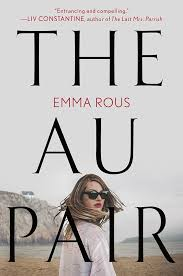
The Au Pair by Emma Rous

There is something niggling at Seraphine as she mourns her father’s recent death. She’s been perusing their family photos and as one in particular catches her eye – one with her mother and only one newborn when she’s a twin – it has made her question her identity, whether she is really who she thinks she is. As she digs a bit into her family’s murky past, she finds there is more uncertainty and confusion than she ever could have imagined.

It’s a bit hard to describe this novel – I sort of liked it until I didn’t…

There is a lot of trust necessary for the reading of this book. While we are told that Seraphine has been teased most of her life that she doesn’t belong, that she’s not really part of her family – we are not really clear why just this one photo suddenly triggers her sudden exploration of her past. But we go with it, we trust the author. We are not really told much in the way of detail about Seraphine’s life, what she does for a living even, and how she has the free time to do the stalking she does to investigate the details of her past. Again, we go with it. And her findings are just too clean, just too easy, in my mind. But ok, again, we go with it.

If we go with it, as we do, there is an actual build up of suspense. We do want to find out what is going on with her past. We get a double story, from her and then from the au pair who was witness to the events leading up to the birth of the twins and to what really happened with Seraphine’s mother, which is an essential element to the mystery. This creates a nice back and forth, a crescendo to the narration. We are waiting and want to know. We’re with the author on this one.

But in the final moments is where the author really loses our trust completely. The explanation, the pinnacle to the story, is so outrageously implausible, that it is just an outright disappointment. And even here, many of the details are obscured and lost to us.

So while there is some suspense, it is, on the whole, so deeply unsatisfying, I cannot in good conscience, recommend this book. Sorry!

The Patron Saint of Liars by Ann Patchett

Finding herself married to a man she doesn’t love and pregnant with his child, Rose does the only thing she truly does love to do: she drives. She abandons her life – and her mother, whom she does love deeply – and drives herself across the country to a home for unwed mothers with the plan to give up her baby as soon as it is born. It is not at all in her plan to grow attached to anyone there, not to the kind, elderly sister who works with her in the kitchen, not to her naive roommate, and certainly not to the older, giant of a groundskeeper who barely says a word to anyone. And it is definitely not her plan to stay. But things don’t always happen as we plan them…

This is Ann Patchett’s first novel, and it is just as understated and pensive as her later books. Her characters, central to her story and artfully developed, are also mysterious and opaque, perhaps even to themselves. Everyone around Rose yearns to connect with her, to get to know her, her story. She is beautiful, quiet, hardworking and devoted to the few things she loves, but she keeps her secrets close. At the same time, Rose struggles with trying to know herself, and cannot forgive herself for her past.

What I also love about Patchett’s stories is that they end with some finality but also with some parts left to the reader’s imagination. And this in just the right proportion. I think this is a hard line to walk for authors, and Patchett has found that perfect balance, in my opinion.

This is an excellent story, with deeply moving characters that you will not forget for a time. Enjoy it!


The Guy Not Taken by Jennifer Weiner

In this collection of short stories by Jennifer Weiner we meet an assortment of characters struggling with both usual and unusual circumstances. We meet a new mother battling fatigue and bewilderment, trying to find her way through midnight feedings, sleeplessness, and wondering “what if I’d taken the alternative path?” We meet another mother finding her way to a support group and making an unlikely connection with a younger mother who surprises her with her pure and natural maternal instincts. And we meet another woman, older, alone, who is overtaken by two sisters who kidnap her inside her own home. Each of these characters and their plight reveals a slice of someone’s experience, a moment of a lived experience that we can peek in on and gain just a bit more insight, a bit more empathy.

In these various stories, Weiner manages to create, in so brief a time, characters that are as deep and authentic as you might find in a full-length novel. She creates stories that bring you in and leave you wanting more. Which is exactly my difficulty – perhaps my own impatience – with short stories. I just want more! Sure, short stories serve a purpose. They create vignettes that set a stage, make a point, relate an adage, perhaps, or even communicate an experience. But for me, I just find them frustrating. I am hooked, I am engaged, I am all in – and then, POOF! – it’s done! Just not fair.

On the other hand, if anyone can pull it off, it is Weiner. And these are quite well done. They are entertaining, engaging, and, well, leave you wanting more. Which is, I guess, the point?


Normal People by Sally Rooney

Marianne has always known that she is different from the other kids at school. She is used to being by herself, reading books alone through her lunch periods, and being somewhat anonymous. So when Connell, of all people, begins to show her attention, albeit in private, she is quite shocked. Of course they have known each other forever, as his mother has worked for years as a cleaner for her family, but they’ve never spoken before now. But the attention he now shows her and the relationship that has now developed, even though they do not acknowledge it in public, will come to change both of their lives forever.

I feel as if this is another example of a good idea that is just poorly executed. Marianne and Connell form a connection but it is not clear how deep that connection actually goes. Connell, begins as a typical, awkward, adolescent male, living mostly in his own head and for the purpose of creating an outwardly “cool” persona. On the other hand, Marianne starts out as a fairly mature adolescent with much self-awareness and respect for the social stratification in her school, keeping herself virtually outside it. But as they come together, we see how Marianne is forever being used and considers herself unworthy of being treated better than someone who should just be used. Connell is not ever brave enough to fully change this.

Why do I think it is poorly executed? While some frustration in the reader can create tension and can be a fine literary tool, I felt that the entire story here was frustrating, and that is not ok. We never fully get Marianne’s story, her family’s history, the full picture. We get glimpses of what she has endured, through scenes with her older brother, but we never really know what has occurred. We never really know why Marianne and Connell keep missing each other’s signals, why they can never fully communicate. And although we understand Marianne’s compulsion to be mistreated, that she feels she does not deserve to be treated better, we never know why it is Connell who gets psychological treatment and Marianne who does not. I felt stranded with more questions than answers by the end – and that was much more frustrating than satisfying. And, as you may know if you’ve read any of my prior entries, while I do not like everything in a story wrapped up with a perfectly tied bow, I also don’t think that the polar opposite needs to be the case.

In a word, I wouldn’t bother…


Pineapple Street by Jenny Jackson

Sasha, much to her dismay, has left her clean, shiny, new apartment to move into her husband’s family’s 3-story brownstone in the historic “fruit” section of Brooklyn. Mind you, she appreciates the generosity of her husband’s extraordinarily wealthy parents for letting them move in there, but when she was told to make it her own, there were a bit too many caveats. She could not change the dark, long curtains that hung in the huge windows, because, well, they’d been made especially for those huge windows and what would you possibly find to fit those? And you couldn’t think about replacing the shabby old couch, even though it had given her a rash when she’d sat on it – because, well, you know it came directly from the governor’s mansion. Nor could her sister-in-law’s entire bedroom be cleared of the junk in there, because, well, she had no idea why. It drove Sasha completely mad. In fact, the way the family clung to their traditions, and to each other, if she were entirely honest with herself, sort of drove her a bit mad. But she did love her husband, Cord. And wasn’t it worth it just to be with him? Or was it?

Apparently, this is this author’s first novel, and I have to say, I can’t wait for her next! I enjoyed this novel from the very first page until the end of the acknowledgements. Her writing is crisp, clever, witty and had me giggling along as often as I was empathizing with her utterly delightful characters. We hear the story not only from Sasha, an artist from a middle class upbringing from a suburb of Providence, RI (center of the universe!), but from her sisters-in-law, Darley and Georgiana, who are the ultimate in NY upper crust, and so privileged they are completely oblivious to how privileged they are; that is, until it hits them smack in their clear-skinned, tanned and tennis-playing faces.

I also hold a special place in my heart for the Rhode Island humor hidden deep in these pages. References to the quahog and its appropriate pronunciation, the use of the word “bubbler” (anyone know what that is???), and teaching their kid to speak Rhode Island – I was sold way before that, but that clinched the deal. It was pure poetry to my Rhode Island-born ears. While you might not guess I am from there from my accent, I still carry a very treasured place in my heart for that tiny state that is not, in fact, an island.

This novel addresses class difference and social justice with a sense of humor, a light touch, and a kindness that might be a bit generous, but it is also done in a way that is digestible. I for one loved it and, as I said, cannot wait to see what is next from this very promising author. Because of the pure fun I had reading this one, I’m giving it a MUST READ!


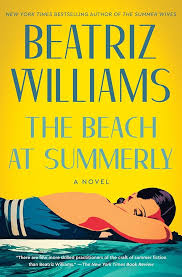
The Beach at Summerly

Emilia, whom most on Winthrop Island know as Cricket, has had something of an idyllic upbringing. Although her family works for the Peabody family, who only grace the island during the summer, she has always seen no difference between herself and the Peabody boys with whom she and her siblings were constant companions from Memorial until Labor Day. But things appear changed for all of them now that each family has lost a son in the second world war, and the sons who have returned have done so having seen what the world could impose. When the Peabodys’ aunt shows up with her children and an offer of a job for Cricket, this opens up possibilities – and danger – for Cricket and for her family.

Once again, Beatriz Williams has written a wonderfully crafted novel with all the ingredients of a MUST READ. We love Cricket, because she is smart, loving, and trying her best to do what is right. Nevertheless, she is of course caught up in a tangle of historical fictional intrigue and there are more than a few sections that even I, who tries to really read every word of a book, found myself glossing over some to try to find out what happens, because I NEEDED to know!

In this novel, we also see how the “bad guys” are not always necessarily “bad,” but just victims of their own ideals. It can be quite easy to be swayed by ideas that feel right or pure. There was a time, for example, particularly after the market crash of the 1930’s when Marxism and communism may have appeared to be a sound alternative to economically vulnerable capitalism. An “equal” society might have seemed to be a fairer way to live when there was such a stark difference between the rich and the poor. It might even appeal today. Nevertheless, the countries who reign under these Marxist/communist theories obfuscated what was really going on in order to maintain these regimes – which was that any opposition of opinion or thought was being rooted out and violently suppressed. It was going on then, during and just after WWII, when Russia was considered an ally, and it is absolutely going on now.

This is both a well-researched, valuable historical perspective and an un-put-down-able work of fiction. The best combination, in my book!

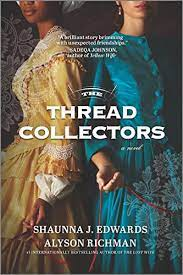
The Thread Collectors by Shaunna J Edwards and Alyson Richman

When Stella and William say a passionate farewell at the beginning of this story, they have no idea if they will ever reunite. William is an enslaved Black man in the South, escaping his master at the outset of the Civil War, and Stella is an equally indentured Black woman who technically is free but is “kept” by a White man for his “pleasure.” All William has is his flute and his magically musical ear, but this wins him a place by the side of his newfound friend, Jacob. Likewise, Jacob, a Jewish New Yorker, who has signed up on the side of the Union, with the dream of fighting to end slavery, has also bid goodbye to his true love, Lily. He also has no idea if he’ll be able to return to her, fearing the worst as he moves closer and closer to the front. All he can hope for is that her continued correspondence and her love for him will help him through his arduous fight.

This narrative was apparently based on true characters in the history of the two authors’ families. Each of them is writing about the marginalization and, particularly in the case of the Black men who fought for the Union, dehumanization, experienced by these soldiers. And how relevant is this story now? With the rise of antisemitism and racism that is rampant in this country – and worldwide – it is both tragically and unsurprisingly, unchanged. Both Jacob and William experience the feeling of being treated as less-than, socially, financially (William is paid less than his White counterparts in spite of doing their scut work), and in terms of supplies, food and healthcare. Moreover, I feel that many of us can, sadly, relate to the schism in Jacob’s family, as he finds that his brother sides with the South and defends the vile institution of slavery, while Jacob and Lily fight for abolition.

As a novel in itself, however, I feel it is just ok. While it tells an important story, and there are some gritty and heart-rending scenes, it is mostly on the predictable side and just a bit corny. A few coincidences are just too perfect and a few situations turn out just too well to believe.

On the whole, however, it is a worthy read and one can learn quite a bit about this slice of history, from a more insider, less glamorized perspective.