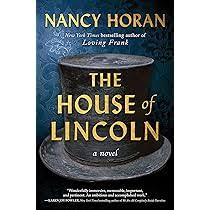
The House of Lincoln by Nancy Horan

1851 in Springfield, IL could be a terrifying time, depending on the color of your skin, your heritage, and your politics. While Illinois was a northern state, there was the constant threat of slave hunters prowling around, searching for the bounty they would earn for themselves if they tracked down runaways. In fact, having arrived into this country as a Portuguese refugee herself, Ana finds herself with her friend Cal, witnessing a frightening scene that she must keep to herself in order to protect those she has come to love and respect. This comes to help form her views as she moves forward through her life, becomes a nanny and cleaner for the Lincoln family and follows the rise and tragic fall of the most impactful presidents our nation has ever seen.

Told through the eyes of this young woman, we glimpse into the home of the Lincolns, seeing their experience of both personal and national tragedies. We view the life of Mary Todd Lincoln, who experienced loss after loss, and, understandably, struggled with her mental health because of it. Yet she still fought so hard to encourage her absent-minded but brilliant and kind husband to fight for what he felt was the best for the Black slave – emancipation. Through Ana, we see how he agonized, how he sought the argument, the magical words that would not only convince his enemies to join him, but how to bring the fractured country back together. Through Ana, we also view the backlash, so quick to happen, so easily sprung back. Even in the hometown of Abraham Lincoln, where he was beloved, or so one would think, there was an evil backlash of hatred.

Not only is this an important part of our history, providing details that one might not know, but it is frighteningly relevant to what is happening today. While we might have made some progress toward freedoms, there is much in the way of backsliding and backlash happening now as well. Not only from people in the streets, but it is being supported and legitimized by our Conservative legislators and the courts. The civil rights of marginalized people are being chipped away and the highest court in our land is jubilantly cementing this in. I fear it will take years to undo the damage they are doing now.

We are growing less and less the “land of the free and the home of the brave” our founders sought for us. Shame on those who are perpetrating this backlash (and the current conservative members of the Supreme Court). This is why it is so important to know what has happened in our past. So that we can do our best to prevent the extreme backsliding to this segregation, this hatred, this fear of the “other” for our future.

 

James by Percival Everett

In this retelling of the story of Mark Twain’s Huck Finn, Jim, or James, as he prefers to call himself, is a literate, enslaved man who has been sneaking into the library of his owner to educate himself and to find material to use to educate other enslaved folks around him. Upon learning he will likely be sold and separated from his family, he decides to run away, and Huck, fearing his own demons, follows him. Their journey takes them through crazy and dangerous escapades. Nevertheless, through it all, James believes there is nothing that can frighten him or debase him more than what he’s already experienced: being owned by another human being.

This is an odyssey, a whirlwind of an adventure – absurd and terrifying in equal parts. We learn about both James’ and Huck’s pasts as the story unfolds, and how their pasts have intertwined. More importantly, we learn so much about James’s character, which is deeply complex. He has an abiding love for his family, even as he develops a growing awareness of his fury toward his oppressors. We both love him and fear him, as his compassion for others in need can be compelling even while his rage can be blinding.

It is also a uniquely powerful story from the perspective of this educated, enslaved man. It is striking how everyone in the story, whether Black or White, reacts to James when he speaks in his normal manner vs his affected, “slave” manner. Everyone, including his peers, expects him to use incorrect wording, grammar, etc. Even when a White man is being threatened by James, with a gun pointed directly at him, all he can focus on is how James is speaking – it is such a shock to him. It is symbolic of how a command of words can signify education, influence, even power.

It’s a wild, frightening, and enlightening journey that we take with James. I daresay, a bit different from the “Jim” Twain had in mind…


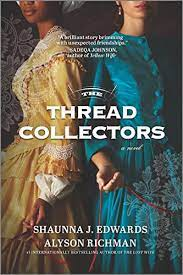
The Thread Collectors by Shaunna J Edwards and Alyson Richman

When Stella and William say a passionate farewell at the beginning of this story, they have no idea if they will ever reunite. William is an enslaved Black man in the South, escaping his master at the outset of the Civil War, and Stella is an equally indentured Black woman who technically is free but is “kept” by a White man for his “pleasure.” All William has is his flute and his magically musical ear, but this wins him a place by the side of his newfound friend, Jacob. Likewise, Jacob, a Jewish New Yorker, who has signed up on the side of the Union, with the dream of fighting to end slavery, has also bid goodbye to his true love, Lily. He also has no idea if he’ll be able to return to her, fearing the worst as he moves closer and closer to the front. All he can hope for is that her continued correspondence and her love for him will help him through his arduous fight.

This narrative was apparently based on true characters in the history of the two authors’ families. Each of them is writing about the marginalization and, particularly in the case of the Black men who fought for the Union, dehumanization, experienced by these soldiers. And how relevant is this story now? With the rise of antisemitism and racism that is rampant in this country – and worldwide – it is both tragically and unsurprisingly, unchanged. Both Jacob and William experience the feeling of being treated as less-than, socially, financially (William is paid less than his White counterparts in spite of doing their scut work), and in terms of supplies, food and healthcare. Moreover, I feel that many of us can, sadly, relate to the schism in Jacob’s family, as he finds that his brother sides with the South and defends the vile institution of slavery, while Jacob and Lily fight for abolition.

As a novel in itself, however, I feel it is just ok. While it tells an important story, and there are some gritty and heart-rending scenes, it is mostly on the predictable side and just a bit corny. A few coincidences are just too perfect and a few situations turn out just too well to believe.

On the whole, however, it is a worthy read and one can learn quite a bit about this slice of history, from a more insider, less glamorized perspective.