The House Party by Rita Cameron

Aah, the year is finally winding down for the students at New Falls High School and they are ready to party.  Will and his older brother Trip are definitely on board, but when they arrive with the beer, they are a bit surprised to find that this one is taking place at the fancy new house being built on the river. Well, Will deserves to party just like the rest of them, doesn’t he? He’s worked so hard to get to where he is – a senior, with a well-deserved acceptance to Princeton and a scholarship from the town’s board. Little does he know how out of control this particular party would get – and how it would impact the course of his life, his family’s, and the lives of the couple building this new home.

This novel, set in a small suburb of Philadelphia just prior to the economic crash of 2008, is a well-crafted indictment of the “lawnmower parent,” the parent who smooths the way for their child at all cost. (Usually wealthy and/or privileged, these parents don’t allow their children to suffer any consequences of their actions; hence these children do not learn that they are to be held accountable for what they do.) We hear the story from the perspective of the teenagers – who are mostly of age (18 or older) – but we also hear it from the perspective of the homeowners who are building their dream house – which, of course, gets demolished. We feel for the children who, yes, have made a mistake and their futures are at risk. But we also understand that they need to be held accountable and restitution made for the damage they’ve created.

We also feel for those who are more vulnerable, those with less means. Even in a town that prides itself on the peaceful blending of the working class and the “newer money” families at the high school, there is a clear division between who the DA’s office deems disposable and who is protected, who can be targeted and whose reputation must be preserved. Meanwhile, we see how quickly this status can change, with the onset of the troubles of the couple who are building the home. No one is immune to this possibility.

This is such an engaging read with a social commentary so important, I believe, that I would consider this a MUST READ. I’d be curious to hear what others think!

 

Memoirs of an Imaginary Friend by Matthew Dicks

Memoirs of an Imaginary Friend: A Novel: Dicks, Matthew: 9781250031853:  Amazon.com: Books

Budo is Max’s imaginary friend, and therefore is visible only to Max and to other imaginary friends. He is able to slide through doorways and windows, appear almost real, and run quite fast, but only because Max has imagined him so. He has been alive longer than many of his fellow imaginary friends and he is quite proud of this fact – although it gives him some anxiety because he is aware that his time in existence may be limited. In fact, he’s watched others disappear. On the other hand, he knows that Max needs him more than many other kids need their imaginary friends, because Max, as Budo describes him, lives more on the inside than on the outside. As Budo narrates Max’s story, we see how truly dependent on Budo Max is – and yet how eventually, Budo empowers Max to save himself.

What begins with the feel of a children’s book actually builds into quite an insightful and even suspenseful novel. Telling the story from the perspective of the imaginary friend gives the story an air of innocence, lulling the reader into a false sense that all will remain benign. This provides that much more of a jolt when Max, who is clearly caught unaware, does get entrapped in a very precarious situation.

This is also a subtle and powerful way to communicate the experience of a child who likely carries the diagnosis of autistic spectrum disorder, formerly known as Asperger’s. Budo speaks for Max as he describes what he likes and doesn’t like, how he has an easier time with routine, how he cannot tolerate too much stimuli, and that he prefers not to be touched. He describes that he prefers to be alone or with Budo, and that he’s ok with being alone, even if his parents are worried by this. Budo also describes the frequent discomfort of others around Max. He highlights the few, and one teacher in particular, who really make an effort to get to know who Max is. He loves this teacher because she focuses on Max’s strengths rather than his shortcomings, how he is special, rather than how he is different.

This is a beautiful story, with very unique narration, and with a surprising crescendo. Something quite different, for sure!

Untamed by Glennon Doyle

Untamed: Glennon Doyle, Glennon Doyle Melton: 9781984801258: Amazon.com:  Books

Just as a cheetah in a zoo is caged and trained to repeatedly chase after what she perceives as prey, so too are women caged in by society’s expectations and rules. We live and breathe in the norms around us — the standard of the thin, beautiful, smart, soft, modest, quiet, unassuming, and all-giving idea of the perfect woman — and cannot avoid striving for this, even when we are not even aware that we are doing so. This is what Glennon Doyle becomes aware of as she watches this caged cheetah pace back and forth and sees that she is not much different from this animal. It’s just a bit more complicated for her to work her way out of her cage, as it involves more than just her own life – it involves the lives of her husband and children as well.

In this memoir, Doyle reflects, through tiny moments and vignettes, about her metamorphosis as she moves from inside the cage to outside. She reflects back through her journey through recovery from bulimia and substance use, disentangling from a dishonest marriage, and tiptoeing through tightrope-like moments of parenting. Unlike many of us who struggle with similar issues, she also had to do this while living as a public figure, so had to also contend with answering to the public about this deeply personal process. What she learns, however, is to use her anger and her pain for good. She learns that rather than trying to escape these feelings, sinking into them actually can make her stronger.and push her into constructive action.

This is a powerful book that has many lines of wisdom contained within. Here are 2 of my favorite lines:

“If you are uncomfortable – in deep pain, angry, yearning, confused — you don’t have a problem, you have a life… You will never change the fact that being human is hard, so you must change your idea that it was ever supposed to be easy.”

and

“Maybe Eve [from the bible] was never meant to be our warning. Maybe she was meant to be our model. Own your wanting. Eat the apple. Let it burn.”

This is an enriching read for both women and men. It will open your mind and your heart and force you to look both inward and outward.

Another MUST READ! (This list is growing so long!)

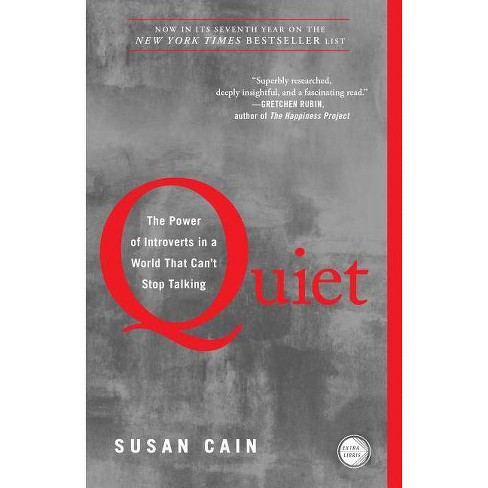
Quiet: The Power of Introverts in a World that Can’t Stop Talking by Susan Cain

Image result for image of quiet by susn cain

Do you ever crave an escape from the noisy world we live in? Do you thrive in quieter settings, when you’re either alone with a good book or just engrossed in deep conversation with one friend? Have you worried there was something wrong with you when you panicked at the thought of having to speak up in a group of co-workers or a study group? If you have, you may actually be an introvert – and that is not a bad thing! While our society seems to prize the extrovert, the one who is the outspoken, confident leader — think Homecoming Queen, for example — it may be the introvert who really is behind so many of our major advancements (think Steve Wozniak, co-founder of Apple). It is the introvert who may allow for the quiet time during which thoughts can generate and percolate, and who may seek deeper conversation that brings people close. To be clear, it is not that introverts do not seek to be with others, but their connections are generally in smaller groups, on their terms, and more intimate. Nor is there a judgement that being introverted vs extroverted is better or worse – this is just a variation in personality style and a way of relating that can be every bit as effective. This book helps to identify and elevate those who are introverts to allow for all of us to prize introverts for their unique value just as we do extroverts for theirs.

An important impact of how society values extroversion is on our educational system. More and more, classrooms are being set up to promote group activity, with desks moved into circles rather than in the classic rows. This is great for those who function well in groups, the extroverts, but those who learn better with time to themselves, this may be more challenging. It is up to the teachers to appreciate and value both personality types and learning styles and to accommodate both.

I wish I had had the opportunity to read this book years ago. I learned so much about both myself and members of my own family through the pages of this book. I now understand why after caring for patients and interacting with my colleagues all day at work, all I am usually able to do by the end of the day is to get into bed and read. I realize that while I feel privileged to have the interactions I have both with my patients and my colleagues and I do feel passionate about what I do and enjoy it, it does take all of my energy to maintain the level of human interaction that it requires. At the end of the day, I need to refuel. Apparently, I am a true introvert.

This is an important book for so many of us to read. It gives us a much deeper understanding of our family, our colleagues, and our friends and enables us to value each of them for their unique styles of interaction. It may also give us a deeper understanding of ourselves. It certainly did this for me.

I recommend this as a MUST READ!


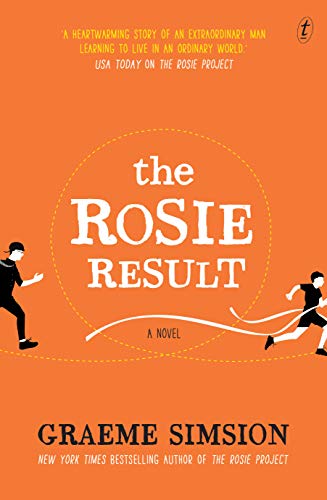
The Rosie Result by Graeme Simsion

This is the third in this delightful series about the exploits of Don Tillman, who has found the love of his life – Rosie – married her, and is now raising their “result,” Hudson.  As Rosie has now been offered a position in their native Australia, they have uprooted 11-year-old Hudson and are trying to help him adjust to the transition.  Because Hudson is definitely a creature of habit, he is not very happy with the change and he is letting Don and Rosie know it.  And so are his teachers.  And the school principal.  As a professional crisis for Don leads him to change his work schedule and focus, he opts to spend more time with Hudson to support him with the adjustment.  This process leads both Don and Hudson down a road to self-discovery that is truly life-changing for both of them.

I love the writing for its voice.  The author creates the most endearing character in Don, even as Don verbalizes little directly of his own emotions.  Don’s utter honesty and kindness are reflected in the things he says and does for those around him and the reactions he elicits are often surprise and wonder., even as people see him as different.  He struggles to fit in with those who are “neurotypical” (not autistic) and wants his son to fit in as well in order to avoid the difficulties Don has had to contend with. In this and many other ways, he demonstrates that he deeply feels compassion and empathy, even if he misses other more subtle social cues.

Clearly, the author,  with the assistance of his wife (a psychologist), has made a statement here in this novel in support of those in the autism community.  Apparently there are differing opinions on how to approach children with autism –whether to teach them skills to integrate more into the neurotypical community or to allow them to be as they are (and obviously to reach out to the general public and educate us more on acceptance, which should be happening anyway).  I imagine this must be a painfully difficult decision for some parents, who want to spare a child’s suffering (these children are often bullied because they are different) but also allow a child to see that they are loved for who they are, no matter what.  I believe this book gives a lot of insight into both the challenges and the capabilities of those with autism and one turns the final pages feeling strongly allied with this community.

I also love the not-so-subtle shout out in support of vaccinations.  There is a very strong statement countering the absolutely unsubstantiated idea that vaccines cause autism.  This idea was started by an unethical researcher in England years ago who was later found to have fudged his data in order to be published.  But the damage was done.  He’s created a community of people who believe in conspiracy theories about vaccines that are just untrue.  Vaccines save lives.  Period.

I love all of the Rosie books – and this one is another great one!  Definitely read it!

This Is How it Always Is by Laurie Frankel

this is how it always is

This is the poignant story of a loving family: parents, Rosie and Penn, and their 5 boys; that is, they believed they had 5 boys until the youngest, Claude, declared that he wanted to bring a purse to kindergarten instead of a lunchbox. Gradually, it became clearer that Claude was much happier in dresses than pants and identified more with the princess in his father’s bedtime fairytale than the prince.  While his parents and brothers were accepting of this, they were fearful that people around him were not, and they went to great lengths to protect Claude, who eventually called herself Poppy.  As the story unfolds, we learn that while intentions may be pure, our actions may not be in others’ best interests and over-protection can lead to inadvertent harm.

This is a fictional story, but it has all the markings of a story that is true.   Every character is endowed with a dynamic, vulnerable, and big-hearted quirkiness that makes all of them larger than life.  We come to love each member of this family almost as our own.  The story is enriched with some detail of how Claude/Poppy’s experience affects the other members of the family – as it certainly would – and their own struggles with growing and seeking their own identities.  And most genuinely, Poppy’s struggle is not straightforward – she is not sure what her journey will be like or where it will end.  This is the true meaning of a non-binary identity.  One does not have to be male or female.  While this may be hard for  many to comprehend, it is even harder for others to squeeze themselves into one or the other, and I believe because of that, we all just have to get over ourselves and accept the vast space in-between.

I loved this novel, both for the message within and for the beauty of the story on its own merit.  It is a story of a family dealing with a secret that they learn doesn’t have to be a secret.  It is a story of a family learning to cope with difference, which most families have to deal with on some level, as no one is exactly like anyone else anyway.  And it is a story about love and family bonds that keep a family tied together no matter what.


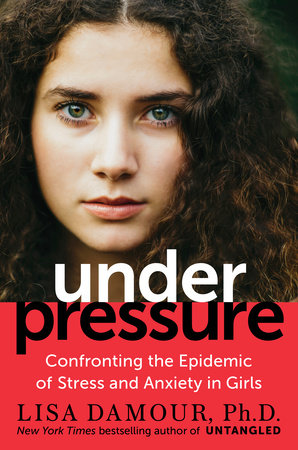
Under Pressure: Confronting the Epidemic of Stress and Anxiety in Girls by Lisa Damour, PhD

under pressure

Working exclusively with young women over the past 15 years, I have seen a frightening trend of increased anxiety among them.  There are many explanations of why this is so, but there are few answers as to how to help them cope.  In this concise, articulate, and surprisingly upbeat book, Lisa Damour guides primarily parents in how to gently and supportively help their daughters to confront the sources of their stress and anxiety and in doing so, to combat them.  As she points out, quite aptly, when one shies away from the cause of the anxiety, most often that anxiety only builds.  Significantly, too, Damour does not demonize stress and anxiety.  She points out that without stress, we might not push ourselves to do our best to achieve our goals; likewise, without the anxiety response, we might not be alert to dangerous situations.  Stress and anxiety are only bad when they reach such high levels as to interfere with our normal functioning – that is when we need intervention.

The writing is insightful, readable, and filled with vignettes that engage the reader.  Damour relates experiences with her clients as well as her own daughters, which make the issues she discusses come alive and tangible.  She divides the issues into those that relate to girls in the home, girls in relationships with other girls, girls in relationships with boys, girls at school and girls as they are portrayed in our culture – and each of the stressors that are inherent to each of these realms.  There are helpful tips along the way, lots of analogies, and very wise, concrete suggestions.

One takeaway I loved was her response when a young woman wasn’t sure how to respond to a conflict.  Our culture conditions women to be agreeable and girls are expected to be and generally are particularly sensitive to others’ feelings.  She summarized peoples’ responses to conflict as being either a bulldozer, a doormat, a doormat with spikes (passive aggressive responder), or (the desirable response) a pillar (stands up for herself without stepping on anyone else).  I thought this was a great way to think about how we respond to conflict and and how we can guide others to do so in a constructive way.

I don’t think all of the advice in this book is exclusive to only girls.  Some of it is generalizable to boys as well.   But there is certainly plenty of evidence that girls experience more stress and anxiety than boys and that it is taking its toll on this generation of girls.  Here are, finally, tools to utilize to help them resist this scourge and be resilient.

Educated by Tara Westover

educaated

Deep in the hills of Idaho, among the potato farms and tiny villages, poverty reigns over large families like the Westovers, who cling to their Mormon faith for the little bit of truth that they can believe in.  Dad preaches to his children his beliefs that the government is part of a socialist plot to undermine the Lord’s will and public education is just a manifest of this.  So while the older children might have benefitted from having gone to school, the younger ones, Tara being the youngest of those, did not.  So the kitchen where Tara mixes herbs with her mother and the junkyard where Tara sorts metals with her father and brothers become Tara’s classrooms.   And the random, outdated history or mathematics textbooks that left around the house became her only source of book learning, such as it was. Sadly, her emotional learning was blunted by the abuse at the behest of her brother Shawn, and her ability to survive in her home was made possible only by quelling any feeling or reaction to what was going on around her. When she finally did allow herself to feel, she realized there was just too much rage at her whole family to do anything with it.  This was the face of mental illness and this was the face of her family.

This is the true account of the life of Tara Westover – and it’s truly a miracle that all of the children actually survived, especially Tara.  The severity of the neglect and abuse at the hand of her father (and her mother) is staggering.  It is really not entirely their fault, as they clearly are mentally ill – at least her father is severely so.  The most egregiously violent and abusive one, however, is her brother Shawn, who is viciously violent and his parents repeatedly turn a blind eye to his cruelty.

I find that the one I am most angry with by the end of the book, interestingly, is Tara’s mother.  She has so many opportunities to come through for Tara.  There are moments when it appears she just might finally side with Tara.  That she might stand up against Tara’s father, or against Shawn, and say that Tara may be right in accusing Shawn of acting violently toward Tara, or of Dad having mistreated Tara when she was younger, not having given her opportunities or believed her when she was telling the truth (that she was NOT a whore, as she was so often accused of being).   Even later, when her mother had more financial success and independence and might have had a chance to break free and it might have appeared she’d stand up for herself.  But no, she did not.  Such. a disappointment for Tara.  No wonder there was such heartbreak and fury.

The fact that Tara has achieved the success that she has is miraculous and I applaud her intellect and courage.  I only pray for her that she is able to find the support that will allow her to find kindness toward herself that will allow her to heal from all the hurt.

I thank her for sharing her story with all of us.  It has been so powerful.  Mental illness rears its ugly head in so many ways.  Sadly, the worst is toward children.


The Coddling of the American Mind by Greg Lukianoff and Jonathan Haidt

coddling of american mind

For anyone who works with or parents a young person who has entered college starting the year 2013, you will have noticed a difference from those who started at any time prior.  There is a rate of anxiety unlike any generation that has preceded it – and it is compounded by parents who perpetuate the sense of fragility that these students have by continuing to overprotect them and college administrations who do the same.  Why?  The researchers who have written this book give explanations based on the following 3 “untruths” that get perpetuated by these parents and college administrators:

  1. What doesn’t kill you makes you weaker.  (Actually – it makes you stronger.  But we still strive to shield our young from any and all potential harm.  This of course deprives them of the opportunity to learn how to cope with adversity.)
  2. Always trust your feelings.  (NO!  Our feelings are often inaccurate.  We need to explore and learn and find that there really isn’t a ghost hiding under the bed, and that girl over there looking at us might not hate us, but might just be shy herself.  We need to look at facts, not at just our own perceptions.)
  3. Life is a battle between good people and evil people.  (This may be the most dangerous of the untruths, creating the us-vs-them mentality that informs the current toxic discourse on college campuses today.  There is so much more intolerance of opposing views and so much less ability to have civil conversation about anything at all controversial that even professors are shying away from anything that may smack of real import in their classrooms.  This is actually a threat to education itself.)

The book expounds upon these ideas, given fascinating – and often appalling – examples of real incidents on college campuses and some high schools where these theories and ideas have come about.  They also expound upon what might have caused this situation and what might improve it.

As someone who not only has children exactly this age and who works professionally with students at a college, I fully appreciate the message of this book.  It is a harsh statement about how restricting free play time, scheduling so many activities, making the college application process so all-consuming that it has to start in preschool (!) — this takes away from a persons ability to develop normal self sufficiency.  There is no room for failure from which to learn valuable life lessons.  And when we don’t learn how to fail, we don’t learn that we can ever be wrong – and that is quite dangerous.

This is an outstanding book that I have to recommend as a MUST READ!

The Forever Letter by Elana Zaiman

forever letter

Rarely have I had the opportunity to review a book written by someone I know – what an intimidating responsibility this is.  Lucky for me, I found this book by Elana Zaiman – a woman I grew up with and whose path randomly crossed mine so many times over the years – very engaging and helpful.  So much so, that I’m contemplating writing a few Forever Letters of my own.

The “forever letter” is an outgrowth of the ethical will, a will or letter that expresses your thoughts, wishes, stories, or apologies to anyone of significance in your life.  Elana’s rationale is that when you put pen to paper,  you can pour out your heart, but at the same time think through exactly what you want to say to a special person in your life.  Many of us can write things we cannot say – whether they sound too corny or make us cry too much or feel too awkward – and sometimes we feel the other person may not be able to hear what we have to say directly from us without reading it in a letter.   In addition, having something written allows for someone to potentially keep it with them long after you are gone.

Elana has traveled around the country,  giving workshops on this subject and peppers each chapter with anecdotes about individuals grappling with the complex issues these letters raise.  How do I transmit to my children the values I hold dear without leaving too restrictive a “commandment” when I die?  How can I express anger at a parent for their absence but not sever a tie with them?  Is it too late to apologize to my sibling after all these years?  There is a lot of emotional baggage that is dragged out of storage when you are talking about these types of letters and writing them, actually putting these feelings into words that are permanent can have lasting effects.  This must be done very thoughtfully.  And each chapter is therefore written with this in mind, giving examples and prompts and guidelines to encourage the writer to be reflective and mindful, but also loving and honest in the writing of these letters.

Elana includes a lot of personal vignettes, her own forever letter that she received from her father that triggered her understanding of the impact of these letters, and her forever letter to her own son.  These are powerful and allow us into her life in a very intimate way.  She shares her own vulnerabilities – mistakes and successes – and allows us to see her not just as a rabbi, spiritual leader, and speaker, but as a human being with a deep emotional life and normal human frailties.  Likewise, she emphasizes that these are components of the best forever letters.

If you are contemplating such a letter – or if you’ve never heard of one! –  this is a compelling book for you to read!