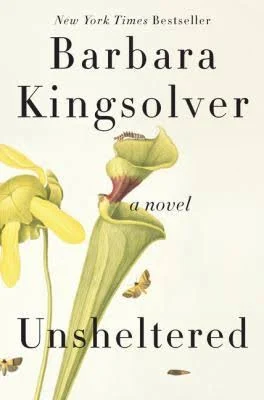
Unsheltered by Barbara Kingsolver

One dilapidated house, two timelines:

Current day: Willa is trying desperately to keep it together. She and her husband have both lost their positions and they’ve just moved to a small town in NJ where her husband is working below his potential, her grown children are forever battling, and she is fretting over their new house which has just been diagnosed a disaster. Her only hope seems to come from the possibility that she can establish a historical significance to the old house, such that she might earn a grant to help rebuild.

1870’s: Thatcher Greenwood considers himself fortunate to be newly married to the beautiful Rose, and they’ve just been restored to the family home, built by her father. Thatcher is the new high school science teacher and he feels he owes it to the young minds of his students to teach them the most current evidence on evolution, the controversial theory that is challenging the religious secular leaders of their small NJ town. His only ally seems to be their next door neighbor, Mary Treat, a woman seen as odd by her local peers, but who is a brilliant naturalist in her own right. And of course, the family challenge is to keep the peace even as their house is literally falling apart around them.

As always, Barbara Kingsolver has managed to construct a clever and challenging narrative. The two timelines keep the story moving along in parallel, and where one leaves off, the other seems to tie in, even when the stories and the characters differ widely. Looking deeper, however, one cannot help but see the symbol of the home, the foundation; and just as one fears a crumbling of the home, man is fearful of any change, but particularly one that challenges his foundational beliefs. For just as the townspeople of the 1870’s story try to hold on to the biblical creation explanation of how fauna and flora came to being in the face of the evidence for Darwin’s evolution theory, many living today deny that the world is at risk of horrifying consequences from climate change in spite of the overwhelming evidence that the earth is warming and impacting our present let alone our future. Both are based in the same root of fear; both deny solid evidence, science, truth.

And as always, Kingsolver creates beautiful characters to relay her message. Willa, the wife and mother who narrates the current story, is particularly endearing. She is coping with the disaster of her home even while trying to help support her two children, each dealing with past and current trauma. As she struggles to maintain patience with everyone around her, we find ourselves inhaling even as she does, crying and laughing and loving along with her.

On the other hand, in my opinion, there is a bit too much scientific detail in the 1870’s story. I understand that Mary Treat must be given the respect she deserves. In so doing, there is much in the way of clarifying her experiments and observations, her contributions to the data upon which Darwin and other scientists base their writings. And of note, she is a real person and did, in fact, contribute years of scientific data to the ones who assumed the credit (men, of course). However, even I, someone with a scientific background, found some of the detail to be a bit too much.

Overall, however, this was an intricately constructed, beautifully executed novel that was both rich and enriching. Truly outstanding, and, as such, a MUST READ.

Demon Copperhead by Barbara Kingsolver

From the very moment of his birth in the narrow, rented trailer home where his teen mom went into an early labor, Damon already felt the stacking of the cards against him. His father already six feet under only six months prior, Damon learned early to try to hide his mom’s alcohol even as he hid from her poor choices in men. He also knew when to escape to the Peggots’, their kindly neighbors and grandparents of his ally, Maggot. But he lost his battle to protect his mom when “Stoner” moved in. While his mom believed this newest partner might provide stability, Damon saw that what he actually provided was constant tension and outright physical warfare. This was the beginning of a journey for Damon that led him through the nightmare of the foster care system, which would test him to the limits of both his weaknesses and his strengths.

Barbara Kingsolver has always been one of my favorite authors and, again, she has proved this justified. As she recreates the narrative of David Copperfield through the voice of a young, poor, Appalachian boy at the brink of the opioid crisis, she does so with authenticity, respect, a love of this part of the land and its people, and, yes, even humor. It is a hard story. Damon, or “Demon” as he is nicknamed, is abandoned into the foster care system and left to his own creative devices and survival instincts at an excruciatingly young age. We follow him through his minimal ups and prolonged downs and we see that he has, in spite of his circumstances, a kind heart and an artistic soul. We come to love him and see his failings as the failings of the system that has tried to eat him alive, rather than his own personal ones. We see how these failings have been built on generations of systemic exploitation and vulnerability.

Kingsolver, through this narrative, brings to light a few important messages. One is how the large mining magnates exploited so much of Appalachia without regard to the land or the people who lived there. They created dependence on the corporations for everything. The people were owned by these corporations, but not protected by them, as their health, education, and welfare were not at all the company’s concern. And once the land was stripped of its use, it was abandoned, as were the people who lived there, leaving only poverty in its wake.

So it is not shocking that Purdue Pharma sought to prey also on this vulnerable population, sending out its sales reps like missionaries to these communities who were middle and lower-middle class without great access to adequate health care. Few on the receiving end were insured, so much of their health care was in the form of emergency room or in-hospital care only. The providers there were sold the BS that Purdue Pharma was dishing out on pain management: that they had invented the miracle panacea for pain relief through Oxycontin and that it was, miraculously, non-addictive. Well, we know how that fable goes…

What I believe I loved most about this story, and what Kingsolver does so tenderly, is highlight the beauty of both this region and the folks who live there. She describes the landscapes: the steep waterfalls, the green mountains, the valleys and rocky streams -and the fauna and flora that thrive there. How even if poverty exists there, folks are able to farm a patch of land to grow vegetables, hunt for food, or knit themselves a few sweaters for the cold weather – and that they do so for each other in their close-knit communities – because there are still close-knit communities where everyone knows everyone else, and have known their parents and grandparents as well.

This is a uniquely gorgeous novel – one that should not be passed up. This is, without a doubt, a MUST READ!

(And I think it’s also time for me to revisit the original David Copperfield as well!)