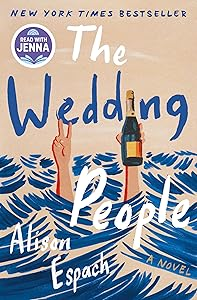
The Wedding People by Alison Espach

Phoebe has had it. She’s checked in to the last available room at the hotel in Newport, where, in spite of the wedding celebrations going on, she will proceed to experience her final evening, alone, in the luxury she so craves for once in her life. Well, alone, until the bride, Lila, barges into her room, demanding she alter her plans so as not to ruin the wedding she’s spent a fortune to plan. Phoebe almost admires Lila’s bald, self-centered honesty, and finds herself matching it with her own snarky bluntness. As Phoebe gets sucked into the drama of the wedding and the family dynamics, she finds it more and more challenging to remain the outsider she has always felt herself to be.

This novel was a delight to read. Even when describing Phoebe’s moments of darkness, it was always done with tenderness, relatability, even humor. And in spite of the moderate predictability of the plot, there were plenty of zany anecdotes and splashy characters tossed in to embellish and entertain and thereby to compensate for it in spades.

I believe my favorite character was actually Juice, the groom’s 13-year old daughter. She was written so beautifully, as a young teen deserves to be. She bounces from pouty silence to spicy irreverence to honest exhilaration, just as an adolescent might. She also observes the adults around her with an innocent but incisive eye and still elicits the gentle care from very adults.

I highly recommend this one – take it on a beach vacation, read it by a fire, or just cuddle up with it in your pajamas and enjoy!

Jane Eyre by Charlotte Bronte

Poor little Jane has found herself orphaned, mistreated by her cousins, and unloved by her aunt who is her only surviving adult relative. While she has been educated, fed (just barely), clothed (in castaway clothing), and housed, she has also been the target of their physical and emotional abuse as well as their general disdain since her arrival at their home following her parents’ sudden death. After a particularly traumatic incident, she is sent away to a boarding school, where her life continues to be difficult but where she finds an inner strength that carries her through her continuous search for happiness and love.

Many of you have likely read this classic – I had not. But after finding myself reading so many novels that referenced it, I felt almost an obligation to enhance my apparently deficient education. So here it is – Jane Eyre, read and appreciated. While I did need a dictionary beside me to ensure I didn’t miss any of it – Bronte’s vocabulary far surpasses mine! – I did find it quite beautiful. The heroine herself is strong, blunt, and unapologetically intelligent. While she is diminutive in size, she is enormous in integrity, humility and character. She is industrious enough to give more than take; wise enough to listen more than speak. She is one we can only aspire to be.

And though the story is a bit far fetched, with coincidences beyond what we might expect to happen in the real world, it is still a plot that captures the imagination and keeps the reader wanting to know what could possibly come next. We are with Jane and her exploits, her journey, all the way. And we root for her until the very end.

This is an old tale, yes, but also timeless. If you haven’t read it, it is absolutely worthwhile. If nothing else, to at least bolster your vocabulary!

Like Mother Like Mother by Susan Rieger

This story begins at the almost end, at Lila’s memorial service, which, of course, Lila orchestrated just before her death. Even in death, Lila was in control: over the ceremony, over what prayers would be uttered, over what emotions would be kindled. And in life, to the extent that she could, she maintained control, never letting feelings interfere with her success. This to the detriment of her family, particularly as her husband and her youngest daughter, Grace, saw it. For these two, life was hard, as they wanted – no, needed – more from Lila. It was unsurprising, though, that Lila was unable to be motherly, given her origin story, which was still unresolved. Did Lila’s own mother die, as she was told she did? Did she run away from her abusive husband? And could Grace live with this question left unresolved?

This is a fascinating story, in that it leads us to question our expectations of “traditional” gender roles. Lila, a daughter and a mother, is fully self-aware in her inability to mother in the common sense of the word, and prior to her becoming one, she acknowledges this. Though her husband takes on the role of both mother and father, he continues to hope against hope that she will change, but people rarely do – and this remains true in Lila’s case. Lila’s two older daughters are comfortable in their situation because they have each other, being close in age – virtually twins – and they move on. Grace, however, is stuck. Stuck in her determination to want a mother, stuck in her frustration with her not having a mother who bakes for the PTA or who picks her up after school.

But the story also highlights these unfair expectations. Why is it that we expect all mothers to be a certain way? In fact, if the story were told as “Like Father Like Father,” it would not even be elevated to the level of “story” at all. If the father had not been nurturing, if the father had not compromised his career to raise the children, or if the father had not been the “manager” for the family – there would be no story, nothing to see here. In fact, when a father does these things, we laud him, we praise him. He stands out. Worse, too, I found myself falling into this pitfall: I felt shocked by some of Lila’s reactions, I felt appalled by some of her comments. Perhaps because it has been my experience that these responsibilities have been shared, I believe that BOTH parents (if there are two) have an obligation to carry the emotional weight of their children, to manage their lives, to show up for them. And they should both be nurturing in whatever ways they can be.

On a more literary note, the book is also a fun read. The characters are easy to get to know and bond with, and the plot has an underlying tension as we continue to wonder what actually did happen to Lila’s mother. I highly recommend this novel – I believe it will entertain as well as make you think. What more could you ask for?

Tell Me Everything by Elizabeth Strout

Lucy and Bob have developed a lovely friendship over the years. While they are both either living with or married to other people, they take frequent walks with each other, confiding in each other about their lives, their relationships, even random thoughts in a way that they do with few others. Even when Bob becomes involved in defending someone accused of murder, they continue to bond and share their stories. But will they be able to stay just friends? Will the secrets they harbor bring them closer or keep them apart?

I am still deciding how I feel about this book… While reading it, I felt very indifferent about it, almost deciding to give up on it at some points, but not doing so. I am not entirely sure why this was so, but I believe it was because it felt as though the author herself was indifferent toward the characters, that they were just sort of there, living their lives. And even when the characters were interesting or had something impactful to say, it was all presented in such an off-hand manner that it was hard to get excited about any of it. Even the most endearing character, Bob, who was truly kind to everyone around him, was hard to really grow attached to. Perhaps because the author felt this way too?

I also found the author to make use of the colon (the punctuation mark, not the anatomical part) more than any other than I’ve ever seen and in such bizarre ways. It often felt as though Tell Me Everything was more of an expository essay than a novel, that ideas were presented as lists or facts rather than a telling of a story. This did not appeal to me at all.

On the other hand, as I sit here and contemplate the narrative as a whole, with its stories within the story, I feel that one might find it a meaningful read in that it is a commentary about relationships and people’s stories and, ironically, how they get told. While some are more willing to share their secrets with others, some are reluctant to share what they know, and others have kept secrets to the detriment of those closest to them. This comes out gradually as the plot unfolds, in layers, as if peeling away at an onion. And we often judge others without knowing the secrets they harbor, without knowing what they are carrying around with them.

So this may be one of those novels that has to sit with you awhile, that grows on you after you have completed the task of reading it. Maybe too much work? Maybe worth the effort? I’m curious to hear your thoughts…

The Latecomer by Jean Hanff Korelitz

Being a triplet is not always as exciting as it may seem. It was most certainly not in the Oppenheimer family. Was it because their parents came together after tragedy had befallen their father, leaving him emotionally incapacitated? Was it because their mother, Johanna, failed to allow herself to see what was missing? Or was it just because the triplets she birthed were just too different, too broken from the start? No matter, their trajectory seemed inevitably destined to crash and burn. Or could it possibly be saved?

This was a weirdly satisfying narrative. While following the triplets’ upbringing was like observing a car accident in slow motion – an inevitable collision that would explode into tiny pieces – it was impossible to turn away. One felt compelled to rant along with Sally against her brothers; to despair with Lewyn’s as he searched for himself; and actively flinch as Harrison arrogantly voiced his supremacist disdain for his peers. These three could not have been more different from each other, more disconnected from their family. And yet, it appeared that their mother could not acknowledge this – nor could their father care. Heartbreaking.

The satisfaction comes with the resolution. And while I generally do not like “packaged” endings, this one is done so wonderfully, with such a subtly victorious coup, that it just feels so good. I could not stop smiling as I read the final chapters, and admittedly let out a few utterances of “YES!” along the way. And as in all fiction, there is a bit of letting go of some reality and allowing for some of the impossible to become possible, I chose to believe because it was just fun to do so. And in this moment, we need a bit of fun – and some victory over extremist conservativism – don’t we????

Allow yourself this opportunity for fun, will you? It’s a good ride!

The Island of Missing Trees by Elif Shafak

It was almost winter break, just before classes were to be let out, and without her even understanding why, Ada did something she could not explain. And it was utterly mortifying. And she would never forget it, especially with social media magnifying it for the world to see. Could it have something to do with her mother’s recent death? With the fact that her father, so dear to her but feeling somewhat cut off because of their separate paths of grief? Or could it be that she has felt cut off from her family’s history, as her parents have rarely spoken of their past lives in the war-torn island of Cyprus? Perhaps the surprise visit by her mother’s sister will reveal the answer she is looking for.

This book had all the potential for an excellent read. It was creative in that it was told from the perspective of both the characters involved as well as a fig tree, an objective observer of both humans and the natural world they inhabit. It provided insight into an island/country about which I knew little and was sad to learn had a violent past; that is, that multiple empires had ruled over the island and most recently the violence was between the islanders themselves: the Turks and the Greeks who had lived there for generations. It also had a personal conflict: that between Ada’s current situation and her past, of which she knew so little but had much curiosity. Her colorful aunt served as the connection between the two.

Sadly, something was sorely missing here. In part, much of the story was predictable. There were few to no surprises. The characters were also not fully developed. I felt that I was left at the door to their hearts but not allowed fully inside. I was told what they had experienced but not what they’d felt. It felt superficial. And yet, at the same time, I also felt that much of the writing was too detailed. I am a fan of science and love learning factoids about nature, but the Fig Tree’s parts were utterly rambling. I often found myself skimming just to get through them.

Another great idea that was not ideally executed. I did learn, however — about Cyprus and its history and culture. That is the up-side! 

Among the Mad by Jacqueline Winspear

Maisie Dobbs, psychologist and private detective, is tapped once again, and this time it’s for help with a case of chemical terrorism. It appears an individual has written a letter to British officials, spewing dissatisfaction on how certain factions of society have been treated and threatening harm to them and many others if action is not taken. Because Maisie herself has been named in this letter, she is brought onto the case, and it is quickly apparent that the author of this letter is suffering, has experienced tragedy, but is also extremely dangerous.

I love this series. I have erred by reading it in completely the wrong order, but because they are so well-written, they are also excellent as stand-alone novels. They serve both as detective/murder-mysteries and historical fiction narratives, and as a series provide vivid details of life in spanning from before the first World War to after the second. This particular one takes place in December, 1931, and one can feel not only the desperation of the Depression that has impacted so many, but also the residual psychological impact of the “Great War.”

Before we had the term “PTSD,” soldiers were diagnosed with “shell shock,” and it was really the first form of trauma that had been even remotely acknowledged. This story describes well how so many, mostly men, were affected by being in the trenches: hearing bombs go off just next to them, feeling explosions blow off body parts, seeing friends killed before their eyes. And so many of them were not allowed to process this trauma, but were forced, because they happened to be physically “ok,” to jump back in to the fighting because the armed forces just needed bodies. And the repeated trauma made for extremely vulnerable men returning to their homes after the war. Their vulnerabilities could manifest in extreme disconnection from their prior personalities, from their families, from their very souls, as is described in this story.

While I think one can skip around a bit, I would recommend beginning the series with the first one, which is called Maisie Dobbs, by Jacqueline Winspear, as it gives an important foundation to the series. And if you can, it is probably best to go in order, but there are a great many books in the series –  it may take you awhile! But the writing is solid, the plots are clever, and Maisie is a strong, ethical and wise character to stick with.

Ina Garten: A Memoir; Be Ready When the Luck Happens

In this memoir, Ina Garten, of Barefoot Contessa fame, shares her story, her breakthrough into the world of epicurean cuisine. And while she shares some vignettes of the challenges she faced along the way as well as the hard work and long hours she put in – especially in the beginning of her career -it is clear that she was fortunate enough to frequently happen to be in the right place at the right time, both in her personal life and her professional life.

I had heard much ado about this book, and so had very much been anticipating reading it… which made it doubly disappointing when I found myself giving up on it around page 100. I so rarely abandon books, but I decided it was not worth my continuing to plow through the pages of Garten’s self adulation. I found it repetitive and dull and kept waiting for the bigger stories that would make the book worthwhile. Perhaps I should have stuck with it, as there may have been more glamorous parts, but honestly, glamour doesn’t impress me as much as genuine reflection. Even when Garten discloses difficulties with her father’s temperament, which of course must have been painful, she keeps it, I felt, at the very surface. We don’t really get to the heart of it, what it really meant to her and to her family more than it meant much time for her in her room, avoiding him. It feels like she tried to paint a picture for us, but it was in a vague black and white. I was seeking color.

Again, perhaps I gave up too early, but I will live with that. I’d love to hear your reactions, particularly if you’ve read it and loved it!

The Most Fun We Ever Had by Claire Lombardo

Marilyn and David have what appears to everyone to be a fairytale marriage: they met when they were young, fell madly in love, and their love has persisted over their years in that affectionate, singular way that few actually are blessed to experience. In truth, they have faced the many challenges that life brings with it, and they and their marriage are not perfect. Their 4 daughters are complicated and have been so throughout their lives, bringing stress and secrets and divisions that have threatened the very fabric of what defines their family. Could it be that Marilyn and David have created a bar that is set intimidatingly high?

In its own, unique way, this narrative is quite stunning. The author entangles the reader into the lives of each character, by swinging back and forth in time, switching focus from one dysfunctional family member to the other, keeping the plot moving forward inch by inch and only very gradually, very subtly delivering its plot punches. Each comes when you least expect it, dressed as a cruel, sisterly jab, a casual observation or a final word in a chapter. Each one leaving you almost breathless.

The relationship between the two eldest sisters – Wendy and Violet, Irish twins, as they are referred to – is at the heart of the deepest conflict here. They have a love/hate relationship and stab each other with venom when they are not depending on each other for their very existences. It is a sometimes heartless and sometimes heartfelt relationship that I am not sure I would be strong enough to survive. But it also shows the most base side of what two people can feel for one another, how family can at once anchor our souls and set us aflame.

I found this novel truly compelling. I suspect you will too.


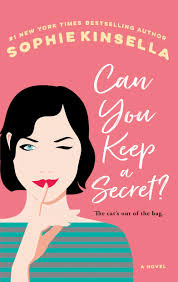
Can You Keep a Secret? by Sophie Kinsella

Emma Corigan has a secret: she is terrified to fly. And when her flight home to London from Glasgow suffers some major turbulence and she is convinced she is going to die, she pours out all of her deepest, darkest secrets to the total, albeit handsome and kind-eyed, stranger sitting next to her. She does not die, to her utter shock, but she does return to her life and to her frustrating job where she feels unappreciated and thwarted by her supervisor and her peers. Little does she know that the quiet, unassuming man to whom she’s poured out her soul will reappear in her life, and surprise her in more ways than she can imagine.

While this story is light and fairly formulaic, it is also entertaining and exactly the kind of therapeutic distraction I needed over these past couple of weeks (the inauguration, the absurd executive orders, clemency for the January 6th attackers, — the list is endless). We need fun reading like this in this moment and this was exactly that. It provides just enough tension, just enough amusement, just enough sarcasm to raise both grin and eyebrow, but not so much that you have to use too much of your brain to get through. Emma is sweet, kind, and sensitive – trying to move her life forward while not stepping on others’ toes, which can be challenging in the business world. But she finds unconventional means of advancement and unusual ideas from the real world and she uses them to her benefit.

And, of course, there is a happy ending. Which is not guaranteed in the real world. Another reason to indulge here!

Yes, this is not high brow literature – but it’s good clean fun right now. A healthy escape!